
Table of Contents
Table of Contents
The first question in an Amazon MSK versus Kafka on EC2 discussion is usually “which one costs less?” That question arrives too early. A Kafka cluster is an operating model as much as it is a set of brokers, and the bill only captures part of that model. The team that owns patching, storage alerts, recovery tests, identity, and capacity decisions also owns the risk when one of those tasks is late.
Amazon MSK moves part of that work into an AWS service boundary. Kafka on EC2 leaves the boundary with your team, but gives you more control over versions, topology, plugins, and the underlying machines. Neither choice removes operations; each one decides where operations happen and which decisions remain visible to you. The production decision should therefore start with ownership and failure boundaries, then move to capacity, security, cost, and exit options.
1Start with the ownership boundary
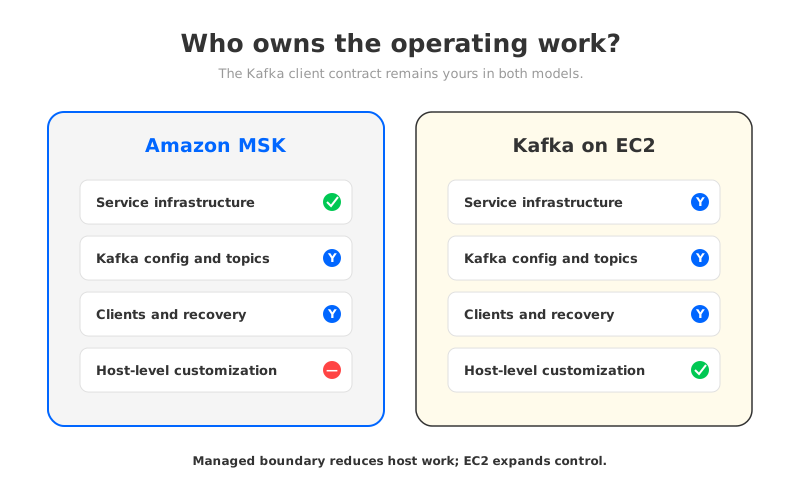
With Amazon MSK, AWS manages the service infrastructure and exposes Kafka clusters through AWS APIs and broker endpoints. You still choose cluster mode, broker sizing, storage, networking, authentication, topic policies, and client behavior. AWS documentation describes the service capabilities and quotas, but your team remains responsible for application-level availability, consumer lag, schemas, connector workflows, and recovery objectives. “Managed” changes the boundary; it does not make the workload self-operating.
With Kafka on EC2, your team owns the full path from operating-system image to Kafka process. That includes selecting a Kafka version, configuring brokers and controllers, sizing EBS volumes, rotating certificates, applying security patches, maintaining monitoring, and proving that a replacement instance can rejoin the cluster. The additional control is real. So is the additional runbook.
Write the boundary down before comparing features. A useful ownership record names the person or team accountable for each item:
| Responsibility | Amazon MSK | Kafka on EC2 |
|---|---|---|
| Service infrastructure and broker replacement | AWS service boundary, subject to service behavior and quotas | Your platform team and cloud account |
| Kafka configuration and topic governance | Your team, within MSK controls | Your team with broader configuration access |
| Client authentication and authorization | Your team integrates IAM, SCRAM, or TLS as applicable | Your team selects and operates the mechanism |
| Connectors, schemas, and consumer recovery | Your team | Your team |
| Version and upgrade choices | Service-supported versions and procedures | Your chosen release and upgrade procedure |
The table exposes an uncomfortable but useful truth: the application-facing responsibilities are nearly identical. The larger difference is who carries the infrastructure recovery work and how much of the implementation you are allowed to change.
2Patching and upgrades are different kinds of work
Self-managed Kafka gives you a broad version envelope. You can test a release against your JVM, plugins, operating system, and internal security baseline, then schedule the upgrade when the evidence is ready. You can also defer the upgrade, which is useful during a release freeze and dangerous when a known issue or unsupported operating system remains in production.
MSK reduces the number of machines and Kafka processes you patch directly, but the upgrade path is constrained by the service’s supported versions and operational procedures. Your change plan still needs client compatibility tests, partition movement checks, monitoring, and a rollback decision. A service upgrade that is operationally simpler can still expose a client that depended on an undocumented broker setting.
Treat an upgrade as a contract test rather than a maintenance ticket. Before changing production, verify:
- The client library and protocol features used by producers, consumers, and connectors are supported by the target broker version.
- Authentication, authorization, TLS trust, and endpoint discovery work from the same subnets and identities used in production.
- Consumer groups recover within the agreed lag and rebalance budget after broker restarts.
- The team can identify the source of a failure: client code, service control plane, network path, or Kafka configuration.
The choice is less about avoiding upgrades than deciding how much of the upgrade mechanism you want to own.
3Capacity: who moves first, storage or compute?
Kafka on EC2 couples several capacity decisions to a broker replacement. When a topic grows, you may need to expand EBS, add brokers, rebalance partitions, and check that network and CPU headroom remain acceptable. Scaling can be deliberate and predictable, but it is a multi-step operation with a capacity plan behind it.
MSK offers service-managed cluster options and storage controls, yet the workload still has a shape. Producers, replicas, consumers, connectors, and rebalances all create different pressure. A larger broker does not automatically fix a partition distribution problem, a consumer bottleneck, or a cross-AZ network path. Use broker and client metrics to identify the limiting resource before changing the cluster.
The important question is whether storage and broker compute need to grow at the same pace. If retention grows while active traffic stays flat, a design that treats every byte as broker-local capacity can force a compute decision for a storage problem. Conversely, a workload with high active throughput may be limited by CPU, network, or partition leadership even when storage is plentiful.
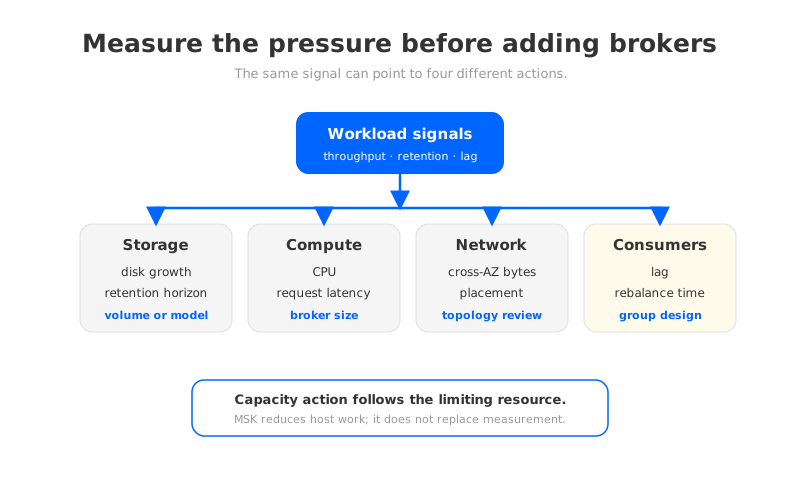
Measure the workload in the dimensions that drive the action:
| Signal | What it can reveal | Decision it informs |
|---|---|---|
| Produce and fetch throughput | Active data path pressure | Broker, network, or partition review |
| Disk usage and retention growth | Storage horizon | Volume, retention, or storage model review |
| CPU and request latency | Compute saturation | Broker size or partition distribution |
| Consumer lag and rebalance time | Downstream capacity | Consumer parallelism and group design |
| Cross-AZ bytes and placement | Network path cost and latency | Client placement and topology review |
The same measurement discipline applies to MSK and EC2. MSK can reduce infrastructure work, but it does not remove the need to understand the shape of the traffic your applications produce and consume.
4Security is a workflow, not a checkbox
Both architectures can use TLS and Kafka authorization controls. The difference is the surrounding workflow. On EC2, your team typically manages certificate issuance and rotation, host hardening, broker listeners, security groups, patch cadence, and the permissions used by automation. That gives you a single place to customize the stack, but also creates more credentials and more renewal paths to test.
MSK supports AWS-integrated authentication options such as IAM, as well as SCRAM and TLS modes subject to the cluster configuration and current service documentation. IAM can align Kafka authorization with AWS identities and policies, while SCRAM or TLS may fit existing client libraries and credential processes. The right choice depends on the clients you operate, the identity boundary you need, and how you audit access. A security design that looks elegant on a diagram can still fail when a connector runs in a different account or subnet.
Use a concrete test matrix rather than a feature checklist:
- Connect from each production runtime identity and verify hostname validation and trust-store behavior.
- Produce and consume with the exact serializers, headers, and compression settings used by the application.
- Verify allowed and denied operations for each service account or IAM role.
- Rotate a credential or certificate in a staging path and observe client recovery.
- Confirm that audit events identify the application actor you need to investigate later.
Self-managed Kafka is a better fit when the organization needs broker-level security customization that the service boundary does not expose. MSK is a better fit when integrating with AWS identity and network controls reduces operational burden without violating the application contract.
5Compare cost as a workload model
An EC2 estimate that includes only instance hours is incomplete. A production Kafka TCO model should account for broker instances, EBS storage and I/O, snapshots, data transfer, monitoring, support tooling, patch automation, and the engineering time required to operate the cluster. MSK pricing similarly depends on the selected cluster mode, broker and storage configuration, data transfer, and related AWS services. Current rates vary by Region and service option, so use the AWS pricing pages for the actual quote.
Build the comparison with the same workload assumptions on both sides:
| Input | Questions to answer |
|---|---|
| Ingress and egress | How many bytes are produced, fetched, and replicated per day? |
| Retention | How long must data remain queryable, and is compaction involved? |
| Availability | What broker count, replica policy, and recovery objective are required? |
| Network | Which traffic crosses AZ or VPC boundaries, and who pays for it? |
| Operations | Which tasks need an on-call owner and how often are they exercised? |
The result is a range, not a universal winner. A small, stable cluster may favor the control and customization of EC2 when a capable platform team already operates the surrounding infrastructure. A team with many clusters or limited Kafka-specific operations capacity may value MSK’s service boundary even when the line-item price is not the lowest. Put labor and recovery practice beside the cloud bill, then run a sensitivity check on retention, traffic, and cluster count.
6Failure handling reveals the real trade-off
When an EC2 broker fails, your runbook may include instance replacement, volume attachment, broker identity, replica recovery, and a capacity check for the remaining nodes. You can design that process exactly around your recovery objectives, but you must test it. Automation that has never been exercised during a noisy failure is an assumption.
MSK changes the first response because AWS operates the service infrastructure, but the application still experiences leader movement, reconnects, rebalances, and possible lag. Your runbook must say what metrics trigger escalation, which clients retry, how long recovery can take, and when to fail over a dependent system. Service-managed replacement does not eliminate the need for consumer and connector recovery tests.
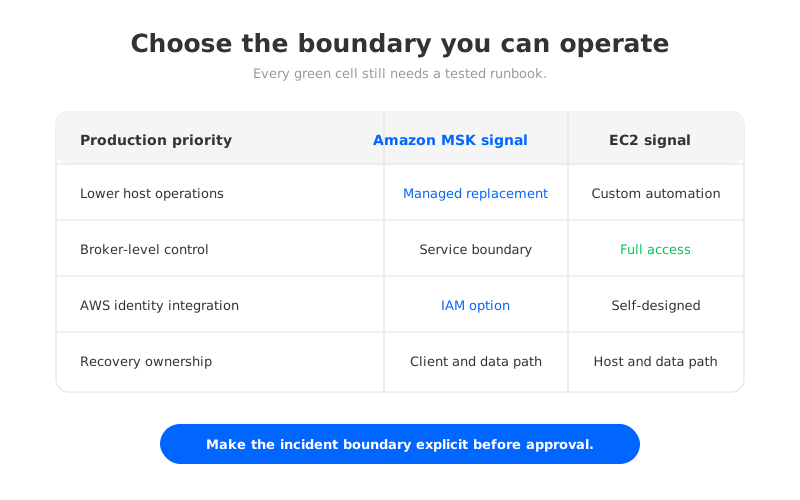
The decisive comparison is therefore the evidence available during an incident. Ask both platform designs:
- Can an on-call engineer identify whether the fault is client, network, Kafka, or service control plane?
- Can the team restore the intended consumer position without guessing at offsets?
- Is the recovery path rehearsed for the cluster sizes and retention windows in production?
- Which actions require an AWS support case or a change to infrastructure code?
If the answer to any of these is “we will investigate during the outage,” the architecture decision is incomplete.
7Exit options and portability
Portability is often discussed as a property of the Kafka protocol, but the operational details matter more. A move between MSK and EC2 can require new endpoints, security protocols, ACL or IAM mappings, topic configuration, monitoring integrations, and connector offsets. Replication tools can move records; they do not automatically preserve every application assumption.
Keep an exit plan small enough to test. Document topic and partition requirements, client bootstrap changes, authentication mapping, consumer-group handling, and the data validation method. Run a representative topic through the path before an emergency creates the deadline. If the team cannot explain how a critical consumer resumes, the cluster is portable only in theory.
This is also where a third architecture can be useful. AutoMQ is a Kafka-compatible cloud-native streaming platform that uses object-storage-backed durability and can run in a customer-controlled environment. Its relevance is conditional: teams that want Kafka client compatibility while separating broker compute from shared storage can evaluate it alongside MSK and EC2. Validate protocol features, networking, recovery, and operational ownership against the workload before treating the architecture as a fit.
8A practical decision rubric
Choose Amazon MSK when the following statements describe the decision:
- The team wants AWS to own more of the broker infrastructure and replacement workflow.
- AWS identity, VPC integration, and managed service operations fit the security model.
- The workload fits the service’s supported versions, modes, quotas, and configuration boundary.
- The organization prefers a repeatable service contract over broker-level customization.
Choose Kafka on EC2 when these constraints matter more:
- The team needs control over Kafka versions, plugins, host configuration, or storage layout.
- Existing automation and on-call practice already cover broker replacement and upgrades.
- The workload or compliance boundary requires controls outside the managed service interface.
- The organization accepts the operational cost in exchange for that control.
Choose a Kafka-compatible shared-storage architecture for evaluation when retention and active compute scale independently, and when BYOC control matters. In every case, run a staging test with real client behavior and write the recovery path before approving production.
9FAQ
9.1Is Amazon MSK cheaper than Kafka on EC2?
There is no workload-independent answer. Compare the same throughput, retention, replica policy, network placement, monitoring, and operations effort. Use current AWS pricing for the selected Region and include the cost of maintaining recovery automation on EC2.
9.2Do I lose Kafka control with MSK?
You keep control over clients, topics, security choices supported by the service, and workload operations. You give up some control over the underlying hosts, service infrastructure, and the set of broker changes exposed by the MSK interface.
9.3Which option is easier to scale?
MSK can reduce infrastructure steps, but both options still require partition, client, network, and consumer analysis. EC2 offers more freedom to design the scaling mechanism, while MSK offers a narrower service path to operate.
9.4Can I move from MSK back to EC2?
Yes, but plan it as a migration. Replicate or export data, map security and topic configuration, validate client behavior, and test consumer offsets and rollback before changing the write owner.
10References
- Amazon MSK Developer Guide
- Amazon MSK pricing
- Amazon EC2 pricing
- Apache Kafka documentation
- Amazon MSK client authentication
The choice becomes clearer when the comparison starts with the incident you are prepared to handle. If your team needs more control, budget for the runbooks that control requires. If it needs a smaller infrastructure boundary, verify that MSK’s supported behavior matches the client contract. Review a Kafka-compatible operating model with AutoMQ when the production decision includes both Kafka compatibility and a different storage boundary.


