
Table of Contents
Table of Contents
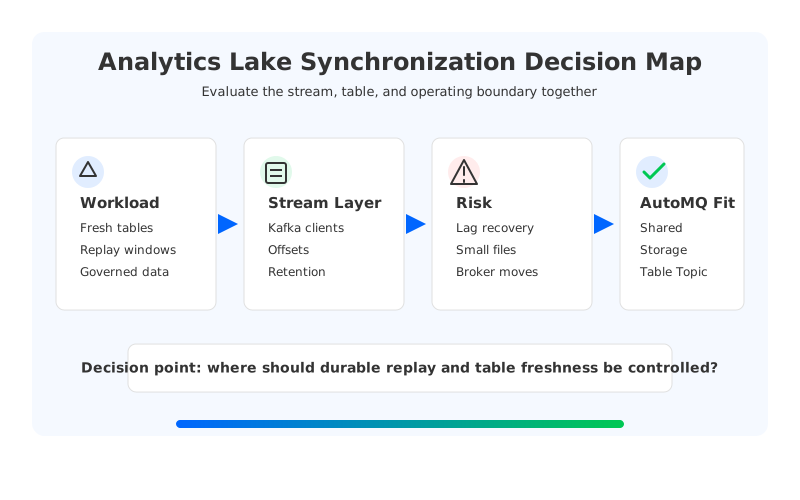
Teams do not search for analytics lake synchronization kafka because they need another diagram with a producer on the left and a table on the right. They search for it after freshness expectations have moved faster than the lake platform around them. Dashboards that used to tolerate hourly batch loads are asked to reflect business events within minutes, and model teams want Apache Iceberg tables that are current enough to trust.
Kafka usually sits at the center of that pressure because it already carries the operational event stream. The hard part is turning that stream into durable table state without losing the properties that made Kafka useful: ordered partitions, replay, consumer groups, client compatibility, and a clean separation between producers and downstream systems. Analytics lake synchronization is therefore not a connector problem alone. It is a storage, governance, recovery, and operating-model problem that happens to surface at the connector boundary.
The practical question is this: can the streaming layer absorb lakehouse freshness requirements without becoming the next capacity bottleneck? The answer depends less on a single sink connector and more on how the Kafka-compatible platform handles retained data, broker replacement, partition ownership, cross-zone traffic, and replay under failure.
1The lakehouse freshness constraint behind the workload
An analytics lake synchronization pipeline has two clocks. The first is the event clock, where records arrive in Kafka topics as applications, services, and devices emit them. The second is the table clock, where those records become queryable snapshots in a lakehouse table format such as Apache Iceberg. Users experience the second clock, while engineers operate both.
That mismatch is where production issues start. Kafka can accept bursts, preserve order within partitions, and let multiple consumer groups read at their own pace. The lakehouse side, however, needs file sizing, schema evolution, snapshot commits, partition transforms, compaction, and catalog consistency. If the streaming layer is treated as a short-lived pipe, late consumers and replay jobs fight with retention limits. If the lakehouse sink is treated as an ordinary batch job, query freshness becomes unstable whenever upstream traffic changes.
The synchronization design has to handle five pressures:
- Freshness pressure. Analytics users want low-lag tables, but overly frequent commits can create small files and catalog churn.
- Replay pressure. Backfills, schema repairs, and model retraining require historical records to remain readable without turning broker storage into a special project.
- Governance pressure. Schema, access control, lineage, and regional boundaries matter more once streams become shared analytics tables.
- Failure pressure. A broker outage or bad deployment should not force teams to choose between data loss and a full rebuild.
- Cost pressure. Long retention, multi-AZ deployment, and high fan-out reads can make a conventional Kafka cluster expensive before the lake storage bill is even visible.
These pressures are connected. Increasing Kafka retention helps replay and backfill, but it also increases local disk or cloud block storage requirements in a Shared Nothing architecture. Increasing connector parallelism helps freshness, but it can amplify small-file creation on the table side. A useful architecture makes those trade-offs explicit.
2Stream-to-table architecture options
The common pattern is a source application writing to Kafka, a stream processor or sink connector reading from Kafka, and a lakehouse table receiving committed files. The question is where the durable synchronization boundary should live.
One option is to keep Kafka as the durable event log and run a sink layer, such as Kafka Connect, Apache Flink, or Spark Structured Streaming, to write table files. This gives teams strong ecosystem flexibility. The risk is operational spread: Kafka retention, connector offsets, table commits, schema changes, and compaction are owned by different systems that must still recover as one pipeline.
Another option is to push more of the stream-to-table behavior into the streaming platform. A Kafka-compatible platform can preserve Kafka client semantics while making lake synchronization a first-class path rather than a sidecar job. That does not remove governance or table maintenance, but it changes the failure boundary when the business requirement is to keep an analytics table synchronized with production events.
The third option is to let the lakehouse ingest directly from object storage or CDC files and keep Kafka out of the table path. That can work when operational consumers are not part of the same event stream. It becomes less attractive when the same records must feed applications, alerts, enrichment, and analytics.
| Architecture pattern | Where it fits | Main risk |
|---|---|---|
| Kafka plus sink connector | Teams already operate Kafka Connect, Flink, or Spark | Recovery spans offsets, connector state, commits, and compaction |
| Kafka-compatible stream-to-table platform | Teams want Kafka clients and lake synchronization together | Must verify table support, governance, and migration boundaries |
| Direct lake ingestion | Events do not need operational fan-out | Harder to reuse the stream for applications, alerts, and replay |
The connector choice is downstream of the durability choice. If Kafka is the system of record for events, then lake synchronization inherits Kafka's storage model. Broker-local storage, partition reassignment, and multi-AZ replication shape how much retained history is affordable and how quickly the platform can recover when synchronization falls behind.
3Why conventional Kafka becomes heavy in lake synchronization
Apache Kafka was designed around a Shared Nothing architecture. Each broker owns local log segments for its assigned partitions, and durability is achieved through replication between leader and follower replicas. This model works well when local storage is the natural place to keep data. In cloud environments, the same model often means that retained event history is tied to broker disks, broker count, and cross-zone replication patterns.
For analytics lake synchronization, that tie becomes uncomfortable. A table sink may need to replay hours or days of records after a failed deployment. An analytics use case may ask for longer retention so correction jobs can run from Kafka rather than from application databases. A traffic surge may require more brokers, but partition data is still attached to the brokers that hold it.
The symptoms are familiar:
- Capacity planning has to reserve storage for peak retention and replica growth, not only for current write throughput.
- Reassignment work competes with production traffic when partitions must move between brokers.
- Multi-AZ durability creates network traffic that is part of the platform bill, even before downstream consumers read the data.
- Long catch-up reads can interfere with hot-path writes if the cluster is not isolated or overprovisioned.
- Connector recovery depends on both Kafka availability and the table sink's ability to resume from the right committed point.
Kafka remains the right abstraction for many teams. The weak point is broker-local storage when Kafka is asked to serve as both a real-time event bus and a long-retention synchronization buffer for the analytics lake.
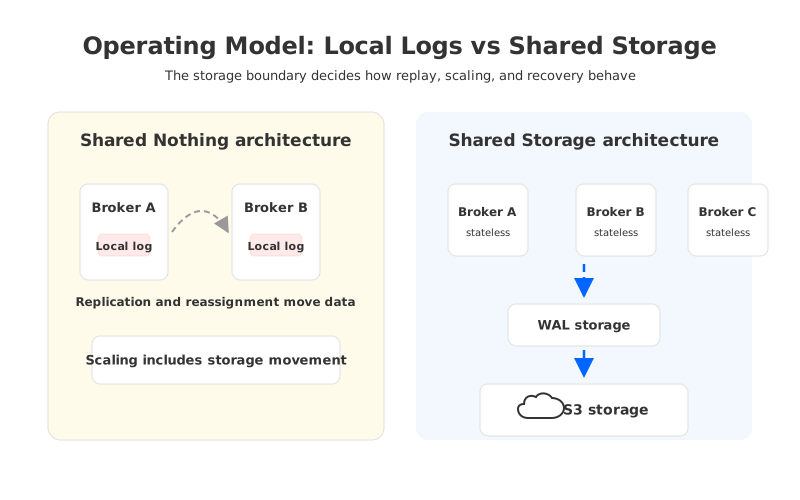
Tiered Storage helps by moving older log segments to remote storage. It can reduce pressure on local disks for historical data, but it does not make brokers stateless. Recent data still sits on broker storage, partition ownership still matters, and recovery still has to respect the boundary between local and remote log segments.
4A neutral evaluation checklist
The strongest synchronization architecture is the one your platform team can recover at 3 a.m. That standard filters out designs that only work in a happy-path demo. Before choosing a stream-to-table implementation, evaluate the streaming layer, sink layer, and table layer together.
Start with compatibility. If producers and consumers already use Kafka clients, the platform should preserve Kafka protocol behavior, topic semantics, offsets, consumer groups, and client tooling. A lake synchronization project should not force every upstream application to learn a different ingestion contract.
Then examine durability and replay. Ask where the authoritative event history lives, how long it can be retained, what happens during broker replacement, and how a failed table commit is retried. Connectors track offsets, but they still rely on the upstream stream to provide replayable records and on the table system to provide consistent commits.
The next layer is cost and elasticity. A lake synchronization pipeline often has uneven traffic: daily peaks, backfill windows, model-refresh jobs, and catch-up reads. If compute and storage scale together, teams pay for storage headroom through broker sizing. Object storage can change that math, but only if the streaming architecture uses it as primary durable storage rather than a distant archive.
Finally, governance has to be designed into the pipeline. Lakehouse tables need schema policy, catalog ownership, access boundaries, lineage, and regional placement. Kafka topics need ACLs, producer discipline, retention policy, and consumer observability. Synchronization joins those concerns.
Here is a compact scorecard that usually reveals the weak spots:
| Dimension | Question to ask | What good looks like |
|---|---|---|
| Kafka compatibility | Can existing clients, tools, and consumer groups keep their contract? | No application rewrites |
| Replay boundary | Can the sink replay from a known offset after failure? | Offsets and table commits recover together |
| Elasticity | Can compute scale without moving retained data? | Broker changes avoid long migrations |
| Cost model | Does long retention require broker-local storage? | Storage grows separately from compute |
| Governance | Are schema, access, catalog, and region controls explicit? | Platform teams can audit the pipeline |
| Observability | Can operators see lag, commits, freshness, and broker health together? | Alerts map to the real failure boundary |
The evaluation should include a failure rehearsal. Stop the sink, let lag build, restart it, and verify that table freshness recovers without duplicate commits or missing records. Replace brokers while traffic continues. Run schema evolution. Trigger a backfill from a known offset. These tests exercise the conditions that cause production incidents.
5How AutoMQ changes the operating model
After that evaluation, AutoMQ is relevant as a Kafka-compatible streaming platform built around Shared Storage architecture. It keeps Kafka protocol and API compatibility while moving persistent stream storage away from broker-local disks and into S3-compatible object storage through S3Stream. AutoMQ Brokers are stateless in the sense that durable data is not tied to local broker disks, which changes how teams think about scaling, replacement, and retained history.
For analytics lake synchronization, that shift matters because the event stream can be durable without making every broker a long-term storage owner. Brokers handle Kafka protocol work, partition leadership, caching, and request routing. The durable data path uses WAL storage for write durability and S3 storage as the primary storage layer.
AutoMQ also gives the lakehouse path a more direct product surface through Table Topic, which writes stream data into Apache Iceberg tables. The point is not that every pipeline must use an integrated table writer. The point is that table synchronization can be part of the streaming operating model instead of living entirely in external jobs.
This is where the cloud-native storage model connects to practical operations:
- Retained history is not anchored to one broker's local disk. That makes replay and catch-up planning less dependent on preallocated broker storage.
- Broker replacement is a compute recovery event. Durable stream data remains in shared object storage, so recovery focuses on metadata, leadership, and traffic routing.
- Storage and compute have separate scaling curves. Longer retention does not automatically imply larger broker disks.
- Lake synchronization can share the same Kafka-compatible entry point. Producers keep using Kafka clients while downstream teams decide how table writes should be governed.
- Zero cross-AZ traffic is achievable in the AutoMQ architecture. That changes the cost discussion around multi-AZ streaming.
Those benefits still need workload-specific validation. S3 WAL, Regional EBS WAL, and NFS WAL have different latency and deployment characteristics. A fraud workload will evaluate latency more aggressively than an hourly analytics pipeline. A team in AutoMQ BYOC will also care about VPC boundaries, IAM, observability export, and control-plane ownership.
6Migration planning for a durable synchronization path
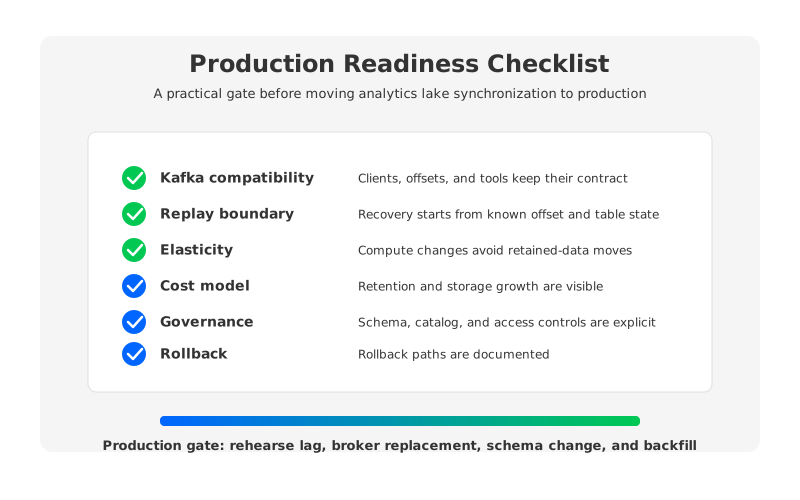
A production migration should avoid changing too many boundaries at once. Keep the producer contract stable, mirror or link the existing topics, validate consumer offsets, and prove that the sink can write equivalent table state before changing upstream applications. Define separate cutover gates for producer writes, consumer reads, and the table freshness SLO.
Rollback deserves the same attention as cutover. Keep a known offset boundary, document how table commits will be reconciled, and decide whether a rollback means returning producers, consumers, or only the sink path. Observability should also be ready before traffic moves: operators need lag, sink status, failed table commits, snapshot age, schema events, and catch-up read pressure.
7References
- Apache Kafka documentation for Kafka clients, consumer groups, Connect, transactions, and Tiered Storage.
- Apache Kafka Connect documentation for connector framework concepts and operational context.
- Apache Iceberg documentation for table format, snapshots, schema evolution, and lakehouse table behavior.
- AWS S3 Tables documentation for an example of managed Apache Iceberg table storage on object storage.
- AutoMQ Shared Storage architecture documentation for the storage model behind stateless brokers.
- AutoMQ Table Topic documentation for stream-to-Apache-Iceberg table synchronization.
8FAQ
8.1Is Kafka still needed if the lakehouse supports streaming ingestion?
Often, yes. Kafka matters when one event stream must serve consumers, alerting, replay, and analytics tables. Direct lake ingestion can fit analytics-only use.
8.2How does analytics lake synchronization differ from ordinary sink connectors?
A sink connector moves data from a topic to a target system. Analytics lake synchronization has a broader production boundary: event retention, offsets, table commits, schema evolution, compaction, freshness SLOs, and recovery all have to work together.
8.3Does Tiered Storage solve the retention problem for this workload?
Tiered Storage can reduce pressure on local broker disks by moving older log segments to remote storage. It does not make brokers stateless or remove all coupling between partition ownership and broker storage. For lake synchronization, it is useful to evaluate, but it is different from a Shared Storage architecture where object storage is the primary durable storage layer.
8.4When should teams consider AutoMQ for this architecture?
AutoMQ is worth evaluating when a team wants Kafka-compatible clients, long retention, cloud object storage durability, independent compute and storage scaling, and a clearer operating model for broker replacement or elasticity. It is especially relevant when lake synchronization is part of a broader event-streaming platform rather than a single export job.
8.5What is a practical next step?
Start with a failure rehearsal on a representative topic. Pause the sink, let lag build, restart it, and verify that the target table catches up from the expected offset without duplicate or missing records. Repeat the test while scaling or replacing brokers. If broker-local storage and reassignment dominate the exercise, evaluate whether Shared Storage changes the risk profile. The AutoMQ Console entry point is the shortest route to a hands-on environment.


