
Table of Contents
Table of Contents
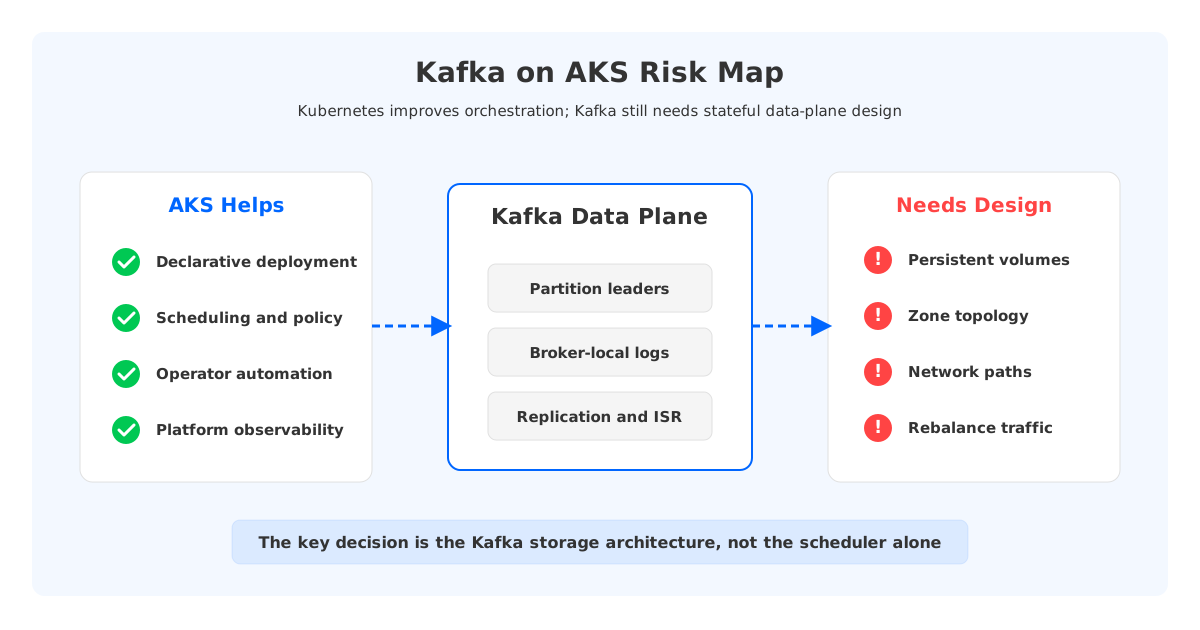
Kubernetes makes application deployment repeatable. It gives platform teams declarative configuration, rolling changes, scheduling, health checks, service discovery, policy, and a consistent operating surface. That is why "Kafka on AKS" is an attractive search for Azure teams already running application platforms on Azure Kubernetes Service.
Apache Kafka, however, is not a stateless web service. It is a stateful distributed log. The difficult parts of Kafka operations are tied to durable storage, partition leadership, broker identity, disk pressure, network placement, rolling upgrades, and the cost of moving data during recovery or scaling. AKS can make the deployment workflow cleaner, but it does not remove the physics of Kafka's broker-local logs.
The decision is not "Kubernetes or no Kubernetes." The better question is: which Kafka architecture are you putting on Kubernetes? Operator-managed traditional Kafka orchestrates brokers that still own persistent volumes. Shared-storage Kafka orchestrates compute while durable log data lives outside broker-local disks. Those models have different scaling and failure behavior.
1Why Teams Want Kafka on AKS
The motivation is legitimate. Many platform teams want one control plane for containerized workloads, security policy, observability agents, deployment automation, GitOps, and upgrades. If the organization standardizes on AKS, adding Kafka can reduce the operational surfaces SREs support.
AKS also offers managed Kubernetes capabilities that matter for production services. Microsoft documents storage integration through volumes, persistent volumes, storage classes, and claims, including Azure Disks, Azure Files, Azure NetApp Files, Azure Blobs, and Container Storage options. It also supports availability-zone-aware clusters, Kubernetes networking models, and cluster autoscaler workflows.
Kafka teams usually pursue AKS for four reasons:
- Deployment consistency. Brokers, exporters, operators, and supporting services can be managed through Kubernetes manifests, Helm, or GitOps.
- Platform governance. Network policies, namespace boundaries, RBAC, node pools, labels, taints, and observability standards can align with the broader platform.
- Operator automation. Kafka operators such as Strimzi can automate cluster creation, rolling updates, listener configuration, and common lifecycle tasks.
- Infrastructure consolidation. A Kubernetes-first organization may prefer fewer VM-only systems outside the platform team's normal operating model.
These benefits are real, but incomplete. Kubernetes can restart a pod, but it cannot make a broker-local log instantly portable. Kubernetes can reschedule a workload, but a Kafka partition leader with terabytes of retained data depends on storage and network locality.
2The Stateful Parts Kubernetes Does Not Remove
Traditional Kafka on Kubernetes usually means one broker pod per persistent volume claim, with a stable network identity and attached storage. In Kubernetes terms, that often maps to StatefulSets, persistent volumes, pod disruption budgets, anti-affinity, and careful node placement. The cluster may be managed through an operator, but the broker still stores partition log segments locally or on broker-attached block storage.
This creates a different operational profile from ordinary application pods. When a broker is replaced, the operator can recreate the pod. The question is what happens to its data, partition leadership, and client traffic during that process. When a node pool scales, Kubernetes can add nodes. The question is whether Kafka can use that compute without copying retained partition data across the cluster.
There are five stateful surfaces to design before running Apache Kafka on AKS:
| Surface | Why it matters on AKS | Failure mode if ignored |
|---|---|---|
| Persistent volumes | Azure Disk is commonly used for block storage and is mounted to one node at a time. | Pods can be delayed by volume attach, zone constraints, or disk performance limits. |
| Availability zones | Kafka replication, pod placement, and storage placement must align with failure domains. | A zone event can remove too many replicas or force slow recovery. |
| Disruption control | Rolling changes, node maintenance, and cluster upgrades must respect quorum and ISR health. | Too many brokers can be unavailable at once. |
| Network paths | Producers, consumers, replication traffic, and cross-zone traffic have different cost and latency profiles. | Internal traffic becomes expensive or adds latency during rebalancing and replication. |
| Reassignment | Scaling traditional Kafka requires moving partition data. | Extra brokers exist, but useful capacity arrives after data migration completes. |
Kubernetes terminology can create false comfort here. A pod may be healthy because its container is running. Kafka health is stricter: leader availability, under-replicated partitions, ISR stability, request latency, disk utilization, controller health, and consumer lag all need to be clean.
3Storage Design Is the Hardest AKS Decision
AKS storage classes abstract provisioning, but they do not make storage interchangeable. Microsoft notes that Azure Disk is mounted as ReadWriteOnce, which means it is available to a single node. For Kafka, that can be a reasonable fit for traditional broker-local storage because each broker owns its log directories. It also means the pod, volume, and node zone relationship matters.
AKS built-in storage classes use Azure managed disks, and Microsoft documents zone-redundant behavior for built-in storage classes in multi-zone clusters starting with Kubernetes version 1.29. That is useful, but it does not mean every Kafka storage risk disappears. Kafka still has its own replication model, flush behavior, segment lifecycle, and recovery process. Azure disk redundancy and Kafka replication solve related but different problems.
A production design should answer these questions before the first topic is created:
- Which storage class is used for broker volumes, and what disk tier supports the expected write throughput and tail latency?
- Are persistent volumes bound in the same zones as the broker pods that need them?
- What is the operational process when a node, disk, or zone fails?
- How much retained data must move when brokers are added, removed, or replaced?
- Which metrics trigger storage expansion before disk pressure affects Kafka availability?
Cost modeling belongs in the same conversation. Azure Managed Disks pricing depends on disk type, size, performance tier, snapshots, and other options. Azure Blob Storage pricing uses a different model based on capacity, redundancy, access tier, operations, retrieval, and data transfer. Azure bandwidth pricing can also matter when data moves across zones, regions, or internet boundaries.
4Networking and Availability Zones Need Explicit Topology
Kafka is network-sensitive because every write and read has a path. Producers connect to brokers, consumers fetch from leaders, followers replicate from leaders, and controllers coordinate metadata. In Kubernetes, listeners, services, DNS, load balancers, ingress choices, and network policy all affect those paths.
AKS networking documentation covers cluster networking models, pod addressing, services, and Azure integration. Kafka adds a further requirement: clients must receive advertised listener addresses that work from their network location. Internal application pods, VM-based clients, cross-VNet clients, and external consumers may need different listener configurations.
Zone placement is equally important. A multi-zone AKS cluster is not automatically a good multi-zone Kafka cluster. Kafka replica placement, Kubernetes anti-affinity, node pools, volume topology, and maintenance windows need to be aligned. Otherwise the system can look resilient in architecture diagrams while concentrating too much risk in one failure domain.
For SREs, the practical checklist is:
- Place broker pods across zones using topology spread or anti-affinity rules.
- Validate that storage provisioning and pod scheduling respect zone topology.
- Keep controller quorum placement separate from accidental single-zone concentration.
- Test producer and consumer connectivity from every real client location.
- Measure cross-zone replication traffic under normal load and during reassignment.
- Treat AKS upgrades and node pool maintenance as Kafka events, not generic platform events.
This is not anti-Kubernetes advice. It is Kubernetes discipline applied to a workload whose data plane has stronger locality and ordering requirements than most services.
5Operators Help, but They Do Not Change Kafka's Storage Model
Kafka operators are valuable. Strimzi, for example, provides Kubernetes-native custom resources and automation for Kafka clusters, listeners, storage configuration, rolling updates, and related components. For a platform team, that reduces manual work and makes Kafka lifecycle management more declarative.
The important boundary is architectural. An operator can coordinate a safer rolling update, but it does not turn broker-local logs into shared storage. It can configure persistent storage, but it does not eliminate volume attachment behavior. It can scale brokers, but traditional Kafka still needs partition reassignment to use added brokers fully.
Operator-managed Kafka on AKS fits teams that want Kubernetes-native lifecycle management and are prepared to run Kafka as a serious stateful system. It is less suitable when the primary goal is rapid elasticity. Adding pods is fast; moving log data is not. Removing brokers can be even harder because retained partitions must be drained or reassigned without damaging availability.
The upgrade story also deserves respect. Kafka upgrades involve broker versions, protocol versions, controller behavior, client compatibility, and sometimes topic-level or feature-level changes. Kubernetes rolling update mechanics help with sequencing, but they do not replace Kafka release planning. A responsible rollout still needs preflight checks, canary brokers or environments, rollback rules, and load-aware scheduling.
6How Shared-Storage Kafka Changes the AKS Tradeoff
The strongest case for Kafka on Kubernetes appears when the Kafka architecture becomes more Kubernetes-native. That means separating durable log storage from broker-local disks so broker pods behave more like replaceable compute.
In a traditional Kafka model, each broker owns local log data. Reassignment and recovery can require copying data between brokers. In a shared-storage model, durable data is stored in object storage or another shared storage layer, while brokers serve Kafka protocol traffic and cache or write through to the storage layer. The broker becomes less tied to a specific persistent volume.
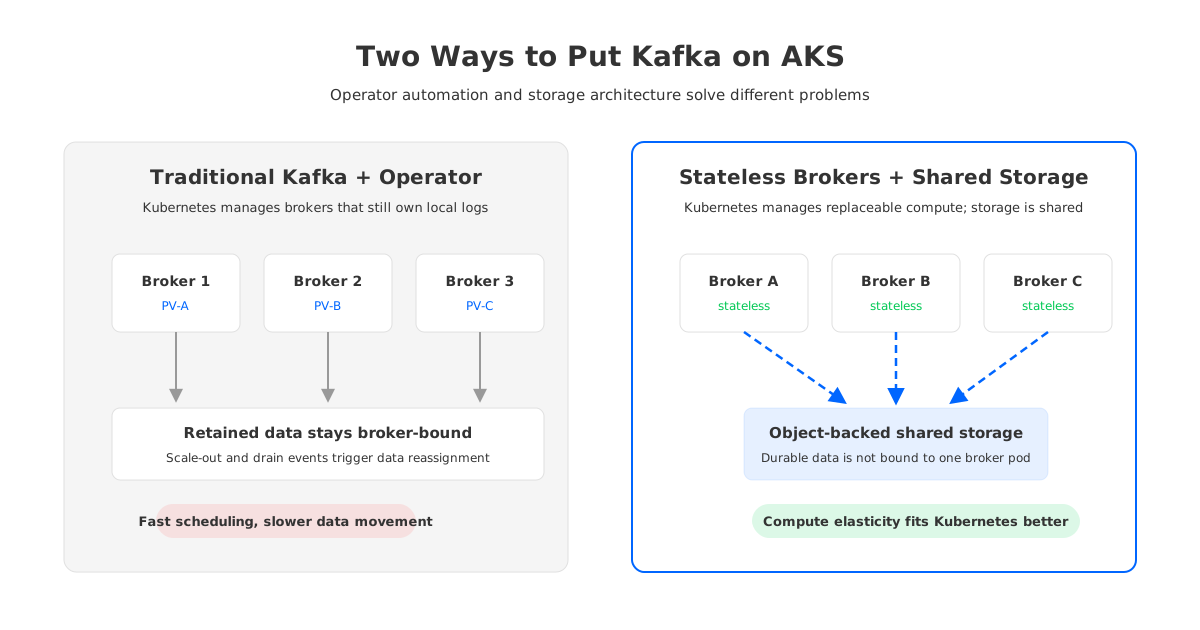
This distinction changes several AKS decisions:
| Decision area | Traditional Kafka on AKS | Shared-storage Kafka on AKS |
|---|---|---|
| Broker identity | Strongly tied to local log data and persistent volumes. | Broker compute can be more replaceable. |
| Scaling | Adds pods first, then moves partitions and retained data. | Adds compute capacity with less data migration. |
| Failure recovery | Broker and volume recovery are linked. | Broker replacement can be closer to stateless service recovery. |
| Storage planning | Size broker disks for retained data and headroom. | Model object storage plus write path requirements. |
| Kubernetes fit | StatefulSet-centric operations. | Deployment-like elasticity becomes more realistic. |
AutoMQ fits this second category. It is a Kafka-compatible streaming platform that separates compute and storage, uses object storage as the durable foundation, and makes brokers stateless. In an AKS context, that architectural property matters more than branding: stateless brokers align with Kubernetes scheduling and autoscaling better than brokers bound to large persistent volumes. Scaling can reduce broker-local partition data movement, and replacement can avoid long recovery paths tied to retained logs.
That does not mean every team should replace a working Kafka cluster. It means the AKS decision should include architecture, not only packaging. If the goal is consistent Kubernetes lifecycle management, operator-managed Kafka may be enough. If the goal is cloud elasticity, faster scaling, and less dependence on broker-local PVs, shared-storage Kafka deserves a serious evaluation.
7Where AutoMQ Fits on Azure
AutoMQ should be evaluated as an Azure Kafka alternative when a team wants Kafka compatibility without the full operational profile of traditional broker-local storage. Existing Kafka clients, Kafka Connect, Kafka Streams, and ecosystem tooling remain relevant because protocol compatibility reduces migration friction. The architectural change is underneath: storage moves away from the broker as the unit of durability.
On AKS, that can be especially relevant for Kubernetes platform teams. Kubernetes is strong at managing stateless or low-state compute. A Kafka-compatible platform with stateless brokers can make Kubernetes a better fit for the streaming data plane, rather than forcing Kubernetes to compensate for a storage model designed around broker-owned disks.
The Azure-specific details still require engineering. Object storage configuration, network placement, IAM or credential management, observability, and production sizing must be designed for the target environment. AutoMQ documentation covers Kubernetes deployment and stateless broker architecture, but production teams should validate the support matrix, Azure storage choices, and operational runbooks for their own account, region, and compliance model.
8AKS Kafka Readiness Checklist
Before committing production Kafka traffic to AKS, use a readiness review that covers platform, Kafka, and cost together.
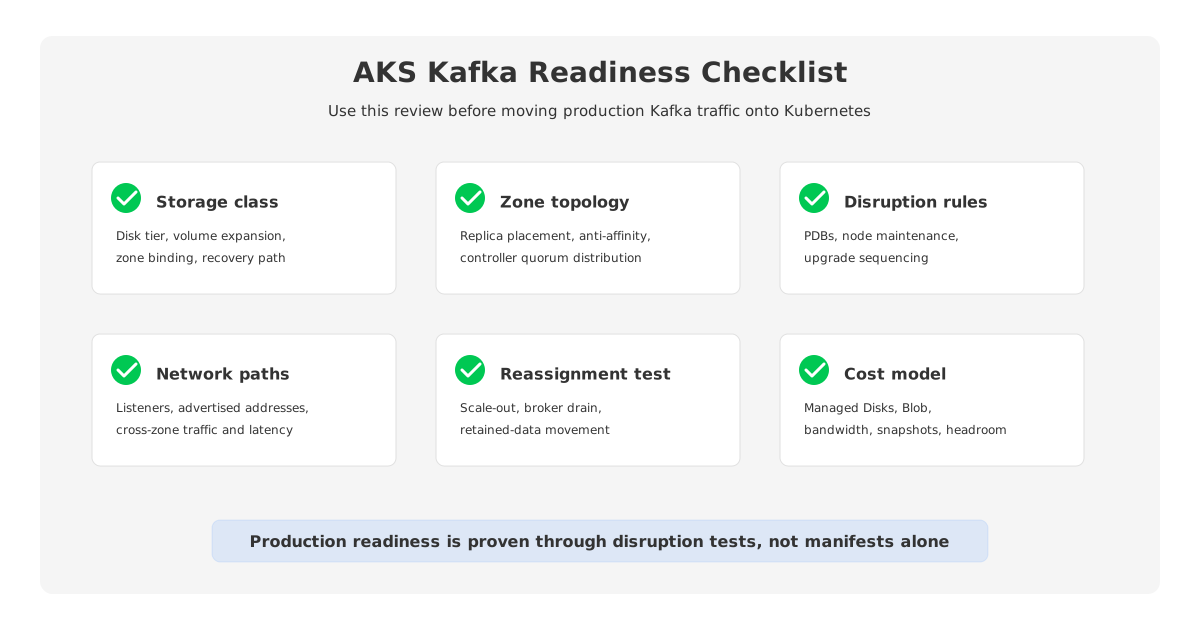
Start with workload shape. Measure write throughput, read fanout, retention, partition count, message size, replay behavior, and peak-to-average traffic. These inputs decide whether the hard part is compute, disk, networking, or operational elasticity.
Then validate the AKS design:
- Storage classes, disk tiers, volume expansion, zone topology, and failure recovery are documented.
- Broker, controller, and monitoring placement rules are tested under node and zone disruption.
- Pod disruption budgets, maintenance windows, and AKS upgrade plans are aligned with Kafka quorum and ISR health.
- Kafka listeners and advertised addresses work for every producer and consumer network.
- Reassignment, broker replacement, and scale-out procedures are load-tested with retained data present.
- Azure Managed Disks, Blob Storage, bandwidth, snapshots, and operational headroom are modeled together.
- The team has a rollback plan for operator upgrades, Kafka version changes, and node pool changes.
The conclusion is conditional. Running Apache Kafka on AKS can be a strong fit when the organization has Kubernetes maturity and accepts Kafka's stateful design requirements. It adds risk when teams expect Kubernetes automation to erase Kafka storage, rebalance, and networking complexity. For teams that want Kafka semantics with a more Kubernetes-aligned compute model, shared-storage Kafka platforms such as AutoMQ change the question from "Can AKS host Kafka?" to "Which Kafka architecture should AKS host?"
9References
- Storage options for applications in Azure Kubernetes Service
- Availability zones in Azure Kubernetes Service
- Network concepts for applications in Azure Kubernetes Service
- Cluster autoscaler on Azure Kubernetes Service
- Azure Managed Disks pricing
- Azure Blob Storage pricing
- Azure bandwidth pricing
- Strimzi documentation
- AutoMQ architecture overview
- AutoMQ stateless broker documentation
- Deploy AutoMQ on Kubernetes
10FAQ
10.1Is it a good idea to run Kafka on AKS?
It can be, but only when the team treats Kafka as a stateful distributed log rather than a normal containerized application. AKS helps with deployment automation, policy, scheduling, and lifecycle management. Storage topology, Kafka replication, disruption planning, listener design, upgrades, reassignment, and cost modeling remain.
10.2What is the biggest risk of Apache Kafka on AKS?
The biggest risk is assuming Kubernetes removes Kafka's storage and data-movement constraints. Traditional Kafka brokers remain tied to local or attached persistent storage. Scaling, replacing, or draining brokers can require moving retained partition data, which affects recovery time, network traffic, and operational risk.
10.3Does Strimzi solve Kafka operations on AKS?
Strimzi can automate Kubernetes-native Kafka lifecycle tasks, including cluster resources, listener configuration, storage configuration, and rolling updates. It does not change traditional Kafka's broker-local storage architecture. Teams still need to design persistent volumes, zones, disruption budgets, and reassignment workflows.
10.4How does AutoMQ differ from traditional Kafka on Kubernetes?
AutoMQ keeps Kafka compatibility while separating compute from storage. Brokers are stateless and durable data is placed in shared object storage. On Kubernetes, that can reduce dependence on broker-local persistent volumes and reduce data movement during scaling or replacement.
10.5Should Azure teams choose Event Hubs instead of Kafka on AKS?
Event Hubs can be a good managed streaming service when its Kafka endpoint and service model match the workload. Kafka on AKS fits teams that need deeper Kafka ecosystem compatibility, broker-level control, or a Kubernetes-native operating model. Shared-storage Kafka is another option when teams want Kafka semantics with more elastic cloud infrastructure.


