
Table of Contents
Table of Contents
Searching for Apache Pulsar alternatives usually means the team has already found something attractive in Pulsar. Pulsar separates serving from storage, uses Apache BookKeeper for durable ledgers, and supports tenants, namespaces, subscriptions, and geo-replication as first-class concepts. Those are real strengths, especially for organizations that need a multi-tenant messaging platform rather than a single event log. The alternative search starts when the architecture conversation meets a harder constraint: existing Kafka applications, a procurement preference for managed Kafka, limited Pulsar operational expertise, or a cloud cost model that no longer fits the workload.
That is why a useful alternatives list cannot rank products as if they all solve the same problem. "Alternative to Pulsar" can mean a protocol alternative, a managed service alternative, a storage architecture alternative, or a procurement alternative. A team replacing a self-managed Pulsar cluster because BookKeeper operations are painful is not asking the same question as a team that wants Kafka Connect, Kafka Streams, and Kafka client compatibility. The first team may want managed Pulsar. The second team may want Kafka-compatible streaming without a full application rewrite.
1What Makes a Good Pulsar Alternative?
The first filter is not the vendor name. It is the part of Pulsar you are trying to replace. Pulsar's official architecture is built around brokers, BookKeeper bookies, and metadata services. Kafka's architecture centers on a broker log and a very large ecosystem of clients, connectors, stream processing tools, and operational practices. Both can run important production workloads, but they create different migration surfaces.
A shortlist should answer five questions before anyone argues about feature checklists:
- Protocol compatibility. Are applications already using Kafka clients, Pulsar clients, or both? A protocol change turns an infrastructure decision into an application migration.
- Ecosystem fit. Do teams depend on Kafka Connect, Kafka Streams, Schema Registry-compatible workflows, or Kafka-oriented observability? Ecosystem dependencies often dominate the real cost of migration.
- Storage architecture. Does the platform bind durable data to broker-local disks, BookKeeper, tiered storage, or object-storage-backed shared storage? This shapes recovery, scaling, and cloud economics.
- Operations model. Will the team self-manage, use a fully managed service, or choose bring-your-own-cloud deployment? The answer changes security review, staffing, and incident ownership.
- Cost and control. Which line items matter most, and where does data live? Broker compute, local disk, object storage, cross-zone traffic, support contracts, VPC ownership, and data residency can all matter more than a feature checklist.
That order is deliberate. If the existing estate is Kafka-heavy, a Pulsar-native alternative may preserve elegant messaging semantics while creating months of client and connector work. If the workload uses Pulsar tenants, namespaces, and subscription modes deeply, a Kafka-compatible product may reduce operational burden but lose behavior the application actually uses.
2Quick Comparison Table
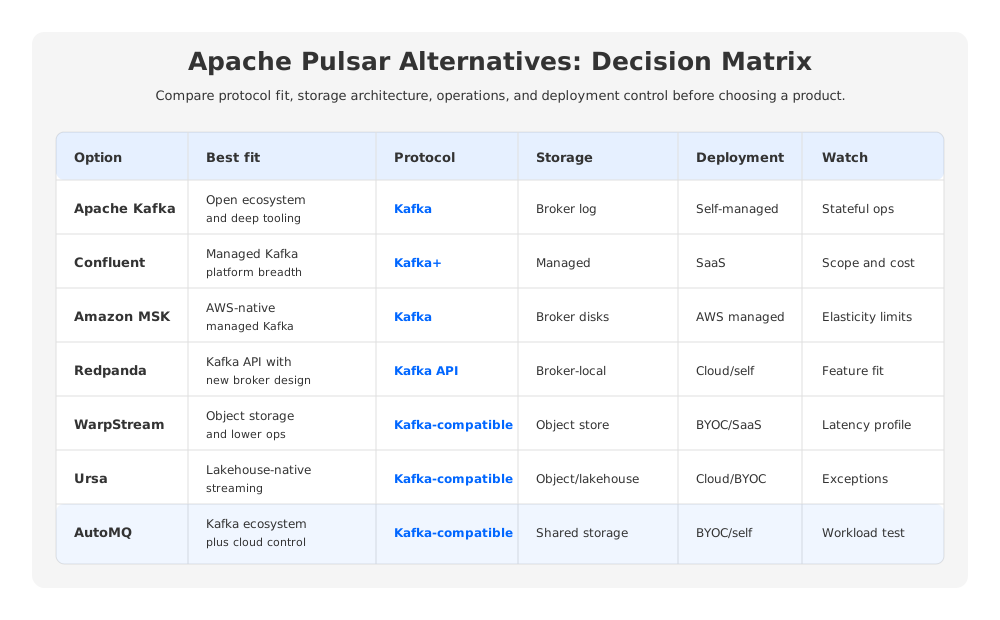
The table below groups the main alternatives by the decision they help with. Use it to choose proof-of-concept candidates, not to declare a universal winner.
| Option | Best Fit | Protocol/Ecosystem | Storage Pattern | Deployment Model | Main Trade-Off |
|---|---|---|---|---|---|
| Apache Kafka | Teams standardizing on the Kafka ecosystem | Kafka clients, Connect, Streams | Broker-owned log storage | Self-managed or vendor-managed distributions | Mature ecosystem, but stateful operations remain yours if self-managed |
| Confluent Cloud | Teams wanting a broad managed Kafka data streaming platform | Kafka plus Confluent services | Managed Kafka platform | Fully managed cloud | Rich platform, but commercial and platform scope can be larger than the broker need |
| Amazon MSK | AWS teams that want managed Apache Kafka inside AWS | Apache Kafka | Broker storage, with AWS-managed operations | AWS managed service | Strong AWS fit, but Kafka's stateful storage model still affects scaling and cost |
| Redpanda | Teams wanting Kafka API compatibility with a different broker implementation | Kafka API-compatible | Single-binary broker design | Self-managed or cloud | Simpler deployment model, but compatibility and feature needs require workload testing |
| WarpStream | Teams prioritizing low ops and object-storage economics | Kafka-compatible | Object storage with stateless agents | BYOC / managed patterns | Strong cost model for latency-tolerant workloads, but latency and feature fit need validation |
| StreamNative Ursa | Teams evaluating Kafka-compatible lakehouse-native streaming | Kafka-compatible; StreamNative also offers Pulsar services | Object storage / lakehouse-oriented engine | StreamNative Cloud / BYOC options | Check Kafka feature support and latency profile carefully |
| AutoMQ | Teams wanting Kafka compatibility, shared storage, and cloud control | Kafka-compatible | Object-storage-backed shared storage with stateless brokers | BYOC or self-managed patterns | Best fit when the goal is to keep Kafka-facing apps while changing the storage and elasticity model |
Many alternatives are not trying to preserve Pulsar semantics. The right option depends on whether Pulsar is being replaced because of protocol fit, operational ownership, cloud economics, or organizational standardization.
3The Main Apache Pulsar Alternatives
3.1Apache Kafka
Apache Kafka is the default alternative when the organization wants the largest event streaming ecosystem. The official Kafka project describes Kafka as a distributed event streaming platform, and that platform is more than a broker. It includes a client model, consumer groups, Kafka Connect, Kafka Streams, a large vendor ecosystem, and deep operational familiarity across data engineering teams.
Kafka is a strong fit when application teams already write and operate Kafka-facing systems. It is a weaker fit when the team expects a self-managed Kafka cluster to remove operational complexity by itself. Traditional Kafka brokers own partition data, and that ownership affects disk sizing, partition reassignment, broker recovery, and capacity planning.
3.2Confluent Cloud
Confluent Cloud is the managed Kafka option for teams that want a broader commercial data streaming platform around Kafka. It can be attractive when the migration goal is not only replacing Pulsar brokers, but also standardizing connectors, governance, stream processing, and operational support under one provider. The trade-off is scope: some teams need a complete data streaming platform, while others only need Kafka-compatible infrastructure with a different cost or deployment model.
3.3Amazon MSK
Amazon MSK is often the first managed Kafka alternative considered by AWS-centric teams. It keeps workloads close to existing VPCs, IAM patterns, CloudWatch monitoring, and AWS procurement. MSK manages important parts of Apache Kafka operations, but the underlying cluster is still Kafka: brokers, partitions, storage, replication, upgrades, and limits still matter. That makes MSK practical when the goal is "managed Apache Kafka in AWS," and less complete when the goal is to change the cost and elasticity behavior of broker-owned storage.
3.4Redpanda
Redpanda positions itself around Kafka API compatibility with a different implementation and a simplified deployment model. That makes it relevant for teams that want Kafka-facing applications but do not want the exact operational profile of Apache Kafka. It is also a useful option when low latency and high performance are first-order requirements.
Compatibility should be tested, not assumed. Kafka API compatibility includes client versions, transactions, compaction, security, admin APIs, metrics expectations, and connector behavior. Redpanda belongs on the shortlist when Kafka compatibility and broker performance matter.
3.5WarpStream
WarpStream is a Kafka-compatible system built around object storage and stateless agents. It is especially relevant when the Pulsar alternative search is really about cloud economics and operations. Instead of running stateful brokers that own durable data, WarpStream moves the durability boundary toward cloud object storage.
That architecture changes failure and scaling because durable data is not tied to a single broker's disk. Object-storage-first systems still need latency, request-cost, cache, and feature validation. For log analytics, observability, and high-retention ingestion, that trade-off can be attractive.
3.6StreamNative Ursa
StreamNative Ursa is notable because it comes from a company closely associated with Pulsar, yet it targets Kafka-compatible and lakehouse-native streaming. StreamNative documentation describes Ursa as a unified stream storage engine with object storage profiles, and its Kafka compatibility documentation calls out both compatibility and exceptions. That makes Ursa a serious option for teams watching the convergence of Kafka, object storage, and lakehouse tables.
Ursa should be evaluated with precision. It may fit Kafka-compatible workloads that benefit from object storage and lakehouse integration. It may be a poor fit if the application depends on Kafka features that the chosen Ursa-powered profile does not support, or if the latency target is tighter than the storage profile is designed for.
3.7AutoMQ
AutoMQ fits a narrower but increasingly common category: Kafka-compatible streaming with object-storage-backed shared storage and stateless brokers. It is not a Pulsar-protocol replacement. It is a way for teams to keep Kafka clients and ecosystem tools while changing the storage model that drives scaling, recovery, and cloud cost behavior.
Many Pulsar alternative searches are not really about Pulsar semantics. They are about keeping a durable streaming log without accepting every operational consequence of stateful brokers or specialized storage services. AutoMQ's architecture moves durable data into shared storage backed by object storage, while brokers act more like elastic compute.
4Which Alternative Fits Which Workload?
A product list becomes useful only when it maps to workload intent. The architecture that works for observability ingestion may be wrong for low-latency trading, and the managed service that works for a central platform team may be too heavy for a small data product team.
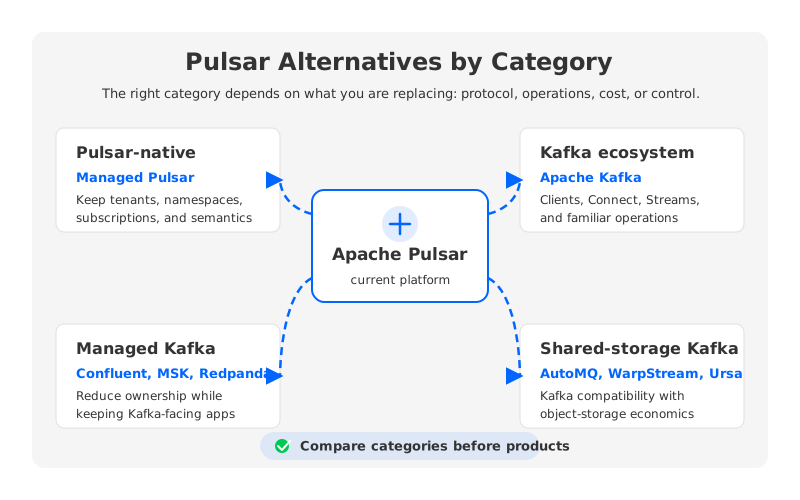
Choose the category first:
- Keep Pulsar semantics. If tenants, namespaces, subscription modes, or Pulsar-native application behavior are central to the system, evaluate managed Pulsar or StreamNative options before jumping to Kafka.
- Keep the Kafka ecosystem. If Kafka clients, Kafka Connect, Kafka Streams, and existing team knowledge dominate the migration risk, evaluate Apache Kafka, Confluent, MSK, Redpanda, AutoMQ, WarpStream, and Ursa.
- Reduce operations ownership. If the team mainly wants fewer on-call responsibilities, managed services such as Confluent Cloud, MSK, Redpanda Cloud, or managed Pulsar may be more important than the storage architecture.
- Change cloud economics. If the pain is broker storage, cross-zone data movement, over-provisioning, or slow recovery from stateful data movement, evaluate shared-storage and object-storage-backed Kafka-compatible systems.
- Preserve cloud control. If data residency, VPC isolation, or account ownership matters, prioritize BYOC or self-managed options rather than pure SaaS.
This framing also keeps the AutoMQ discussion honest. AutoMQ is not the answer when a team wants to preserve Pulsar-specific semantics. It becomes relevant when the team's real goal is Kafka compatibility plus a cloud-native storage model.
5A Practical Use-Case Selector
The safest selection process starts with a narrow proof of concept. Pick one workload that represents the migration risk: a high-throughput ingestion topic, a connector-heavy pipeline, a low-latency consumer group, or a long-retention audit stream. Then test the alternatives against that workload rather than against a generic feature grid.
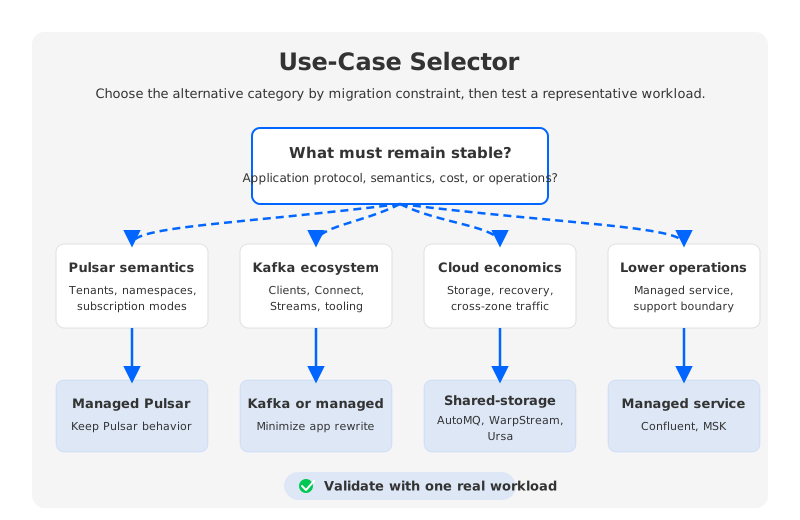
For platform teams, a focused evaluation plan includes:
- Client validation. Run the actual producer and consumer libraries, not only benchmark clients.
- Connector validation. Test Kafka Connect or Pulsar IO paths that the business depends on.
- Failure simulation. Kill brokers, agents, or storage nodes and observe recovery time, lag, and operator steps.
- Cost and operations review. Estimate compute, storage, cross-zone traffic, object storage operations, support, and headroom. Then review metrics, alerts, runbooks, upgrades, and support boundaries.
A streaming platform is selected when the people who operate it can explain failure modes at 2 a.m. and defend the bill at month end.
6When to Choose AutoMQ
Choose AutoMQ when the Pulsar alternative discussion has narrowed to a specific shape: the organization wants Kafka-facing applications, wants to reduce stateful broker storage constraints, and wants deployment control in its own cloud or private environment. That combination is common in teams that adopted Pulsar for cloud-native separation but now need Kafka compatibility for applications and ecosystem tooling.
AutoMQ's useful distinction is architectural. Traditional Kafka stores durable data on brokers, so scaling and recovery often involve moving partition data or planning around broker-local capacity. Object-storage-backed shared storage changes that boundary. Brokers can be treated more like stateless compute because durable data is no longer trapped on a specific broker disk.
There are still trade-offs to test. Low-latency workloads should be benchmarked with production-like producers and consumers. Compatibility should be checked with real connectors, security settings, and admin workflows.
If your team is comparing Pulsar alternatives because Kafka compatibility and cloud storage economics now matter more than Pulsar-specific semantics, start from the workload selector above and test a representative topic. AutoMQ documentation is a practical next stop for understanding how the Kafka-compatible, object-storage-backed model changes the architecture without turning the decision into a marketing slogan.
7FAQ
7.1Which Apache Pulsar alternative should you choose?
There is no single answer. Apache Kafka fits Kafka ecosystem standardization. Confluent Cloud and Amazon MSK fit managed Kafka requirements. Redpanda fits teams that want Kafka API compatibility with a different broker. WarpStream, Ursa, and AutoMQ fit teams evaluating object-storage-backed or lakehouse-oriented streaming.
7.2Is Kafka a direct replacement for Pulsar?
Kafka can replace Pulsar for many event streaming workloads, but it is not a drop-in replacement for Pulsar semantics. Pulsar's tenants, namespaces, subscription modes, and BookKeeper-based storage model differ from Kafka's topic, partition, and consumer group model. Treat Kafka as a strong alternative when Kafka ecosystem compatibility matters more than preserving Pulsar-specific behavior.
7.3Which managed Pulsar alternative should you evaluate?
If the goal is to keep Pulsar semantics while reducing operational ownership, managed Pulsar from a Pulsar-focused provider is usually the first category to evaluate. If the goal is to move away from Pulsar semantics and standardize on Kafka, managed Kafka services such as Confluent Cloud or Amazon MSK are more relevant.
7.4When should I choose AutoMQ instead of Pulsar?
Choose AutoMQ when the target architecture is Kafka-compatible streaming with object-storage-backed shared storage and deployment control. It is most relevant when applications use Kafka clients and ecosystem tools, while the platform team wants to reduce the friction of broker-owned durable storage.
7.5Are object-storage-backed Kafka alternatives slower?
They can be, depending on the write path, cache design, storage profile, and workload. Object storage changes the latency and cost trade-off, so teams should test representative producers, consumers, retention, and failure scenarios. For high-retention ingestion and cloud-scale workloads, the economics can be attractive; for strict low-latency workloads, proof-of-concept testing is mandatory.
8References
- Apache Pulsar architecture overview
- Apache Kafka introduction
- Confluent Cloud overview
- Amazon MSK developer guide: What is Amazon MSK?
- Redpanda architecture documentation
- WarpStream documentation
- StreamNative Kafka compatibility overview
- StreamNative data streaming engine documentation
- AutoMQ documentation overview


