
Table of Contents
Table of Contents
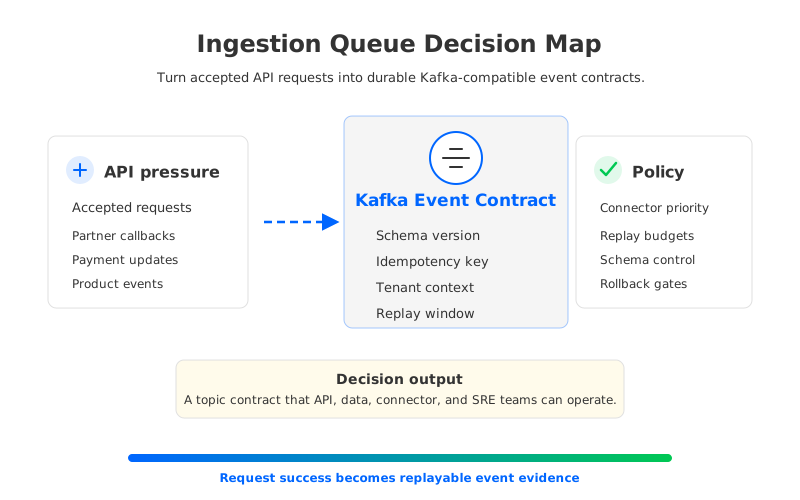
Teams search for api ingestion kafka pipeline when API traffic has outgrown request handling alone. A payment authorization, partner callback, order status change, or AI product event may begin as an HTTP request, but the same event must feed audits, analytics, fraud checks, notifications, replay workflows, and downstream data products. The ingestion queue becomes the contract between the API layer and every system that depends on what the API accepted.
That contract is easy to underdesign. Many teams start with a web service, a retry queue, and a sink connector. The shape works until the API becomes a boundary for multiple producers, tenants, schemas, and service-level objectives. At that point, the queue is the system of record for accepted events, and the harder question is whether the platform around Kafka can keep the contract stable as ingestion volume, retention, replay, and governance demands change.
1Why teams search for api ingestion kafka pipeline
The search phrase usually appears after a specific incident or scaling review. An API endpoint accepts traffic faster than a downstream database can write. A partner integration retries after timeouts and creates duplicate events. A connector falls behind during a cloud maintenance window. A compliance team asks whether every accepted request can be replayed with its original headers, schema version, and tenant boundary. The phrase sounds like an implementation query, but the underlying need is architectural.
API ingestion sits between two operating models. The API world optimizes for request latency, authentication, rate limits, idempotency, and clear error responses. The streaming world optimizes for durable append, ordered consumption, replay, backpressure, and independent downstream processing. If the boundary is weak, API teams absorb streaming failures and data teams inherit ambiguous request semantics.
A Kafka-compatible event contract makes that boundary explicit. The API layer validates and normalizes the request, assigns identity and idempotency metadata, and appends an event to a topic. Consumers then process the event according to their own pace and guarantees. The event contract should state what the topic represents, which fields are stable, how schemas evolve, how duplicates are handled, how long replay is possible, and which teams own failures on each side of the boundary.
The goal is not to put Kafka behind every endpoint. The pattern earns its keep when the accepted API event becomes a shared fact. Once multiple teams treat that fact as input, the queue needs stronger guarantees than a service-local buffer can provide.
2The operational constraint behind connector-heavy platforms
API ingestion platforms become connector-heavy because the business value rarely stops inside Kafka. Accepted events may flow into object storage, warehouses, lakehouse tables, search indexes, operational databases, and stream processors. Kafka Connect, custom consumers, Flink jobs, and managed sink services all extend reach, but they also add operational coupling.
The coupling shows up in three places. Connector lag can turn into API pressure when product teams expect tight downstream freshness. Connector retries can create duplicate writes when idempotency is not designed across the API event, Kafka record key, and sink system. Connector recovery can consume large amounts of broker read capacity when a sink replays retained history after a failure.
Those costs are not bugs in Kafka. They are the result of using Kafka correctly as a durable log while forgetting that logs need operating policy. A connector platform should distinguish between event classes:
- Operational commands represent state changes that downstream services must process with tight ordering and failure handling.
- Partner events require tenant isolation, schema versioning, audit trails, and deduplication because producers sit outside the company boundary.
- Analytical events feed lakehouse, warehouse, and BI systems where batch repair and replay are part of normal operations.
- Product telemetry may be high volume and less sensitive to per-event recovery, but it still needs retention and governance rules.
Once the classes are visible, the platform can avoid treating every connector equally. Some consumers need high priority and narrow retention. Others should read from materialized tables after the first sink succeeds. Repair jobs may need scheduled replay windows, quotas, or separate clusters.
3Failure handling, schema, and replay trade-offs
An API ingestion queue must decide what happens when success is partial. The API may return success after the event is durably written to Kafka, while downstream sinks are still pending. That is often the right boundary: the system has accepted the event, and downstream processing is asynchronous. It also means the event contract must carry enough information for downstream recovery without calling the original API again.
Idempotency is the first design point. The API should attach an idempotency key, producer identity, request timestamp, tenant context, and semantic event type. Kafka record keys should follow ordering and partitioning needs, not convenience. Downstream sinks should know whether they are expected to upsert, append, compact, or reject duplicates.
Schema is the second design point. API request payloads often evolve faster than downstream systems can change. A stable event contract separates external request shape from internal event schema. Schema registry, compatibility rules, and contract tests prevent a request change from breaking a warehouse table or fraud model.
Replay is the third design point, and it is where infrastructure cost becomes visible. Longer retention makes recovery easier, but in a traditional Kafka deployment it can require more broker-local storage and more careful capacity planning. A replay-heavy connector can compete with serving consumers, and multi-zone deployments can add network cost. The event contract therefore needs an explicit replay window.
4Evaluation checklist for platform teams
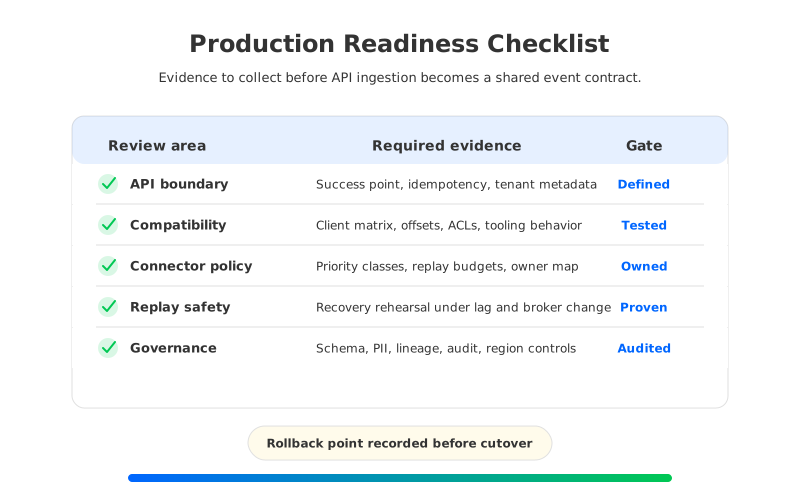
Before choosing a service or rewriting ingestion code, platform teams should evaluate the contract. The checklist should start from the API boundary and follow the event until each downstream team consumes it, stores it, or ignores it.
| Dimension | Review question | Evidence to collect |
|---|---|---|
| API boundary | When does the API return success, and what has been durably committed at that point? | Request flow, error policy, idempotency design |
| Kafka compatibility | Can existing producers, consumers, tooling, ACLs, offsets, and client libraries keep their expected behavior? | Client test matrix and compatibility notes |
| Connector policy | Which downstream paths are production-critical, analytical, repair-only, or experimental? | Consumer group inventory and priority rules |
| Replay window | How far back can each event type be replayed without emergency capacity work? | Retention model and recovery rehearsal |
| Governance | Are schema, tenant, PII, region, lineage, and audit fields part of the event contract? | Data contract and schema compatibility tests |
| Cost model | Does storage, cross-zone traffic, and replay load scale with business demand or broker count? | Cloud bill model and stress test metrics |
| Rollback | Can producers, consumers, connectors, and schemas roll back independently? | Cutover plan with offset and schema checkpoints |
This checklist keeps the team honest because it ties every architecture claim to evidence. A pipeline diagram may look clean while recovery still depends on manual offset edits and a late-night connector restart. A managed connector may remove deployment work while leaving storage and replay cost unchanged.
The most useful evaluation is a failure rehearsal. Pause a sink connector, let lag build, restart it, and watch broker CPU, fetch throughput, storage growth, and duplicate handling. Rotate a schema version while a consumer group is behind. Replace a broker while API writes continue.
5Where traditional Kafka absorbs ingestion pressure
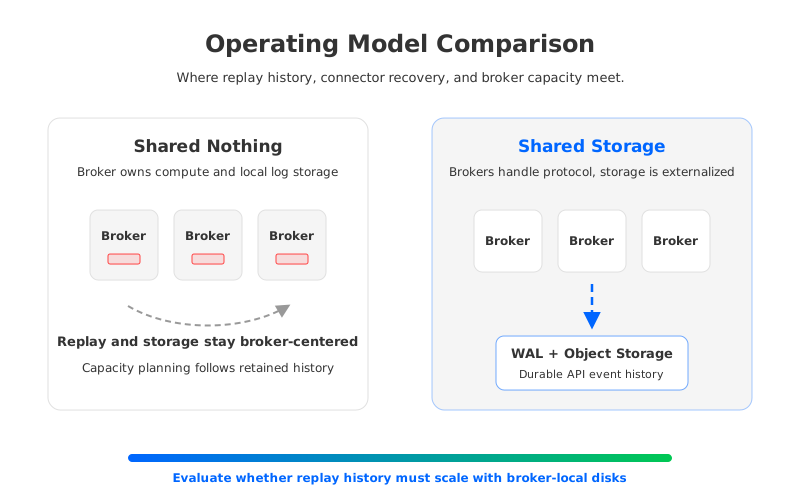
Apache Kafka's Shared Nothing architecture keeps partition data on broker-owned storage. Leaders serve reads and writes, followers replicate for availability, and local disks or attached volumes hold log segments. This model is proven, which is one reason teams trust Kafka for ingestion queues. It also means the broker remains the place where write bursts, retained history, consumer fan-out, and replay traffic meet.
For API ingestion, that convergence matters. A spike in partner callbacks increases write load. A downstream warehouse outage increases retained data and catch-up reads. A compliance rule may extend retention for a subset of topics. A broker replacement can trigger data movement. Each event sounds separate in the incident channel, but all of them draw from the same broker-centered capacity envelope.
Tiered Storage can reduce pressure from older segments by moving historical data to remote storage. It is useful, but it does not make brokers stateless and it does not remove the need to size the hot path, partition ownership, recent fetch behavior, or recovery operations. The team still has to ask whether retained API history and broker compute should grow together.
This is where a neutral architecture review matters. Kafka works for API ingestion. The question is whether the platform's storage model gives the organization enough room to absorb replay, connector growth, and cloud cost without turning every ingestion change into a broker capacity project.
6How AutoMQ changes the operating model
After the contract is defined, AutoMQ becomes relevant as a Kafka-compatible streaming platform built around Shared Storage architecture. It keeps Kafka protocol and API compatibility while moving persistent stream storage away from broker-local disks and into object storage through S3Stream. Brokers remain responsible for Kafka request handling, partition leadership, caching, and routing, while durable data is backed by WAL storage and object storage.
For API ingestion queues, the practical change is that replay history and broker-local capacity are no longer the same planning unit. A team can evaluate longer retention, connector recovery, and broker replacement without assuming every retained byte must sit on broker disks. Compute and storage can be scaled along different dimensions, which matters when API writes are steady but repair reads are bursty.
AutoMQ also changes the cloud cost conversation for multi-zone deployments. Its zero cross-AZ traffic architecture is designed to avoid the broker-to-broker replication traffic pattern that often appears in cloud bills. The exact impact depends on workload shape, cloud provider, region, and deployment choices, so it should be validated against the team's own traffic model.
Several AutoMQ capabilities matter in an ingestion review:
- Kafka-compatible APIs help teams preserve producer and consumer contracts while changing the storage architecture underneath.
- Shared Storage architecture reduces the operational tie between durable log history and broker-local disks.
- Independent compute and storage scaling helps separate steady API writes from bursty connector recovery.
- Zero cross-AZ traffic can improve the cost profile for cloud deployments that run across availability zones.
- Customer-controlled deployment boundaries support teams that need to keep data plane resources, object storage, IAM, and network controls in their own cloud environment.
- AutoMQ Linking for Kafka can help stage migrations from existing Kafka-compatible clusters in supported scenarios, giving teams a way to validate topics and consumers before full cutover.
The right test is whether these features improve the checklist evidence. If a connector falls behind, can it recover without emergency broker expansion? If a schema rollback is required, can consumers continue from known offsets? If a broker is replaced, does durable API history remain available without lengthy partition movement?
7Migration and rollout scorecard
A clean rollout separates four changes that teams often bundle together: API event shape, Kafka-compatible infrastructure, connector topology, and downstream storage contracts. Move one boundary at a time. Keep producers on the existing API behavior while the event schema is hardened. Mirror representative topics into the new platform, then validate consumer offsets, connector recovery, security rules, and observability before moving production traffic.
Rollback should be designed before the first cutover. Record the topic, partition, offset, schema version, and connector state for each migration wave. Decide whether rollback means sending API writes back to the previous cluster, moving selected consumers, or pausing a sink while the event log continues.
Observability closes the contract. API success rate, Kafka append latency, consumer lag, connector task state, replay throughput, schema compatibility failures, storage growth, and cross-zone traffic should be visible in one operating view.
Back at the original search phrase, api ingestion kafka pipeline is not mainly about wiring an API to a topic. It is about deciding what the organization promises once an API accepts an event. If your team is evaluating Kafka-compatible infrastructure for that boundary, use the checklist against your replay, connector, governance, and cost requirements, then review AutoMQ's architecture or start a technical conversation here: contact AutoMQ.
8References
- Apache Kafka documentation for Kafka clients, topics, partitions, consumer groups, offsets, transactions, operations, and Tiered Storage.
- Apache Kafka Connect documentation for connector framework concepts, source connectors, sink connectors, workers, and task behavior.
- Apache Kafka producer configuration documentation for producer delivery, batching, idempotence, and reliability settings.
- AWS S3 pricing for object storage and data transfer pricing considerations that affect retained event history.
- AWS PrivateLink documentation for private connectivity patterns relevant to API ingestion boundaries.
- AutoMQ Shared Storage architecture documentation for stateless brokers and object-storage-backed stream storage.
- AutoMQ Kafka compatibility documentation for client and Kafka ecosystem compatibility.
- AutoMQ cross-AZ traffic documentation for the architecture behind reducing inter-zone traffic.
- AutoMQ migration documentation for staged migration and Kafka Linking concepts.
9FAQ
9.1Is an API ingestion queue different from an ordinary message queue?
Yes. An ordinary queue often decouples a producer from a worker. An API ingestion queue becomes a durable event contract for systems that need replay, independent consumption, schema governance, and auditability.
9.2Should every API request become a Kafka event?
No. Use Kafka where the accepted request represents a shared fact, a state change, or a durable event that multiple systems need to process. Transient UI actions, low-value logs, and synchronous request paths may be better handled by other systems unless replay and independent consumption are required.
9.3What should be included in an API ingestion event contract?
The contract should include event type, schema version, producer identity, tenant context, idempotency key, timestamp policy, ordering key, retention expectation, PII classification, replay window, and ownership for downstream failures.
9.4Can Kafka Connect handle API ingestion by itself?
Kafka Connect can move data between Kafka and external systems, but it does not define the API boundary, idempotency model, schema policy, retention window, or rollback process by itself. Treat connectors as part of the ingestion platform rather than the whole platform.
9.5Where does AutoMQ fit?
AutoMQ fits when teams want Kafka-compatible ingestion queues with a cloud-native storage model. It is most relevant when replay history, connector recovery, broker elasticity, cross-AZ cost control, and customer-controlled deployment boundaries are part of the architecture review.


