
Table of Contents
Table of Contents
An api to kafka pipeline usually starts with a narrow job: accept HTTP requests from a service, partner endpoint, webhook, or internal gateway, then publish those events into Kafka. The first version can look modest. A stateless service validates JSON, maps fields to a schema, calls a Kafka producer, and returns a status code. That is enough for a proof of concept, but it is not the full system platform teams are asked to operate.
The pressure arrives when the HTTP edge becomes a shared ingestion surface. Product teams want replayable events. Data engineers want stable downstream contracts. Security teams want audit trails. SREs want backpressure and a failure mode that does not turn every producer outage into a user-facing incident. At that point, the question is no longer "how do we send an API request to Kafka?" The question is whether this pipeline is becoming streaming infrastructure, with all the durability, scaling, and governance expectations that come with that label.
This article gives platform teams a vendor-neutral framework for evaluating API-to-Kafka designs. The goal is to separate integration code from durable infrastructure, then decide where Kafka, Kafka Connect, shared storage, cloud networking, and operating boundaries should sit.
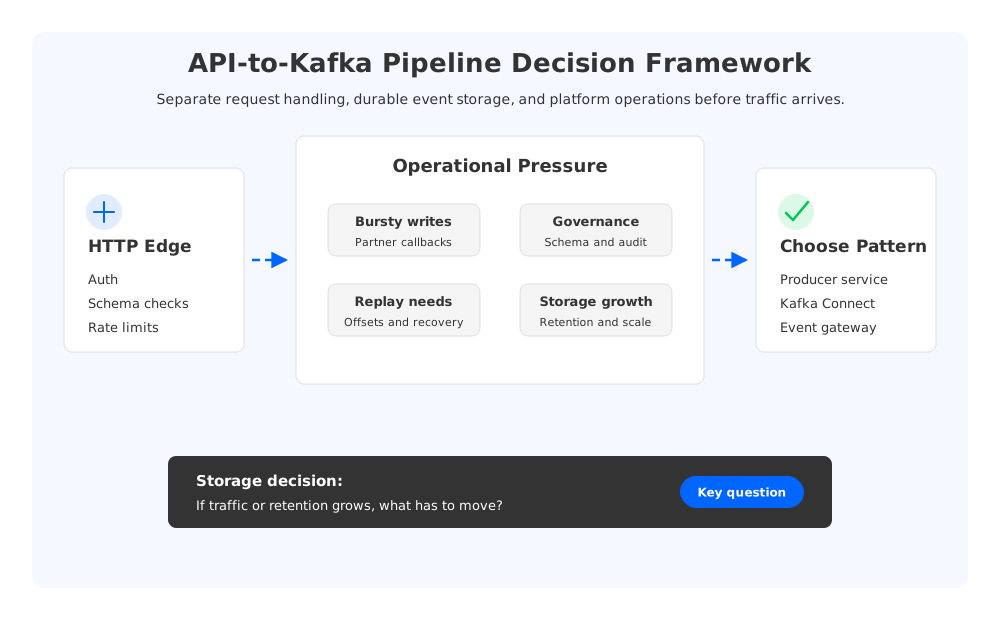
1The HTTP Edge Is Not the Hard Part
Most teams can build the HTTP side of the pipeline. They know how to terminate TLS, authenticate callers, rate-limit requests, validate payloads, and map fields into an internal event format. Those pieces matter, but they are not what usually breaks the operating model. The harder part is what happens after the API accepts the request and before every downstream consumer processes the event.
That middle zone has several obligations that plain request-response thinking tends to hide:
- The producer path needs explicit retry, idempotency, and timeout behavior.
- Payloads need schema ownership, compatibility rules, and a plan for rejected events.
- The Kafka cluster needs enough headroom for bursts without turning every spike into a broker or partition incident.
- Consumers need a clear offset and replay model when an upstream API changes behavior.
- Operators need a way to inspect lag, failed writes, dead-letter records, and cross-region routing without reading application logs from five teams.
Kafka is well suited to many of these concerns because it provides a durable log, partitioned parallelism, consumer groups, offsets, and transactional producer semantics for workloads that need stronger guarantees. The architectural trap is assuming that using Kafka automatically gives the API pipeline a production operating model. Kafka gives you the log. You still have to decide where ingestion logic, durability boundaries, storage growth, and cluster operations belong.
2Three Patterns Teams Usually Compare
The first serious design decision is ownership. Who owns the ingestion path, the Kafka write path, and the failure behavior between them?
| Pattern | Where it fits | Main risk |
|---|---|---|
| Custom API producer service | Product-specific APIs, strict validation, custom auth, request-level business logic | Application teams inherit producer tuning, retries, dead-letter design, and Kafka client behavior |
| Kafka Connect source path | Standardized ingestion from systems with connector support, repeatable operational controls | HTTP-specific behavior may require connector customization or a separate gateway layer |
| Event gateway plus shared Kafka platform | Multi-team ingestion, external partners, high governance needs, or high fan-in | Requires platform ownership of schema policy, routing, quotas, and operational contracts |
The custom producer service is often the fastest route because it lives close to the API contract. It can apply business rules before records enter Kafka and return domain-specific errors. The downside is that every service team may reimplement producer retries, batching, idempotency, schema validation, and poison-message handling differently. That fragmentation becomes expensive when a compliance team asks where an event was rejected or an SRE needs to trace a write failure during a spike.
Kafka Connect moves some of that burden into a framework built for moving data between external systems and Kafka. For sources and sinks that map well to connector semantics, this can reduce custom code and standardize deployment, configuration, and monitoring. The fit is weaker when the API surface itself is the product contract, especially if callers expect synchronous validation, per-tenant quotas, or response semantics that are not natural for a connector task.
An event gateway treats API ingestion as a platform capability. The gateway owns HTTP behavior, authentication, rate limits, schema checks, tenant routing, and sometimes dead-letter handling. Kafka remains the durable event backbone behind it. This is heavier than a small producer service, but it gives platform teams one place to define contracts.
3The Storage Model Sets the Cost of Change
Once the API-to-Kafka path carries production traffic, broker storage stops being an implementation detail. Kafka's classic Shared Nothing architecture keeps partition data on broker-local disks and uses replication across brokers for durability. That design is mature, but it also ties storage, compute, and partition placement together. When ingestion volume grows or retention expands, platform teams often add brokers, move partitions, and reserve disk headroom before application teams feel the next spike.
The coupling matters because HTTP traffic is rarely as smooth as batch ingestion. Partner callbacks, mobile releases, marketplace events, and incident retries can create sharp bursts. If the Kafka cluster is already close to disk, network, or partition balancing limits, the API layer may be healthy while the storage layer becomes the bottleneck.
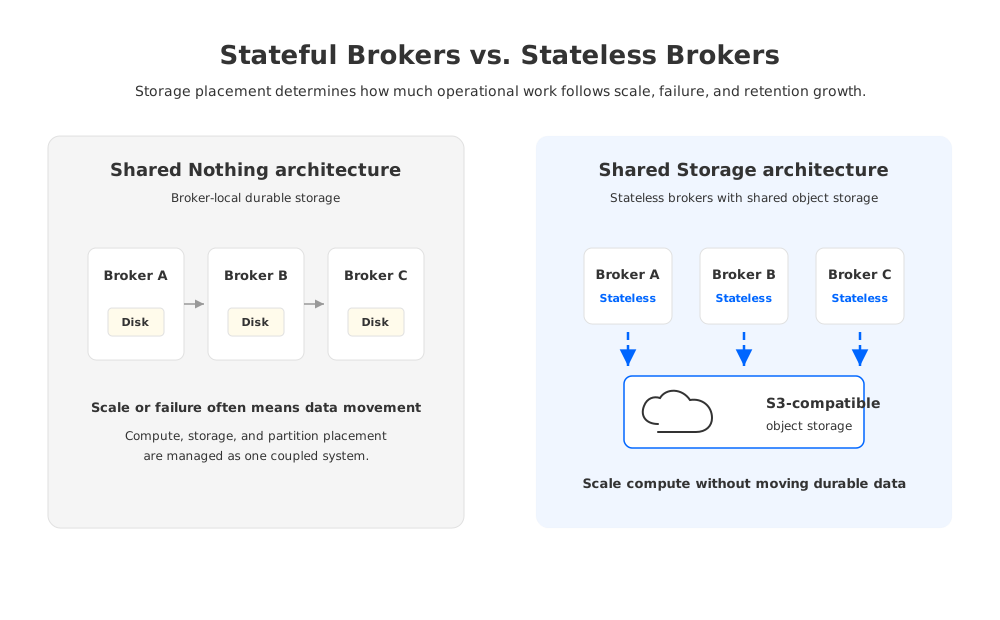
This is where teams should evaluate the infrastructure under the API pipeline, not only the pipeline code. A broker-local model can be a solid choice when traffic is predictable, retention is bounded, and the team has mature Kafka operations. It becomes harder when the organization wants rapid scaling, long retention, many small ingestion tenants, or lower operational overhead for partition movement.
The useful question is: if the API pipeline doubles write volume or retention, what has to move? If partition data moves across brokers, storage architecture is part of the design risk. If compute scales while durable data stays in shared storage, the operating model changes.
4Reliability Is More Than a Retry Loop
Retry logic is necessary, but it is not a reliability strategy by itself. In an API-to-Kafka pipeline, retries interact with HTTP client behavior, Kafka producer behavior, downstream consumer idempotency, and the business meaning of the event. A payment callback, an inventory update, and an observability event do not deserve the same failure policy.
The reliability design should make several decisions explicit:
- Accept or reject at the edge. Decide whether the API returns success only after Kafka acknowledges the record, or whether the edge can accept the request into an intermediate durable buffer before publishing.
- Preserve caller identity. Keep enough metadata, such as tenant, source system, request ID, schema version, and trace ID, for audit and replay.
- Define duplicate behavior. Use idempotency keys or event IDs where the business process cannot tolerate repeated effects.
- Separate bad data from late data. A schema violation and a temporary broker timeout need different paths. One belongs in a quarantine or dead-letter topic, the other in controlled retry.
- Test consumer recovery. Consumer groups and offsets are useful only if teams know how to replay safely after a failed deployment or schema issue.
For workloads that require stronger write guarantees, Kafka's idempotent producers and transactions may be relevant. They add constraints and configuration choices, so they should be selected for the event's business semantics rather than turned on as a blanket comfort setting. A practical platform standard should say which API events require idempotency keys, which require transactional writes, and which can tolerate at-least-once delivery with downstream de-duplication.
5Governance Starts Before the Record Enters Kafka
Many Kafka governance discussions begin at the topic. API-to-Kafka pipelines need governance earlier, at the ingress contract. The API endpoint is where external shape, authentication, schema version, tenant identity, and routing policy first meet the streaming platform. If that boundary is loose, Kafka stores ambiguity.
Platform teams should define a small set of ingress rules before the first shared pipeline goes live:
- Topic ownership: who approves a new topic, names it, and decides partitioning?
- Schema ownership: who can introduce a breaking change, and how is compatibility checked?
- Tenant routing: how does the gateway map callers to topics, headers, or partitions?
- Quotas: what happens when one caller floods the ingestion path?
- Data classification: which fields are allowed in Kafka, which must be encrypted, and which should be rejected?
- Replay policy: who may request replay, from what offset range, and under which audit process?
These rules do not need a huge governance program. They need to exist where teams operate the API pipeline. Otherwise, governance arrives later as manual review, emergency topic cleanup, or undocumented consumer assumptions.
6Where AutoMQ Changes the Operating Model
After the architecture questions are clear, Kafka-compatible shared-storage systems become easier to evaluate. AutoMQ is one option in this category: it keeps Kafka protocol compatibility while changing the broker storage model. AutoMQ uses a Shared Storage architecture in which brokers are stateless and durable data is stored in S3-compatible object storage, with a WAL layer for persistence and recovery.
For an API-to-Kafka pipeline, that distinction matters because the ingestion layer and storage layer fail and scale differently. If brokers do not own durable partition data on local disks, adding or replacing brokers is less tied to data movement. That can reduce the operational cost of bursty API traffic, partition growth, and node replacement.
The deployment boundary also matters. AutoMQ BYOC runs in the customer's cloud account, and AutoMQ Software targets private data center deployment. That is relevant because partner APIs, private service endpoints, VPC routing, and regulated datasets all affect where the data plane is allowed to run.
This does not mean every API-to-Kafka pipeline needs a shared-storage Kafka-compatible platform. If an existing Kafka cluster is stable, retention is modest, and operational ownership is clear, the right move may be to standardize producer libraries and gateway behavior. AutoMQ becomes more interesting when the pain is structural: broker-local storage slows scaling, partition movement constrains operations, cross-AZ traffic is a material cost driver, or platform teams want Kafka compatibility without preserving the same storage coupling.
7A Practical Evaluation Checklist
The strongest API-to-Kafka designs answer operational questions before traffic arrives. If a team cannot answer these points, the architecture is not ready to be a shared ingestion platform.
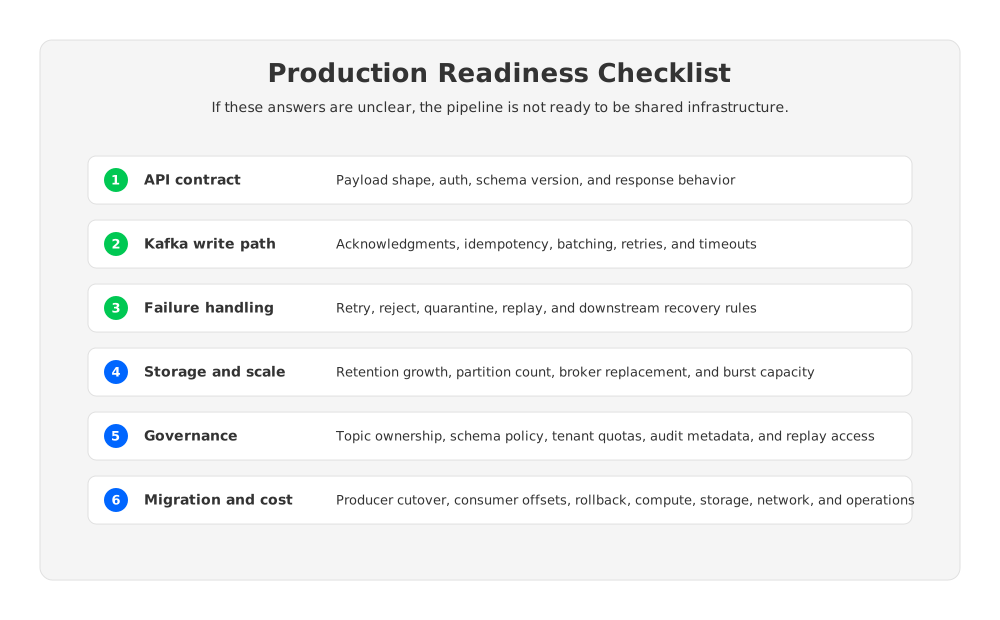
| Area | Questions to answer |
|---|---|
| API contract | What is the accepted payload shape, schema version policy, authentication model, and error response behavior? |
| Kafka write path | Which producer settings, acknowledgment policy, idempotency rules, batching limits, and timeout values are standard? |
| Failure handling | Which failures are retried, which are quarantined, and which are rejected at the edge? |
| Storage and scale | What happens when write volume, partition count, or retention grows faster than forecast? |
| Governance | Who owns topics, schemas, tenant quotas, audit metadata, and replay requests? |
| Migration | Can the team move producers, consumers, offsets, and topics without a large coordinated outage? |
| Cost model | Which costs scale with traffic: compute, storage, network transfer, operations, or all of them at once? |
The decision is rarely binary. A platform team may keep a custom API gateway, standardize Kafka producer behavior, and still reassess the Kafka layer underneath it. Another team may use Kafka Connect for internal sources while using a stricter event gateway for partner-facing APIs. What matters is separating request handling, event durability, storage growth, and consumer recovery instead of treating them as one service.
8Decision Table
Use this table as a starting point when the discussion moves from implementation to architecture.
| Situation | Likely path |
|---|---|
| One service owns the API and the topic, traffic is predictable, and replay needs are narrow | Custom producer service with a documented producer standard may be enough |
| Many teams are building similar ingestion services with uneven retry and schema behavior | Centralize the HTTP edge as an event gateway and define shared producer controls |
| Source systems already fit connector semantics and do not need custom synchronous API behavior | Evaluate Kafka Connect as the integration layer |
| Retention growth, partition movement, broker replacement, or burst scaling dominate operations | Evaluate Kafka-compatible shared-storage architecture, including AutoMQ |
| Data residency, private networking, and cloud account control are hard requirements | Compare deployment boundaries, BYOC models, VPC design, and private connectivity early |
An API-to-Kafka pipeline becomes infrastructure when other teams depend on it as a durable boundary. That shift is easy to miss because the first version still looks like integration code. Treat the pipeline as a platform surface sooner, and the design conversation changes: less "where do we put the HTTP handler?" and more "which durability, governance, storage, and migration guarantees are we willing to operate?"
If your team is evaluating Kafka-compatible infrastructure for this kind of ingestion platform, the AutoMQ GitHub repository is a useful next stop for architecture notes, deployment examples, and code-level details.
9References
- Apache Kafka Documentation
- Apache Kafka Connect Documentation
- Apache Kafka Message Delivery Semantics
- Apache Kafka Consumer Configuration: group.id
- AWS PrivateLink Documentation
- AutoMQ Architecture Overview
- AutoMQ Compatibility with Apache Kafka
10FAQ
10.1What is an API-to-Kafka pipeline?
An API-to-Kafka pipeline accepts events through an HTTP interface and writes them into Kafka topics for downstream consumers. It often includes authentication, validation, schema checks, Kafka producer logic, retry handling, and observability.
10.2Should HTTP requests wait for Kafka acknowledgments?
For many production ingestion paths, the API should return success only after the event crosses a defined durability boundary. That boundary may be Kafka itself or an intermediate durable buffer. The right answer depends on latency targets, caller expectations, and the business cost of losing or duplicating an event.
10.3Is Kafka Connect a replacement for an API gateway?
Not usually. Kafka Connect moves data between Kafka and external systems through source and sink connectors. An API gateway handles HTTP behavior such as authentication, request validation, rate limits, response codes, and tenant-specific routing. Some architectures use both.
10.4Why does broker storage architecture matter for API ingestion?
API ingestion can create bursty write patterns and unpredictable retention growth. In a broker-local storage model, scaling often involves broker capacity planning and partition data movement. A shared-storage model changes that tradeoff by separating durable data placement from broker compute capacity.
10.5When should teams evaluate AutoMQ for API-to-Kafka pipelines?
Evaluate AutoMQ when Kafka compatibility is required but broker-local storage is becoming an operational constraint. Common signals include slow partition reassignment, high storage growth, costly cross-AZ replication patterns, bursty ingestion, or a requirement to keep the data plane in the customer's environment.


