
Table of Contents
Table of Contents
Searches for application ownership metadata kafka usually begin after ownership has already failed in production. A consumer group is lagging, but the alert names only a cluster and a group id. A producer is sending more traffic than expected, but the bill rolls up under a shared platform account. A connector is writing into a critical topic, but the team that owns the downstream application is not on the incident bridge. Kafka is working as designed; the operating model around it is not.
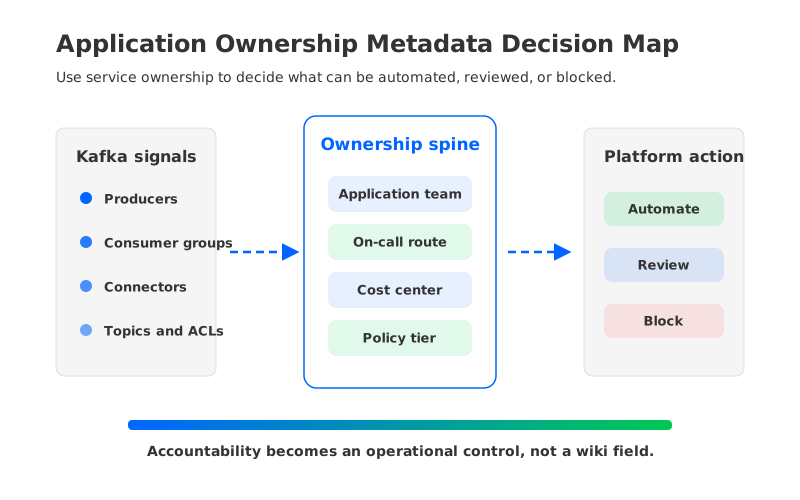
Application ownership metadata is the missing layer between Kafka resources and accountable services. It maps producers, consumers, connectors, topics, service accounts, cost centers, alert routes, deployment environments, and data contracts back to the application team that can make a decision. Topic ownership metadata is part of this, but application ownership goes wider. It answers who owns the workload that uses the stream, who can approve a change, who pays for retained data and replay traffic, and who must be contacted when a consumer group, connector, or producer becomes the production risk.
The hard part is that ownership metadata is not only a catalog problem. A spreadsheet can say which service owns a consumer group, but it cannot make broker-local storage scale independently. A service registry can record a team name, but it cannot make a partition reassignment low risk. Once platform teams turn ownership metadata into self-service automation, they discover that governance quality depends on the architecture underneath it.
1Why Teams Search for application ownership metadata kafka
Most platform teams do not start by designing a metadata model. They start with tickets. Application teams ask for topics, ACLs, additional consumer groups, connector changes, larger retention windows, replay access, and temporary environments. The platform team tries to keep the shared Kafka estate reliable while giving application teams enough autonomy to ship. Metadata becomes attractive because it promises a clean boundary: if every stream and client has an owner, automation can route requests, enforce policy, and reduce meetings.
The useful metadata set is broader than a single owner field. A practical record usually includes application name, owning team, on-call route, environment, business capability, data classification, producer services, consumer groups, service principals, connector jobs, schema or contract policy, retention class, replay policy, cost center, and deprecation owner. Some organizations also include recovery tier, change approval path, dependency criticality, and allowed regions.
That information supports several operating workflows:
- Incident routing. Broker metrics show symptoms, while application ownership metadata identifies the team that can change the producer, restart a consumer, pause a connector, or approve a replay.
- Cost attribution. Retention, catch-up reads, partition count, connector fan-out, and cross-zone traffic can be associated with the application that creates demand.
- Self-service governance. Topic creation, ACL requests, consumer group resets, and connector deployments can be checked against known owners and policy templates.
- Migration planning. A Kafka migration is easier to sequence when the platform can group producers, consumers, connectors, and alert routes by application boundary instead of only by topic name.
This is why the search term contains both "application" and "Kafka." The problem is not merely labeling assets. It is making Kafka-compatible infrastructure legible to the teams that own software, budgets, incidents, and compliance evidence.
2The Production Constraint Behind the Problem
Traditional Kafka gives platform teams strong primitives: topics, partitions, offsets, consumer groups, ACLs, transactions, replication, and a mature client ecosystem. Those primitives are intentionally generic. Kafka does not know that payments-ledger-v2 belongs to the settlement team, that fraud-score-consumer has a fifteen-minute recovery target, or that a connector job is funded by analytics rather than the producer team. The platform has to build that ownership layer outside the broker.
That separation is healthy until the metadata starts driving change. A metadata-backed request to increase retention is not only a governance update; it changes disk pressure. A request to add partitions can change ordering assumptions, consumer parallelism, and future reassignment cost. A request to replay a month of events can turn cold retained data into active read pressure. A connector rollout can multiply downstream traffic without changing the producer at all.
In a shared-nothing Kafka architecture, retained log data lives on broker-attached storage. Replication provides durability by placing copies on different brokers. Scaling, failover, and partition reassignment therefore involve data placement, not only compute placement. The platform team can automate metadata approval, but the physical cluster still has to absorb broker-local disk growth, replica movement, catch-up reads, and capacity buffers. Ownership metadata tells you who asked for the change; it does not make the change inexpensive.
The mismatch becomes visible in platform engineering programs. Teams want a developer portal where an application owner can request a topic, bind a schema, attach ACLs, configure alerts, and declare a retention class. That portal can validate naming rules and owners in milliseconds. The underlying Kafka cluster may still need hours of operational caution for capacity changes, rebalancing, or migration work if the change touches retained data.
The lesson is uncomfortable but useful: metadata quality and architecture elasticity must be evaluated together. A clean service catalog on top of a rigid data plane still leaves the platform team carrying the operational risk.
3Architecture Options and Trade-offs
The first option is to keep the existing Kafka footprint and improve the ownership model around it. This is often the right first move. Add application tags to service registry entries, standardize consumer group naming, require topic templates, bind service accounts to teams, and export labels into Prometheus, Grafana, Datadog, or the incident platform. If the cluster is stable and request volume is moderate, stronger metadata may deliver most of the value without a platform migration.
The second option is to put ownership metadata into an internal platform workflow. Terraform modules, Backstage plugins, CI policy checks, GitOps repositories, and Kafka admin APIs can make the desired state reviewable. This is stronger than a wiki because changes go through code review, produce an audit trail, and can be tied to deployment evidence. It also clarifies what should not be automated. Offset resets, high-retention topics, broad ACLs, and connector fan-out often deserve different approval paths than routine topic creation.
The third option is to re-evaluate the Kafka-compatible data plane. If the operating pain comes from broker-local storage and data movement, metadata alone cannot solve it. Shared-storage and diskless approaches change the unit of operation: brokers handle compute and protocol work, while durable log data is placed in shared storage. The practical question is whether the platform can keep Kafka APIs and semantics while reducing the amount of retained data that has to move during scaling, failover, or reassignment.
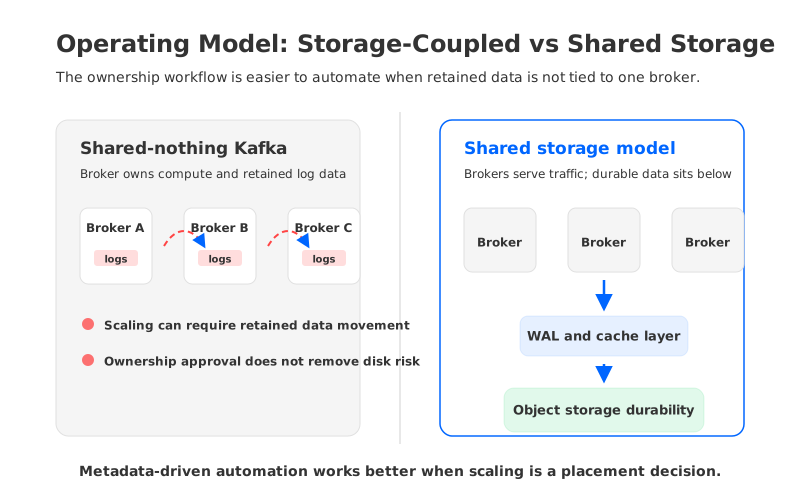
The trade-off is not "metadata tool versus streaming platform." Mature teams need both. The ownership layer describes accountability and policy. The data plane determines how much physical work each policy-approved change triggers.
| Decision area | Metadata-only improvement | Architecture-level evaluation |
|---|---|---|
| Topic and client ownership | Map topics, producers, consumer groups, connectors, and service accounts to application teams. | Check whether changes to those resources force broker-local storage movement or long capacity windows. |
| Cost governance | Attribute retention, traffic, and replay demand to teams or cost centers. | Test whether compute, storage, and network costs can scale independently as applications change. |
| Incident response | Route lag, throughput, connector, and ACL alerts to application owners. | Verify recovery behavior when brokers fail, consumers replay, or traffic shifts across zones. |
| Migration safety | Group cutovers by application boundary and dependency graph. | Confirm that migration tools preserve consumer progress, access control, and rollback paths. |
This table also prevents a common overcorrection. Some teams try to put every detail into Kafka topic configs or labels. That can help discovery, but ownership metadata usually belongs in a control plane or platform inventory that can reference Kafka resources, service identities, code repositories, alert routes, and cloud accounts together. Kafka remains the streaming substrate; the ownership layer is the operational map around it.
4Evaluation Checklist for Platform Teams
A useful checklist starts with the questions that connect ownership, Kafka mechanics, and production operations. If the answer is vague, automation will encode that vagueness and make it faster.
Compatibility. Can existing producers, consumers, Kafka Connect jobs, schema tooling, and admin workflows continue to use Kafka-compatible APIs? Ownership metadata should improve operations without forcing every application team to rewrite clients.
Metadata authority. Where does the source of truth live: service catalog, Git repository, Terraform state, control plane database, or a combination? The answer matters less than consistency. The same application should not have one owner in the portal, another in the alert route, and a third in the cost report.
Change classification. Which changes are safe for self-service, which require review, and which should be blocked? A good model distinguishes accountable metadata updates from physical-risk changes such as high retention, partition expansion, replay-heavy consumers, and broad network access.
Cost visibility. Can the platform show how an application consumes storage, broker compute, connector resources, cross-zone traffic, and catch-up read capacity? Cost attribution becomes credible only when it follows the same boundary as application ownership.
Recovery behavior. During a broker failure, zone impairment, or bad deployment, does ownership metadata remain usable? Incident routing should still identify the affected application owners when the cluster is under stress.
Migration and rollback. Can a team migrate producers, consumers, connectors, ACLs, and offsets in phases? Application ownership metadata is especially useful during migration because it groups technical assets by decision maker, not only by Kafka topic.
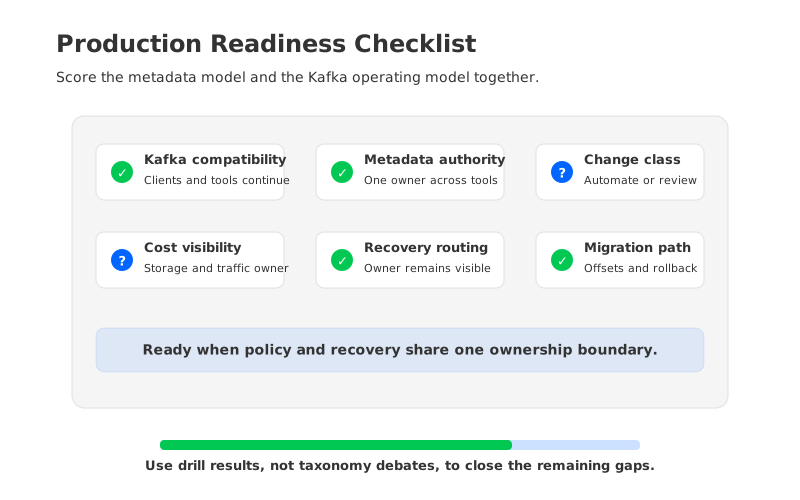
This checklist is intentionally operational. It does not ask whether the metadata model is elegant. It asks whether the platform can act on the metadata when the system is changing, failing, scaling, or being audited.
5How AutoMQ Changes the Operating Model
If the evaluation points to a storage-coupled operating problem, the architecture target becomes clearer. The platform needs Kafka-compatible clients and semantics, but it also needs scaling and recovery paths that are less tied to broker-local disks. That is where AutoMQ fits as a Kafka-compatible, shared-storage streaming platform: it keeps the Kafka protocol surface while moving the durable storage model toward object storage and stateless broker operation.
AutoMQ's shared-storage architecture separates compute from storage. Brokers continue to serve Kafka-compatible traffic, while durable stream data is backed by object storage through the S3Stream layer and protected by a WAL design. In operational terms, the broker is no longer the long-term home of retained log data. That changes the platform team's risk model for ownership-driven automation because adding or replacing broker capacity is less entangled with moving historical data between machines.
For application ownership metadata, the effect is practical rather than cosmetic. A platform workflow can still record owners, service accounts, topics, consumer groups, connectors, and alert routes. The difference is that scaling or balancing the data plane is less likely to become a retained-data logistics project. Partition reassignment and node changes can be treated more like ownership and traffic placement changes than full log-copy operations.
The cost boundary also becomes easier to explain to application teams. In broker-local architectures, compute, storage, and replication traffic often blur together. In a shared-storage design, platform teams can reason more directly about broker compute, object storage, WAL configuration, cache behavior, and network placement. AutoMQ documentation also describes inter-zone traffic reduction patterns, which matter when cost attribution is part of the ownership model.
There is still real platform work to do. Application ownership metadata has to be modeled, reviewed, synchronized, and exposed in the tools teams already use. AutoMQ does not remove the need for service catalogs, IAM design, schema policy, alert hygiene, or migration rehearsals. It changes the data-plane constraints under those workflows, which is the part a metadata catalog cannot change by itself.
For teams building a developer platform around Kafka-compatible streaming, the evaluation sequence should be: define the ownership boundary, classify operational risk, test the data-plane behavior, then automate. Putting AutoMQ into that evaluation after the neutral framework keeps the decision grounded. Start from your highest-risk application map and review AutoMQ Cloud against the workflows that create the most operational risk.
6References
- Apache Kafka Documentation
- AutoMQ Architecture Overview
- AutoMQ Native Compatibility with Apache Kafka
- AutoMQ WAL Storage
- AutoMQ Stateless Broker
- AWS PrivateLink Documentation
7FAQ
7.1What is application ownership metadata in Kafka?
Application ownership metadata is the operational mapping between Kafka resources and accountable application teams. It usually connects topics, producers, consumer groups, connectors, schemas, ACLs, service accounts, alert routes, cost centers, and environments to the team that owns the software and can approve changes.
7.2How is application ownership metadata different from topic ownership metadata?
Topic ownership metadata focuses on who owns a Kafka topic and its policy. Application ownership metadata includes the wider workload boundary: producers, consumers, connector jobs, identities, deployment environments, cost attribution, incident routing, and migration dependencies.
7.3Should ownership metadata live inside Kafka?
Some metadata can be reflected in Kafka naming conventions, configs, labels, or external admin workflows, but the source of truth usually belongs in a platform control plane, GitOps workflow, Terraform module, or service catalog. Kafka does not naturally model every application, repository, on-call route, cost center, and cloud account relationship.
7.4Why does streaming architecture matter for ownership metadata?
Ownership metadata becomes operationally important when it drives self-service change. If every approved change can trigger broker-local storage pressure, partition movement, or long capacity planning, metadata alone will not remove platform toil. Architecture determines the physical cost of acting on a metadata-approved request.
7.5Where does AutoMQ fit in this evaluation?
AutoMQ is relevant when a team wants Kafka-compatible APIs but needs a more elastic data-plane operating model. Its shared-storage architecture and stateless broker design can reduce the amount of retained-data movement tied to scaling, recovery, and balancing decisions.


