
Table of Contents
Table of Contents
Searches for cloud account permission design kafka rarely come from curiosity. They usually come from a production review that has stopped being abstract. A security team wants to know which cloud account owns the object storage bucket. A platform team wants to know whether an operator needs broad IAM permissions to resize a cluster. A procurement team wants to know whether a managed streaming platform changes the organization's data boundary. The Kafka decision is no longer only about partitions, throughput, and retention; it is about who can act on infrastructure, who can see operational signals, and where persistent records live.
That pressure is reasonable. Apache Kafka is a durable commit log, so every design choice touches storage, networking, identity, and recovery. Kafka clients also carry assumptions that platform teams cannot casually break: consumer groups rely on committed offsets, transactional producers rely on broker-side coordination, and integration stacks such as Kafka Connect expect compatible protocol behavior. A permission model that looks clean on a slide can fail in production if it ignores those runtime contracts.
The practical question is not "Which permissions does Kafka need?" The better question is: what operating boundary should the permissions enforce? Once the boundary is clear, IAM policies, network paths, audit logs, and deployment automation become implementation details instead of a long list of exceptions.
1Why Teams Search for cloud account permission design kafka
Cloud account permission design starts to matter when Kafka becomes shared infrastructure. A single application team can often run a cluster with a narrow set of assumptions. A platform organization has to serve many teams, many data domains, and several review groups at once. The same Kafka instance may handle customer events, product telemetry, fraud signals, analytics feeds, and AI feature pipelines, each with a different tolerance for access, residency, and operational change.
The usual review meeting mixes several concerns that sound similar but are not the same:
- Data ownership: which account, VPC, region, and storage system holds durable Kafka records?
- Operations authority: which automation can create brokers, attach storage, read metrics, rotate credentials, and perform recovery?
- Network exposure: which clients connect over private networking, public endpoints, VPC peering, or PrivateLink-style access?
- Auditability: can the team prove what changed, who approved it, and whether the change touched customer data?
- Migration control: can producers, consumers, offsets, and rollback paths be managed without widening access during the move?
Those questions are often handled late because Kafka is treated as an application runtime. In production, Kafka is closer to a cloud storage and networking system with a streaming API. Permission design should therefore be reviewed with the same care as database account design, object storage access, and cross-account automation.
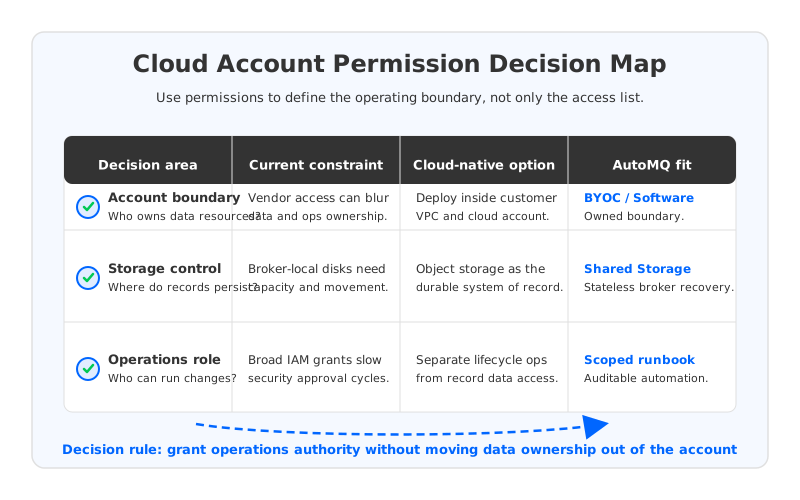
The decision map above is deliberately not a vendor scorecard. It separates the review into account boundary, storage control, and operations role because those are the places where teams usually talk past each other. Security is asking about data and identity. Platform engineering is asking about automation and recovery. Finance is asking about capacity and network cost. Architecture has to make those views compatible.
2The Production Constraint Behind the Problem
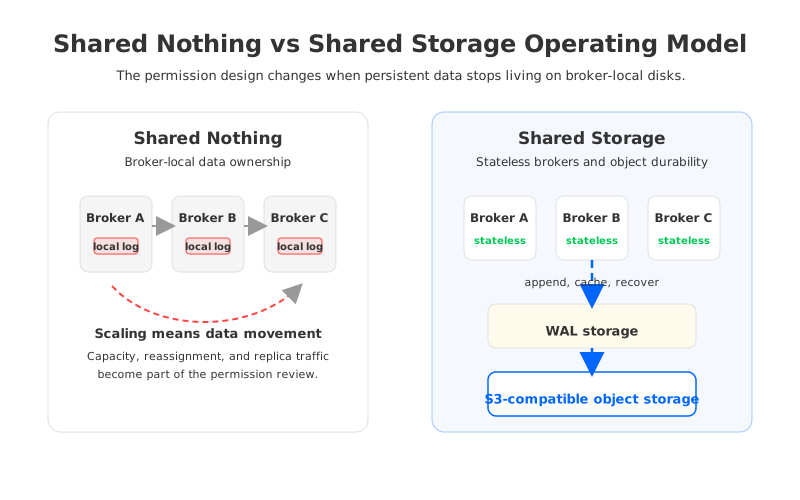
Traditional Kafka uses a Shared Nothing architecture. Each broker owns local storage for the partitions assigned to it, and durability is achieved through replicated partition logs across brokers. This design is deeply proven and still valid in many environments. It also means broker identity, local disk, replica placement, inter-broker networking, and partition reassignment are tightly connected.
That connection is where permission design gets complicated. When storage is broker-local, scaling a cluster is not only a compute action. It may require adding disks, moving partition data, rebalancing replicas, and sending more inter-broker traffic. A failure recovery action is not only "replace a node"; it can become "restore the node's storage role, rebuild replicas, and verify the cluster has enough capacity while the work runs." Permissions that looked like lifecycle automation now have a path to persistent data movement.
Kafka's own feature set reinforces the need for caution. Consumer groups coordinate partition ownership and commit offsets. Transactions and idempotent producers depend on broker-maintained state. KRaft metadata removes ZooKeeper from Kafka cluster management, but it does not remove the need to reason about metadata authority. Tiered Storage can move older log segments to remote storage, yet the broker still has an operating role in local log management and remote log metadata. These are useful capabilities, not problems. The permission issue appears when teams assume that one cloud role can safely cover every layer.
The result is a common anti-pattern: a broad platform role is granted because the team needs reliable operations, and later everyone tries to prove that the role will not be misused. A better design starts by splitting the operating model into three paths:
- The data path, where Kafka clients produce and consume records.
- The control path, where authorized systems create, scale, upgrade, and observe infrastructure.
- The support path, where limited operational access is granted for incident response under audit.
When those paths are not separated, security reviews become slower because every permission feels like it could be a data permission. When they are separated, the review becomes a concrete discussion about scope, evidence, and failure modes.
3Architecture Options and Trade-offs
The first architecture option is self-managed Kafka in a customer cloud account. It gives the platform team direct control over IAM, networking, storage, and observability. It also places all operational burden on that team: capacity planning, broker replacement, version upgrades, partition balancing, disk management, and incident response. This option can fit organizations with strong Kafka operations skills, but the permission model usually grows with every operational edge case.
The second option is a managed service that runs outside the customer's account boundary. It can reduce operational work, but the review has to ask harder questions about data location, control authority, network connectivity, and compliance evidence. Some organizations accept that boundary. Others cannot, especially when the streaming platform handles regulated data or must stay inside a specific VPC and cloud account.
The third option is BYOC-style deployment, where the streaming platform runs in the customer's own cloud account while the provider's software or control components help operate it. This model can align better with procurement and security expectations because cloud resources remain under customer ownership. It is not automatically safe, though. The critical design work is defining which permissions are needed for lifecycle automation, which telemetry leaves the environment, and which access paths are blocked from record data.
The fourth option is a Shared Storage architecture for Kafka-compatible streaming. Instead of binding durable data to broker-local disks, the system stores persistent data in S3-compatible object storage and treats brokers primarily as compute, protocol, caching, and coordination nodes. That changes the permission discussion because storage ownership can be tied to the customer's object storage boundary, while broker lifecycle actions become less coupled to data migration.
| Design question | Shared Nothing Kafka | Shared Storage Kafka-compatible platform |
|---|---|---|
| Persistent data location | Broker-local disks plus replicas | Customer-owned object storage plus WAL storage |
| Scaling impact | Often includes partition movement | Mostly compute and metadata ownership changes |
| Permission review focus | Broker, disk, replica, and network actions | Storage boundary, lifecycle automation, and audit scope |
| Recovery model | Rebuild or catch up replicas | Replace brokers and recover from shared storage plus WAL |
| Cost model to inspect | Compute, disks, replication, and cross-AZ traffic | Compute, object storage, WAL storage, and private networking |
This table should not be read as "one architecture wins every case." It should be read as a review prompt. If a workload is latency-sensitive, the WAL type matters. If a cloud provider charges for particular private networking paths, that cost must be modeled. If compliance requires a specific region or account, the deployment boundary must be provable. The matrix narrows the discussion from vague preference to concrete architecture evidence.
4Evaluation Checklist for Platform Teams
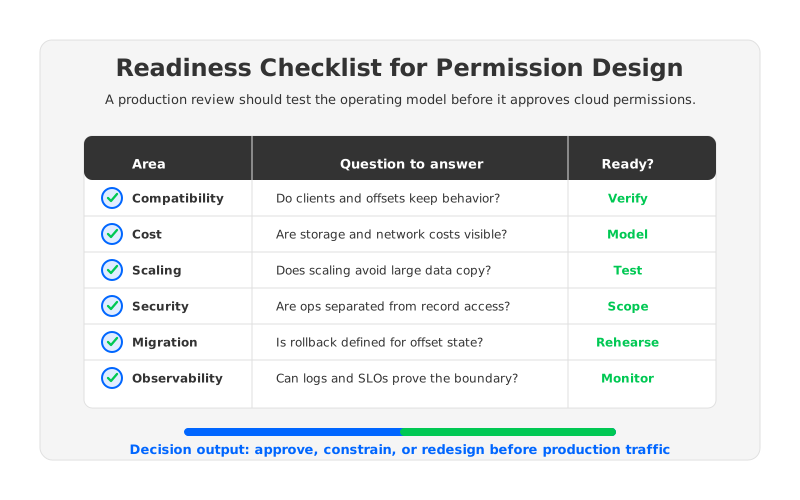
A production checklist should test the permission model against runtime behavior, not only against policy syntax. IAM documents can prove what a role is allowed to do, but they do not prove whether the architecture can operate with that role during a broker failure, traffic spike, migration, or audit request.
Start with compatibility. Existing producers and consumers should not need application rewrites because the platform team changed the deployment boundary. Verify bootstrap behavior, security protocols, ACL expectations, consumer group offsets, transactional workloads, schema and connector integrations, and client version compatibility. Apache Kafka's documentation is the baseline reference here because it defines the behavior that existing applications expect.
Then model cost as an architectural side effect, not an afterthought. Cross-Availability Zone replication, PrivateLink-style endpoints, object storage requests, retained data, and WAL storage can all affect the bill. Use cloud provider pricing pages for the actual region and date of approval. Avoid unqualified percentage claims in the design review; they will not survive procurement or finance scrutiny.
Security should be written as boundaries and verbs. A useful permission statement is not "the operator needs access." It is "the operator can create and update lifecycle resources, read operational metrics, write release metadata, and cannot read Kafka record payloads." This level of specificity gives security reviewers a concrete object to approve or reject.
Migration deserves its own section. Kafka migrations fail less often because teams cannot copy data and more often because producers, consumers, offsets, certificates, ACLs, and rollback paths are not rehearsed together. A permission design that requires emergency broad access during cutover is not production-ready. The migration plan should show how it handles dual running, offset continuity, client switching, and rollback without changing the data boundary.
5How AutoMQ Changes the Operating Model
After the neutral evaluation, the architectural pattern becomes clearer: the strongest permission model is usually the one that keeps record data in the customer's environment while minimizing the operational need to manipulate broker-local persistent storage. AutoMQ fits that pattern as a Kafka-compatible, cloud-native streaming platform built around Shared Storage architecture.
AutoMQ keeps the Kafka protocol and API surface familiar to existing Kafka applications, while changing the storage layer underneath. AutoMQ Brokers are stateless brokers: they handle Kafka protocol work, leadership, caching, and request processing, but durable data is stored through S3Stream in shared object storage with WAL storage as the write durability and recovery buffer. In practical terms, a broker replacement or scale-out action no longer has to mean copying large amounts of partition data from one broker's local disk to another broker's local disk.
That shift matters for cloud account permission design. In AutoMQ BYOC, the control plane and data plane run inside the customer's cloud account and VPC. In AutoMQ Software, the same boundary principle applies in a customer-managed environment such as a private data center. The customer can review the cloud resources, networking, IAM roles, operational buckets, observability paths, and data plane access because the system is not asking them to move the streaming workload outside their environment.
The permission model still needs careful design. AutoMQ does not remove the need for IAM, network policy, certificate management, observability, or approval workflows. It changes what those controls are protecting. Instead of granting broad authority because brokers own durable local disks, the design can focus on a narrower separation: customer-owned object storage for record durability, scoped lifecycle permissions for operations, private connectivity for clients, and auditable support access for incidents.
This is also why BYOC and Software deployment boundaries can help procurement and security teams. They make it easier to answer concrete review questions: where does data live, who owns the account, what can the operator access, what telemetry is collected, how are upgrades delivered, and how can access be revoked? A Kafka-compatible API keeps application migration risk lower, while Shared Storage architecture changes the infrastructure risk profile that the permission model has to cover.
For teams evaluating AutoMQ, the next step is not to accept a generic claim about lower operating burden. The right next step is to map the checklist to your own cloud account. Identify the exact account, VPC, object storage bucket, WAL storage option, private networking path, observability path, and operations role. Then test whether the design still works during scale-out, broker failure, migration, and rollback.
If your review started with cloud account permission design kafka, keep the decision anchored there. The durable architecture question is not only how Kafka runs; it is who can prove control over the system when production traffic, audits, and incidents arrive at the same time. To evaluate AutoMQ BYOC or AutoMQ Software against your own permission boundary, start with the AutoMQ team through the AutoMQ deployment consultation.
6FAQ
6.1What does cloud account permission design mean for Kafka?
It means defining which cloud identities can create, update, observe, and recover Kafka infrastructure, and which identities can access durable record data. A production design should separate the data path from lifecycle operations and support access.
6.2Is BYOC automatically safer than an external managed service?
No. BYOC gives the customer stronger ownership of the cloud account boundary, but the implementation still needs scoped IAM roles, private networking, audit logs, certificate management, and a clear support model.
6.3Why does Shared Storage architecture affect permissions?
When durable data lives in shared object storage instead of broker-local disks, broker lifecycle operations become less coupled to persistent data movement. That can make it easier to scope operational permissions around automation, observability, and recovery.
6.4What should security teams ask before approving a Kafka platform?
Ask where records persist, which account owns storage, what operational telemetry is exported, whether support access can be limited and audited, how credentials rotate, and how migration rollback works without broad emergency access.
6.5Can existing Kafka clients keep working with AutoMQ?
AutoMQ is designed as a Kafka-compatible streaming platform. Teams should still validate their specific client versions, security protocols, transactions, consumer group behavior, Connect jobs, and operational tooling before production cutover.


