
Table of Contents
Table of Contents
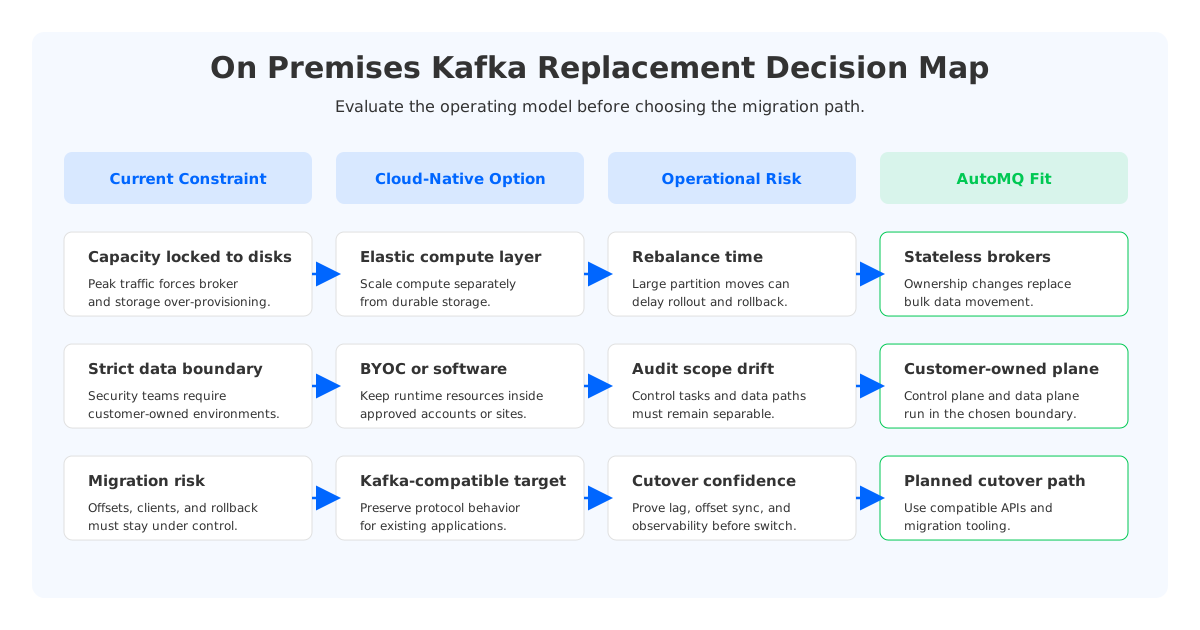
Teams search for on premises kafka replacement when the Kafka cluster has stopped being a neutral piece of infrastructure. Broker disks fill faster than capacity plans, rebalancing windows collide with release calendars, security reviews reject data paths outside the approved boundary, and platform teams spend more time moving partitions than improving the data platform. The question is whether the operating model around the existing cluster still matches the business boundary, cloud strategy, and reliability target.
That makes replacement a risky word. For a production streaming platform, "replace Kafka" rarely means rewriting every producer and consumer. It usually means preserving the Kafka protocol, client behavior, topic model, offsets, and ecosystem integrations while changing the infrastructure underneath. A useful decision process starts with architecture: where does durable data live, who owns the runtime boundary, how does scaling work, what changes during failure recovery, and how much migration risk can the team absorb?
1Why teams search for on premises kafka replacement
The search often starts in a budget review, but the root cause is usually operational. A data center Kafka estate was built around predictable hardware, local disks, static network boundaries, and long-lived brokers. That design can run reliably when traffic patterns are stable and capacity is purchased in large increments. The pressure shows up when streaming becomes a shared platform for analytics, payment events, observability, AI feature pipelines, and change data capture at the same time.
The first instinct is to add brokers or attach larger disks. That buys time, but it deepens the coupling between compute and storage. More local state means longer partition movement when the cluster needs to scale, evacuate a node, rebalance load, or recover from a failed volume. Kafka's consumer group, offset, transaction, and replication semantics are documented in the Apache Kafka documentation, but those semantics do not remove the physical cost of keeping many broker-local logs healthy.
Security and procurement add a second layer of pressure. Some organizations can consume a managed service where the provider owns most of the infrastructure boundary. Others need the data plane to run inside a customer-owned cloud account, a specific VPC (Virtual Private Cloud), or a private data center. For those teams, the replacement target has to satisfy two requirements at once: it must reduce the operational load of self-managed Kafka, and it must keep ownership, network routing, IAM, encryption, audit logs, and procurement controls inside an approved boundary.
2The production constraint behind the problem
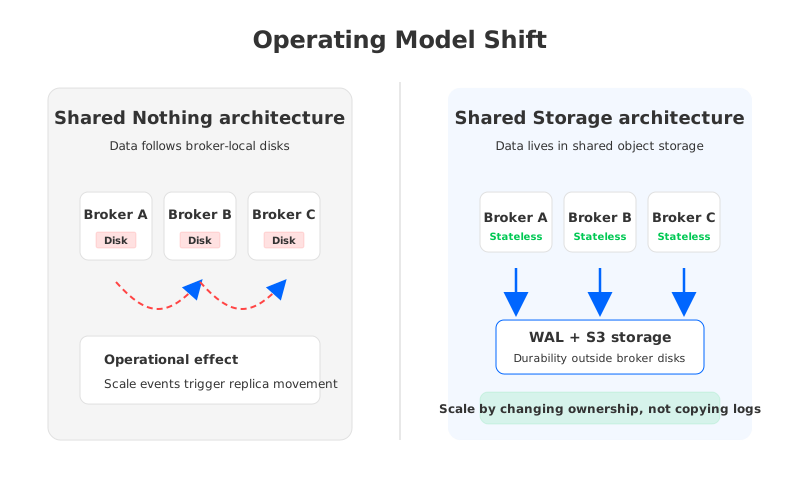
Traditional Kafka follows a Shared Nothing architecture. Each broker owns local storage, each partition replica lives on one broker, and durability comes from replication across brokers through ISR (In-Sync Replicas). This model was designed for a world where machines owned their disks and expanding a cluster was a planned operation rather than a frequent elasticity event.
The same model becomes awkward when the platform is expected to behave like elastic cloud infrastructure. Scaling out is not only adding compute; it is deciding which partitions should move, copying data, watching the rebalance, and protecting application latency. Scaling in has the same problem in reverse. Failure recovery is also restoring the broker's role in the replica set and catching up the state it used to hold.
Tiered Storage changes part of this picture by moving older Kafka log segments to remote storage while keeping recent data on broker disks. It can be the right answer when the main pain is long retention. It is not the same as making brokers stateless. The hot path still depends on local broker storage, and operational workflows can still involve broker-bound data movement. That distinction matters because many replacement projects fail when the team treats retention optimization and architecture replacement as the same decision.
3Architecture options and trade-offs
The replacement target should be evaluated as an operating model. A platform team can choose a managed service outside the customer boundary, a customer-owned cloud deployment, a software deployment in a private environment, or a rebuilt self-managed Kafka estate with better automation. Each one changes a different boundary: operational responsibility, data ownership, cloud integration, migration complexity, and long-term cost structure.
Use a small number of architectural questions to keep the evaluation grounded:
- Compatibility: Does the target preserve Kafka clients, topic behavior, Consumer group mechanics, offsets, transactions, Kafka Connect, Schema Registry integrations, and operational tools? Compatibility should be proven with representative applications, not assumed from a marketing phrase.
- Storage model: Does durable data remain broker-local, move partly to remote tiers, or move into Shared Storage architecture? This determines how scaling, recovery, and rebalancing behave under load.
- Deployment boundary: Does the data plane run in a provider account, a customer cloud account, or a private data center? This affects security review, procurement, network design, and incident ownership.
- Cost model: Does the cost grow with provisioned disks, retained data, cross-AZ replication, broker count, network paths, or operations headcount? A good estimate separates compute, storage, network, support, and migration cost instead of hiding them in one line item.
- Migration safety: Can the team synchronize topics, validate offsets, test consumer lag, run parallel reads, and roll back without guessing? Migration is a runtime workflow, not a spreadsheet decision.
This framing also prevents a common procurement mistake. A service can look attractive because it removes broker maintenance, yet still be a poor fit if data residency, private connectivity, or audit requirements are fixed constraints. A self-managed platform can look safer because the team owns everything, yet still be expensive if it requires large reserved capacity and long rebalance windows.
| Decision area | Good sign | Risk signal |
|---|---|---|
| Kafka behavior | Existing clients and tools work with limited configuration changes. | Application teams must rewrite producers, consumers, or offset handling. |
| Scaling | Compute can change without large broker-local data movement. | Every capacity event becomes a partition migration project. |
| Governance | Control plane tasks and data plane traffic are clearly separated. | Security review cannot explain where messages, metadata, logs, and metrics go. |
| Migration | Cutover has validation gates and a rollback owner. | Migration depends on a single maintenance window and manual offset checks. |
| Cost | Storage, compute, network, and operations are modeled separately. | The estimate ignores cross-zone traffic, retained data growth, or staff time. |
4Evaluation checklist for platform teams
A useful checklist is short enough to use in a meeting and specific enough to block a weak design. Start by mapping the existing cluster: topics, partitions, replication factor, retention policies, ACLs, client versions, Connect workloads, consumer lag tolerance, peak throughput windows, and operational runbooks. Then identify which constraints are hard requirements and which ones are habits from the current deployment.
For example, a private network boundary may be a hard requirement. Keeping broker-local disks or running every upgrade manually may only be habit. The checklist should separate these categories because replacement projects create value by changing habits while respecting real constraints.
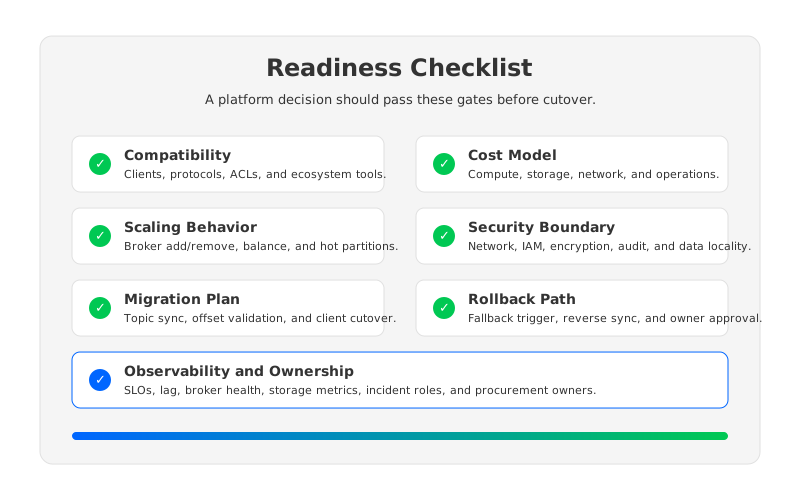
The readiness review should answer seven questions before architecture selection moves into procurement:
- Can compatibility be tested with real clients? Use the applications that matter most, including transactional producers, long-running consumers, Connect tasks, and monitoring tools.
- Can the cost model survive traffic growth? Model retained data, write throughput, read fan-out, network paths, object storage, compute, licenses, and operational labor separately.
- Can scaling happen without a risky data movement window? If every scale event still means moving many partition replicas, the replacement has not changed the operating model enough.
- Can security explain the boundary? The answer should show where Kafka records live, where control actions originate, what telemetry is exported, and who can access each path.
- Can migration be rehearsed? Topic synchronization, offset validation, consumer lag checks, and client cutover should be tested before the production switch.
- Can rollback be triggered by objective signals? Define the failure conditions, fallback route, and decision owner before the migration starts.
- Can the team operate the target after day one? Dashboards, alerts, on-call ownership, upgrade paths, and support workflow matter as much as the cutover itself.
This checklist should produce a scorecard, not a yes-or-no vote. Some teams will accept higher migration complexity to preserve strict private deployment. Others will accept a larger provider boundary to reduce day-two operations. The trade-off must be explicit and tied to production constraints.
5How AutoMQ changes the operating model
If the core constraint is broker-local durable state, the architectural answer has to remove durable state from the broker without breaking Kafka behavior. AutoMQ takes that path: it is a Kafka-compatible streaming platform that uses Shared Storage architecture to separate compute from storage. AutoMQ Brokers handle Kafka protocol work, partition leadership, caching, and scheduling, while durable data is stored through S3Stream in WAL (Write-Ahead Log) storage and S3-compatible object storage. The AutoMQ architecture overview describes this separation in its Shared Storage architecture documentation.
The operational shift is the important part. When durable data is not tied to a broker's local disk, a broker can be added, replaced, or removed with less dependence on bulk log copying. Partition ownership and traffic placement become scheduling problems rather than storage migration projects. The team can reason about compute capacity separately from retained data and evaluate scaling by recovery behavior rather than rebalance duration.
For on-premises Kafka replacement, the deployment boundary matters as much as the storage layer. AutoMQ BYOC is designed for customer-owned cloud environments where the control plane and data plane run in the customer's cloud account and VPC. AutoMQ Software is designed for private data centers where the customer operates the platform. In both cases, the architecture is easier to explain when the data path, control actions, cloud permissions, and telemetry paths are separated during review.
Compatibility is another reason to evaluate architecture before product features. AutoMQ's Kafka-compatible design is meant to preserve producer and consumer behavior, Kafka APIs, and common ecosystem integrations; its compatibility page documents the scope of Apache Kafka compatibility. That does not remove testing. It changes what you test: client configuration, workload behavior, operational runbooks, observability, and migration gates.
Migration also needs a controlled path. AutoMQ documentation describes migration execution around data synchronization, business cutover, and validation in the migration guide. The practical value is that topic data, offsets, lag, application readiness, and rollback decisions can become gates that platform, application, and security owners review together.
6A decision matrix you can use
The matrix below is designed for an architecture review, not a product comparison slide. Fill it out for the current Kafka estate, the preferred replacement target, and at least one fallback option. The gaps will show where the proof of concept needs evidence.
| Criterion | Ask this in review | Evidence to collect |
|---|---|---|
| Protocol and ecosystem fit | What breaks if clients keep their existing Kafka behavior? | Client tests, transaction tests, Connect validation, ACL checks. |
| Storage architecture | Is durable data tied to broker-local disks? | Architecture diagram, failure recovery test, scale-out and scale-in runbook. |
| Data ownership | Where do records, metadata, logs, metrics, and backups live? | Security boundary diagram, IAM policy review, network path review. |
| Elasticity | How does the platform react to traffic spikes and quiet periods? | Capacity test, rebalance timing, hot-partition behavior, automation plan. |
| Failure recovery | What happens when a broker, zone, storage path, or network link fails? | Fault test, recovery timeline, alert behavior, operator actions. |
| Migration and rollback | Can the team rehearse cutover and reverse the decision? | Migration dry run, offset comparison, lag threshold, rollback checklist. |
| Commercial fit | Does the buying model match the ownership model? | Procurement path, marketplace or contract review, support scope. |
The strongest replacement candidate is not the one with the longest feature list. It is the one whose failure modes are easy to explain, whose migration can be rehearsed, whose cost drivers are visible, and whose operating model matches the boundary your organization must keep.
7FAQ
7.1Is on-premises Kafka replacement the same as moving to a managed Kafka service?
No. A managed service is one possible target, but replacement is broader than service packaging. Many teams need a Kafka-compatible platform that runs in a customer-owned cloud account or private data center. The architectural question is where the data plane runs, where durable data lives, and how much responsibility the team retains.
7.2Does Tiered Storage solve the same problem as Shared Storage architecture?
Not exactly. Tiered Storage helps move older log segments to remote storage, which can improve retention economics. Shared Storage architecture changes the broker operating model by moving durable storage outside broker-local disks. If the main pain is long retention, Tiered Storage may help. If the main pain is scaling, recovery, and broker-bound data movement, evaluate whether the brokers are actually stateless.
7.3What should be tested before replacing a production Kafka cluster?
Test real client behavior, not a synthetic happy path. Include transactional producers, consumer groups, offset reset workflows, Connect tasks, ACLs, monitoring tools, lag behavior, failover, scale events, and rollback. The proof of concept should end with a runbook that application and platform owners can sign off.
7.4When should AutoMQ BYOC and AutoMQ Software enter the shortlist?
They should enter the shortlist when the team needs Kafka compatibility, customer-owned deployment boundaries, and a storage model that separates compute from durable data. AutoMQ BYOC fits customer-owned cloud environments, while AutoMQ Software fits private data centers. The final choice still needs validation against compatibility, security, migration, and day-two operations.
The search usually begins with a cluster that has become too hard to change. The durable decision is to choose an operating model that your team can scale, audit, recover, and migrate without turning every infrastructure event into a data movement project. To evaluate AutoMQ for a customer-owned Kafka-compatible deployment, start from AutoMQ Cloud.


