
Table of Contents
Table of Contents
Teams search for private streaming platform slo kafka when the platform conversation has moved beyond throughput. A security reviewer wants the data plane to stay in a customer-controlled boundary. A platform lead wants Kafka-compatible behavior with less recovery work. A CTO wants SLOs that can survive traffic spikes, broker failures, audits, and migration pressure.
That search is specific because the problem is specific. Public managed services can reduce operational work, but they may not fit data residency, private networking, or account ownership rules. Self-managed Apache Kafka can preserve control, but it often leaves the team with broker-local storage, replica placement, capacity reservations, and long operational windows. The hard question is not whether Kafka is useful. It is whether the architecture behind the Kafka-compatible platform can meet private deployment SLOs without hiding risk in storage, network, or operating procedures.
1Why teams search for private streaming platform slo kafka
A private streaming platform usually carries two promises at the same time: it must behave like shared production infrastructure, and it must keep the deployment boundary under customer control. Those promises collide when the platform becomes a dependency for fraud detection, product telemetry, payment events, AI feature pipelines, operational logs, and change data capture. The more teams depend on the same streaming backbone, the less acceptable it becomes to rely on heroic operations during failures.
The keyword also reveals who is in the room. Platform engineering cares about scaling, upgrades, partition placement, and observability. Security and compliance teams care about which account owns storage, what telemetry leaves the environment, and how support access is audited. Procurement cares about whether the buying model matches the ownership model. Application teams care about Kafka clients, Consumer group behavior, offsets, transactions, connectors, and rollback.
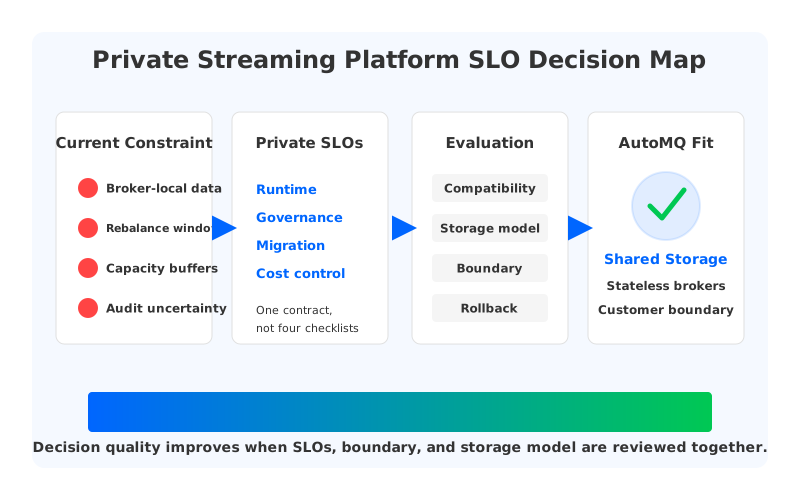
Those groups often use the same word, SLO, to mean different things. For a private streaming platform, an SLO is an operating contract that connects architecture to ownership:
- Runtime SLOs define produce latency, fetch latency, availability, throughput, lag recovery, and failure behavior.
- Governance SLOs define where records live, who can operate the system, how changes are approved, and which logs or metrics are exported.
- Migration SLOs define how topic data, offsets, clients, and rollback gates move without widening the data boundary.
- Cost SLOs define which cost drivers are acceptable: compute, storage, private networking, retained data, replication, support, and staff time.
2The production constraint behind the problem
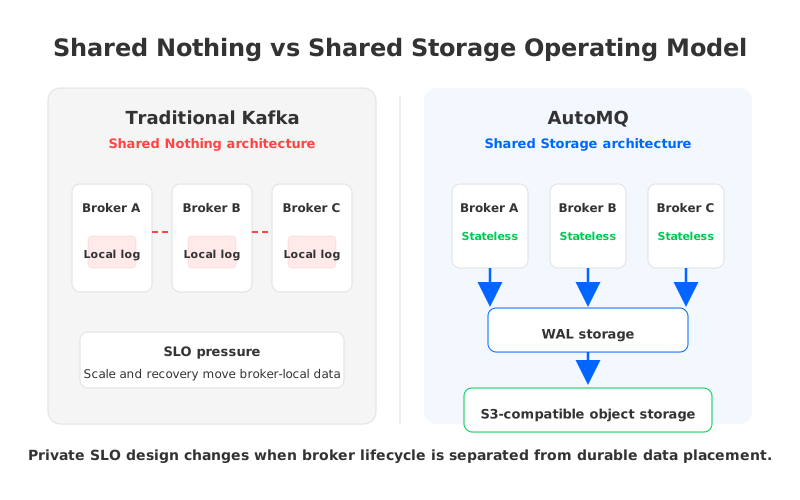
Traditional Kafka uses a Shared Nothing architecture. Each broker owns local storage for the partitions assigned to it, and durability is achieved through replicated logs across brokers using ISR (In-Sync Replicas). This model is proven, and the Apache Kafka documentation remains the right baseline for core behavior such as Consumer groups, offsets, transactions, KRaft metadata, Kafka Connect, and client configuration.
The operating constraint appears when the platform must scale or recover under a private boundary. Scaling out is not only adding broker compute; it can also mean moving partition replicas and rebalancing broker-local data. Scaling in has the same issue in reverse. A failed broker is not only a failed process; it is a failed owner of local partition state that other brokers must compensate for. The more retained data and partitions the platform carries, the more storage placement becomes part of every availability conversation.
Tiered Storage changes retention economics by moving older log segments to remote storage while keeping the hot path tied to broker-local storage. It is useful when the main problem is long retention. It is not the same as making brokers stateless. If the SLO problem is scale recovery, failure isolation, or data movement during operational change, teams should ask whether the target architecture still depends on broker-local durable state.
That distinction matters for private platforms because security boundaries do not remove operational physics. A VPC (Virtual Private Cloud), private subnet, customer-owned bucket, and strict IAM policy can define control, but they do not make partition movement faster. A good private architecture has to satisfy both sides: the control boundary must be explainable, and the runtime model must reduce the amount of state that has to move when the system changes.
3Architecture options and trade-offs
The first option is self-managed Kafka in a customer-owned environment. It gives the platform team maximum infrastructure control, direct access to logs and metrics, and familiar tools. It also keeps the team responsible for broker sizing, disk growth, upgrades, partition balancing, failure recovery, and capacity buffers.
The second option is a managed service where more operations move to a provider-controlled boundary. This can reduce day-two maintenance, but it changes the security and procurement review. Teams need to verify data location, private connectivity, support access, audit evidence, contract terms, and regional availability.
The third option is a customer-owned cloud deployment, often described as BYOC (Bring Your Own Cloud). In this model, the platform runs inside the customer's account or VPC, while software and operational automation reduce the burden on the internal team. BYOC is attractive when security wants account ownership and platform engineering wants managed lifecycle workflows. The risk is assuming that BYOC alone changes the storage model. It does not; the architecture underneath still determines whether scaling and recovery involve large broker-local data movement.
The fourth option is a Kafka-compatible platform built around Shared Storage architecture. Durable data lives in shared object storage, while brokers primarily handle protocol processing, leadership, caching, scheduling, and request routing. This does not remove the need for careful WAL (Write-Ahead Log) storage design, private networking, observability, or migration testing. It does change the operating model: broker lifecycle events can be reasoned about as compute and metadata changes rather than as bulk local-log relocation projects.
| Architecture option | Where it fits | SLO risk to examine |
|---|---|---|
| Self-managed Kafka | Maximum infrastructure control and deep existing expertise. | Broker-local storage, capacity buffers, rebalance windows, and staffing load. |
| Provider-managed service | Lower direct operations burden and standard service packaging. | Data boundary, private connectivity, regional control, and support access. |
| Customer-owned cloud deployment | Customer account ownership with vendor-assisted operations. | Whether the underlying architecture still binds durable data to brokers. |
| Shared Storage Kafka-compatible platform | Private deployment with less broker-local state movement. | WAL choice, object storage design, compatibility testing, and migration gates. |
4Evaluation checklist for platform teams
The useful version of an SLO review starts with evidence, not preferences. Map the current Kafka estate first: topic count, partition count, replication factor, retention, peak write throughput, read fan-out, client versions, authentication methods, ACLs, connector workloads, lag tolerance, incident history, and upgrade cadence. Then decide which items are hard constraints and which ones are artifacts of the existing implementation.
For example, "records must stay in our cloud account" may be a hard constraint. "Brokers must own local disks" is usually an implementation habit. "Consumers cannot change offset semantics" is a hard compatibility requirement. "The platform team manually approves every rebalance" may be a habit that automation should remove. Separating these categories helps the review focus on architecture instead of defending the current operating model.
Use the checklist below before moving from architecture review to vendor selection or procurement:
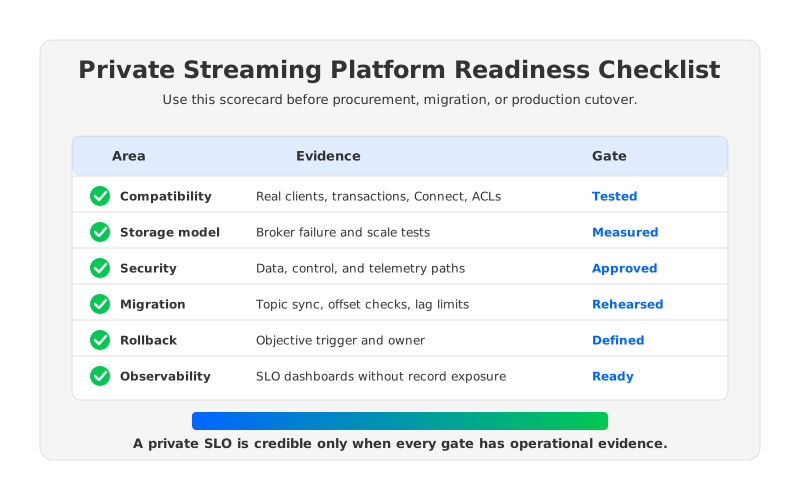
- Compatibility: Validate real producers, long-running consumers, transactional workloads, offset reset workflows, Kafka Connect tasks, Schema Registry integrations, monitoring tools, and security protocols. Kafka compatibility should be proven with the applications that carry production risk.
- Storage and recovery: Identify whether durable data is broker-local, tiered, or shared. Test broker replacement, scale-out, scale-in, and zone-level failure behavior under realistic retained-data conditions.
- Deployment boundary: Draw the data path, control path, and observability path. The diagram should show accounts, VPCs, subnets, object storage buckets, credentials, telemetry, and support access.
- Cost model: Separate compute, storage, WAL storage, object storage requests, private networking, cross-zone traffic, support, and staff time. Avoid unqualified savings claims; use cloud provider pricing for the selected region and date.
- Operational ownership: Define who can scale, upgrade, rotate credentials, change network paths, read operational metrics, and approve emergency access.
- Migration and rollback: Rehearse topic synchronization, offset validation, consumer lag thresholds, client cutover, and rollback. The rollback trigger should be objective, not a meeting held during an outage.
- Observability: Confirm that dashboards, alerts, logs, and traces can explain SLO violations without exposing record payloads or bypassing the private boundary.
5How AutoMQ changes the operating model
After the neutral evaluation, the architectural requirement becomes clearer: if broker-local durable state is what makes scaling and recovery hard, the platform should reduce the broker's responsibility for durable storage while preserving Kafka behavior. AutoMQ fits that category as a Kafka-compatible streaming platform built on Shared Storage architecture.
AutoMQ keeps the Kafka protocol and API surface familiar to existing applications, while changing the storage layer underneath. AutoMQ Brokers handle Kafka protocol processing, partition leadership, caching, and scheduling. Durable data is stored through S3Stream, with WAL storage providing the write durability and recovery buffer before data is organized in S3-compatible object storage. The practical effect is that broker lifecycle operations no longer have to be organized around copying large local partition logs from one broker to another.
This matters for private streaming platform SLOs because it changes the failure and scaling conversation. A broker replacement is primarily a compute and ownership event. Retained data is not sized by broker disks. Partition reassignment can be evaluated by traffic placement and metadata ownership rather than by how long bulk local-log movement will run.
AutoMQ BYOC addresses the customer-owned cloud boundary. The control plane and data plane run in the customer's cloud account and VPC, which helps security teams review infrastructure ownership, private networking, IAM, operational buckets, and telemetry paths. AutoMQ Software addresses private data center deployments, where the customer operates the platform in its own environment. In both cases, the deployment model is easier to review when the data path, control actions, support access, and observability signals are described separately.
Compatibility still needs validation. AutoMQ's documentation describes Apache Kafka compatibility, including client and ecosystem alignment, but production teams should test their own client versions, authentication methods, transactions, Consumer groups, Connect jobs, and operational tools. A private platform decision is strongest when compatibility, security, migration, and day-two operations are tested together instead of as separate workstreams.
6A decision matrix you can use
The matrix below is designed for an architecture review. Fill it out for your current Kafka estate, your preferred target, and at least one fallback option. The empty cells will show where the proof of concept needs evidence.
| Criterion | Review question | Evidence to collect |
|---|---|---|
| SLO contract | Which latency, availability, recovery, governance, and migration SLOs are hard requirements? | SLO document, incident history, audit requirements, and application owner sign-off. |
| Kafka behavior | What breaks if clients keep their existing Kafka assumptions? | Client tests, transaction tests, Consumer group behavior, Connect validation, and ACL checks. |
| Storage architecture | Is durable data tied to broker-local disks? | Architecture diagram, retained-data model, broker failure test, and scale test. |
| Private boundary | Where do records, metadata, logs, metrics, and backups live? | Account and network diagram, IAM policy review, object storage policy, and telemetry review. |
| Elasticity | Can compute change without a risky data movement window? | Scale-out and scale-in runbooks, measured recovery behavior, and hot-partition tests. |
| Migration safety | Can the team rehearse cutover and reverse it? | Topic sync plan, offset comparison, lag thresholds, rollback checklist, and decision owner. |
| Commercial fit | Does the buying model match the operating boundary? | Marketplace path, contract terms, support scope, and procurement approval route. |
The strongest candidate is rarely the one with the longest capability list. It is the one whose failure modes are clear enough to explain, whose migration can be rehearsed, whose cost drivers are visible, and whose deployment boundary matches the control your organization must keep.
7FAQ
7.1What does private streaming platform slo kafka mean in practice?
It means the team wants Kafka-compatible streaming behavior inside a private operating boundary, with explicit SLOs for availability, latency, recovery, governance, migration, and cost. The architecture has to explain both runtime behavior and ownership boundaries.
7.2Is BYOC enough to meet private streaming platform SLOs?
BYOC helps with account ownership and private deployment, but it is not sufficient by itself. Teams still need to evaluate the storage model, WAL design, networking, IAM, observability, compatibility, migration workflow, and support access.
7.3Does Tiered Storage make Kafka brokers stateless?
No. Tiered Storage moves older log segments to remote storage, which can help retention economics. It does not make the hot path fully independent of broker-local storage. If the SLO problem is scaling or recovery, evaluate whether durable state is still bound to brokers.
7.4What should be tested before choosing a private Kafka-compatible platform?
Test real clients, Consumer group behavior, transactions, Connect jobs, authentication, authorization, scale events, broker failure, observability, migration cutover, and rollback. The proof of concept should produce a runbook that platform, application, security, and procurement owners can review.
7.5Where should AutoMQ enter the shortlist?
AutoMQ should enter the shortlist when the team needs Kafka compatibility, customer-controlled deployment boundaries, and an operating model based on Shared Storage architecture. AutoMQ BYOC fits customer-owned cloud environments, while AutoMQ Software fits private data center deployments.
The search starts with SLO pressure, not product curiosity. Keep the decision anchored there: define what the private boundary must protect, what Kafka behavior must remain stable, and what operating model can recover without moving large amounts of broker-local state. To evaluate AutoMQ against your private streaming platform SLOs, start with an AutoMQ deployment consultation.


