
Table of Contents
Table of Contents
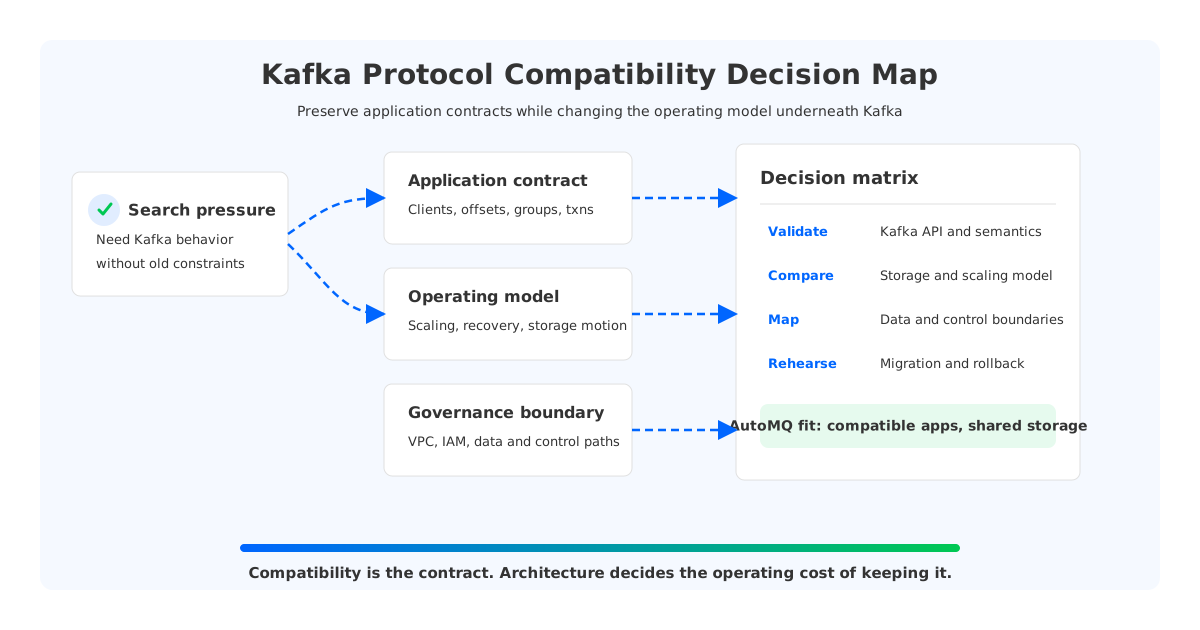
Teams do not search for kafka protocol compatibility because they want a vocabulary lesson. They usually have a running Kafka estate, a queue of applications that depend on Kafka behavior, and pressure to change something underneath it: cost, elasticity, deployment boundary, recovery time, governance, or cloud operating model. The hard question is whether a Kafka-compatible platform can change the infrastructure layer without turning an application migration into a semantic rewrite.
That question gets messy because compatibility has layers. A producer can connect and send records, but that does not prove consumer group behavior, offset handling, transactions, ACLs, tooling, monitoring, and connector workflows will behave the way production teams expect. A platform can preserve the Kafka protocol while changing storage architecture, scaling mechanics, or control plane ownership. The useful evaluation is not "Is this Kafka-compatible?" It is "Which parts of Kafka behavior stay stable, and which operational assumptions change?"
1Why Teams Search for kafka protocol compatibility
The search usually starts with a constraint that cannot be solved by another round of broker tuning. Maybe partition reassignment takes too long when a cluster grows. Maybe storage retention keeps increasing while hot data stays small. Maybe a security review rejects a managed service boundary because business data would leave the customer's cloud account. Or maybe a platform team wants cloud-native elasticity, but application teams cannot rewrite producers, consumers, Kafka Connect jobs, and stream processing code at the same time.
Kafka protocol compatibility is valuable because it narrows the migration surface. Existing applications can keep familiar concepts such as Topics, Partitions, Offsets, Consumer groups, transactions, and idempotent producers. Operators can keep much of the Kafka mental model around bootstrap servers, Topic configuration, lag, and client behavior. Ecosystem components such as Kafka Connect and Kafka Streams also matter because many production estates are not broker clusters alone; they are pipelines, schemas, ACLs, monitoring dashboards, and incident playbooks tied together by Kafka semantics.
The trap is treating compatibility as a single checkbox. Protocol support is necessary, but production readiness depends on the exact workload. A batch producer, a CDC pipeline, a transactional writer, and a lag-sensitive consumer group stress different parts of the Kafka contract. Compatibility has to be tested where the application depends on it, not where a vendor feature table looks reassuring.
2The Production Constraint Behind the Problem
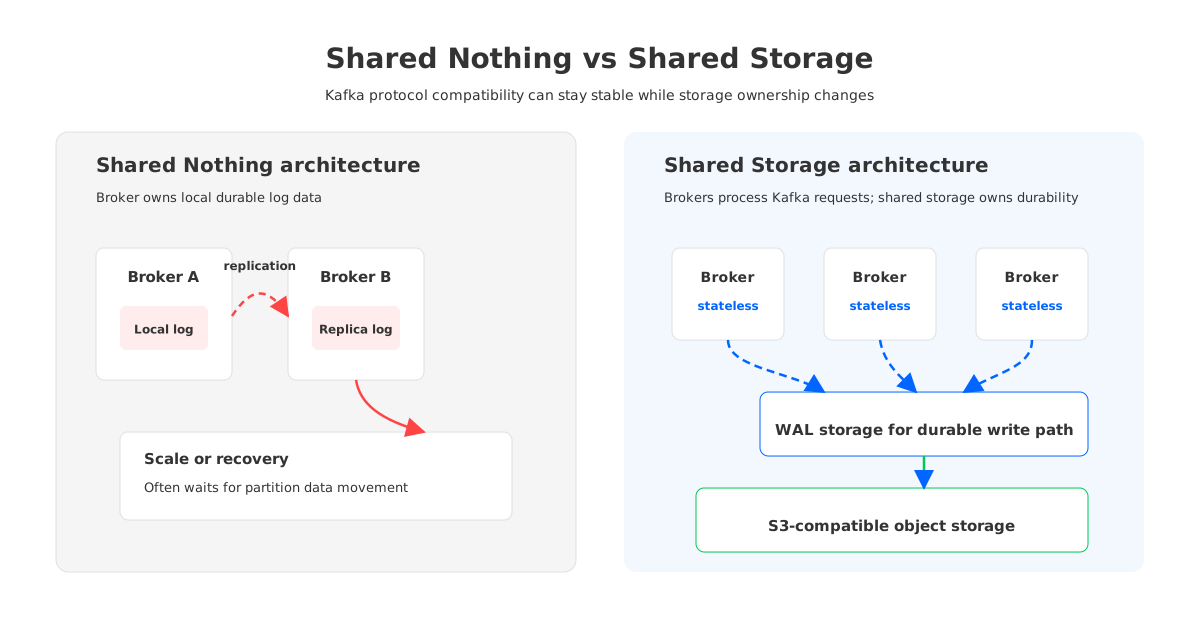
Traditional Kafka runs as a Shared Nothing architecture. Each broker owns local log data for the partitions assigned to it, and durability is achieved through replication across brokers. That design has carried Kafka through a huge range of workloads, and it remains a reasonable choice when local-disk performance, mature operations, and direct broker control are the team's priority.
The trade-off appears when cloud operations push against broker-local storage. Scaling a cluster adds compute, then often waits for partition data to move so brokers own the right amount of local state. Recovery starts a replacement node, then requires leadership changes, replica catch-up, and enough storage and network headroom to return the cluster to a healthy state. Retention may look like a policy setting, but it still ties disk capacity, broker placement, and failure-domain planning together.
These mechanics turn an application-level compatibility question into an architecture question:
- Capacity is coupled. Compute, storage, and network headroom are usually planned together because broker-local disks carry durable data.
- Elasticity waits for data movement. Adding brokers helps only after partition ownership and local data placement catch up.
- Recovery consumes the same resources as production traffic. Replica catch-up and rebalancing compete with client reads and writes.
- Governance spans more than clients. Security teams need to know where the data plane, control plane, object storage, logs, metrics, and administrative credentials live.
The point is not that Shared Nothing architecture is broken. It is that Kafka protocol compatibility does not automatically preserve the old operating model, and preserving the old operating model may be exactly what the team is trying to escape.
3Architecture Options and Trade-Offs
Platform teams have several realistic paths. The right answer depends on how much they need to preserve above the broker boundary and how much they need to change below it.
| Option | Compatibility value | Architecture trade-off |
|---|---|---|
| Tune existing Kafka | Lowest application risk when the main issue is configuration, client behavior, or capacity headroom. | Broker-local storage, replication, and partition movement remain the operating model. |
| Use managed Kafka | Reduces some operational work while preserving familiar Kafka clients and tooling. | Service boundary, pricing model, feature support, and data-plane control must match governance needs. |
| Add Tiered Storage | Moves older segments to remote storage and can reduce pressure from long retention. | Recent data and broker operations still depend on the local log path. |
| Adopt Shared Storage architecture | Keeps Kafka-compatible behavior while separating durable data from broker-local disks. | WAL design, cache behavior, object storage integration, and migration tooling become core evaluation items. |
This is where a simple "Kafka-compatible" label becomes too thin. A managed service may be a good fit when the team wants fewer infrastructure tasks and accepts the service boundary. Tiered Storage may be enough when long retention is the pain and hot-path broker operations are stable. Shared Storage architecture becomes more interesting when scaling, recovery, and retention pressure all come from the same root cause: durable data is bound to broker-local ownership.
4Evaluation Checklist for Platform Teams
A production review should begin with the application contract, then move downward. If the platform cannot preserve the contract that applications depend on, architectural benefits do not matter. If it preserves the contract but leaves the same operational bottleneck intact, the migration may only move the pain.
Use this checklist before a proof of concept:
- Client and protocol surface. Test the exact producers, consumers, admin clients, serializers, security mechanisms, and client versions in use. Pay attention to request behavior that matters to your workload rather than relying on a generic compatibility claim.
- Consumer group and offset behavior. Validate group coordination, offset commits, lag monitoring, rebalance behavior, and cutover mechanics. This is where many "it connects" tests fail to become migration tests.
- Transactional and idempotent workloads. If applications use idempotent producers or transactions, test those paths under retry, broker failover, and rolling changes.
- Ecosystem dependency. Include Kafka Connect, Kafka Streams, Schema Registry integrations, monitoring exporters, ACL automation, and Topic provisioning workflows.
- Storage and scaling model. Ask whether adding compute requires moving durable partition data, how recovery works, and what happens during rebalancing under load.
- Cost and failure domains. Include compute, storage, cross-Availability Zone traffic, private connectivity, load balancers, observability, and operational labor. Avoid evaluating only broker list price.
- Governance boundary. Map where customer data, metadata, credentials, logs, metrics, and administrative APIs live. Security review is easier when the data path and control path are explicit.
- Migration and rollback. Define how Topics, ACLs, offsets, schemas, clients, and observability move. A rollback plan should be rehearsed, not described in a meeting.
The strongest proof of compatibility is not a clean lab cluster. It is a representative workload with real client versions, peak traffic, consumer lag, a planned scale event, a broker failure drill, and a rollback rehearsal. That exercise exposes whether the platform preserves Kafka semantics while changing the operating model in a way your team can actually run.
5How AutoMQ Changes the Operating Model
Once the neutral framework is in place, AutoMQ fits a specific category: a Kafka-compatible cloud-native streaming platform built around Shared Storage architecture. It keeps Kafka protocol compatibility while replacing Kafka's broker-local persistent storage with S3Stream, WAL storage, data caching, and S3-compatible object storage. The product point is secondary to the architecture point: brokers no longer need to be the long-term owners of durable partition data.
In AutoMQ, AutoMQ Brokers still handle Kafka request processing, leadership, routing, and cache behavior. Durable stream data moves through WAL storage and is stored in S3 storage. The WAL layer provides the low-latency durable buffer and recovery path, while object storage becomes the primary durable storage layer. That separation changes the operational unit of scaling. Adding or replacing brokers is closer to changing compute capacity than moving the full local history attached to each partition.
This distinction matters for teams evaluating protocol compatibility because it separates application preservation from infrastructure preservation. Applications can keep Kafka clients and Kafka semantics, while the platform team evaluates a different recovery and scaling model underneath. The trade-off is that Shared Storage architecture must be tested as its own design, especially WAL type, cache behavior, object storage performance, metadata handling, and failure drills.
AutoMQ BYOC also changes the governance discussion. In BYOC deployments, the control plane and data plane run in the customer's cloud account and VPC, so customer business data stays within the customer's environment. That boundary can matter as much as storage architecture for regulated teams that want Kafka-compatible APIs without moving the data plane into an external SaaS environment.
AutoMQ is not the automatic answer for every Kafka-compatible workload. A team that mainly needs mature self-managed Kafka with local-disk hot-path behavior may stay with traditional Kafka. A team that wants a fully outsourced service boundary may prefer a managed SaaS model. AutoMQ is most relevant when the platform goal is to keep Kafka application contracts while reducing broker-local data movement, over-provisioned storage, and cloud governance ambiguity.
6Readiness Scorecard
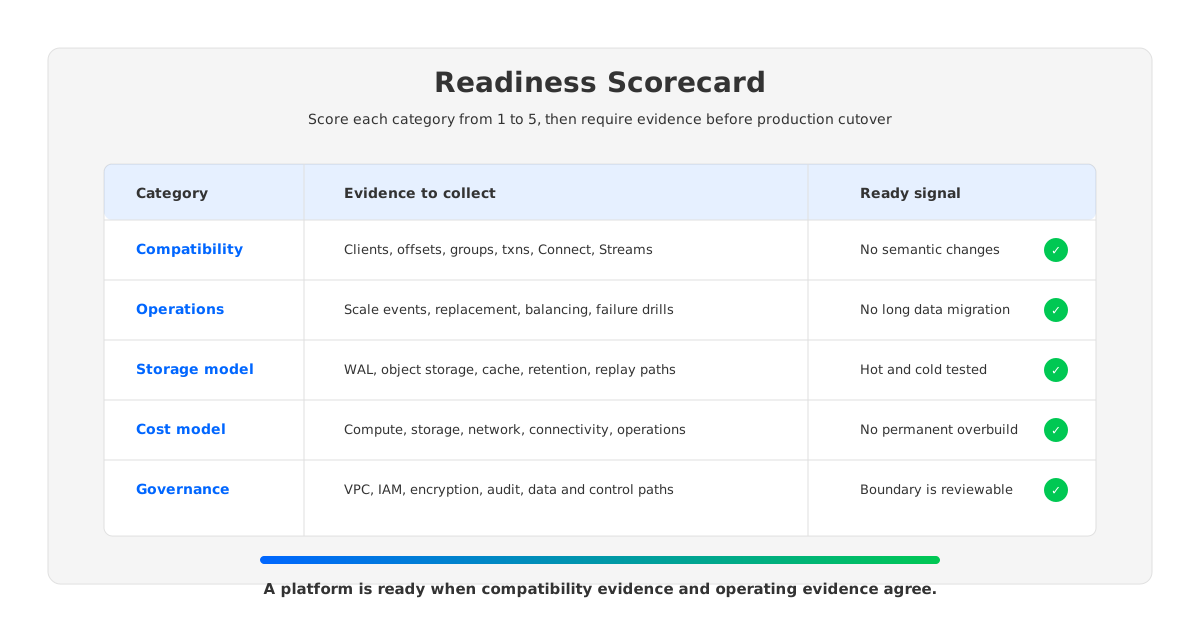
The final decision should be written down as a scorecard, not left as a general impression after a demo. Give each category a 1 to 5 score and require evidence for every score above 3. The exercise forces teams to separate "works in a test" from "ready for production ownership."
| Category | What to verify | Ready signal |
|---|---|---|
| Compatibility | Clients, admin APIs, Consumer groups, offsets, transactions, Connect, Streams, and monitoring tools. | Existing applications move without semantic changes. |
| Operations | Scaling, broker replacement, rebalancing, deployment, and failure drills. | Platform events do not depend on long broker-local data migration. |
| Storage model | WAL behavior, object storage, cache, retention, and replay paths. | Hot and cold workloads are tested separately under load. |
| Cost model | Compute, storage, network, private connectivity, observability, and labor. | The architecture does not require permanent over-provisioning as the main control. |
| Governance | VPC boundary, IAM, encryption, audit logs, data residency, and control path. | Security reviewers can map every data and admin path. |
| Migration | Topic mapping, ACLs, schemas, offsets, client cutover, monitoring, and rollback. | The team can rehearse migration before production cutover. |
The scorecard will usually reveal one of three outcomes. If most risk sits in clients and connectors, fix the compatibility test plan first. If most risk sits in storage, scaling, and recovery, compare architecture options rather than managed service labels. If most risk sits in governance, draw the deployment boundary before running performance tests.
Back where the search began, kafka protocol compatibility is not a yes-or-no question. It is a way to protect application contracts while deciding whether the infrastructure underneath Kafka should keep the same constraints. If your team is evaluating a Kafka-compatible platform with Shared Storage architecture, run the scorecard against a representative workload and include governance, migration, and rollback in the same test plan. To evaluate AutoMQ in a customer-controlled cloud environment, talk to the AutoMQ team.
7FAQ
7.1What does Kafka protocol compatibility mean in practice?
It means existing Kafka clients can communicate with the platform using Kafka APIs and protocol behavior. In production, teams should test more than connection success: Consumer groups, offsets, transactions, ACLs, client versions, Kafka Connect, Kafka Streams, monitoring, and operational tooling all affect whether the migration preserves application behavior.
7.2Is Kafka protocol compatibility the same as being identical to Apache Kafka?
No. A Kafka-compatible platform can preserve client-facing behavior while changing storage, deployment, scaling, or control plane architecture. That is often the reason teams evaluate Kafka-compatible alternatives in the first place. The important step is to identify which Kafka behaviors are application contracts and which infrastructure assumptions can change.
7.3Does Tiered Storage remove the need for Shared Storage architecture?
Not always. Tiered Storage can help with long retention by moving older log segments to remote storage. Shared Storage architecture changes a deeper operating assumption by separating durable data from broker-local disks. Teams should evaluate both against their real constraint: retention cost, scaling speed, recovery, governance, or migration risk.
7.4Where does AutoMQ fit in a Kafka-compatible evaluation?
AutoMQ fits when a team wants Kafka protocol compatibility with a cloud-native Shared Storage architecture, stateless brokers, object-storage-backed durability, and customer-controlled deployment boundaries. It should be evaluated with representative workloads, not assumed from a feature list.
7.5What should a proof of concept include?
Include the exact client versions, real Topic configurations, Consumer group behavior, offset migration, transactional paths if used, connector dependencies, monitoring, a scale event, a broker failure drill, and rollback rehearsal. The goal is to prove both application compatibility and operating model fit.
8References
- Apache Kafka Documentation
- Apache Kafka Concepts and Terms
- Apache Kafka Message Delivery Semantics
- Apache Kafka KRaft Documentation
- Apache Kafka Tiered Storage Documentation
- Apache Kafka Connect Documentation
- AutoMQ Compatibility with Apache Kafka
- AutoMQ Architecture Overview
- AutoMQ S3Stream Shared Streaming Storage
- AutoMQ WAL Storage


