
Table of Contents
Table of Contents
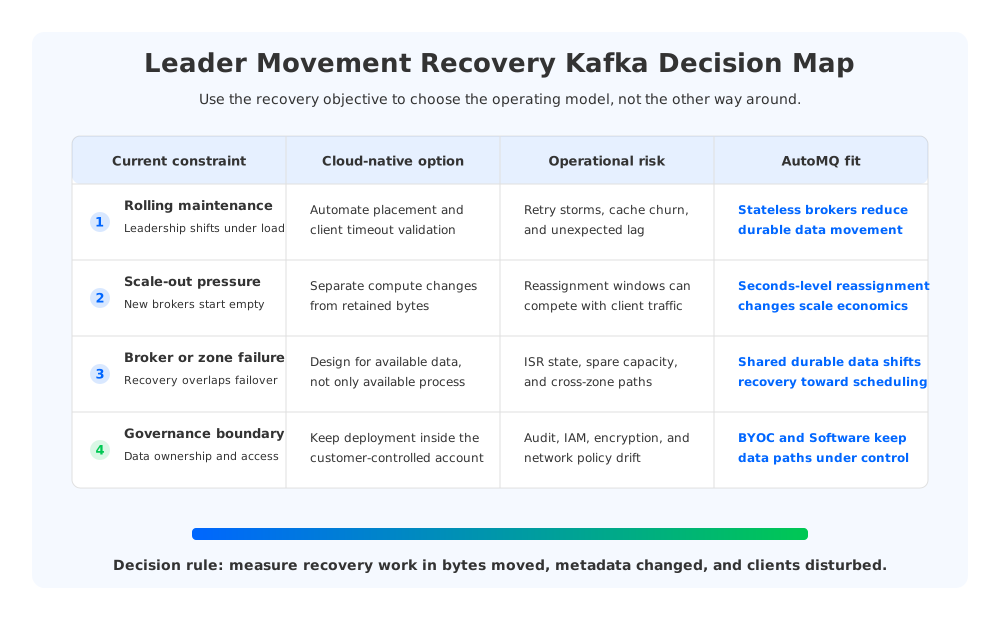
Searches for leader movement recovery kafka usually begin in a narrow place: a broker restart took longer than expected, a maintenance window generated more lag than the runbook predicted, or a failover drill raised a question nobody wanted to answer during an incident. The team is not asking what a leader is. They are asking what must happen before the cluster is safe again after leadership moves.
That distinction matters. In Apache Kafka, partition leaders serve reads and writes, consumer groups track progress through offsets, and clients depend on metadata updates to find the right broker. Leader movement can look like a metadata operation from the outside while activating storage, replication, client retry, cache, and capacity behavior underneath. A platform team that treats it as one controller action will under-test the parts that hurt production.
The useful question is not "How do we move leaders?" It is "What work does the architecture create when leaders move, and who pays for that work during recovery?"
1Why teams search for leader movement recovery kafka
Leader movement becomes interesting only when the system is already under pressure. A planned rolling upgrade is easy to model when traffic is quiet and every broker has spare disk, CPU, network, and page cache. The same operation feels different when one broker is hot, consumers are catching up from an outage, and producers have short delivery timeouts. The leader election may complete quickly, but user-visible recovery is still shaped by client reconnection, follower catch-up, request queueing, and consumer lag.
That is why the search term mixes "leader movement" with "recovery." Operators are usually trying to connect two layers of evidence:
- Control-plane evidence: leadership changed, metadata propagated, and partition state moved into the expected shape.
- Data-plane evidence: producers resumed stable acknowledgments, consumers made forward progress, and the cluster stopped burning recovery headroom.
- Business evidence: the applications that depend on the stream returned to their normal latency, freshness, and replay windows.
The gap between those layers is where postmortems become uncomfortable. A dashboard may show the intended leader distribution, but application teams still see retry bursts. A broker may return to service, but disk or network pressure remains elevated because replica catch-up is still running. A consumer group may keep committed offsets, but rebuilding downstream state can take longer than the leadership event itself.
Kafka gives teams the primitives to reason about these behaviors: partitions, leaders, followers, offsets, consumer groups, transactions, and KRaft metadata. The production challenge is assembling them into an operating model that survives change, not only steady state.
2The production constraint behind the problem
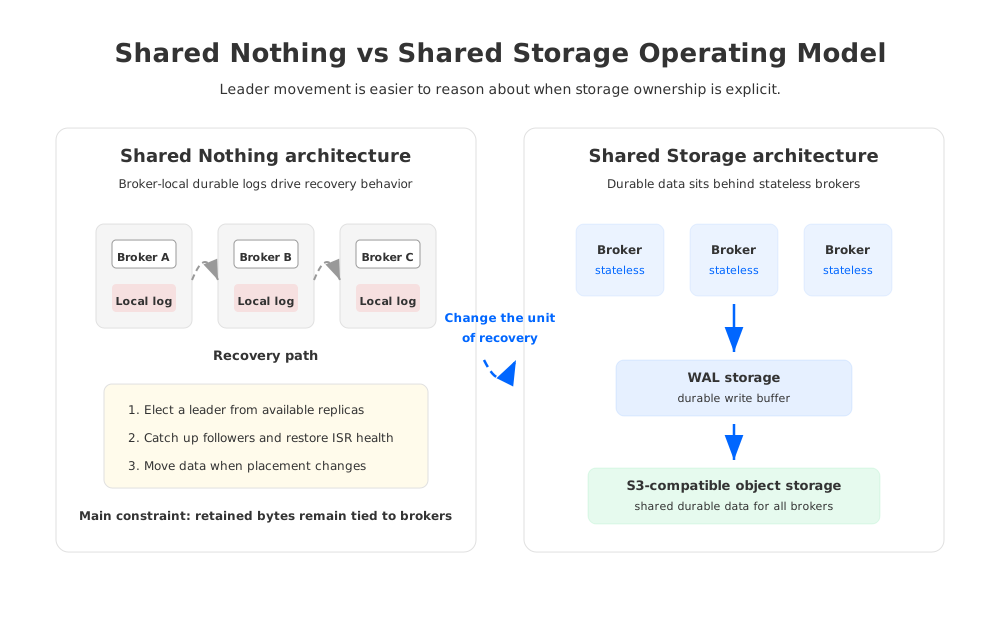
Traditional Kafka deployments follow a Shared Nothing architecture. Each broker owns local or attached storage for the partitions assigned to it, and reliability comes from replicas placed across brokers. This model is mature, observable, and widely understood. It also means compute placement and durable data placement are tied together.
When leadership moves in that model, the immediate step is not necessarily a full data copy. Kafka can elect an eligible replica as leader if replication state allows it. Heavier work often arrives around the leadership event: restoring replication health, moving partitions for balance, rebuilding broker capacity after failure, and keeping spare resources for future incidents. The cluster may be technically available while still doing recovery work.
That coupling creates four practical constraints:
- Broker-local storage becomes part of the recovery budget. If a broker is replaced or placement changes, retained bytes can become an operational constraint, not only a retention setting.
- Replication traffic competes with user traffic. Replica catch-up, reassignment, and client retries may use the same network and disk paths that producers and consumers need.
- Capacity planning becomes conservative. Teams keep headroom for broker failure, leader movement, rolling maintenance, and replay, even if steady-state traffic is much lower.
- Cloud failure domains become cost and governance questions. Multi-zone placement improves availability, but cross-zone replication, client routing, and recovery traffic need explicit design and monitoring.
Tiered Storage changes part of this picture by offloading older log segments to remote storage. That can help long retention and replay economics. It does not make brokers stateless, because the active write path and recent serving behavior still depend on broker-local resources. For leader movement recovery, the key distinction is whether durable data is anchored to a broker or available through shared storage.
3Architecture options and trade-offs
There is no universal best architecture for leader movement recovery. A small, stable Kafka deployment with predictable traffic may be well served by careful broker sizing, disciplined maintenance windows, and tested reassignment procedures. A platform serving many teams, long retention, bursty consumers, and frequent infrastructure changes needs a different lens.
The neutral framework starts with seven questions:
| Dimension | What to evaluate | Why it matters during leader movement |
|---|---|---|
| Compatibility | Client versions, protocol behavior, transactions, offset commits, and tooling | Recovery can expose timeout, retry, metadata refresh, and consumer group assumptions. |
| Cost | Broker storage, spare capacity, replication traffic, and cloud networking | The expensive part may be recovery headroom, not steady-state load. |
| Elasticity | Whether added compute can help before large data relocation completes | Scale-out is less useful if added brokers cannot serve meaningful traffic quickly. |
| Governance | IAM, encryption, network boundaries, audit logs, and data ownership | Recovery paths must stay inside approved operational and compliance boundaries. |
| Fault recovery | Broker loss, zone impairment, storage latency, and controller behavior | A drill should show both leadership correctness and application recovery. |
| Migration risk | Topic mapping, offsets, schemas, connectors, and rollback | A platform change is only safe if the team can prove continuity and exit. |
| Team boundary | Who owns clients, platform, cloud resources, and incident decisions | Recovery fails when evidence exists but no team owns the next action. |
This table separates platform behavior from product names. The right choice depends on the recovery work your team is trying to remove, reduce, or make more observable.
If your pain is mostly operational discipline, improve the runbook first. Test rolling restarts under realistic load, validate timeouts, monitor leader distribution, and measure recovery until client latency and lag return to normal. If your pain is retained data movement, over-provisioned broker storage, or slow scale-out, tuning alone may not change the root cause. The architecture is still asking brokers to carry compute and durable storage responsibilities.
4Evaluation checklist for platform teams
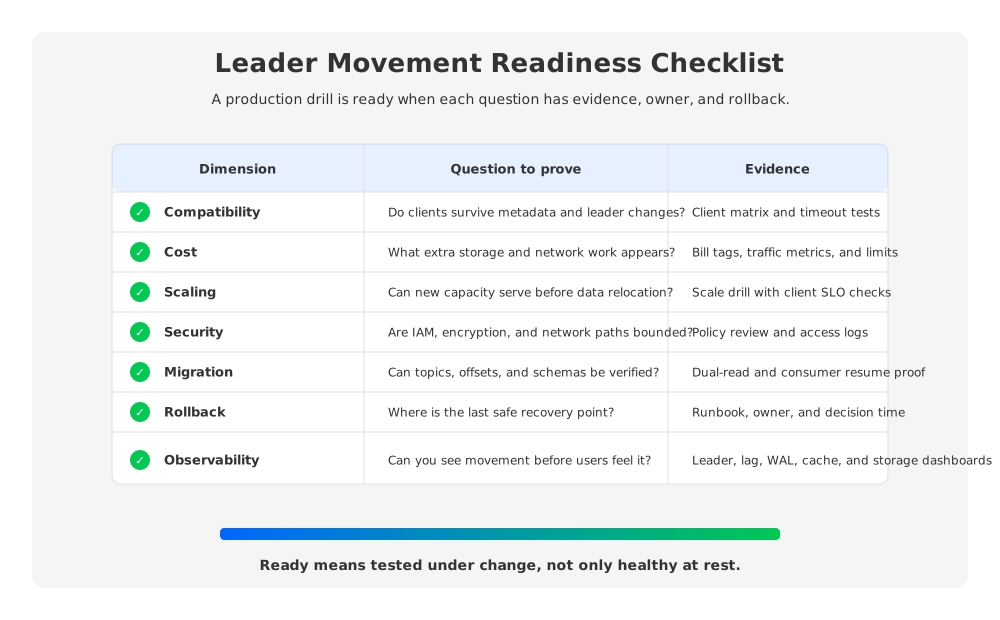
A useful readiness checklist should force evidence, not opinions. "We have high availability" is too broad. "A broker can be replaced during peak ingress while producers stay within delivery timeout and consumers recover within freshness objectives" is testable.
Before approving a leader movement or recovery strategy, ask for proof in these areas:
- Client behavior: Test producer retries, idempotent producer settings, transactional producer behavior, consumer group rebalances, and offset commits during leadership changes.
- Storage ownership: Identify whether recovery requires local log copy, replica catch-up, remote segment reads, cache warmup, WAL recovery, or metadata-only reassignment.
- Capacity headroom: Model the failure case, not only steady state. Include the extra work created by catch-up reads, reassignment throttles, monitoring load, and downstream replay.
- Failure-domain routing: Verify broker placement, rack or zone awareness, client connectivity, and cloud network paths. A correct leader on the wrong side of a network boundary can still create cost or latency surprises.
- Rollback: Define the last safe recovery point before the drill starts. For migrations, this includes topic parity, offset continuity, schema compatibility, and a decision time for returning traffic.
- Observability: Track leader changes, under-replicated partitions, client errors, request latency, consumer lag, controller events, storage errors, and cloud traffic indicators in one timeline.
The checklist should include a negative test. Remove a broker, interrupt a zone path, slow down storage, or force a client metadata refresh under load. A recovery design that only passes a clean rolling restart has not answered the question operators search for when they type leader movement recovery kafka.
5How AutoMQ changes the operating model
If the hard part of recovery is durable data tied to each broker, the architectural alternative is to separate compute from storage. AutoMQ is a Kafka-compatible cloud-native streaming platform built around Shared Storage architecture: brokers handle Kafka protocol work and serving, while durable data is stored through S3Stream using WAL storage and S3-compatible object storage.
That changes the recovery question. A broker is no longer valuable because it owns a large local log for a partition. It is valuable because it can take scheduling, serving, and caching work for data that remains durable in shared storage. Leader movement and reassignment still require coordination, client validation, and observability, but they are less dominated by moving retained bytes between broker-local disks.
The practical effect shows up in three places:
- Broker replacement becomes less data-placement-heavy. A failed or drained broker does not imply that the durable history for its partitions must be rebuilt on another broker before the cluster can make useful progress.
- Scale-out can focus on compute. Adding brokers helps request handling and traffic distribution without waiting for the same volume of retained local logs to move first.
- Recovery planning can become more explicit. Teams can separate WAL behavior, object storage access, metadata scheduling, cache warmup, and client recovery into distinct test items.
This is not the same as saying storage disappears. It moves into a different control surface. WAL type, object storage latency, IAM policy, bucket access, encryption, cache design, and metadata scale become production concerns. That is a better trade for many cloud teams because those concerns match infrastructure they already govern: object storage, identity, network boundaries, and elastic compute.
AutoMQ BYOC and AutoMQ Software also matter for governance. In BYOC deployments, the control plane and data plane run inside the customer's cloud account and Virtual Private Cloud (VPC). In Software deployments, they run inside the customer's private environment. For leader movement recovery, that boundary determines where Kafka records live, which IAM policies apply, who can inspect logs, and how drills are audited.
The migration question should remain disciplined. A Kafka-compatible platform reduces application rewrite risk, but it does not remove validation. Teams should still test client libraries, ACLs, topic configs, offset continuity, schema tooling, Kafka Connect jobs, observability, and rollback. The architecture can reduce one class of recovery work; the migration plan must prove the surrounding ecosystem still behaves as expected.
6A decision matrix for the next drill
The next leader movement drill should produce a decision, not only a pass/fail result. If your current Kafka environment recovers cleanly, has predictable costs, and gives application teams enough evidence, better automation may be enough. If every drill turns into a negotiation between disk headroom, reassignment windows, client retry settings, and cloud network paths, the recovery unit is too large.
Use this scorecard after the drill:
| Question | Green signal | Red signal |
|---|---|---|
| Did leadership move without hidden client impact? | Producers and consumers returned to normal within the defined SLO. | Metadata changes completed, but applications kept retrying or lagging. |
| Did storage work stay bounded? | Catch-up, cache, and WAL behavior were visible and expected. | Disk, replication, or remote-read work dominated the recovery window. |
| Did added capacity help quickly? | Added brokers or nodes absorbed useful load during the event. | Added capacity stayed idle until data placement caught up. |
| Did governance stay intact? | IAM, encryption, network, and audit controls stayed inside approved boundaries. | Recovery required exception access or unexplained data paths. |
| Did the team know when to roll back? | The rollback point and owner were defined before the test. | The decision depended on improvised judgment during the incident. |
The point of leader movement recovery kafka is not to chase a magic setting. It is to understand the recovery unit your architecture has chosen. In broker-local designs, that unit often includes replicas, retained bytes, and spare broker capacity. In Shared Storage architecture, it shifts toward metadata, WAL, object storage, cache, and scheduling. Both need testing. Only one may match the operating model your cloud platform team is trying to build.
If your next drill shows that broker-local recovery work is the bottleneck, evaluate a Kafka-compatible shared-storage architecture with the same rigor you apply to any production platform change. Start with the AutoMQ deployment boundary and migration path, then test it against your own leader movement, failure, and rollback scenarios. To explore AutoMQ BYOC with a technical evaluation, use the short link: https://go.automq.com/home?utm_source=blog&utm_medium=cta&utm_campaign=leader-movement-recovery-kafka.
7FAQ
7.1What does leader movement mean in Kafka?
Leader movement means that leadership for one or more partitions changes from one broker to another. The visible metadata change may be quick, but production recovery also depends on clients, replica state, storage pressure, cache behavior, and consumer progress.
7.2Is leader movement the same as partition reassignment?
No. Leader movement changes which broker handles reads and writes for a partition. Partition reassignment changes replica placement. They can interact during maintenance, balancing, and recovery, but they are not the same operation.
7.3Does Tiered Storage solve leader movement recovery?
Tiered Storage can reduce the amount of historical data kept on broker-local storage, which helps long retention and replay economics. It does not automatically make brokers stateless or remove the need to validate active-path recovery.
7.4What should teams test first?
Start with a broker replacement or rolling restart under realistic load. Measure producer errors, request latency, consumer lag, leader changes, replica health, storage pressure, and the point at which applications return to normal.
7.5Where does AutoMQ fit in the evaluation?
AutoMQ fits when the team wants Kafka-compatible behavior while reducing the recovery work created by broker-local durable storage. Its Shared Storage architecture and stateless brokers change leader movement recovery from a data-placement-heavy operation into a scheduling, WAL, object storage, cache, and client-validation problem.


