
Table of Contents
Table of Contents
Teams usually search for share consumer api operations kafka after they have already hit a scaling edge case. A conventional Kafka consumer group is excellent when each partition can be owned by one consumer at a time. It gives clear ordering, clear offset progress, and a familiar operational model. The pressure starts when the workload looks more like a task queue: many workers, uneven record processing time, retries that should not block the whole partition, and a desire to run more consumers than partitions without repartitioning the topic.
Share consumer behavior changes that conversation. Instead of treating a partition assignment as the unit of work, it lets consumers in a share group cooperatively process records with finer-grained ownership. Apache Kafka documentation describes share groups as a preview feature in Kafka 4.1, and Kafka 4.2 consumer configuration includes share consumer options such as acknowledgement mode and acquire mode. That matters because platform teams should evaluate it as an API and operations decision, not as a one-line replacement for existing consumer groups.
The architecture question is not “Can Kafka behave more like a queue?” The harder question is “What happens to storage, recovery, observability, and migration when queue-like work becomes part of the streaming platform contract?” That is where the trade-off becomes interesting.
1Why teams search for share consumer api operations kafka
Classic consumer groups are built around partition ownership. If a topic has 24 partitions, the group can use up to 24 active consumers for that topic before extra consumers sit idle. For many event-streaming systems, that is the right trade-off: partition order is preserved, offset commits are understandable, and lag can be reasoned about per partition. The partition becomes the boundary for work, progress, and failure.
Queue-like workloads create a different shape. A fraud-scoring event may take milliseconds for most records and seconds for a few difficult records. A document-processing pipeline may have one record that fans out into OCR, enrichment, and model inference while the next record is routine. A customer-support automation stream may need high parallelism at the worker level but still wants Kafka durability, retention, replay, and ecosystem tooling.
In those cases, the partition boundary can become too coarse. Adding more workers does not help once consumer count exceeds partition count. Increasing partition count can help, but it changes ordering, metadata scale, assignment churn, and operational overhead. Moving the workload to a separate queue can help, but it creates a second messaging system next to Kafka and splits governance across two platforms.
Share consumer APIs are attractive because they try to keep the workload inside Kafka while loosening the one-consumer-per-partition bottleneck. The appeal is practical, not theoretical. Teams want retries, high worker concurrency, and Kafka-native integration without turning every topic into an over-partitioned operational compromise.
2The production constraint behind the problem
The first mistake is to evaluate share consumer behavior only at the client API layer. The API is visible, but the operational consequences land on the brokers. More flexible record sharing means more coordination state, more nuanced acknowledgement behavior, and more ways for lag to be explained incorrectly if dashboards still assume classic consumer group behavior.
Apache Kafka’s share group model is designed to sit alongside traditional consumer groups, not erase them. That distinction matters. Traditional consumer groups remain the better fit when strict partition-level ordering and stable partition ownership are the primary requirements. Share groups fit workloads where work distribution matters more than a single consumer owning all records from a partition for a period of time.
Once the workload is in production, three questions decide whether the design holds:
- What is the unit of failure? A worker failure, an unacknowledged record, a stuck batch, and a broker failover should be distinguishable. If all of them collapse into “consumer lag went up,” the platform team will troubleshoot by guesswork.
- What is the unit of scale? If the workload needs more worker concurrency, the platform should not force a topic repartition every time traffic changes. If the cluster needs more broker capacity, scaling should not begin with hours of data movement.
- What is the unit of migration? Client compatibility is only one part of migration. Offsets, group state, ACLs, producer cutover, rollback, and observability have to move as one operating model.
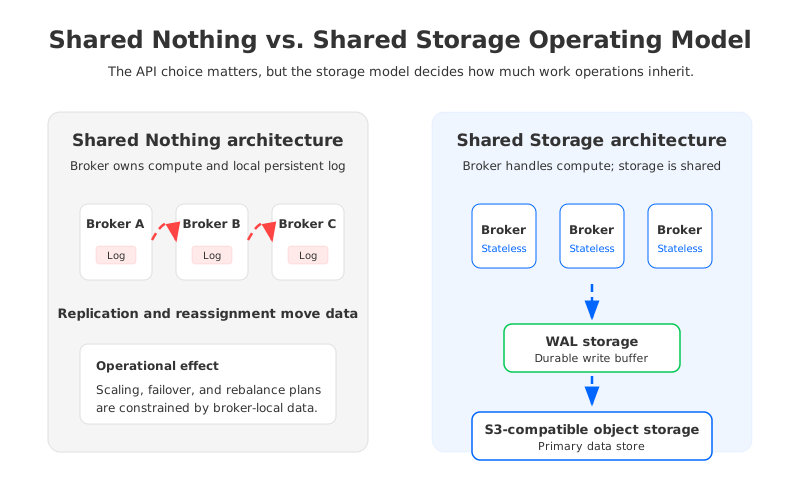
These questions are architecture questions because Kafka’s historic operating model is tightly coupled to broker-local storage. When data is bound to broker disks, capacity changes are not only metadata changes. They trigger reassignment, replication, network transfer, and long-running operational windows. Share consumer workloads do not create that constraint, but they make the cost of the constraint easier to feel.
3Architecture options and trade-offs
There are three realistic paths for platform teams evaluating share consumer API operations in Kafka. None is universally right. The decision depends on whether the team is optimizing for API continuity, operational simplicity, queue semantics, or cloud elasticity.
| Option | When it fits | Trade-off to inspect |
|---|---|---|
| Classic Kafka consumer groups | Ordered stream processing, partition-level ownership, stable lag semantics | Worker concurrency is capped by partition count for a topic. |
| Share consumer APIs | Queue-like processing inside Kafka-compatible clients and tooling | Feature maturity, acknowledgement semantics, and observability need explicit validation. |
| Separate queue system | Workloads that need queue-first semantics more than stream replay | Governance, data movement, and platform sprawl increase. |
| Kafka-compatible cloud-native platform | Teams that want Kafka APIs with a different operating model underneath | Compatibility, migration tooling, and storage architecture must be verified. |
Tiered Storage is a related but different decision. Apache Kafka’s KIP-405 describes a two-tier model with local and remote storage. It can reduce the pressure of retaining older data locally, but the local tier still exists and the broker still manages partition-local log state. That can be the right step for retention-heavy workloads, yet it does not turn brokers into stateless compute nodes.
The deeper trade-off is Shared Nothing architecture versus Shared Storage architecture. In a traditional Shared Nothing architecture, each broker owns local persistent data and replication protects availability. In a Shared Storage architecture, durable data is moved to shared object storage, and brokers can focus on request processing, leadership, caching, and coordination. That difference becomes important when API-level flexibility increases the need for elastic operations.
4Evaluation checklist for platform teams
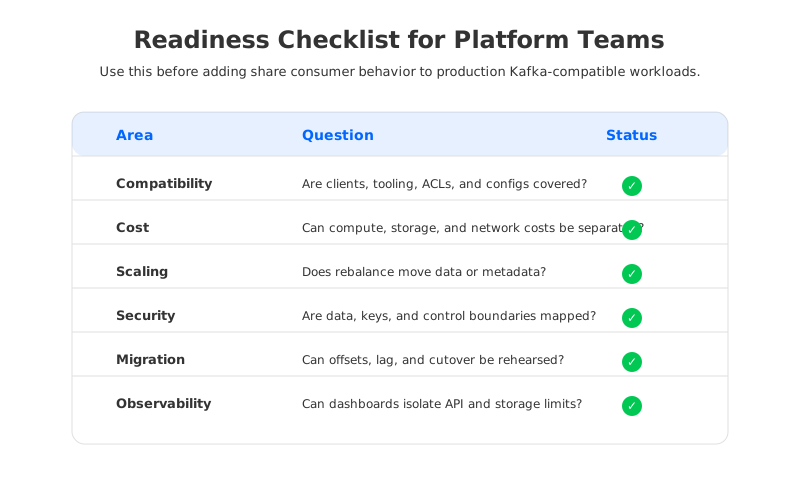
Before adopting share consumer behavior for production workloads, treat the evaluation as a platform readiness review. The API surface is the entry point, but the success criteria should include lifecycle operations, security boundaries, and failure recovery.
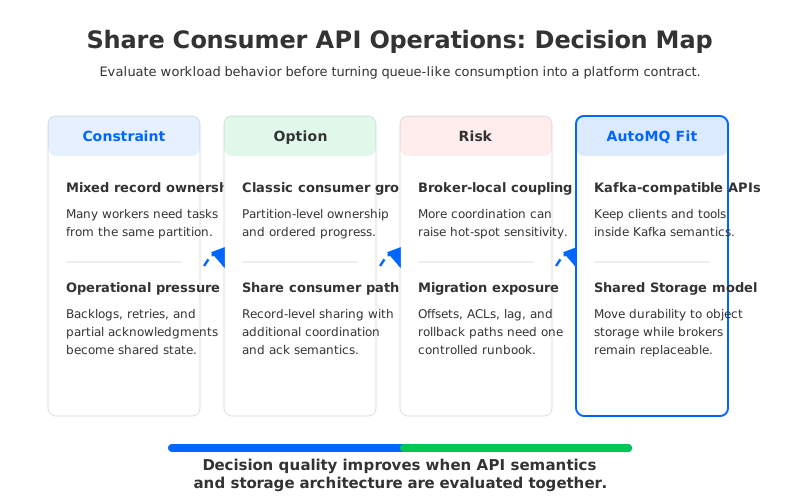
Use this decision map as a working model rather than a vendor checklist. Start with the workload constraint, then decide whether classic consumer groups, share consumer APIs, or a queue-first system best matches the processing pattern. Only after that should the team ask whether the underlying Kafka-compatible platform reduces or amplifies the operational risk.
A practical readiness review should include these questions:
- Compatibility: Which Kafka client versions, libraries, and deployment images are allowed? Does the team need
ShareConsumersupport, or is the workload still better served by existing consumer group APIs? - Acknowledgement semantics: Will acknowledgements be implicit or explicit? How will the team test retries, poison records, delivery attempts, and partial progress?
- Ordering assumptions: Which downstream systems assume partition order? If record-level sharing weakens an old assumption, the design must make that visible.
- Cost model: Which costs are driven by compute, storage, replication traffic, cross-AZ traffic, object storage requests, and operational time? Avoid treating “Kafka cost” as one number.
- Observability: Can dashboards separate consumer lag, share group state, broker saturation, storage latency, and network pressure?
- Migration and rollback: Can the team rehearse producer cutover, consumer progress, ACLs, topic configs, and rollback without changing application behavior at the last minute?
The point is not to slow adoption. The point is to avoid adopting a more flexible API while leaving the old operating assumptions untouched.
5How AutoMQ changes the operating model
If the evaluation points toward Kafka-compatible streaming with a more elastic operating model, AutoMQ is one architecture answer. AutoMQ keeps Kafka protocol compatibility while replacing Kafka’s broker-local log storage with S3Stream, a shared streaming storage library built on WAL storage and S3-compatible object storage. The important part for platform teams is not the product label. It is the shift from “brokers own durable data” to “brokers process Kafka requests while durable data lives in shared storage.”
In AutoMQ’s Shared Storage architecture, data is written to WAL storage for durable write acceleration and then stored in object storage as the primary data store. AutoMQ documentation describes WAL storage as a fixed-size, cyclic write buffer that mixes data from multiple partitions, uses sequential writes and group commit, and supports different WAL backends depending on the deployment model. S3 storage is the long-term data location; WAL is for write acceleration and recovery, not a second local log tier.
That distinction changes several operational behaviors:
- Scaling is less tied to data movement. When brokers are stateless, adding or removing compute capacity is closer to changing ownership and traffic placement than copying partition logs between disks.
- Recovery has a smaller local-data problem. Broker replacement does not depend on reconstructing all partition data from a failed node’s disk. The recovery path focuses on WAL data that has not yet reached object storage and on metadata-driven reassignment.
- Cloud cost drivers become easier to isolate. Compute, WAL storage, object storage, cache behavior, and network traffic can be evaluated as separate dimensions instead of being hidden inside broker disk sizing.
- Migration can stay Kafka-centered. AutoMQ’s Kafka compatibility and migration tooling are designed around existing Kafka clients, topics, offsets, and ecosystem components, so platform teams can evaluate the operating model without starting from another messaging protocol.
This does not mean every share consumer workload should move platforms before it ships. If a team is experimenting with Kafka 4.x client behavior in a small cluster, the fastest path may be to test directly on Apache Kafka and keep the blast radius low. If the team is planning production adoption across many workloads, regions, and worker pools, the storage architecture becomes part of the API decision.
6A migration-minded way to decide
The safest evaluation starts with the workload, not the feature. Pick one candidate pipeline where partition ownership is the actual bottleneck. Measure how much processing time varies by record, how often retries block useful work, and which ordering assumptions are real rather than inherited. Then run a design review that separates API behavior from platform behavior.
For the API layer, test the share consumer path against client support, acknowledgement mode, failure handling, and operational dashboards. For the platform layer, test what happens when traffic rises, workers scale, brokers fail, and the team needs to roll back. These tests should be boring. A feature that works only during a clean demo is not ready to become a platform primitive.
The decision usually lands in one of three places. Keep classic consumer groups when ordering and partition-level reasoning are more important than worker over-subscription. Use share consumer APIs when queue-like execution belongs inside Kafka and the team can validate the preview or version-specific behavior it depends on. Revisit the platform architecture when broker-local storage, reassignment time, or cloud network cost has become the limiting factor rather than the client API.
Back to the original search query: share consumer api operations kafka is not really a search for syntax. It is a search for confidence that a more flexible consumption model will not create a harder platform to operate. If your team is evaluating Kafka-compatible streaming with shared storage, stateless brokers, and customer-controlled deployment boundaries, explore AutoMQ on GitHub or review the AutoMQ architecture documentation.
7FAQ
7.1Is a share consumer the same as a classic Kafka consumer group?
No. A classic consumer group assigns partitions to consumers, while share group behavior allows consumers to cooperatively process records with finer-grained sharing. That changes how teams should think about ordering, acknowledgements, retries, and observability.
7.2Should every queue-like workload move to share consumer APIs?
No. Some workloads are better served by classic consumer groups, some by a dedicated queue, and some by share consumer behavior. The deciding factor is whether record-level work sharing is worth the added operational validation.
7.3Does Tiered Storage solve the same problem as Shared Storage architecture?
No. Tiered Storage adds a remote tier for older log segments while the broker still has a local storage role. Shared Storage architecture moves durable data to shared object storage and makes brokers more stateless.
7.4Where does AutoMQ fit in this decision?
AutoMQ fits when a team wants Kafka-compatible APIs but wants to reduce the operational coupling between brokers and durable storage. It should be evaluated after the workload requirements and API semantics are clear.
8References
- Apache Kafka, Share groups design documentation
- Apache Kafka, Consumer and Share Consumer Configs
- Apache Kafka, KRaft operations documentation
- Apache Kafka, KIP-405: Kafka Tiered Storage
- AutoMQ Documentation, Architecture Overview
- AutoMQ Documentation, Compatibility with Apache Kafka
- AutoMQ Documentation, WAL Storage


