
Table of Contents
Table of Contents
The query arm instance kafka performance cost usually appears when a Kafka platform team has moved past cloud optimization. The team is asking whether a production streaming platform can move to Arm without turning the review into a reliability incident, a client compatibility project, or a benchmark that does not match real traffic.
That concern is rational. Kafka workloads are sensitive to more than raw CPU price. Brokers handle network interrupts, compression, TLS, page cache behavior, disk flushes, replication, and uneven partition leadership. Connector workers may depend on native libraries, while stream processors add their own JVM and state profiles. A lower instance price matters, but it is not a complete cost model.
The useful question is not whether Arm instances are good or bad for Kafka. The useful question is where Arm changes the unit economics of the platform, where it adds migration risk, and where the storage architecture makes instance selection less painful.
1Why Teams Search for arm instance kafka performance cost
Arm-based cloud instances entered many infrastructure roadmaps through general-purpose compute savings. Web services, stateless workers, and batch jobs are often evaluated first because their failure modes are easy to isolate. Kafka is shared infrastructure with durable state, client-facing compatibility constraints, and recovery behavior visible across many teams.
That shared nature changes the evaluation. If a stateless service underperforms on an Arm instance, the team can scale replicas, route traffic away, or roll back. If a Kafka broker fleet underperforms, the symptoms can spread through producer latency, consumer lag, replication catch-up, and rebalance duration. The rollback path may involve data movement, not only replacing a compute node.
The search query often comes from one of three situations:
- A FinOps team sees attractive instance pricing and asks whether Kafka should follow the rest of the compute fleet.
- A platform team is preparing a cluster refresh and wants to know whether Arm can be part of the target architecture.
- A procurement or architecture review needs a defensible model that compares x86 and Arm across performance, migration effort, and operational risk.
Those scenarios have different owners, but they share the same weakness: instance price is visible before platform behavior is measured. A sound review separates compute from streaming architecture. Arm may improve the cost of broker CPU, Connect workers, or stream processing nodes. It does not automatically reduce replication traffic, retained storage, cross-zone movement, or operational labor.
2The Cost Drivers Behind an Arm Decision
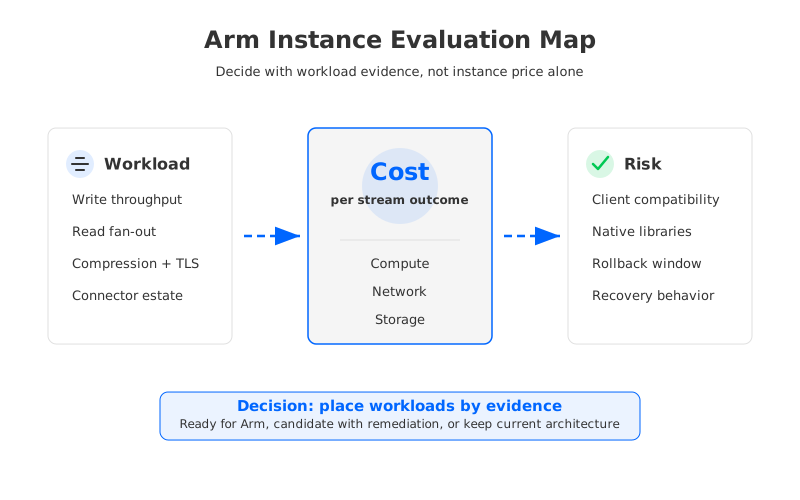
A Kafka cost model has several layers, and Arm only touches some directly. Compute is the obvious layer: instance hourly price, vCPU count, memory, sustained CPU utilization, and headroom. The next layer is network behavior. Kafka can saturate network paths through producer writes, broker replication, consumer fan-out, replays, and connector traffic. The third layer is storage, where broker-local disks, attached volumes, object storage, retention, and recovery windows shape the bill.
That layered model prevents a common mistake. Teams compare two instance families, find a lower compute line item, and then assume the platform will become proportionally less expensive. Kafka rarely behaves that neatly. If brokers are storage-bound, Arm CPU efficiency will not fix disk throughput. If read fan-out dominates, network cost may outweigh compute.
The right unit of analysis is workload cost per useful stream outcome. For a Kafka-compatible platform, that usually means cost per sustained MiB/s of write throughput, cost per retained TiB-hour, cost per consumer fan-out unit, and cost per recovery objective. Arm can be part of that equation, but it should be tested against the whole equation.
| Cost domain | What Arm can influence | What Arm does not solve alone |
|---|---|---|
| Broker compute | CPU efficiency, instance price, compression throughput, TLS overhead | Replica placement, partition skew, broker-local storage ownership |
| Connector workers | JVM runtime cost, task density, worker fleet size | Connector-specific native dependencies, sink throttling, schema governance |
| Stream processing | Operator CPU cost, serialization, state backend behavior | State recovery design, downstream backpressure, checkpoint storage |
| Network | Possible change in instance network bandwidth per dollar | Cross-AZ traffic paths, consumer fan-out, replication topology |
| Storage | Possible rebalancing of compute-to-storage spend | Retention policy, local disk coupling, recovery data movement |
The table does not argue against Arm. It argues against shallow evaluation. A platform can benefit from Arm in one layer and still lose the business case if the architecture remains dominated by storage movement, network transfer, or operational work.
3Benchmark the Workload, Not the Processor
The first benchmark should not be a processor contest. It should be a workload replay that captures the platform's normal and failure-mode behavior. Kafka's performance profile changes with message size, batch settings, compression codec, TLS, producer acknowledgments, replication factor, partition count, consumer group count, and retention. A single throughput chart hides those variables and can steer the instance decision in the wrong direction.
Use a benchmark matrix that reflects production traffic. Write-heavy workloads need compression and replication tests. Fan-out workloads need consumer locality and replay tests. Connector-heavy platforms need task density and sink behavior checks. Security-sensitive environments need TLS and authentication enabled because crypto overhead is part of the workload.
For Arm evaluation, four checks deserve attention:
- Java runtime and dependency readiness. Brokers, Connect workers, stream processors, agents, and internal tools should all run on the target architecture without hidden x86-only packages.
- Compression and encryption behavior. Codecs, TLS libraries, and serialization paths should be measured with the exact settings used in production.
- Network and storage balance. The target instance must provide enough network bandwidth, disk throughput, and memory headroom for the workload shape, not only enough CPU.
- Operational lifecycle. Broker replacement, rolling upgrades, partition leadership movement, and recovery should be part of the benchmark, because they decide whether the migration is reversible.
The last item is where many benchmark plans are too optimistic. Steady-state throughput matters, but production teams also pay for bad days. If a broker fails during a migration window, the platform needs to recover predictably. If consumer lag grows during a replay, the team needs to know whether the bottleneck is CPU, network, storage, or downstream systems.
4Storage Architecture Changes the Instance Conversation
Traditional Kafka binds compute and durable storage inside the broker. A broker owns local log segments, serves reads, writes data to local or attached disks, replicates records to other brokers, and participates in leadership decisions. This design is proven, but it makes instance selection more consequential because the broker is both a compute choice and a long-lived data placement choice.
That coupling can distort an Arm migration. If the team wants to replace x86 brokers with Arm brokers, it may need to consider partition reassignment, disk capacity, recovery bandwidth, and maintenance windows. If storage is attached to broker identity, compute refresh becomes a data movement project.
Tiered storage can reduce local disk pressure by moving older log segments to object storage. That helps long-retention economics and can lower the amount of broker-local data. It still does not make brokers fully stateless. Hot data placement, leader movement, local cache behavior, and broker lifecycle remain part of the operating model.
A shared-storage architecture changes the conversation because long-lived data is no longer tied to a specific broker's local disk. AutoMQ, for example, is a Kafka-compatible cloud-native streaming system that separates broker compute from durable storage through Shared Storage architecture and a write-ahead log layer. In an Arm evaluation, compute fleet changes can be evaluated with less broker-local data ownership in the way.
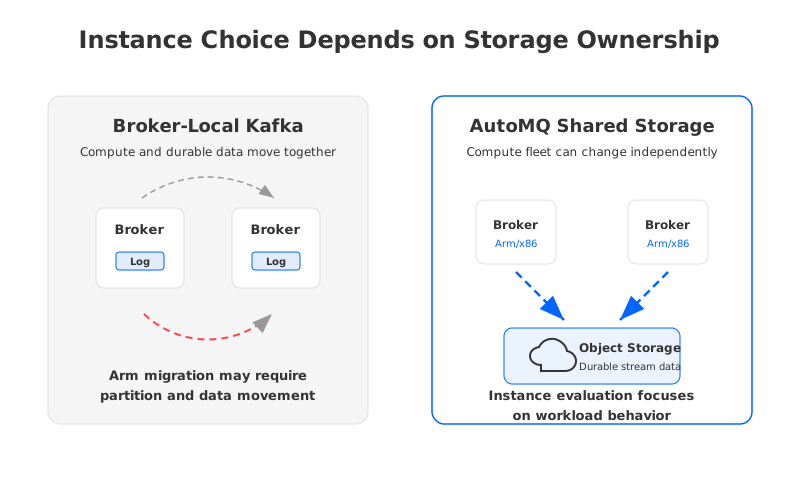
This matters for mixed or phased deployments. A team may want to test Arm for part of the workload, compare instance families, or scale brokers up and down as traffic changes. Stateless broker behavior makes those experiments more realistic because the evaluation does not require the same volume of durable data migration as a broker-local model.
5Evaluation Checklist for FinOps and Platform Teams
FinOps teams usually see instance prices before they see Kafka internals. Platform teams see Kafka internals before they see the full allocation model. Arm evaluation works when those perspectives are combined into one scorecard. The scorecard should not stop at average CPU utilization, which says little about partition skew, recovery windows, replay pressure, or multi-AZ traffic.
Start with workload segmentation. Not every Kafka workload needs the same answer. High-throughput ingestion, large-message pipelines, CDC connectors, stream processing jobs, and low-latency service events stress different parts of the platform. A broad "Kafka on Arm" decision is often less useful than a per-workload placement policy.
| Review area | Question to answer | Decision impact |
|---|---|---|
| Compatibility | Do all brokers, clients, connectors, agents, and libraries support the target CPU architecture? | Determines whether Arm is a platform option or a limited workload option. |
| Workload shape | Is the workload CPU-bound, network-bound, storage-bound, or recovery-bound? | Shows whether instance price can influence the dominant cost driver. |
| Performance envelope | Does the Arm fleet meet p95 and p99 latency, throughput, and lag targets under production settings? | Prevents steady-state averages from hiding tail behavior. |
| Operating model | Can the team replace, scale, and roll back instances without large data movement surprises? | Turns benchmark results into production readiness. |
| Governance | Can costs be attributed by topic family, team, connector estate, and environment? | Keeps optimization from becoming a shared-cluster blame game. |
| Migration path | Is there a tested rollback path with client compatibility, monitoring, and capacity headroom? | Decides whether the project is an optimization or an outage risk. |
The checklist should produce a decision, not a vague recommendation. A workload may be ready for Arm now, ready after dependency cleanup, or blocked by architecture constraints.
6How AutoMQ Changes the Operating Model
Once the neutral framework is in place, AutoMQ is relevant as a Kafka-compatible architecture that reduces the amount of durable state tied to broker instances. It preserves Kafka protocol compatibility while using shared object storage and a WAL design to separate compute lifecycle from long-lived stream storage. For an Arm evaluation, that separation matters because CPU architecture can be treated more like a compute fleet policy and less like a full data placement redesign.
In a broker-local Kafka deployment, changing the broker fleet often means thinking about both process replacement and data ownership. In AutoMQ's Shared Storage architecture, brokers are stateless relative to durable stream data, so compute scaling and broker replacement do not carry the same local-disk migration burden. That does not remove the need for benchmark discipline. It changes what the benchmark is allowed to focus on: CPU efficiency, network behavior, workload fit, and operational controls rather than a large data shuffle caused by broker identity.
AutoMQ also documents zero cross-AZ traffic as an operating goal for cloud deployments. That point is relevant because an Arm cost model can fail when compute savings are overwhelmed by avoidable data transfer. If the architecture can keep producer and consumer paths aligned with local-zone access patterns while using object storage for durability, the instance decision becomes part of a larger cloud cost model.
The migration review still needs conservative boundaries. Kafka compatibility reduces client replacement risk, but production workloads include topic settings, ACLs, transactions, consumer group behavior, connectors, monitoring, and recovery procedures. A serious pilot should test those behaviors with the actual client mix before the team expands the Arm footprint.
7Production Readiness Scorecard
A mature Arm strategy is a policy, not a one-time benchmark. Kafka workloads change as teams add consumers, increase retention, or introduce stream processing. A scorecard gives the platform team a repeatable way to decide which workloads belong on which compute architecture.
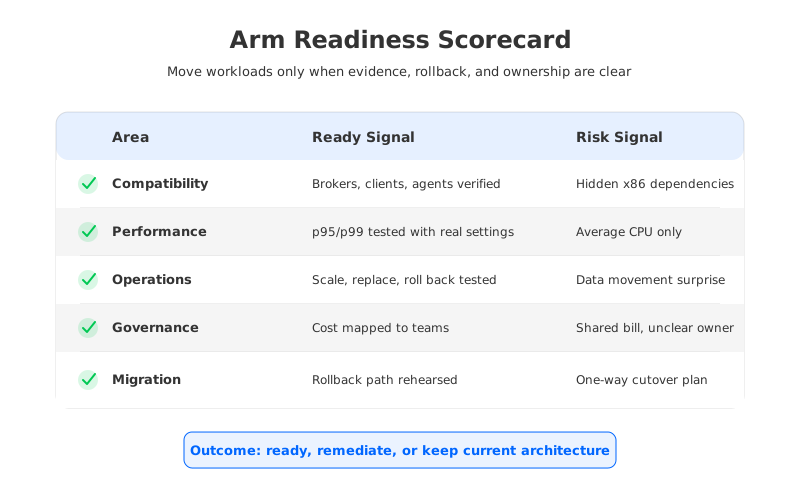
The strongest scorecards separate readiness from aspiration. A workload is ready when compatibility is verified, performance is measured under production settings, observability can explain regressions, and rollback is tested. A lower list price is not enough.
Use three categories when reporting results:
- Ready for Arm: production-like tests pass, dependencies are architecture-neutral, and rollback does not require risky data movement.
- Candidate with remediation: the workload shows promising economics, but connectors, agents, native libraries, or observability gaps need cleanup.
- Keep on current architecture: the dominant cost driver is storage, network, recovery movement, or workload behavior that Arm compute does not materially improve.
This is where the original search query becomes a platform decision. The goal is not to prove that Arm is universally right for Kafka. The goal is to make compute architecture one controllable variable inside a broader streaming cost model.
If your team is evaluating Arm instances for Kafka-compatible streaming, start with workload segmentation, dependency checks, production-like benchmarks, and rollback design. AutoMQ's Shared Storage architecture is worth including when broker-local data movement, cross-AZ traffic, or compute-storage coupling are material parts of the business case. Start here: explore AutoMQ for Kafka-compatible streaming infrastructure.
8References
- Apache Kafka documentation
- Apache Kafka design documentation
- Apache Kafka producer configuration
- Apache Kafka consumer configuration
- Apache Kafka Connect documentation
- AWS Graviton processors
- AWS EC2 instance types
- AWS EC2 on-demand pricing
- AutoMQ Shared Storage architecture
- AutoMQ Kafka compatibility
- AutoMQ inter-zone traffic overview
9FAQ
9.1Are Arm instances always lower cost for Kafka workloads?
No. Arm instance pricing can be attractive, but Kafka cost depends on compute, network, storage, retention, replication, consumer fan-out, and operations. A workload-specific benchmark is required before the platform team can claim savings.
9.2What should be tested before moving Kafka brokers to Arm?
Test Java runtime behavior, broker throughput, compression, TLS, producer latency, consumer lag, connector dependencies, rolling upgrades, broker replacement, and rollback. Run the test with production-like settings rather than a synthetic throughput profile alone.
9.3Does Kafka client compatibility change when brokers run on Arm?
Kafka protocol compatibility is separate from broker CPU architecture, but the deployment still needs end-to-end validation. Clients, connectors, agents, libraries, and monitoring tools may have their own architecture-specific dependencies.
9.4How does shared storage help an Arm evaluation?
Shared storage reduces the amount of long-lived data tied to broker-local disks. That can make compute fleet changes easier to evaluate because the team can focus more on workload behavior and less on large data movement caused by broker replacement.
9.5Where does AutoMQ fit in the decision?
AutoMQ fits after the team has defined compatibility, workload shape, benchmark criteria, and migration risk. Its Kafka-compatible Shared Storage architecture and zero cross-AZ traffic design are relevant when the business case is constrained by broker-local storage, data movement, or cloud transfer cost.


