
Table of Contents
Table of Contents
Teams search for asynchronous reply pattern kafka when request-response collides with distributed systems behavior. A checkout service needs a fraud decision, but the workflow depends on several signals. A claims platform needs an eligibility answer that may require enrichment, policy evaluation, and a human exception queue. A customer-facing API wants a reply soon, while the back-end workflow needs durability, retries, and auditability more than a synchronous call stack.
Kafka-compatible streaming is a natural fit for this shape because it gives the request a durable timeline. A service can publish a command or query event, another service can process it independently, and the requester can receive a reply through a separate topic. The trap is that an asynchronous reply pattern is not only a programming pattern. In production, it becomes a platform contract around correlation IDs, timeouts, offsets, retries, partitioning, governance, and retained history.
The pattern works well when the team treats replies as events with lifecycle rules. It becomes fragile when teams copy the surface shape of request-response into Kafka and ignore the parts HTTP used to hide: who owns pending state, what happens after timeout, how duplicates are handled, and how operators prove where a lost reply went.
1Why teams search for asynchronous reply pattern kafka
The search usually starts with a practical constraint. A synchronous API call is too brittle for a workflow that crosses services, regions, or teams, but a pure event-notification model does not give the original caller a clear answer. The team wants Kafka's decoupling and replayability while preserving a reply path developers can reason about.
The basic design is familiar. A requester writes a message to a request topic with a correlation_id, a reply address, and a timeout budget. A worker consumes the request, performs the business action, and writes a response to a reply topic using the same correlation ID. The requester, or a gateway, matches the reply to the pending request and returns a result if it arrives within the allowed window.
That small loop hides several decisions:
- Correlation and ownership. The correlation ID must be unique enough to join request and reply, and the pending state must live somewhere durable enough for the caller's reliability target.
- Partitioning and ordering. The request key should route related work predictably, while the reply key should support efficient lookup by the waiting component.
- Timeout semantics. A timed-out request is not the same as a failed request. The worker may still complete after the caller has moved on.
- Duplicate handling. Producers can retry, consumers can restart, and replies can be written more than once. The receiver needs idempotent matching and a clear terminal state.
- Audit and repair. Operators need to reconstruct the path from request to processing attempt to reply, especially when the user-visible symptom is a missing answer.
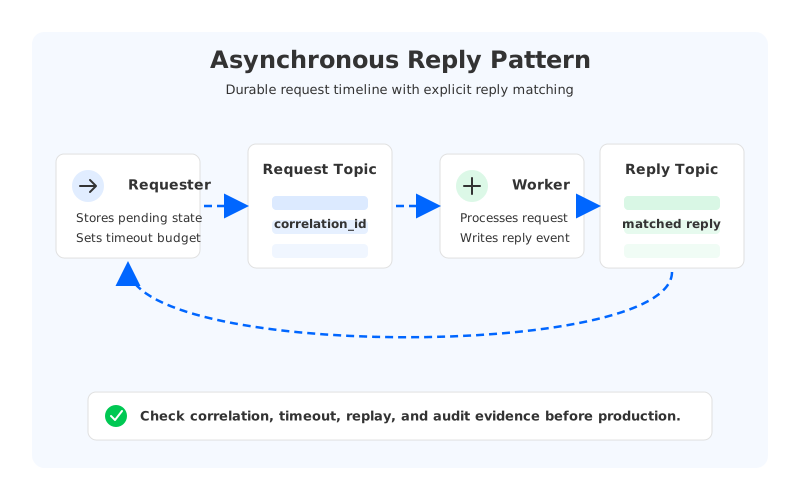
The pattern is useful because it separates the user-facing latency budget from the back-end processing lifecycle. The user may get a pending response, a later notification, or a fast answer depending on the workflow. The platform still keeps the full event sequence. That separation makes Kafka attractive here, and it also requires more design care than a direct RPC call.
2The production constraint behind the pattern
The hardest part of asynchronous replies is not sending a reply message. It is controlling the gap between the caller's clock and the system's durable state. A caller may time out after 2 seconds, while the worker finishes after 8 seconds. A gateway may crash after publishing the request but before registering pending state. A worker may complete the operation and fail before committing its consumer offset. Each case can produce a different symptom, and each symptom needs a different repair path.
Kafka gives teams the primitives for this contract: durable topics, consumer groups, offsets, producer acknowledgments, transactions, retention, and replay. Those primitives do not decide the business state machine. The application still defines whether a late reply is ignored, delivered to another channel, stored for polling, or treated as a compensating event.
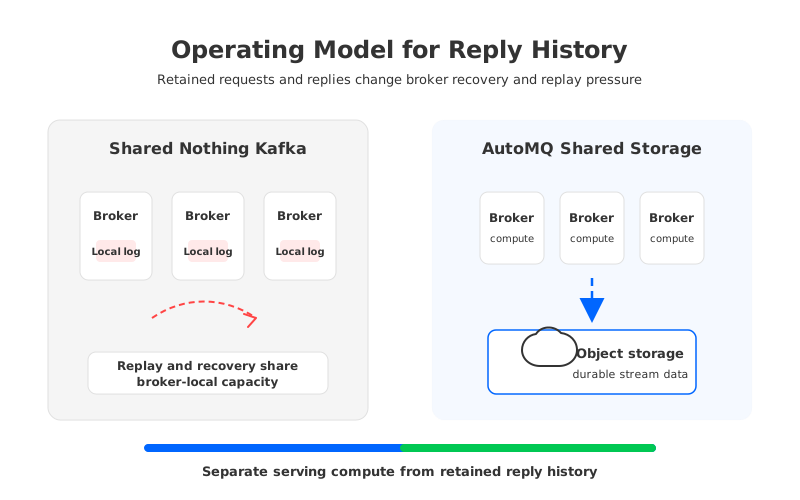
The infrastructure constraint appears when the pattern becomes popular inside a platform. Reply topics often have high fanout because gateways, audit processors, metrics jobs, and domain services all want visibility. Retention needs grow because teams want to debug delayed or missing replies. Replay jobs appear after a bad deploy, a schema issue, or a downstream outage. Traditional Kafka can support these needs, but the shared-nothing model ties durable retained data to broker-local disks and recovery behavior.
That coupling matters during incidents. A replay of reply history can compete with live request traffic. Broker maintenance can trigger data movement that affects latency. Larger retention windows can increase storage planning pressure even when the compute needed for normal traffic is modest. The application pattern may look clean in a sequence diagram, while the operating model underneath becomes a capacity and recovery problem.
| Production concern | Design question | What to verify before launch |
|---|---|---|
| Pending state | Where does the requester store correlation state across restarts? | Restart the gateway after publishing requests and confirm matching still works. |
| Late replies | What happens when a reply arrives after the caller timed out? | Test timeout, completion, duplicate delivery, and user-visible status. |
| Offset commits | When does a worker commit a consumed request? | Prove that retries do not create unsafe duplicate side effects. |
| Retention | How far back can teams replay requests and replies? | Compare retention policy with incident investigation and rebuild needs. |
| Fanout | Which teams can read reply streams? | Validate access control, schema compatibility, and consumer isolation. |
The useful architecture review starts with those questions, not with a library choice. Libraries reduce boilerplate around correlation IDs and consumers, but they do not remove the need for a platform-level contract.
3Architecture options and trade-offs
There are three common ways to implement asynchronous replies with Kafka-compatible infrastructure. The first is a gateway-owned pattern. The gateway accepts an HTTP or gRPC request, publishes a Kafka record, stores pending state in a database or cache, listens to the reply topic, and returns a response if the reply arrives before timeout. This is often the right design when external clients still expect a synchronous interface, because the gateway contains the mismatch between synchronous clients and asynchronous services.
The second option is a fully asynchronous API. The initial request returns an operation ID, and the client polls or subscribes for completion. This design makes timeouts more honest because it does not pretend that a distributed workflow can always finish inside a narrow API deadline. It works well for approvals, provisioning, analytics jobs, and any workflow where "accepted" and "completed" are different states.
The third option is service-to-service asynchronous request-reply inside the back end. A domain service writes a command and waits on a reply topic or state store. This can reduce direct coupling, but it can also recreate distributed synchronous dependencies if every service waits on another service's reply. Use the pattern where the reply is part of a durable workflow, not as a blanket replacement for every RPC call.
The partitioning model is where the architecture becomes concrete. Request topics usually key by account, order, tenant, or workflow ID so related operations remain ordered. Reply topics often key by correlation ID, requester ID, or workflow ID depending on who consumes the reply. A poor key choice can force every requester to scan a shared reply stream, while a poor partition count can turn one hot tenant into a platform-wide latency issue.
Error handling deserves the same level of detail. A failed request can produce a business rejection, a retryable technical failure, a dead-letter event, or no reply because the worker crashed before completion. Treating all of those as "timeout" makes the system hard to operate. A better design gives each terminal state a record type, investigation context, and a retention policy that matches the business risk.
4Evaluation checklist for platform teams
An asynchronous reply platform should be evaluated as a reliability system, not as a messaging shortcut. Start by writing the lifecycle as a state machine: received, published, pending, processing, completed, failed, timed out, cancelled, and expired. Then map each transition to a topic write, database update, offset commit, or metric.
For a production review, the checklist should cover both application semantics and streaming infrastructure:
- Kafka compatibility. Existing producers, consumers, security settings, serializers, and operational tools should work without a client rewrite. Compatibility is especially important when multiple teams adopt the pattern at different speeds.
- Durability boundary. The team should know whether the source of truth for pending state is Kafka, a database, a cache with persistence, or a workflow engine. Ambiguity here creates the hardest incident reviews.
- Idempotency. Request handlers and reply consumers should tolerate duplicate records. The correlation ID is a join key, not a guarantee that the world will deliver exactly one reply.
- Backpressure. Workers should slow down without losing requests, and gateways should shed load without publishing requests they cannot track.
- Replay and repair. Operators should be able to replay a narrow range by offset, time, workflow ID, or tenant without disturbing live traffic.
- Governance. Reply topics often contain sensitive decisions or derived business data. Access control, schema evolution, masking, and retention need the same attention as the request path.
- Cost model. Include broker compute, retained storage, replication, cross-zone traffic, reply fanout, observability, and replay windows. The cost of the pattern grows with operational history, not only request rate.
Cloud architecture also enters the decision. Multi-AZ deployments improve fault isolation, but cross-zone traffic, private connectivity, and recovery paths affect both cost and failure behavior. A sequence diagram that ignores zones may look simpler, but the bill and incident timeline will not.
5How AutoMQ changes the operating model
Once the evaluation points to Kafka-compatible APIs, retained history, replay-heavy repair, and cloud cost control, AutoMQ becomes relevant as a Kafka-compatible cloud-native streaming system built around shared storage. The important shift is not that the application code gets a different asynchronous reply pattern. The shift is that durable stream data is no longer treated as broker-local state that must move with broker lifecycles.
In a shared-storage architecture, brokers can behave more like stateless compute nodes while object storage holds durable stream data. AutoMQ combines Kafka compatibility with this storage model and a write-ahead log layer designed for cloud deployment. For asynchronous replies, that changes the operating model around retention, replay, and recovery. Keeping more request and reply history for audits or repairs does not have to force every broker sizing decision through local disk growth.
That separation matters when the pattern spreads across a platform. One product team may use asynchronous replies for fraud decisions, another for provisioning, and another for data access approvals. Normal traffic may be predictable, but repair traffic arrives in bursts after incidents and deployments. A platform that can scale compute and storage more independently gives SREs more room to protect live traffic while preserving the history needed to debug and replay.
AutoMQ does not remove application responsibilities. Teams still need deterministic correlation IDs, clear timeout semantics, idempotent handlers, schema discipline, and a state machine that operators can understand. What it can change is the infrastructure pressure beneath those choices: retained history can be treated as a cloud storage concern, broker compute can be planned around serving load, and cross-zone traffic controls can be evaluated as part of the deployment architecture.
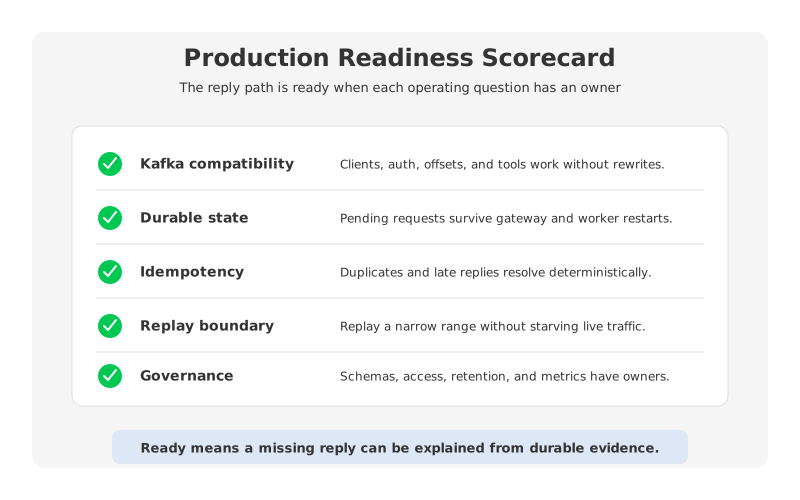
A meaningful proof of concept should test the uncomfortable cases. Publish requests, crash the requester, restart workers, delay replies beyond timeout, replay a subset of reply history, and prove that the platform can answer a basic question: for this correlation ID, what happened and which component owns the next action?
6Migration and readiness scorecard
Teams moving from synchronous calls to asynchronous replies should start with one workflow where delayed completion is acceptable and auditability matters. A good first candidate has a clear operation ID, bounded terminal states, and a business owner who can define what happens after timeout. A poor first candidate is a low-latency dependency that every request path waits on before it can continue.
The readiness scorecard should be blunt. If the requester crashes after publish, can the system recover pending state? If the worker performs the side effect twice, is the result still correct? If a reply arrives late, does the user see a coherent status? If a replay runs during business hours, can live requests keep their latency budget? If a schema change breaks one consumer, can the rest of the platform continue?
The final decision should distinguish application fit from platform fit. Some workflows should stay synchronous because the dependency is local, fast, and tightly owned. Some should become fully asynchronous because a reply inside the original call is a false promise. The asynchronous reply pattern belongs in the middle: the caller needs a meaningful answer, but the workflow needs durable coordination more than it needs a direct call stack.
If your team is evaluating Kafka-compatible infrastructure for asynchronous reply patterns, use the AutoMQ Cloud trial to test the operating questions, not only the happy path. The useful outcome is a repeatable answer for correlation, timeout, replay, and recovery before the pattern becomes a shared platform dependency.
7References
- Apache Kafka documentation: Consumer configurations
- Apache Kafka documentation: Producer configurations
- Apache Kafka documentation: Delivery semantics
- Apache Kafka documentation: Kafka Connect
- AWS documentation: Availability Zones and fault isolation
- AWS PrivateLink
- AutoMQ documentation: Architecture overview
- AutoMQ documentation: S3Stream shared streaming storage
- AutoMQ documentation: WAL storage
- AutoMQ Cloud documentation: Eliminate inter-zone traffic
8FAQ
8.1Is the asynchronous reply pattern the same as RPC over Kafka?
No. RPC over Kafka usually tries to preserve synchronous call semantics on top of topics. A production asynchronous reply pattern should model request acceptance, processing, timeout, completion, failure, and expiry as explicit states. That makes it more honest about distributed workflow behavior.
8.2Should every microservice call become an asynchronous reply?
No. Use the pattern where durable coordination, replay, and decoupled ownership matter. A direct call is often better for local, fast, tightly owned dependencies. A fully asynchronous workflow is often better when the original caller does not need a reply inside the same interaction.
8.3What is the most common implementation mistake?
The most common mistake is treating timeout as failure. Timeout only means the caller stopped waiting. The worker may still complete, retry, fail, or emit a late reply, so the system needs explicit rules for late completion and duplicate replies.
8.4Where does AutoMQ fit?
AutoMQ fits when teams want Kafka-compatible APIs with a shared-storage operating model for retained history, replay-heavy repair, and cloud deployment controls. It does not replace application-level state design, but it can reduce the broker-local storage pressure behind the pattern.


