
Table of Contents
Table of Contents
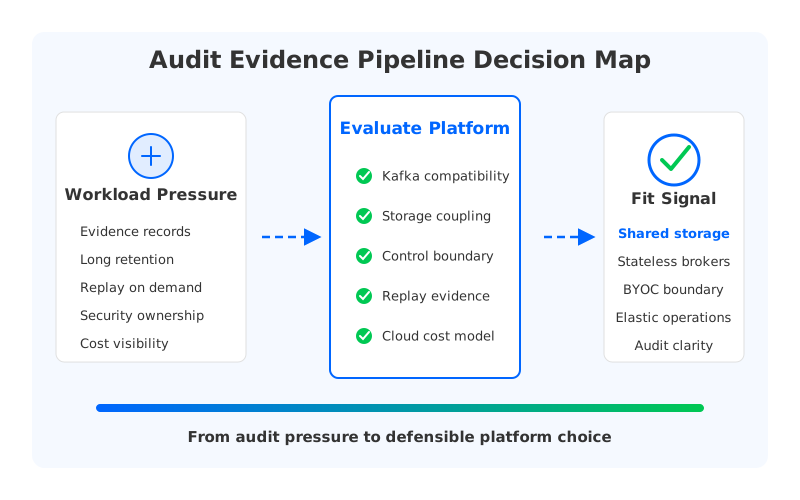
Teams search for audit evidence pipeline kafka when the streaming platform has become part of the control environment. A security review board wants to know which events prove access, approval, policy change, data movement, incident handling, or recovery. The platform team wants a durable log that can feed analytics and case management without turning every audit request into manual evidence collection.
The pressure starts when audit evidence moves from quarterly screenshots to live infrastructure. Security needs records that are complete, attributable, retained, searchable, and protected from accidental loss. Compliance teams need enough context to explain who did what, when it happened, and which policy applied. A pipeline that drops events during broker maintenance may look healthy to an application team and still fail the review board.
The useful question is not "can Kafka move audit logs?" It is "can the Kafka-compatible platform preserve audit evidence under production conditions?" The answer depends on storage architecture, client compatibility, cost model, identity boundaries, connector operations, observability, and replay safety.
1Why teams search for audit evidence pipeline kafka
Audit evidence pipelines usually begin as an integration project. Cloud activity logs, identity provider events, CI/CD approvals, database audit trails, SaaS admin logs, and application authorization records need to land somewhere. Kafka gives teams a common event backbone, consumer groups, offsets, retention controls, and a large connector ecosystem. That makes it attractive for security telemetry consumed by multiple downstream systems.
The deeper requirement appears after the first design review. Evidence is not ordinary observability data. A missing metric sample can be annoying; a missing approval event can break an investigation. The platform therefore has to treat audit evidence as a controlled data product with ownership, schema rules, retention intent, replay procedures, and access review.
This is where architecture and governance meet. Kafka can retain records, compact selected topics, coordinate consumers through committed offsets, and support transactional processing patterns. Those primitives help, but they do not automatically produce a defensible evidence pipeline. The team still has to decide which event classes are mandatory, how schemas evolve, who can read or replay evidence topics, how connectors are validated, and what happens when downstream systems are unavailable.
The review board will also ask where the evidence lives. A hosted service, self-managed cluster, BYOC deployment, or private environment can all expose a Kafka API while placing records, network paths, keys, logs, and support access in different control boundaries. If the evidence proves control, the evidence store itself becomes part of the control.
2The production constraint behind the problem
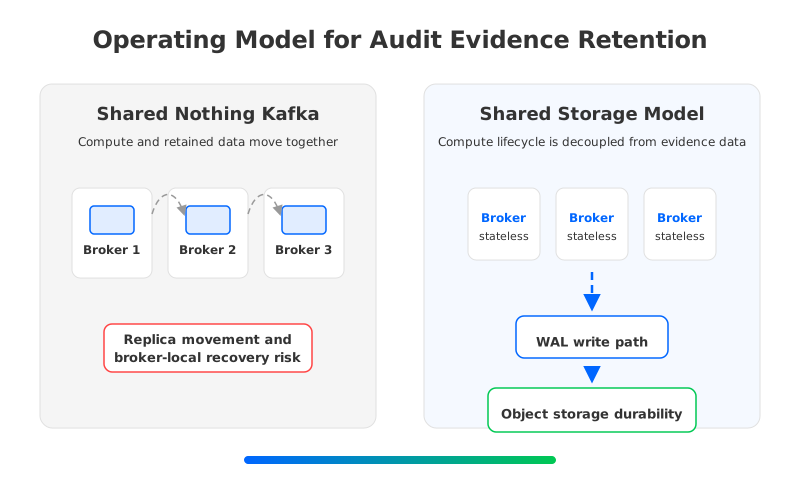
Traditional Apache Kafka was designed around brokers that own local log segments and replicate partitions across brokers. That shared-nothing model is well understood and operationally proven, but it creates friction for audit evidence pipelines in cloud environments. Storage, compute, replication, and broker lifecycle are tightly coupled. When the retained evidence window grows, the broker fleet or disks grow with it. When brokers are replaced or partitions are reassigned, data movement becomes part of the maintenance story.
For ordinary event streams, this coupling is often acceptable. For audit evidence, it shows up in uncomfortable places. Long retention increases disk planning pressure. High fan-out investigations create read amplification. Multi-AZ durability creates network and replication cost. Broker failures during a review period may force the team to explain evidence continuity.
The governance side is equally important. Security owns the control objective. Platform engineering owns the Kafka runtime. Application teams own many event sources. Data governance owns classification and retention policy. SRE owns incident response. FinOps owns cost visibility. A pipeline design that makes one of those teams invisible will eventually create a gap.
The safest architecture review separates three paths:
- Event path: how records are produced, authenticated, serialized, partitioned, retained, and consumed.
- Control path: how topics, ACLs, schemas, connectors, retention changes, keys, and emergency access are approved and deployed.
- Evidence path: how the organization proves those paths behaved correctly during operations, incidents, replay, and migration.
Those paths should be reviewed together. A pipeline can have strong encryption and weak replay evidence, excellent connector coverage and unclear access review, or low steady-state cost and high recovery cost. Security review boards care about the whole chain because attackers, outages, and auditors do not respect architecture boundaries.
3Architecture options and trade-offs
There are several reasonable ways to build an audit evidence pipeline with Kafka-compatible infrastructure. The right answer depends on data sensitivity, operational maturity, procurement model, and the review board's tolerance for external control boundaries.
| Option | Where it fits | What to challenge in review |
|---|---|---|
| Self-managed Apache Kafka | Teams that need deep control over hosts, disks, network, and security configuration | Capacity planning, broker replacement, replica movement, patching, and operational evidence are fully internal responsibilities |
| Cloud-provider managed Kafka | Teams that want reduced broker administration and cloud-native procurement | Data-plane boundary, network paths, service logs, support access, and feature constraints need explicit review |
| Hosted SaaS streaming | Teams that prioritize abstraction and provider-operated operations | Evidence location, tenant isolation, private connectivity, audit exports, and exit path must be defensible |
| Kafka-compatible BYOC or private deployment | Teams that need Kafka APIs while keeping resources in a customer-controlled environment | Shared responsibility, deployment automation, product compatibility, and customer-side controls must be tested |
The table is not a ranking. It exposes the decision surface. A small internal evidence stream with short retention may not warrant a heavy migration. A regulated payment, healthcare, public-sector, or security operations pipeline may put more weight on data residency, key ownership, network isolation, and platform auditability.
Cost deserves a precise conversation. Kafka audit evidence pipelines can look small at ingestion time and become expensive through retention, replicas, cross-zone traffic, connector fan-out, and investigation replays. Cloud pricing changes, so the review should use current provider documentation rather than inherited assumptions. The important pattern is stable: broker-local replication pays through provisioned disks, replication traffic, and headroom, while shared storage shifts the model toward storage capacity, request patterns, WAL design, and compute elasticity.
Migration risk is another trade-off that review boards often underestimate. If the pipeline already feeds a SIEM, data lake, compliance workflow, and incident response system, a platform change touches offsets, schemas, replay windows, connector state, ACLs, and downstream deduplication. Kafka compatibility reduces that risk, but the cutover plan still has to prove no evidence was skipped, duplicated without labeling, or stranded in a retired topic.
4Evaluation checklist for platform teams
A useful evaluation starts with evidence obligations rather than product features. Write down the controls the pipeline must prove, the event classes that support each control, and the systems that depend on those events. Then map the Kafka architecture underneath. Vague terms become testable only when tied to runtime behavior.
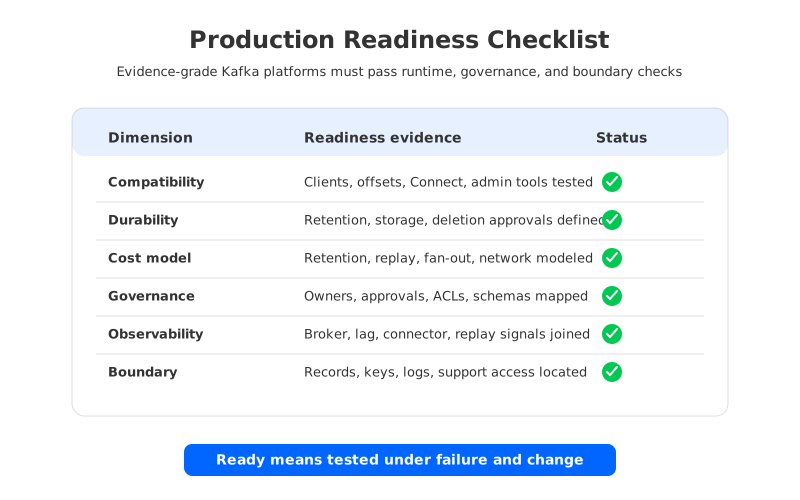
Use this checklist before approval:
- Compatibility: Validate Kafka client behavior, consumer groups, committed offsets, transactions if used, Kafka Connect, schema tooling, admin APIs, and monitoring integrations. Compatibility should be proven with representative workloads, not assumed from a marketing claim.
- Durability and retention: Define which topics are evidence-grade, how long they are retained, whether compaction is allowed, how object storage or disks are protected, and how deletion is approved.
- Cost and elasticity: Model ingestion, retention, fan-out reads, replay reads, cross-zone traffic, storage requests, compute headroom, and investigation spikes. Keep the assumptions attached to the estimate.
- Governance: Tie every topic, schema, connector, ACL, key policy, and retention exception to an owner and approval path.
- Observability: Monitor broker health, producer errors, consumer lag, connector task status, authorization failures, replay jobs, and evidence export failures in one operational view.
- Recovery and migration: Rehearse broker failure, source outage, connector restart, downstream outage, replay, region impairment, and platform migration with evidence reconciliation.
- Control boundary: Document where records, metadata, logs, metrics, encryption keys, support access, and operational automation live.
The last item is often decisive. A security review board can accept operational complexity when the boundary is clear and the evidence is strong. It is harder to approve a design where no one can say whether evidence is inside the customer's account, a provider environment, a SaaS system, or all three.
5How AutoMQ changes the operating model
Once the evaluation framework is explicit, AutoMQ becomes relevant as an architectural option rather than a shortcut around governance. AutoMQ is a Kafka-compatible cloud-native streaming platform that separates compute from storage through a shared-storage design. Brokers are stateless in the sense that durable log data is not permanently owned by broker-local disks. Object storage provides durability, while WAL storage handles the write path before data is organized into shared storage.
That design changes the operating model. In a shared-nothing Kafka deployment, a broker is both compute and a local custodian of retained log data. Replacing it, scaling it, or recovering it can involve partition movement and storage coordination. In AutoMQ's shared-storage model, broker lifecycle work is less coupled to retained evidence. The platform team still has to manage clients, ACLs, schemas, retention, connectors, and observability, but routine compute changes are less likely to become data relocation events.
Evidence pipelines must survive operational work. Separating compute and storage gives teams another lever: scale brokers for throughput and connection pressure while durable evidence lives in object storage.
AutoMQ's deployment boundaries are also relevant. AutoMQ BYOC is designed for customer-controlled cloud environments, and AutoMQ Software addresses private deployments. For teams that need evidence data, network routes, cloud resources, and audit signals inside their own control boundary, that model is easier to explain than an opaque external data plane. It does not make compliance automatic; configuration, contracts, key management, and tested operations still matter.
Zero cross-AZ traffic is another point to evaluate carefully. Traditional multi-AZ Kafka designs can create inter-zone traffic through replication and client paths. AutoMQ documents an architecture intended to eliminate inter-zone traffic in supported deployments. For audit evidence pipelines, the value is a cleaner explanation of where data moves.
Run the same audit evidence workflow against the candidate platform: produce records, consume them downstream, change ACLs, rotate a connector secret, simulate an outage, replay a time window, replace brokers, and reconcile event counts. If AutoMQ or any Kafka-compatible platform changes the operating burden, that test will show it in recovery time, operational steps, data movement, and audit artifacts.
6Decision matrix for security review boards
Security review boards do not need to become Kafka administrators, but they do need a decision matrix that prevents platform details from disappearing behind vendor labels. The matrix should score normal traffic and stress conditions.
| Review dimension | Strong signal | Weak signal |
|---|---|---|
| Evidence completeness | Event classes, schemas, owners, and reconciliation checks are documented | The pipeline only proves that bytes reached a topic |
| Platform resilience | Broker maintenance, connector failures, and replay are tested with evidence workloads | The design relies on steady-state dashboards |
| Data control | Records, keys, metadata, logs, and support access have mapped boundaries | The team uses "managed" or "private" without a resource-level diagram |
| Cost transparency | Retention, fan-out, replay, cross-zone traffic, and headroom are modeled | The estimate only covers broker instances |
| Migration readiness | Cutover, rollback, offsets, ACLs, and duplicate handling are rehearsed | Migration is treated as a client endpoint change |
| Audit artifacts | Change approvals, run logs, metrics, and reconciliation reports are retained | Evidence collection depends on screenshots after the fact |
This matrix keeps the review grounded. It prevents a team from choosing a platform because it looks simple while ignoring where evidence lives. It also prevents the opposite mistake: staying with a familiar cluster because the team has learned to work around its storage and maintenance constraints.
Start with one high-value evidence stream and make the design concrete. Pick a privileged access workflow, CI/CD approval trail, financial control, or security operations event class. Trace it from source identity to Kafka topic, from schema to retention policy, from ACL to consumer group, from replay to downstream reconciliation, and from incident runbook to audit artifact.
If that trace exposes storage coupling, unclear data boundaries, or fragile broker operations, evaluate a Kafka-compatible shared-storage model next. AutoMQ is one option for teams that need Kafka compatibility, customer-controlled deployment boundaries, object-storage-backed durability, elastic broker operations, and a clearer cloud cost model. Review the AutoMQ deployment model against your own evidence obligations, then test the pipeline before the security review board has to ask for proof.
7References
- Apache Kafka documentation: Consumers and consumer groups
- Apache Kafka documentation: Transactions
- Apache Kafka documentation: Kafka Connect
- Apache Kafka documentation: KRaft mode
- AutoMQ documentation: Compatibility with Apache Kafka
- AutoMQ documentation: Technical advantages
- AutoMQ documentation: WAL storage
- AutoMQ documentation: Eliminate inter-zone traffic
- AWS documentation: Amazon S3 data durability
- AWS: Amazon S3 pricing
- AWS documentation: AWS PrivateLink concepts
- Google Cloud documentation: Cloud Storage locations
- Microsoft Learn: Azure Storage redundancy
8FAQ
8.1What is an audit evidence pipeline in Kafka?
An audit evidence pipeline is a Kafka-backed data flow that collects, retains, processes, and exports events used to prove security or compliance controls. Typical sources include identity systems, cloud activity logs, CI/CD approvals, database audit trails, SaaS admin logs, policy engines, and authorization events. The pipeline must preserve context, ownership, retention, access control, replay behavior, and audit artifacts.
8.2Is Kafka a good fit for audit evidence pipelines?
Kafka is often a strong fit because it provides durable topics, consumer groups, offsets, replay, and a broad connector ecosystem. The platform still needs careful governance. Evidence-grade streams require schema control, least-privilege access, retention policy, reconciliation checks, connector monitoring, and recovery procedures.
8.3What should security teams review before approving Kafka for audit evidence?
Security teams should review data classification, producer identity, topic ownership, schema evolution, ACLs, encryption, key ownership, connector access, retention policy, replay procedure, operational logs, migration plans, and the deployment boundary. They should also require a failure drill that proves evidence continuity during broker maintenance, connector failure, downstream outage, and replay.
8.4How does shared storage help audit evidence pipelines?
Shared storage decouples durable log data from broker-local disks. That can reduce the operational weight of broker replacement, scaling, and recovery because retained evidence is not tied to a specific broker's local storage. It does not remove governance work, but it can make long retention and elastic compute easier to reason about.
8.5Where does AutoMQ fit in an audit evidence architecture?
AutoMQ fits when teams want Kafka compatibility with a cloud-native shared-storage architecture and customer-controlled deployment boundaries. It can be evaluated for audit evidence workloads that need object-storage-backed durability, elastic broker operations, BYOC or private deployment options, and clearer control over where data and audit signals live.


