
Table of Contents
Table of Contents
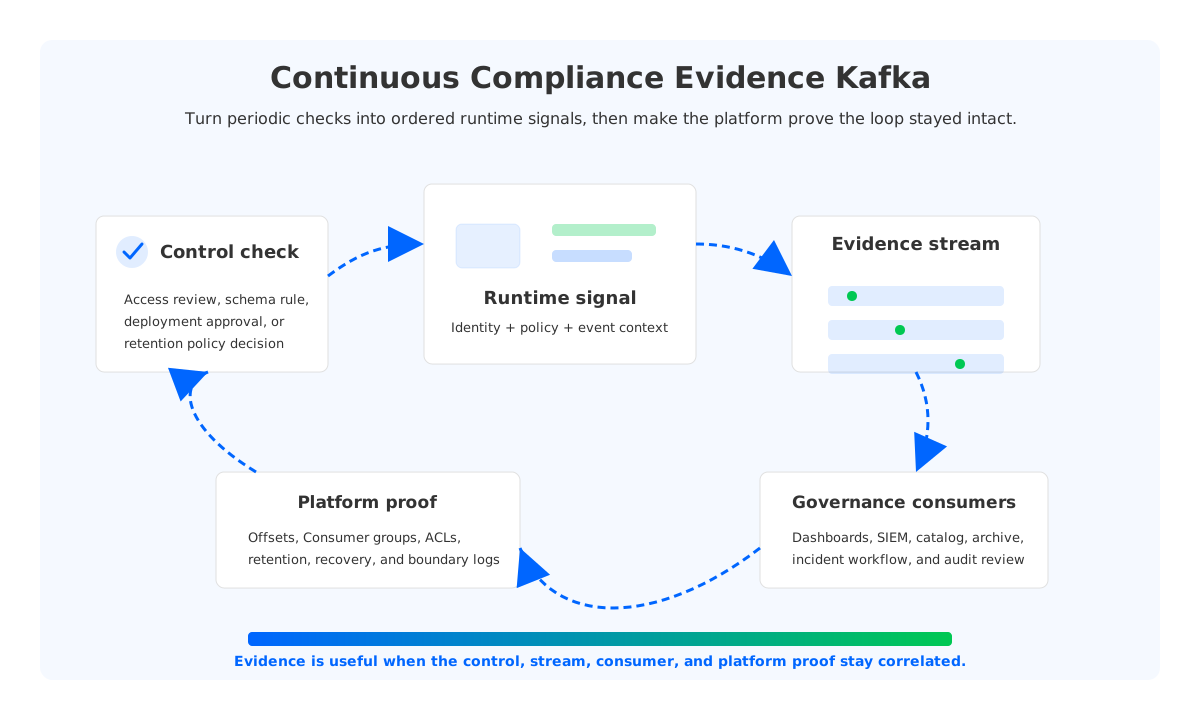
Teams search for continuous compliance evidence kafka when the quarterly control review no longer matches how production systems behave. Access policies change through automation, schemas evolve through CI/CD, and connectors move records into warehouses, applications, and security tools. A compliance team may still ask for proof in the language of reviews, but the platform team has to answer with runtime facts: which identity acted, which topic was touched, which Consumer group progressed, and whether the stream stayed recoverable.
The uncomfortable part is that compliance evidence is often collected after the system has moved on. Someone exports logs, attaches screenshots, searches tickets, and reconstructs a timeline from systems that were not designed to agree with each other. That works for slow controls. It fails when a sensitive event can be produced, transformed, consumed, retried, and archived before the next human review begins. The useful design goal is not "more audit logs." It is a runtime evidence stream that proves how a control behaved while the platform was serving traffic.
1Why teams search for continuous compliance evidence kafka
The search usually begins with a governance question and ends in architecture. Security wants continuous proof that access and data controls work. Governance wants data contracts to become enforceable, not advisory. The Kafka platform owner wants an answer that does not force every application team to invent its own audit trail. They are all describing the same shift: evidence has to move from periodic review into the event path.
Kafka is a natural place to evaluate that shift because its core primitives already express time, ownership, and replay. A Topic gives evidence a named stream. A Partition and Offset provide order within a shard. Consumer groups expose which applications have processed which part of the log. Transactions and idempotent producers help when teams need stronger write semantics. Kafka Connect can move evidence into archives, catalogs, SIEM systems, and analytical stores without coupling every producer to every downstream tool.
Those primitives are useful, but they do not create a compliance architecture by themselves. The platform still needs an evidence model that connects policy decisions, producer identity, schema or contract validation, authorization, Consumer group progress, connector delivery, retention, observability, and recovery drills. Without that correlation, a team may have plenty of logs and still be unable to answer the question auditors and incident responders care about: what happened to this stream interval, and how do we know?
2The production constraint behind the problem
Continuous evidence changes the workload. A periodic control review may generate a report once a month. A runtime evidence system produces records whenever a permission changes, a producer writes a sensitive event, a schema rule evaluates, a connector exports data, or an operator changes configuration. The stream becomes both a control artifact and a production dependency.
That dependency creates pressure in four places:
- Retention: Evidence topics often need longer retention than operational metrics because they must support audits, investigations, and replay.
- Replay: Governance teams need to rebuild the event path for specific intervals, which can create catch-up reads while live producers and consumers continue to run.
- Correlation: The evidence stream must connect application facts with platform facts, including identities, ACLs, Offsets, Consumer groups, connector state, and storage health.
- Boundary control: Regulated teams need to know where data, metadata, logs, object storage, network paths, and support actions live.
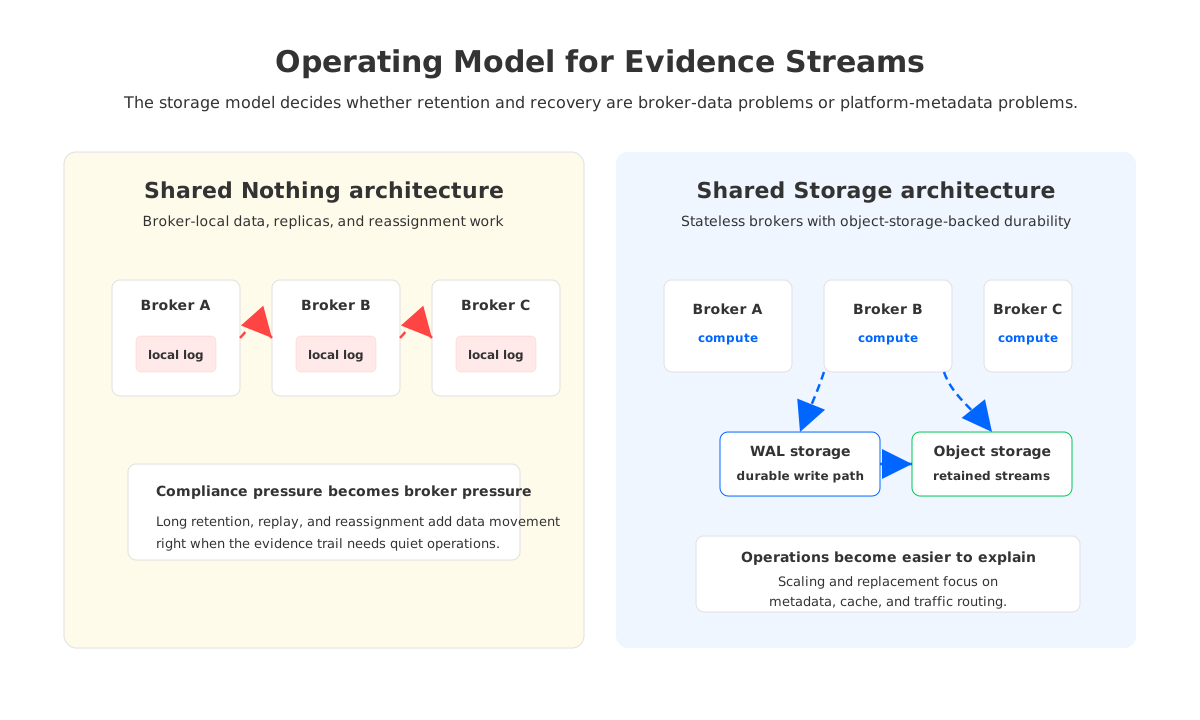
Traditional Kafka can support evidence workloads, but its Shared Nothing architecture turns many of these requirements into broker-local storage and operations questions. Each broker manages local log storage, and replication keeps copies across brokers. Longer retention needs storage headroom. Replay adds historical reads. Scaling or maintenance can trigger partition reassignment at the same moment the team wants a calm, explainable audit trail.
Tiered Storage changes part of this equation by moving older log segments to remote storage. That can help long-retention topics when the active log remains manageable and historical reads are well understood. It does not make brokers stateless or remove local-log, metadata, leadership, and recovery considerations. For continuous compliance evidence, the platform is not only storing old records; it is proving that evidence stayed available while the system changed.
3Architecture options and trade-offs
A useful platform review separates evidence capture from evidence storage, governance workflow, and platform recovery. Producer-side capture is closest to the business action and can record domain context the Kafka platform cannot infer. Its weakness is consistency: different teams, languages, and release cadences can produce uneven evidence without strong contracts and enforcement.
Centralized governance collection gives security and compliance teams a common intake path for IAM logs, deployment approvals, schema changes, access reviews, catalog updates, and platform metrics. That makes reporting easier, but it can become a delayed log sink when evidence is not treated as ordered runtime data. A collector that receives events hours later may be useful for reporting and weak for incident response.
Kafka-native evidence streams sit between those extremes. The platform can carry control events as ordered records, expose replay through Offsets, and distribute the same evidence to multiple consumers. This pattern works best when teams define the evidence stream as a production data product with ownership, schemas, retention classes, dead-letter handling, replay procedures, and monitoring.
The review should use the same questions for every option.
| Evaluation area | What to verify | Strong signal |
|---|---|---|
| Kafka compatibility | Existing clients, connectors, ACL workflows, and tools continue to work. | Evidence controls do not require a broad client rewrite. |
| Runtime correlation | Identity, contract result, Offset, Consumer group state, connector delivery, and platform event can be joined. | A team can reconstruct the evidence path without manual archaeology. |
| Storage model | Retention and replay are planned as first-class workloads. | Evidence windows do not depend on fragile broker-local capacity assumptions. |
| Failure recovery | Broker failure, controller failover, storage disruption, and operator mistakes are tested against the evidence workload. | The audit trail survives the incident that triggers review. |
| Governance boundary | Data plane, control plane, VPC, IAM, encryption, observability, support access, and object storage ownership are explicit. | Security reviewers can inspect where records and actions reside. |
| Migration path | Offsets, rollback, linking, access controls, and evidence continuity are tested together. | A platform change does not create a blind spot in the audit timeline. |
This table is vendor-neutral, and it shows why "audit logging" is too small a category. A platform can expose admin logs and still fail the evidence workload if retained records are hard to replay, Consumer group state is disconnected from delivery, or storage recovery is too noisy to explain.
4Evaluation checklist for platform teams
The first checklist item is taxonomy. Decide which events belong in the evidence stream and which belong in surrounding systems. Access grants, ACL changes, service-account creation, schema decisions, data contract exceptions, topic configuration changes, connector deployment, key-policy changes, and incident actions are good candidates because order and replay matter. A dashboard refresh or static approval may not need to be a Kafka record unless it participates in a runtime decision.
The second item is identity. Every evidence event should carry the actor, resource, evaluated policy, and timestamp source. For application events, that may involve producer identity and domain ownership. For platform events, it may involve cloud IAM, Kafka ACLs, service accounts, CI/CD actors, and operator workflows. Weak identity creates weak evidence even when the data is durable.
The third item is contract enforcement. Data contracts should define more than JSON shape or Avro compatibility. Regulated streams often need required fields, privacy tags, purpose labels, retention classes, masking rules, and exception handling. The evidence model should show where each check runs and how failures become visible.
The fourth item is replay design. Teams should be able to name the Offset interval, Consumer groups, connector tasks, downstream systems, and archive state involved in a suspicious event window. A plan that says "we can rerun the job" is too vague. The stronger plan says which consumers rewind, how duplicate effects are handled, and which metric proves completion.
The fifth item is negative evidence. A mature control system does not show only successful paths. It records missing producers, schema failures, denied access attempts, dead-letter events, delayed consumers, connector failures, retention-policy violations, and recovery gaps. That visibility is what makes the control credible.
5How AutoMQ changes the operating model
After the neutral review, AutoMQ becomes relevant for teams that need Kafka-compatible behavior, customer-controlled deployment boundaries, and less coupling between retained stream data and broker-local disks. AutoMQ is a Kafka-compatible streaming platform built around Shared Storage architecture. It preserves the Kafka protocol and ecosystem while replacing Kafka's native log storage with S3Stream, WAL (Write-Ahead Log) storage, and S3-compatible object storage.
The architectural shift changes the evidence conversation. In a Shared Nothing cluster, broker replacement, scaling, and reassignment often involve local data placement and replication work. In AutoMQ's Shared Storage architecture, durable stream data is not owned by a specific broker disk. Brokers act as stateless compute nodes for protocol handling, leadership, caching, and traffic routing, while durable data lives in shared storage. A retention-heavy evidence stream can then be evaluated against object storage policy, WAL health, metadata correctness, cache behavior, and access boundaries.
This is not a promise that compliance becomes automatic. It changes what the team has to prove. Instead of proving that long-retained evidence data can survive a broker-local storage operation, the team can focus on whether the WAL path is durable, object storage access is controlled, metadata remains consistent, consumers recover from known Offsets, and observability catches gaps.
Deployment boundary carries the same weight as storage boundary. AutoMQ BYOC runs the control plane and data plane inside the customer's cloud account and VPC. AutoMQ Software is designed for customer-managed private environments. For compliance evidence, that gives reviewers concrete places to inspect: cloud IAM, private network paths, object storage ownership, logs, metrics, support access procedures, and the runtime data path.
AutoMQ also fits a broader governance stack. Kafka-compatible clients, Kafka Connect pipelines, Schema Registry workflows, data contracts, observability systems, and long-term archives can remain part of the design. Kafka Linking can be evaluated for migration continuity where offset consistency matters. Self-Balancing can be evaluated for evidence workloads that change traffic shape. Table Topic can be evaluated when selected streams should flow into Apache Iceberg tables for analytical review. The point is to evaluate whether Shared Storage architecture makes the evidence system easier to operate and prove.
6Readiness scorecard
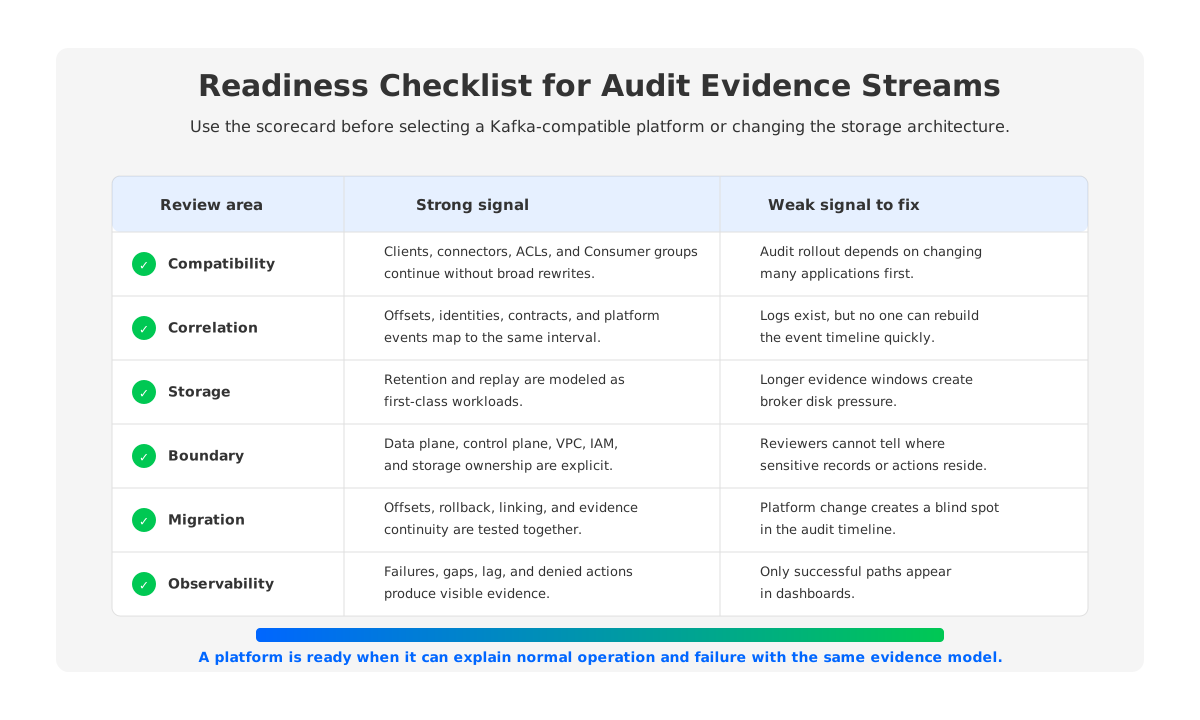
A good scorecard turns abstract compliance goals into testable platform work. Start with compatibility: inventory client versions, serializers, transactional producers, Consumer groups, Kafka Connect workers, ACL workflows, and operational tools. If the evidence architecture requires a large client rewrite, the control will be delayed by application adoption.
Then test correlation under load. Produce controlled events, trigger contract failures, change ACLs, run connector tasks, pause consumers, and replay a known interval. The team should be able to follow the evidence from producer identity to topic, Offset, Consumer group, downstream delivery, archive, and alert.
Storage and recovery deserve their own test. Increase retention on evidence topics, run catch-up reads, replace brokers, fail a component, and verify that the evidence stream still explains itself. Measure produce errors, consumer lag, replay completion, missing records, and archive completeness. The important result is whether the platform can show what happened when operations were imperfect.
Finally, review the boundary. Map where the data plane runs, where the control plane runs, which cloud account owns object storage, which identities can operate the platform, which logs leave the environment, and how support access is approved. These details become the first questions in a serious compliance review.
7FAQ
7.1What is continuous compliance evidence in Kafka?
Continuous compliance evidence in Kafka is the practice of producing control evidence as ordered runtime events. Instead of reconstructing proof from tickets and logs, teams capture access changes, policy decisions, data contract results, connector activity, platform changes, and recovery signals while the system is running.
7.2Is Kafka enough for continuous compliance evidence?
Kafka provides useful primitives such as Topics, Partitions, Offsets, Consumer groups, transactions, and Kafka Connect integration. Teams still need identity design, data contracts, ACL governance, retention policy, replay procedures, observability, incident workflow, and deployment-boundary review.
7.3How are audit logs different from evidence streams?
Audit logs usually record that an action happened. Evidence streams connect the action to runtime context: which policy evaluated it, which event interval it affected, which consumers processed it, which connector delivered it, and whether the platform could recover or replay it.
7.4Does Shared Storage architecture replace Tiered Storage?
They solve different parts of the problem. Tiered Storage moves older log segments to remote storage while Kafka brokers still manage the active local log. Shared Storage architecture moves durable stream data away from broker-local disks, making brokers stateless compute nodes. For evidence workloads, that changes how teams reason about retention, recovery, scaling, and broker replacement.
7.5When should AutoMQ be evaluated?
Evaluate AutoMQ when the team needs Kafka-compatible streaming, customer-controlled deployment boundaries, long-retention evidence topics, replay under operational pressure, and a storage model that reduces dependence on broker-local disks. The proof of concept should use real evidence topics and test migration, replay, failure recovery, and access controls together.
The search that began as continuous compliance evidence kafka should end with a concrete operating test: can the platform prove what happened while producers, consumers, policies, storage, and operators were all changing? If your team is evaluating a Kafka-compatible Shared Storage architecture for governed streaming, review AutoMQ's architecture and deployment model, then run the scorecard against your own evidence workload: start with AutoMQ BYOC or Software.
8References
- Apache Kafka official documentation
- Apache Kafka Tiered Storage
- Apache Kafka transactions
- Apache Kafka Connect
- Apache Kafka KRaft
- AutoMQ compatibility with Apache Kafka
- AutoMQ Shared Storage architecture overview
- AutoMQ WAL storage
- AutoMQ zero cross-AZ traffic
- AutoMQ Table Topic overview
- AutoMQ migration overview


