
Table of Contents
Table of Contents
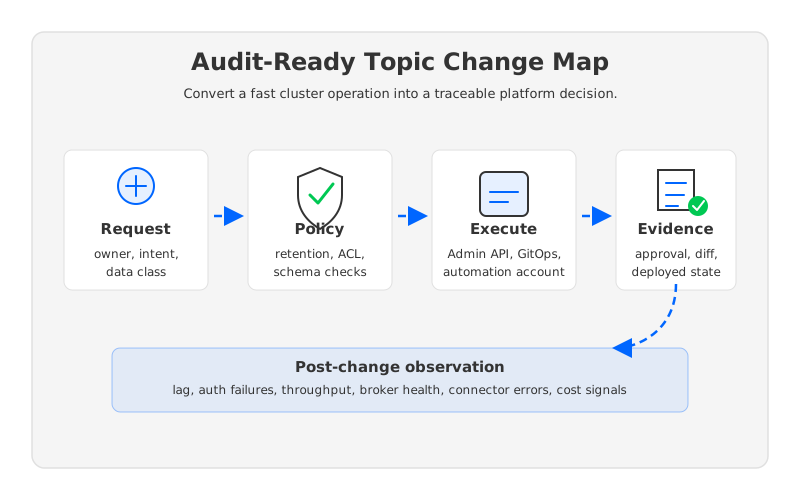
The uncomfortable moment in a Kafka review rarely starts with a broker failure. It starts with a question from security, risk, or an application owner: who changed this topic, why was retention modified, and which consumers were affected? In regulated environments, a topic is not only a technical object. It is a contract for retention, replay scope, access boundaries, schema expectations, chargeback, and sometimes legal evidence. A harmless-looking CLI change can become a governance incident when the platform team cannot reconstruct intent, approval, blast radius, and rollback readiness.
That is why teams search for audit ready Kafka topic changes. They are not looking for a prettier form around kafka-topics.sh. They are trying to turn topic creation, partition changes, retention updates, ACL modifications, and connector dependencies into a controlled operating model. Kafka exposes powerful administrative primitives, while enterprises need workflow evidence for ownership, approvals, policy checks, and results.
1Why topic changes become governance work
Kafka topic changes are deceptively small because the command surface is small. A platform engineer can create a topic, update configuration, or grant access in seconds. The downstream consequences take longer to understand. Retention affects replay and storage cost. Partition count affects ordering assumptions, consumer parallelism, and broker load. ACLs define which applications can read or write regulated data. Schema compatibility rules decide whether consumers fail fast, drift silently, or process records they no longer understand.
The gap between execution speed and governance speed is where audit risk appears. The platform team may know that a change was safe because they discussed it, reviewed a ticket, or watched metrics after deployment. An auditor cannot rely on memory. Evidence has to show the requested state, approved state, deployed state, and observed result.
For shared streaming platforms, the evidence also needs to cross team boundaries. A payment topic may be owned by one product group, consumed by fraud analytics, mirrored into a lakehouse, and inspected by security monitoring. A retention change for the payment team can change replay costs for analytics and evidence windows for risk. If the platform treats a topic as a broker-local resource rather than a governed data product, the review trail breaks exactly where the organization needs it most.
2The change types that need an audit trail
Not every Kafka operation deserves the same level of friction. Regulated teams get into trouble when they apply one process to every change, then watch developers bypass it because the process is too slow. A useful model classifies topic changes by the kind of risk they introduce.
| Change type | Typical risk | Audit evidence to retain |
|---|---|---|
| Topic creation | Unowned data products, missing classification, weak defaults | Requester, owner, data class, default configs, approval |
| Retention update | Lost replay window, higher storage cost, longer compliance exposure | Previous value, proposed value, reason, affected consumers |
| Partition increase | Ordering surprises, consumer rebalance pressure, broker load | Workload rationale, client readiness, rollback note |
| ACL change | Unauthorized access or broken application flows | Principal, resource, operation, approval, expiry if temporary |
| Connector dependency | Hidden sink/source side effects | Connector owner, target system, lag and error checks |
| Schema or contract change | Consumer breakage and semantic drift | Compatibility result, impacted consumers, release link |
This table is intentionally operational. It does not turn every topic update into a legal review. It asks the team to record the minimum context needed to explain why a change was safe for connected systems. That context is often missing from the Kafka control plane because Kafka focuses on cluster state, not enterprise workflow state.
3A neutral architecture for audit-ready changes
The cleanest pattern is to separate request intent from execution authority. Application teams should describe the topic state they need, while the platform control plane validates that request against policy before applying it to Kafka. That policy layer can live in an internal developer platform, GitOps workflow, service catalog, or governance tool. The important part is not the tool name. The important part is that the workflow creates a durable record before the cluster state changes.
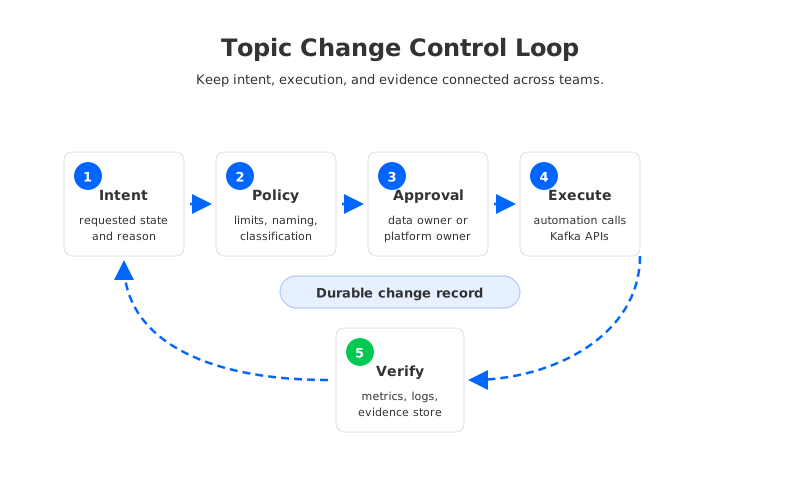
A practical flow has five stages. First, the requester submits a desired topic change with ownership, classification, environment, and business reason. Second, automated checks compare it against naming rules, retention limits, data classification policy, ACL templates, and quota boundaries. Third, the right approver reviews only changes that exceed policy thresholds. Fourth, an automation account applies the change through Kafka administrative APIs. Fifth, the platform records the deployed state, links it to observability signals, and keeps evidence available.
That sequence matters because each stage answers a different audit question. The request explains intent. The policy check explains why the change was allowed. The approval explains who accepted the risk. The execution record explains what changed. The post-change observation explains whether the system behaved as expected.
Apache Kafka already provides the technical foundation for many of these operations. The AdminClient API exposes administrative actions such as describing and altering configurations. Kafka ACLs let teams manage authorization for cluster resources, including topics and consumer groups. KRaft moves Kafka metadata management into Kafka itself rather than ZooKeeper, which simplifies the operational model for teams standardizing on current Kafka releases. These capabilities are necessary, but they are not sufficient by themselves. Audit readiness comes from binding those capabilities to an evidence-producing workflow.
4Shared platforms need policy, not heroics
The usual anti-pattern is a privileged operations channel where senior engineers make manual changes because they know the system well. That can work for a small platform. It collapses when the platform becomes a shared service with many application teams, several environments, and regulated data classes. The problem is not engineer competence. The problem is that manual expertise leaves too much context outside the system of record.
Good policy design removes ambiguity from common changes. A platform team can define safe defaults for replication, retention, cleanup policy, minimum in-sync replicas, compression, and ACL templates. It can also define escalation rules: temporary access to restricted topics requires expiry; retention beyond a threshold requires data owner approval; partition changes on ordered event streams require consumer owner acknowledgement. These rules should be explicit enough that most requests are resolved automatically, with human review reserved for exceptions.
There is a cost angle hiding inside this governance problem. Retention and fan-out are not only compliance settings. They also shape storage, network, and compute demand. In traditional Kafka deployments, long retention and catch-up reads can increase pressure on broker-local disks. Partition changes can trigger data movement. Cross-AZ replication and consumption can show up in cloud networking bills. A change workflow that ignores cost will pass technical checks while still creating a FinOps surprise.
The audit trail should capture cost-sensitive fields alongside security-sensitive fields. Retention, expected write throughput, read fan-out, mirror requirements, and data locality are part of the same decision. When those fields are available at request time, the platform can warn teams before a small topic change becomes an expensive pattern.
5Where traditional Kafka architecture adds operational drag
Traditional Kafka's Shared Nothing architecture binds partitions and their durable log segments to broker-local storage. That design is well understood, and it remains a solid fit for many deployments. It also means that some administrative changes are coupled to broker capacity, disk placement, partition reassignment, and replica movement. When a regulated platform grows, the governance process starts depending on operational timing: whether the cluster has enough headroom, whether reassignment will compete with production traffic, and whether a rollback is realistic during a release window.
Tiered Storage reduces some pressure by moving older log segments to remote storage, a direction formalized in Apache Kafka's KIP-405. That is valuable for retention-heavy workloads, but it does not make brokers stateless. The active write path, leadership, metadata, and operational duties still require careful capacity planning. Platform teams should be precise about this distinction because audit-ready changes depend on predictable execution. A workflow can approve a change, but the architecture still determines how disruptive the change is to apply.
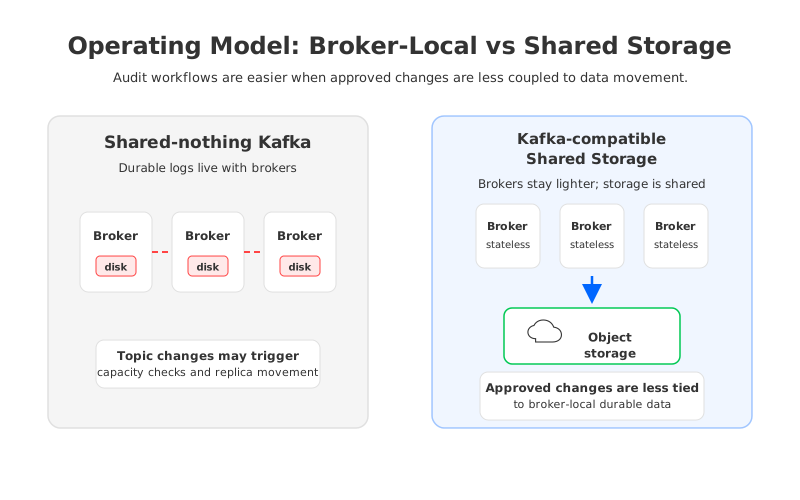
This is where a Kafka-compatible Shared Storage architecture changes the operating model. If brokers are less tied to durable local data, the platform has more room to scale compute, recover nodes, and rebalance workload without turning every storage-heavy operation into a broker-local movement project. Governance remains necessary, but execution risk behind approved changes becomes easier to reason about.
6How AutoMQ fits after the evaluation
If the platform requirement is Kafka compatibility plus lower operational coupling between topic changes and broker-local storage, AutoMQ belongs in the architecture discussion. AutoMQ is a Kafka-compatible streaming platform that uses a Shared Storage architecture and Stateless brokers to separate compute from durable stream storage. The goal is not to replace governance with architecture. The goal is to make approved governance decisions easier to execute predictably.
For an audit-ready topic workflow, the most relevant AutoMQ properties are practical. Kafka protocol compatibility lets existing clients, tools, and operational habits remain familiar. Shared Storage architecture reduces the amount of durable state bound to individual brokers. Stateless brokers make capacity changes and failure recovery less dependent on moving large volumes of broker-local data. AutoMQ's documented Zero cross-AZ traffic approach is also relevant for teams that want governance workflows to account for cloud networking cost instead of discovering it after deployment.
The product fit is strongest when the platform team already knows what it wants to control: topic lifecycle, ACL lifecycle, retention policy, schema contract, migration windows, and observability. AutoMQ does not remove the need for a request system, approval model, or catalog. It gives that control plane a data plane whose storage and compute behavior aligns better with cloud-native operations.
7A readiness checklist for platform teams
An audit-ready topic workflow is mature when a reviewer can reconstruct a change without interviewing the engineer who made it. The checklist below is a useful design target before building or buying more tooling.
| Readiness area | Question to answer before rollout |
|---|---|
| Ownership | Can every topic be traced to an application owner, data owner, and platform contact? |
| Policy | Are naming, retention, ACL, schema, and quota rules enforced before execution? |
| Evidence | Does each change record include request, approval, deployed state, and actor identity? |
| Compatibility | Are clients, connectors, schemas, and consumer groups checked before risky changes? |
| Cost | Are retention, fan-out, cross-AZ traffic, and storage growth visible at request time? |
| Rollback | Does the workflow define what can be reverted and what needs compensating action? |
| Observability | Are lag, error rate, throughput, authorization failures, and broker health checked after deployment? |
The checklist also prevents a common governance mistake: treating the audit log as the goal. An audit log is useful only if the upstream process captures meaningful intent and the downstream platform can execute the change safely. A perfect log of a bad decision is still a bad decision.
8Migration and rollout advice
The safest way to introduce audit-ready topic changes is to start with high-value workflows rather than all Kafka operations. Topic creation and ACL changes are usually good first candidates because they have clear ownership boundaries and frequent developer demand. Retention and partition changes can follow once the platform has enough observability to explain cost and performance impact.
For existing clusters, avoid a big-bang policy rollout. Import current topics into a catalog, mark unknown owners as remediation work, and define defaults for new topics before forcing legacy topics into perfect compliance. Then put the change workflow in front of new requests. Over time, the platform can turn exceptions into explicit debt rather than leaving them as undocumented reality.
Migration to a Kafka-compatible platform should follow the same evidence standard. Teams need compatibility checks, dual-run validation where appropriate, offset confidence, rollback criteria, and a clear cutover path for producers and consumers. If AutoMQ is part of that evaluation, use its Kafka compatibility, migration, Shared Storage architecture, and observability documentation as validation inputs, not as a substitute for workload-specific testing.
The practical endpoint is a streaming platform where change control is not a bottleneck. Developers can request topics and access through a predictable path. Platform engineers can enforce policy without becoming a manual ticket queue. Security and risk teams can review evidence without reverse-engineering cluster history. FinOps teams can see why a retention or fan-out decision changed cost. That is what audit-ready Kafka topic changes should mean in production.
When your next topic review asks who changed what and why, the answer should come from the platform, not memory. To evaluate whether a Kafka-compatible Shared Storage architecture can simplify that operating model, review the AutoMQ architecture and Kafka comparison here: AutoMQ vs Apache Kafka.
9References
- Apache Kafka topic configuration documentation
- Apache Kafka AdminClient API documentation
- Apache Kafka authorization and ACL documentation
- KIP-405: Kafka Tiered Storage
- AutoMQ architecture overview
- AutoMQ compatibility with Apache Kafka
- AutoMQ zero inter-zone traffic overview
- AutoMQ WAL storage documentation
- AutoMQ migration overview
10FAQ
10.1What does audit-ready mean for Kafka topic changes?
Audit-ready means that a platform can reconstruct the full lifecycle of a change: who requested it, who approved it, which policy checks ran, what was deployed, and what happened after deployment. It is stronger than keeping a shell history or a ticket comment because it links intent, execution, and observed outcome.
10.2Which topic changes should require approval?
Approval should be risk-based. Topic creation with standard defaults may be automated. Retention increases, access to restricted data, partition changes on ordering-sensitive streams, and connector changes that affect downstream systems usually deserve stronger review. The exact thresholds should come from data classification, business criticality, and platform capacity policy.
10.3Can Kafka ACLs alone make topic changes audit-ready?
Kafka ACLs are necessary for authorization, but they do not capture the full governance workflow. Teams still need request context, approval evidence, ownership metadata, expiry rules for temporary access, and post-change validation. ACLs answer whether a principal is allowed to act; the audit workflow explains why the access exists.
10.4How does Shared Storage architecture help with regulated streaming operations?
Shared Storage architecture separates durable stream data from individual broker-local disks. In a Kafka-compatible design such as AutoMQ, that separation can reduce the operational coupling between governance-approved changes and broker-local data movement. The result is not automatic compliance, but it can make capacity changes, recovery, and workload balancing easier to execute inside controlled processes.
10.5Should every organization build a custom topic governance platform?
No. Some teams can start with GitOps, a service catalog, or an internal developer portal that calls Kafka administrative APIs. The key is to enforce policy before execution and preserve evidence after execution. The tooling can evolve as the number of teams, regulated data classes, and Kafka environments grows.


