
Table of Contents
Table of Contents
Teams searching for alert routing event streams kafka usually have a practical problem, not a taxonomy problem. A Kafka alert fired, the on-call rotation received a page, and the early part of the incident was spent deciding whether the owner was the application team, the platform team, the observability team, or the group that owns a downstream database. The stream did exactly what it was designed to do: it preserved a durable sequence of events. The operating model around that stream was less precise.
Alert routing becomes harder when Kafka is used as shared infrastructure. A single Topic may feed fraud detection, customer notifications, materialized views, warehouse ingestion, and machine learning features. One symptom, such as Consumer lag, may mean a slow consumer, a blocked sink connector, a broker under storage pressure, a bad deployment, or a deliberate replay. Automation helps only when the route preserves that context. Otherwise, it turns one ambiguous alert into several faster ambiguous alerts.
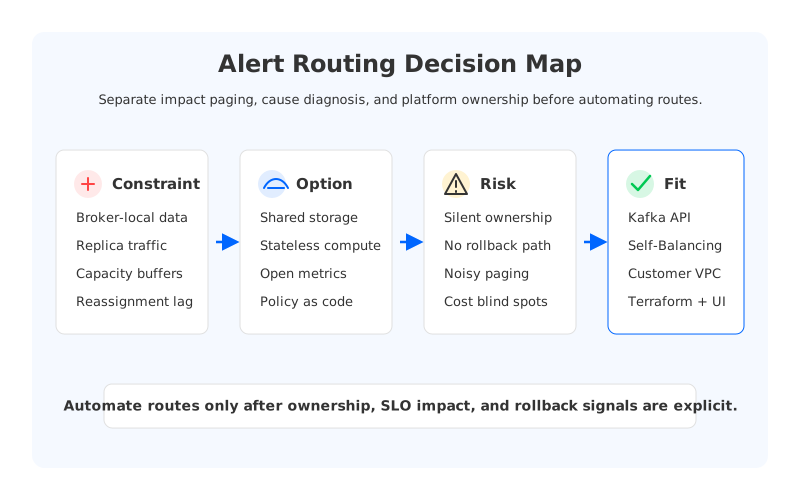
The useful boundary is not “automate everything” versus “make humans inspect every graph.” Automate where ownership, impact, and rollback are explicit; keep human judgment where the system cannot yet distinguish business impact from infrastructure noise. That boundary depends on Kafka semantics, platform architecture, cost visibility, and migration maturity.
1Why teams search for alert routing event streams kafka
The search phrase usually appears after a team has moved past basic monitoring. They already collect broker metrics, client errors, connector failures, Consumer group lag, and dashboard panels. The pressure comes from the gap between seeing a signal and knowing where it should go. For a stream that carries payment events, a lag spike may page the payments team if checkouts are delayed, the platform team if brokers are saturated, or the data platform team if a sink connector is throttled. Routing by metric name alone is too coarse.
Kafka makes this especially visible because its operational signals sit between application behavior and infrastructure behavior. Producers define keys, batching, retries, idempotent producer settings, and transactions. Consumers define group membership, poll loops, committed Offset progress, replay behavior, and downstream idempotency. Kafka Connect adds source and sink task ownership. The platform owns topics, partitions, quotas, ACLs, storage, network placement, and broker lifecycle. An alert that ignores those layers will route faster than it explains.
A workable alert routing model starts by separating three questions:
- Impact owner: This is the service, workflow, or customer-facing function affected by the stream delay, data loss risk, or processing failure.
- Diagnosis owner: This may be a platform engineer reading broker, storage, network, and controller signals, or an application team reading consumer code and downstream errors.
- Action owner: The owner of a remediation path must also own its rollback path, whether that path changes a connector task, scales compute, updates a quota, promotes a migration target, or pauses a consumer.
That split sounds procedural, but it is also architectural. If the streaming platform cannot expose the right ownership labels, isolate noisy tenants, show cost and capacity pressure, or recover without large data movement, the routing policy will keep absorbing infrastructure uncertainty.
2The production constraint behind the problem
Traditional Kafka runs on a Shared Nothing architecture: each broker owns local storage, and reliability comes from leader/follower replication across brokers. This model is familiar and proven, but it turns many operational events into stateful broker events. A broker is not only a compute process that accepts requests. It is also the place where partition replicas, local logs, page cache behavior, disk capacity, and reassignment work meet.
That coupling affects alert routing in subtle ways. A lag alert may start as an application symptom, but the cause may be a broker-local storage bottleneck. A scaling alert may look like a capacity action, but adding brokers can require partition reassignment and data movement. A recovery alert may begin with one failed node, but the route has to account for replica catch-up, under-replicated partitions, controller decisions, and network traffic. The platform can automate parts of this, but the automation still works inside a stateful operating model.
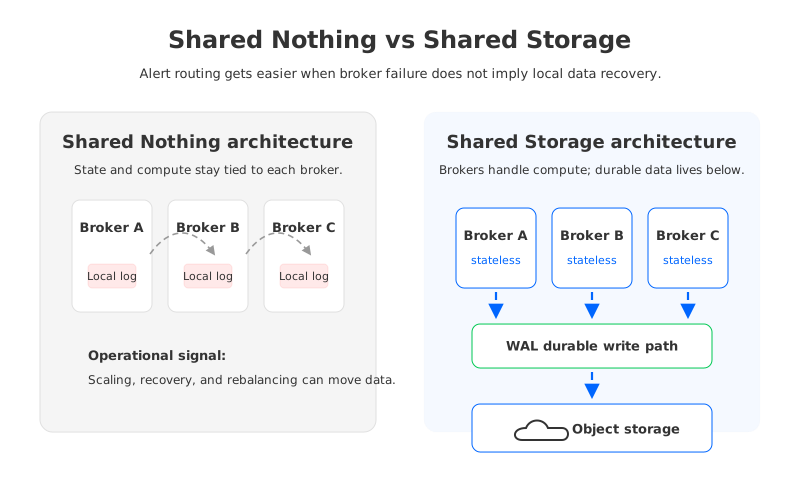
The storage model also shapes cost signals. Multi-Availability Zone deployments protect service availability, but server-side replication and cross-zone client paths can create network charges in clouds where cross-zone transfer is billed. If the alerting system has no way to distinguish “consumer is slow” from “consumer is reading across zones because locality is wrong,” the page goes to the wrong team. Cost alerts become operational alerts because cost is often a symptom of data movement, not only a finance line item.
Capacity planning adds another boundary. Many Kafka teams keep extra broker, disk, and network headroom because emergency scaling is not small. That headroom reduces incident frequency, but it also hides routing problems. A cluster can look stable until a replay, seasonal spike, or sink outage consumes the buffer.
3Architecture options and trade-offs
The first option is to improve alert routing on the existing Kafka footprint. This is often the right starting point. Add topic ownership metadata, map Consumer groups to services, separate impact alerts from diagnostic alerts, and require every automated route to include a runbook and rollback path. Prometheus and Grafana can support this pattern well when labels are consistent and dashboards reflect service ownership rather than only broker internals.
The second option is to add a control plane around Kafka operations. A control plane can enforce topic templates, ACL policy, quotas, labels, service accounts, dashboard registration, and contact metadata. It can also prevent alert routing from becoming a free-form chat convention. The risk is false confidence: a control plane can describe desired state, but it cannot remove the underlying cost of broker-local storage, replication traffic, or slow reassignment if the data plane still behaves the same way.
The third option is to evaluate Kafka-compatible platforms that change the operating model. This is where architecture matters more than a feature checklist. A platform that keeps Kafka protocol and ecosystem compatibility while separating durable storage from broker compute changes the failure and scaling boundaries. Broker replacement becomes less about recovering local data. Scaling becomes less tied to moving partition replicas. Alert routing can focus more on ownership, workload behavior, and policy outcomes.
Use a matrix before choosing where automation belongs:
| Evaluation area | What to verify | Why it affects alert routing |
|---|---|---|
| Kafka semantics | Consumer group behavior, Offset handling, transactions, client compatibility, and Kafka Connect support | Routing and migration must not break application contracts. |
| Ownership metadata | Topic owner, service owner, data class, SLO, runbook, and escalation path | Automation needs a destination that is more precise than a broker name. |
| Storage and recovery model | Whether broker failure requires local data recovery or heavy replica movement | Recovery alerts change when durable data is not tied to a failed broker. |
| Network and cost visibility | Cross-zone paths, PrivateLink or VPC routing, connector placement, and replay traffic | Some “cost alerts” are really topology or locality alerts. |
| Change safety | Terraform coverage, policy review, rollback steps, and drift detection | Automated remediation is unsafe without a reversible control surface. |
| Migration readiness | Topic sync, Consumer group progress, offset behavior, client cutover, and rollback drills | Routing should not depend on assumptions that migration will later invalidate. |
The matrix also keeps the discussion neutral. A team may decide that its current Kafka architecture is adequate and that the next investment should be ownership labeling and runbook quality. Another team may discover that most pages are downstream application issues, not broker issues. A third team may find that broker-local data movement keeps turning routine capacity changes into incidents. Those are different problems, and they deserve different automation boundaries.
4Evaluation checklist for platform teams
Good alert routing has two layers. The first layer is semantic: what does this alert mean in Kafka terms? Consumer lag is not one condition; it is a difference between the latest produced Offset and the consumer’s committed or processed position. A transactional producer alert is not the same as a non-transactional retry storm. A connector failure may be a source-side outage, a sink-side throttle, a schema problem, or a worker capacity problem. If the alert name hides the semantic layer, the route will be brittle.
The second layer is operational: what can the receiving team do without creating a larger problem? An application team can often scale a consumer deployment, pause a bad rollout, or inspect downstream errors. A platform team can adjust quotas, rebalance traffic, replace brokers, or investigate storage and controller pressure. A governance team may own data class violations or unauthorized topic access. The alert should route to the team that can act, but it should also notify the team that feels customer impact.
Before promoting alert routing rules into automated action, ask for concrete evidence:
- Compatibility evidence: Validate client versions, Consumer group behavior, Offset reset procedures, idempotent and transactional producer assumptions, Kafka Connect dependencies, and ecosystem tooling.
- Cost evidence: Model broker compute, storage, replication, cross-zone traffic, connector traffic, observability volume, and idle capacity. Keep exact price calculations in a dated worksheet because cloud pricing changes.
- Governance evidence: Require topic ownership, schema ownership, data classification, ACL review, RBAC scope, audit logging, and runbook ownership.
- Recovery evidence: Drill broker failure, consumer replay, connector restart, storage pressure, controller failover, and migration rollback.
- Automation evidence: Prove that every automated remediation has a success signal, a failure signal, and a rollback route.
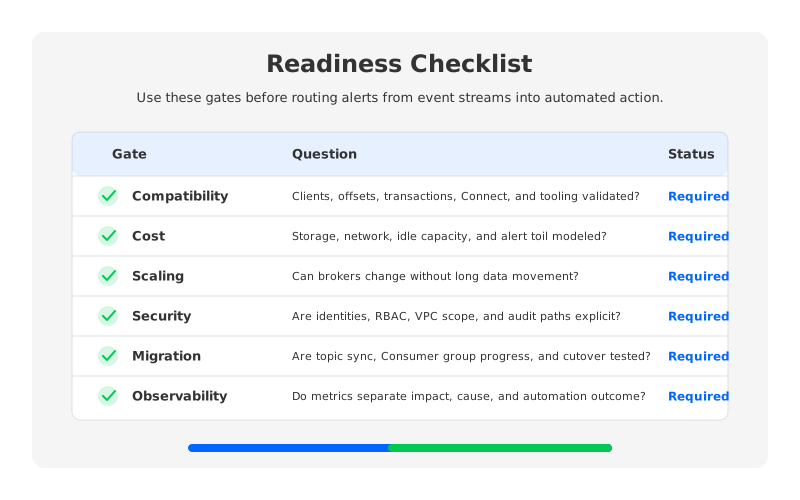
The checklist should be owned like production code. Store routing rules, labels, dashboard references, and escalation policies in version control or a system with review history. Review them after incidents. Retire routes that page teams without action. Alert routing is an operating contract for shared streams.
5How AutoMQ changes the operating model
After the neutral checklist, the architectural question becomes sharper: can the platform reduce the number of cases where alert routing has to compensate for stateful broker operations? AutoMQ is a Kafka-compatible streaming platform built around Shared Storage architecture. It keeps the Kafka protocol and ecosystem model while replacing broker-local persistent storage with S3Stream, WAL storage, and S3-compatible object storage.
That change matters for alert routing because AutoMQ Brokers are stateless brokers. Durable stream data is not owned by a broker’s local disk. The broker still handles Kafka requests, partition leadership, caching, scheduling, and traffic, but persistent data is written through WAL storage and then to object storage. When compute and durable storage are separated, broker replacement, scaling, and traffic balancing can be treated more like control actions than data recovery projects.
AutoMQ’s operating surface also changes team boundaries. AutoMQ Console gives platform teams a place to manage instances, topics, monitoring, identities, and lifecycle operations. Terraform support lets teams express environment and resource changes through reviewable configuration. Metrics can be exported through Prometheus-compatible paths, which means existing observability teams can keep familiar tools while adding storage, WAL, cache, and balancing signals that are specific to the Shared Storage model.
This does not remove the need for alert design. A slow consumer is still a slow consumer. A sink system that rejects writes still needs the owning application or data team. A bad schema rollout still needs governance and rollback. AutoMQ’s value is narrower and more useful than “no operations”: it reduces the cases where a platform team has to route alerts around broker-local data movement, storage overprovisioning, and capacity changes that are risky because state is attached to compute.
For migration, the same boundary logic applies. Kafka-compatible APIs reduce application change, but a real migration still needs topic mapping, Consumer group progress, Offset behavior, cutover order, and rollback evidence. AutoMQ Kafka Linking is designed for migration workflows that preserve message bytes and consumption progress, and teams should still test those claims against their own workloads before routing production incident response through the new platform. The correct goal is not a heroic cutover. The goal is a platform boundary that makes future alerts easier to explain.
6FAQ
6.1What is the right first alert for Kafka-based event streams?
Start with business impact, not broker internals. A checkout delay, fraud decision delay, missing notification, or broken ingestion path should page the service owner. Broker, storage, and connector alerts should support diagnosis unless they directly threaten shared platform availability.
6.2Should Consumer lag always page the application team?
No. Consumer lag should include ownership and cause context. Lag caused by downstream throttling belongs to the consuming service or sink owner. Lag caused by broker saturation, storage pressure, or a platform-wide network issue belongs to the platform team, with affected service owners notified when SLOs are at risk.
6.3Where should automation stop?
Automation should stop where the system cannot prove ownership, impact, and rollback. Scaling a known stateless consumer may be a good automated action. Promoting a migration target, changing retention, or altering a shared quota usually needs stronger review unless the team has already drilled the exact scenario.
6.4How does a Shared Storage architecture help alert routing?
Shared Storage architecture separates durable stream data from broker-local disks. That reduces the number of incidents where recovery or scaling depends on moving local partition data between brokers. Alert routing can then focus more on workload ownership, SLO impact, and policy decisions.
6.5Does Kafka compatibility remove migration risk?
No. Kafka compatibility protects a large part of the application contract, but teams still need to verify client versions, transactions, offset behavior, connectors, ACLs, dashboards, alert rules, and rollback paths. Compatibility is a requirement for low-risk migration, not a replacement for migration testing.
7Closing the loop
The page that started this discussion was never about a single metric. It was about whether a shared streaming platform can tell the right team what happened, why it matters, and what action is safe. If your team is reviewing Kafka-compatible infrastructure for that operating model, evaluate AutoMQ’s Shared Storage approach through the AutoMQ Cloud Console and run the checklist above against one production-like stream.


