
Table of Contents
Table of Contents
Searches for topic ownership metadata kafka usually start after a workflow has become uncomfortable. A developer wants to create a topic without waiting for a ticket. A platform engineer wants every topic to carry an owner, retention class, data classification, and incident contact. An SRE wants alerts to route to the team that can fix the producer or consumer, not only to the broker team.
The hard part is not storing a few labels. Kafka teams can put ownership in naming conventions, a catalog, Terraform variables, CI policy, portals, or topic configs. The harder question is where automation should stop. If a service can request a topic through self-service, should it also choose partitions, retention, compaction, ACLs, quotas, schema policy, and rollback behavior?
That is why topic ownership metadata belongs in the same conversation as Kafka architecture. Metadata policy controls who can ask for change. Architecture controls how expensive and risky those changes become once automation starts issuing them at production speed.
1Why Teams Search for topic ownership metadata kafka
Topic ownership metadata answers a messy operational question: who is accountable for this stream, and under what boundaries can it change? A useful record usually includes the application team, purpose, environment, data classification, retention target, schema policy, service contacts, allowed principals, alert route, and deprecation owner. Some teams also include cost center, replay policy, and downstream impact tags.
That record becomes valuable only when it is connected to behavior. A topic catalog that nobody checks is documentation. A workflow that validates metadata before creation is governance. Alert routing by owner is operations. Deletion blocked until consumers and owners approve it is risk control.
The search intent usually comes from four production pressures:
- Developer experience pressure. Application teams want Kafka resources through a fast path. Ownership metadata is the minimum information the platform team needs before allowing it.
- Governance pressure. Security and data teams need to know which topics carry sensitive data, which teams can read them, and which retention rules apply.
- Incident pressure. Broker metrics explain infrastructure symptoms; ownership metadata explains who owns the workload behind a hot partition, lag spike, or schema break.
- Cost pressure. Kafka cost is not only a broker problem. Topic count, partition count, retention, replication, cross-zone placement, and replay patterns all affect the bill.
The failure mode is letting metadata become too weak or too powerful. Weak metadata sits outside the control path, so it decays. Overpowered metadata lets a workflow make changes that should still be reviewed, especially when the Kafka cluster turns a small request into disk movement, replica traffic, or a long recovery window.
2The Production Constraint Behind the Problem
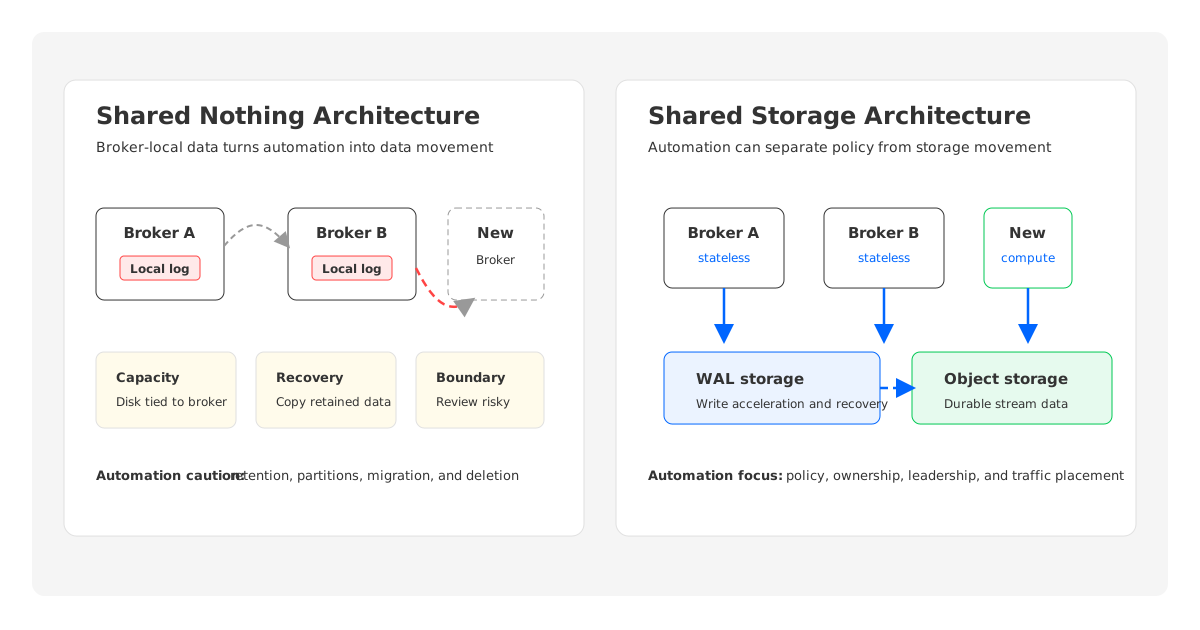
Traditional Kafka runs as a Shared Nothing architecture. Each broker owns local storage, and partitions are replicated across brokers for durability and availability. That model is well understood and still works for many environments, but it makes topic automation more tightly coupled to capacity than teams expect.
Consider a topic request that looks simple in a portal: eight partitions, seven days of retention, compacted cleanup policy, two consuming teams, and a production alert route. The metadata is easy to validate. The storage consequences are less abstract. Retention consumes broker-local disk. Partition count affects placement, file handles, leader distribution, and future reassignment. Replication multiplies storage and network work. When a broker is added or repaired, retained data may need to be copied before the cluster is balanced again.
This is the point where topic ownership metadata becomes an automation boundary. The platform team can safely automate fields that express accountability, such as owner, pager, cost center, and data class. It can usually automate policy checks, such as naming, retention ranges, schema compatibility, and ACL templates. It should be more careful with changes that alter physical pressure on the cluster: partition expansion, retention increase, traffic-heavy consumer rollout, or bulk topic migration.
Apache Kafka has improved the storage picture. KRaft moves Kafka metadata management into a quorum-based controller model, and tiered storage can offload older log segments to remote storage while retaining a local tier. Kafka Connect and the client ecosystem also support repeatable migration and integration workflows. These are useful building blocks, but they do not remove the need to ask what happens when automation meets broker-local storage, replica placement, and recovery behavior.
3Architecture Options and Trade-Offs
There are three common ways to draw the boundary around topic ownership automation. None is universally correct. The right answer depends on request volume, platform maturity, workload criticality, and how much the architecture amplifies a single resource change.
| Option | What it automates well | Where the boundary should stay | Watch for |
|---|---|---|---|
| Ticket plus catalog | Ownership record, approval evidence, audit trail | Most production changes remain manual | Slow delivery, stale metadata, hidden side channels |
| Self-service on existing Kafka | Topic creation, ACL templates, schema gates, alert routing | Large retention, partition expansion, deletion, and migration | Automation can create broker pressure faster than humans notice |
| Cloud-native Kafka-compatible platform | Ownership workflows plus faster compute changes and lower data-movement coupling | Data classification, privileged access, rollback, and compliance review | Teams still need explicit policy, not only platform elasticity |
The first option is often the safest starting point for a small platform team. A catalog, a pull request, and a clear approval chain are better than chat approvals. The drawback is that teams route around slow processes. Once manual creation is faster than a governed topic, the ownership model loses authority.
The second option is where many mature Kafka teams land. They build a portal or Terraform module, enforce naming, require owner metadata, generate ACLs, and connect topic records to dashboards. This can work well, but the platform must classify requests by blast radius. Creating a low-throughput topic is different from raising retention on a high-throughput stream or expanding partitions for a hot service.
The third option changes the operating model by reducing the physical work behind some automated changes. A Kafka-compatible platform with shared storage can make brokers more replaceable because durable data is not bound to local disk. That does not mean every governance decision should be automated. It lets the platform separate two concerns: "Is this change allowed?" and "Will this change force a long data movement event?"
4Evaluation Checklist for Platform Teams
The evaluation should start before a tool is chosen. If the team cannot describe the automation boundary in plain language, the platform will encode accidental policy. Start with the questions that force ownership metadata, Kafka mechanics, and operational risk into the same room.
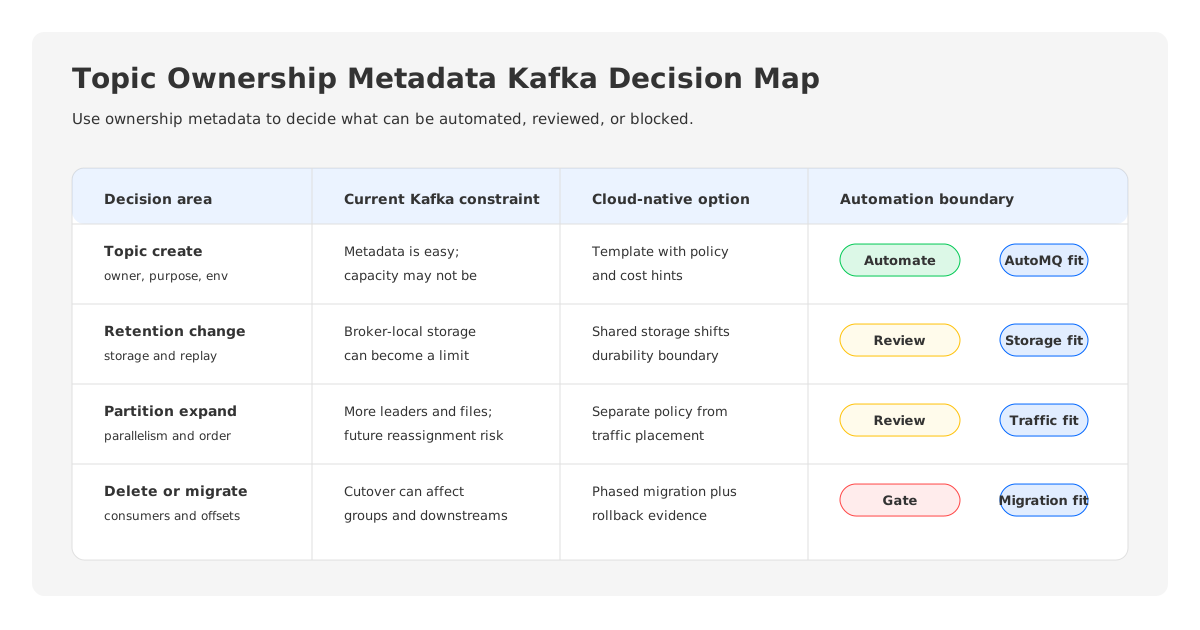
Compatibility. Does the workflow preserve Kafka client behavior, topic semantics, consumer group offsets, transactions, Kafka Connect integrations, and observability? A metadata system that breaks the ecosystem becomes another migration project.
Cost model. Can the workflow show whether a request changes storage, compute, network, or operational cost? Retention and partition changes should not look like harmless form fields. In cloud deployments, cross-zone traffic, private endpoints, object storage requests, and managed network paths may have separate pricing rules.
Elasticity. Does scaling require moving retained data, or can the platform mostly change leadership, placement, ownership, and traffic routing? This question matters because topic metadata automation tends to increase request volume.
Governance. Which fields are mandatory, inherited, or blocked from application teams? A good model lets teams move fast on routine topics while forcing review for sensitive data, unusual retention, privileged ACLs, and broad consumer access.
Failure recovery. If a broker fails, does ownership metadata still point to the right incident owner, and does the platform recover without forcing a long manual rebuild? Topic ownership should remain useful during the incident, not only after the postmortem.
Migration and rollback. Can the team move topics, consumers, and offsets in phases? Can it roll back without losing the ownership record or confusing alert routes? Migration tooling should treat metadata as part of the cutover plan, not as a spreadsheet to reconcile later.
Observability. Do dashboards show both broker health and service ownership? Broker CPU, request latency, storage, and consumer lag are necessary. They are not enough when an SRE needs the team behind the stream causing the symptom.
5How AutoMQ Changes the Operating Model
Once the neutral evaluation is clear, AutoMQ becomes relevant as an architectural answer rather than a metadata tool. AutoMQ is a Kafka-compatible streaming platform that keeps Kafka protocol compatibility while replacing broker-local log storage with a Shared Storage architecture backed by S3-compatible object storage.
That storage change matters because it weakens the link between a governance action and broker-local data movement. AutoMQ Brokers are stateless in the sense that durable stream data lives in shared storage, while brokers handle Kafka protocol work, leadership, caching, and traffic. S3Stream stores data through WAL storage and object storage. The WAL provides write acceleration and fault recovery, while object storage is the durable layer.
For a platform team, the practical effect is not "governance disappears." The practical effect is that routine automation can be evaluated with a different failure model:
- Topic lifecycle workflows can stay Kafka-compatible. Existing producers, consumers, Kafka Connect jobs, Schema Registry patterns, and observability tools can remain in the operating model.
- Scaling can focus more on compute and traffic. When retained data is not pinned to broker-local disk, adding or replacing brokers does not have to mean copying the topic's retained log from one broker to another.
- Self-Balancing and Self-healing can reduce manual intervention. Automated traffic balancing and node isolation help the platform keep workload placement closer to policy without turning every adjustment into an operator task.
- Customer-controlled deployment boundaries remain explicit. AutoMQ BYOC runs in the customer's cloud environment, and AutoMQ Software runs in the customer's private environment. That helps security and compliance teams evaluate where data, metadata, monitoring, and access control live.
AutoMQ Console and Terraform workflows fit this model because ownership metadata is usually part of a broader resource workflow: environments, instances, users, ACLs, topics, monitoring, and migration steps. Kafka Linking in AutoMQ commercial editions can help when a team needs phased migration with byte-level message synchronization and offset consistency. For AutoMQ Open Source, MirrorMaker2 remains the recommended community migration path.
The point is not to hand every decision to automation. Sensitive topics still need review. Privileged access still needs approval. Retention increases still need cost awareness. What changes is the set of operations that can be handled as metadata, leadership, traffic, and policy changes rather than large storage events.
6Readiness Scorecard
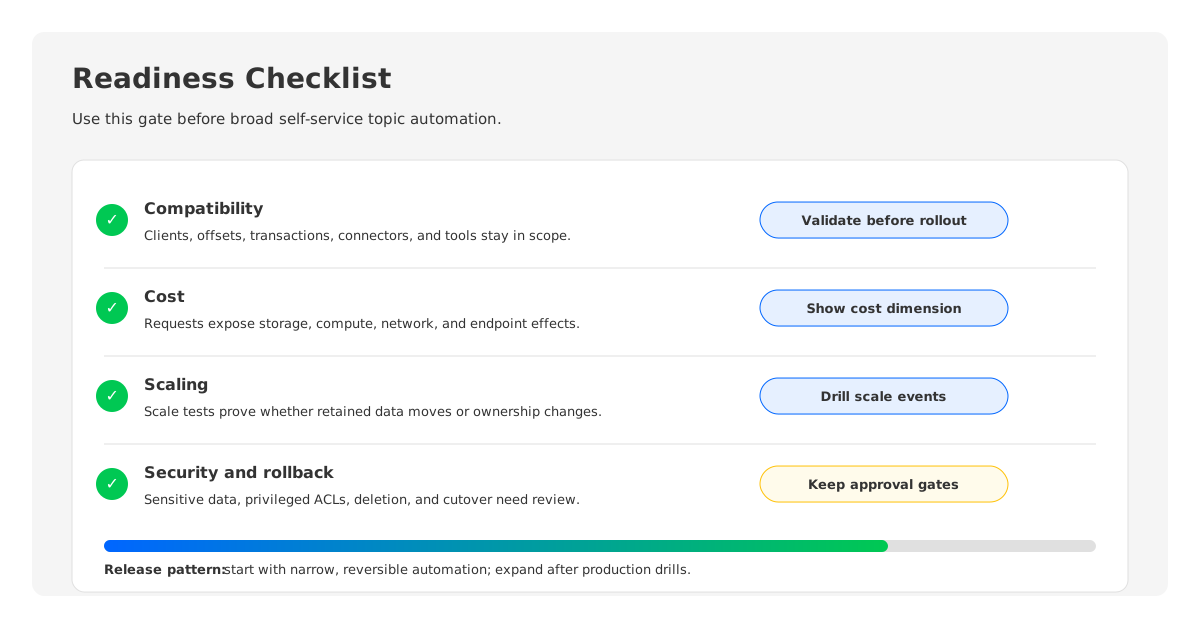
Use this scorecard before putting topic ownership metadata into a self-service workflow. A low score does not mean the team should avoid automation. It means the first release should automate narrow, reversible actions and keep higher-risk changes behind review.
| Readiness area | Production question | Green signal |
|---|---|---|
| Ownership model | Does every topic have an accountable team and incident contact? | Required metadata is validated before creation. |
| Policy boundary | Which topic changes are self-service, reviewed, or blocked? | Retention, partitions, ACLs, and deletion have explicit thresholds. |
| Cost visibility | Can requesters see the cost dimension they are changing? | Storage, compute, network, and endpoint effects are visible. |
| Architecture fit | Does scaling mostly change placement, or does it move retained data? | The team has tested scale-out, scale-in, and broker replacement. |
| Migration safety | Can topics and consumer progress move in phases? | Cutover and rollback are rehearsed with ownership metadata included. |
| Observability | Can alerts route by service owner and infrastructure symptom? | Dashboards join topic, consumer group, broker, and owner context. |
The first useful version is often modest: standard topic templates, required ownership fields, generated ACLs, consumer group ownership, and alert labels. Later versions can add cost hints, migration workflows, and stronger policy gates. The dangerous version jumps directly to broad automation without knowing which changes carry physical storage risk.
7FAQ
7.1What is topic ownership metadata in Kafka?
It is the set of fields that identifies who owns a Kafka topic and how that topic should be governed. Common fields include owning team, contact, data classification, retention target, schema policy, incident route, cost center, and deprecation owner.
7.2Should topic ownership metadata live in Kafka topic configs?
Some metadata can live near the topic, but most teams need a system that also connects to CI, Terraform, alerting, dashboards, schema checks, ACL workflows, and audit logs. The usual pattern is a catalog or platform workflow that writes to Kafka and surrounding control systems.
7.3Which topic changes should not be fully automated?
Partition expansion, large retention increases, deletion, privileged ACLs, sensitive data classification changes, and migration cutovers should usually require review. These changes can affect cost, recovery, compliance, or downstream consumers.
7.4How does shared storage affect topic ownership automation?
Shared storage can reduce broker-local data movement behind scaling, reassignment, and recovery. That makes some operational changes easier to automate, but it does not remove review around data access, retention, and compliance.
7.5Can AutoMQ use existing Kafka clients and tools?
AutoMQ is designed for Kafka protocol and ecosystem compatibility, so existing Kafka clients and common tools can remain part of the workflow. Teams should still validate client versions, connectors, security settings, observability, and migration steps before production cutover.
If your team is deciding where Kafka topic automation should stop, use the scorecard above against a real production topic. Then review whether a Kafka-compatible shared-storage architecture changes your risk profile: evaluate AutoMQ with your platform workflow.
8References
- Apache Kafka documentation
- Apache Kafka KIP-405: Kafka Tiered Storage
- Apache Kafka KRaft operations
- Apache Kafka Connect documentation
- AutoMQ architecture overview
- AutoMQ compatibility with Apache Kafka
- AutoMQ S3 storage architecture
- AutoMQ migration overview
- AutoMQ Table Topic overview
- AutoMQ inter-zone traffic overview
- AWS S3 pricing
- AWS PrivateLink pricing


