
Table of Contents
Table of Contents
Teams usually move to Amazon MSK for a practical reason. They do not want to babysit brokers, patch operating systems, maintain provisioning scripts, or rebuild the same Kafka cluster runbook every time another business unit needs streaming infrastructure. MSK removes a meaningful amount of Day 1 work, and that value is real. The surprise comes later, when the monthly bill, broker sizing process, storage expansion limits, partition rebalancing workflow, and cross-AZ traffic all still feel a lot like running Kafka yourself.
That surprise has a simple cause: Amazon MSK is managed Kafka, but it is still disk-bound Kafka. The service manages cluster lifecycle operations, while the underlying architecture still ties partition data to stateful brokers and broker-attached storage. When traffic grows, brokers need to be added and partition data has to move. When retention grows, EBS grows. When the cluster spans availability zones, replication traffic crosses availability zones. The managed service wrapper reduces operational setup, but it does not remove the storage physics underneath Kafka.
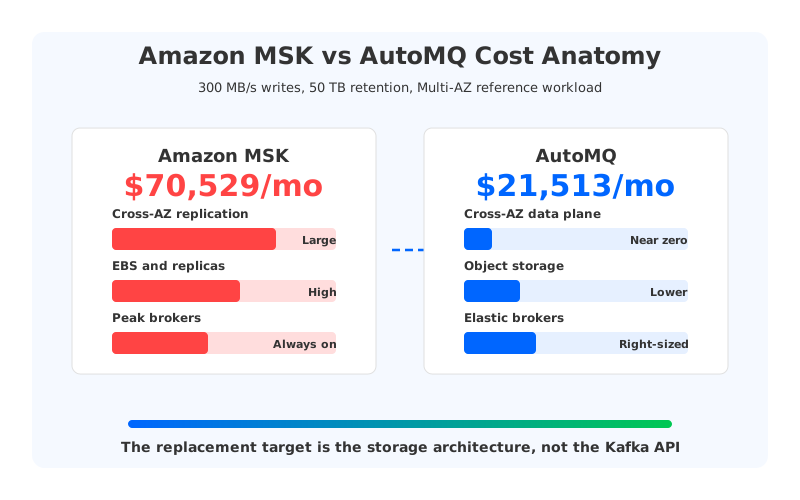
An Amazon MSK alternative should not force you to leave AWS or rewrite Kafka applications. For many platform teams, that would create more risk than it removes. The more useful question is whether you can keep the Kafka API, keep the deployment inside your AWS environment, and replace the disk-bound storage model that drives cost and elasticity constraints. That is where AutoMQ fits: Kafka-compatible streaming with stateless brokers and object-storage economics.
1Why Teams Start Looking for an MSK Alternative
The first MSK cluster often feels like relief. Provisioning is faster than self-managed Kafka, AWS handles infrastructure plumbing, and the team can move away from fragile broker setup scripts. For a small or stable workload, that may be enough. A three-broker cluster with short retention and predictable traffic can run for a long time without creating a strategic platform problem.
The search for an MSK alternative usually begins when Kafka becomes shared infrastructure. The cluster count grows. Retention grows. Teams add read fanout for analytics, machine learning, monitoring, and downstream services. A workload that began as a straightforward event pipeline becomes a multi-AZ, high-throughput, always-on data plane. At that point, the painful parts are no longer "how do we create a Kafka cluster?" They are "why is this cluster so hard to resize?" and "why does the bill keep growing even when the application team did not ship anything?"
The symptoms are familiar:
- Broker additions are planned as operational events because partition reassignment carries production risk.
- Storage can be expanded, but not reduced, which turns temporary retention growth into permanent spend.
- Cross-AZ replication appears as a recurring bill line that grows with write throughput and read fanout.
- Hot partitions degrade latency while other brokers sit underused.
- MSK Serverless helps some workloads, but quota boundaries leave large clusters in the provisioned model.
- Platform teams want consistent Kafka-compatible infrastructure across AWS, Kubernetes, and sometimes other clouds.
None of these are signs that MSK is badly engineered. They are signs that the service inherited Kafka's broker-owned storage model. A managed service can automate parts of that model, but it cannot make stateful brokers behave like stateless cloud compute unless the storage architecture changes.
2MSK Is Managed Kafka, Not Cloud-Native Kafka
The phrase "managed Kafka" can hide an important distinction. MSK manages broker provisioning, patching, certificate integration, monitoring hooks, and parts of the upgrade workflow. It does not turn Kafka into a stateless cloud-native service. A provisioned MSK broker still owns local partition data. Storage is still attached to brokers. Partition ownership changes still involve data movement. Capacity is still planned around broker count, broker type, storage per broker, partition count, and expected headroom.
That model is familiar because it is Kafka's original model. Kafka was designed when long-lived servers and local disks were normal infrastructure assumptions. Replication at the application layer was the right answer because the storage layer did not already provide cloud-grade durability and availability. In AWS, the environment changed. S3, EBS, and cross-AZ networking each have different price and elasticity characteristics, but MSK largely keeps the same broker-centered storage model.
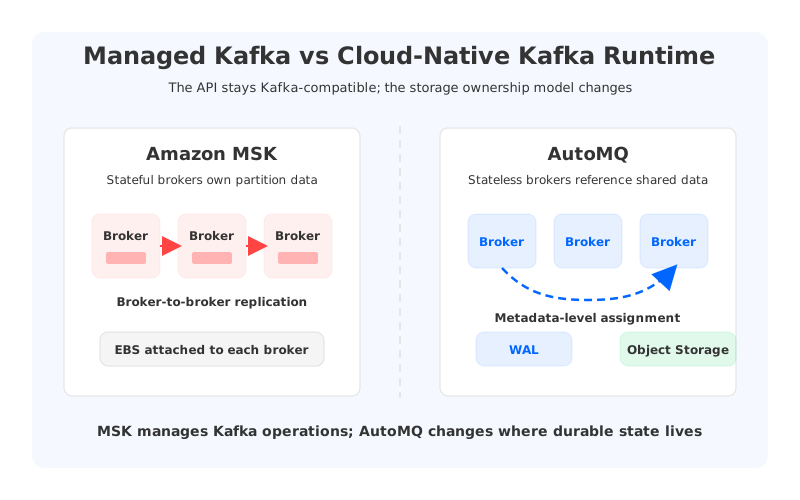
This is where the word "alternative" needs precision. Replacing MSK with another Kafka deployment that still ties durable data to broker disks may improve packaging, support, or usability, but it does not change the largest structural constraints. An architecture-level MSK alternative changes where durable state lives. Once brokers stop being the owners of durable data, scaling, failure recovery, storage growth, and cost allocation start to behave differently.
AutoMQ's approach is deliberately narrow: keep Kafka compatibility, change the storage architecture. Producers, consumers, Kafka Streams applications, and Kafka Connect integrations continue to speak Kafka protocol. Underneath that familiar API, brokers become stateless compute nodes backed by shared storage and object storage. The WAL layer handles the low-latency write path before data is persisted, while the durable log is no longer trapped on an individual broker's EBS volume.
3The Cost Drivers MSK Does Not Make Disappear
The expensive parts of MSK are not mysterious. They are the normal consequences of running Kafka's shared-nothing broker model on cloud infrastructure. Brokers need compute. Broker-attached EBS stores data. Replication multiplies storage and network movement. Multi-AZ deployments add cross-AZ transfer. Headroom keeps the cluster alive during spikes and failures, but it also means idle capacity is paid for around the clock.
For a concrete reference point, AutoMQ's published cost comparison uses a 300 MB/s write workload, 50 TB retention, and Multi-AZ deployment. In that scenario, AWS MSK is listed at $70,529/month, while AutoMQ is listed at $21,513/month. Apache Kafka self-managed is listed at $80,043/month in the same comparison. The exact number in your AWS account will depend on region, read fanout, retention, instance families, storage class, and discounts, but the cost categories are the part that matters.
| Cost category | Why it grows in MSK | What changes with AutoMQ |
|---|---|---|
| Storage | Kafka stores replicated data on broker-attached EBS volumes | Object storage becomes the durable log, so storage scales independently |
| Cross-AZ traffic | Broker-to-broker replication moves data across availability zones | Shared storage and zone-aware access reduce data-plane transfer |
| Compute | Brokers are sized for storage ownership, throughput, and headroom | Brokers become stateless compute and can be right-sized separately |
| Scaling operations | Reassignment moves partition data between brokers | Partition movement is primarily metadata-level assignment |
| Long-term retention | More retained data means more broker-attached storage | Retention shifts toward object-storage economics |
The table is not a claim that every workload saves the same percentage. A small, stable, low-retention MSK cluster may not justify migration effort. A high-throughput cluster with long retention and multi-AZ replication is a different story. Once storage and cross-AZ traffic dominate the bill, incremental tuning has diminishing returns because the largest costs come from the architecture itself.
4Cross-AZ Traffic Is the Line Item Teams Underestimate
Kafka's replication model is durable and battle-tested, but on AWS it has a cost side effect. In a multi-AZ cluster, a leader broker writes data locally and replicates it to follower brokers in other availability zones. That movement is not an implementation detail; it is part of the durability design. If consumers in other zones read from leaders outside their own zone, read traffic can add another layer of cross-AZ movement.
For low-throughput clusters, the line item may be tolerable. For high-throughput clusters, it can become one of the largest parts of the bill. The frustrating part is that the traffic does not represent additional business value. It is mostly the cost of making broker-attached storage durable across zones. The application sends one event, but the infrastructure moves copies of that event so the cluster can survive broker and zone failures.
AutoMQ changes the shape of that cost by moving durable storage out of the broker layer. Object storage provides durability outside the broker fleet, while brokers act as stateless compute. With zone-aware access patterns, the architecture reduces the need for broker-to-broker data-plane replication across availability zones. The result is not a tuning trick; it is a different durability boundary.
This is the key distinction between optimization and replacement. Compression, retention tuning, partition balancing, and client placement can reduce waste in MSK. They are worth doing. But if the largest cost comes from copying data between stateful brokers across zones, the bigger lever is to stop making broker-to-broker replication the core durability mechanism.
5Scaling MSK Means Moving Data
Adding brokers to MSK is not the same as adding usable capacity. A fresh broker joins the cluster empty. It does not automatically absorb existing partition load until partitions are reassigned to it, and those reassigned partitions bring data with them. That data movement competes with production traffic for network bandwidth and disk I/O, which is why Kafka teams throttle reassignment even when they need more capacity.
AWS's own MSK documentation reflects this operational reality. Expanding broker count is a cluster operation, and after adding brokers, teams still need to reassign partitions to rebalance traffic. Storage expansion has its own constraints: AWS documents that storage can be increased but not decreased, and that another storage scaling operation must wait for a cooldown window after the prior one completes. Those rules are manageable for predictable growth. They are painful when traffic moves faster than the cluster can.
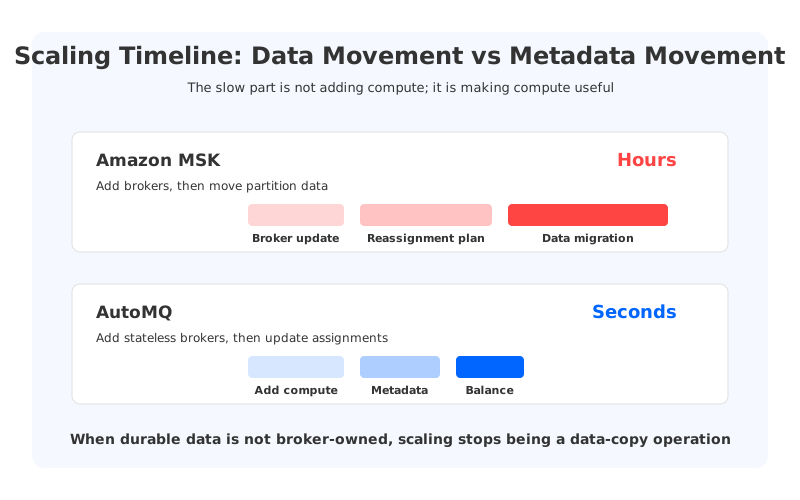
The result is a familiar pattern. Teams provision for peak because scaling during a spike is too slow. They leave extra brokers running because scaling down requires another careful rebalance. They tolerate hot partitions because fixing them requires the same data migration workflow that might disturb production. MSK made the cluster easier to start, but it did not make the data easier to move.
In AutoMQ, scaling is a different operation because brokers do not own the durable log. Adding compute does not require copying partition data from one broker's disk to another broker's disk. Partition assignment can move at the metadata layer, while the assigned broker reads the same durable data from shared storage. That turns scaling from a data migration event into a compute and metadata event, which is why stateless broker architectures can react to workload changes with far less operational weight.
6Storage Expansion Is Not the Same as Storage Elasticity
MSK supports storage expansion, and that is useful. The problem is that expansion is one-directional. Once storage is increased, it cannot be decreased in place. A temporary retention spike, a compliance window, a backfill, or a delayed consumer group can push a cluster toward a larger storage configuration that remains in the bill after the temporary reason has disappeared.
That behavior is normal for broker-attached disk. EBS volumes belong to brokers. Kafka partitions live on those volumes. Reducing capacity safely would require a broader data movement and placement operation, not a simple setting change. The same stateful ownership model that makes scaling slow also makes storage elasticity hard.
Object storage changes that relationship. Retention becomes less tightly coupled to the broker fleet, and storage capacity does not need to be pre-attached to compute nodes. The broker layer can scale around active traffic, while the storage layer scales around retained data. That separation is the core of the cost argument for diskless Kafka architectures: compute and storage stop growing as one bundled unit.
7MSK Serverless Is Useful, but It Is Not a Universal Escape Hatch
MSK Serverless tries to hide more of the capacity planning problem, and for the right workloads it can be a good fit. The limitation is that serverless does not mean unlimited. AWS documents account and cluster quotas for MSK Serverless, including throughput limits such as 200 MBps ingress and 400 MBps egress per cluster. Many mid-size and large Kafka workloads exceed those numbers, especially when observability, CDC, or event fanout grows across many teams.
That matters because the teams searching for an MSK alternative are often not running small clusters. They are running Kafka as shared infrastructure. Their challenge is not only provisioning convenience; it is cost control at sustained throughput, predictable tail latency, long retention, and operational freedom when workloads change. A quota-limited serverless model can simplify some clusters while leaving the largest and most expensive clusters in the provisioned world.
There is also a platform boundary. MSK is AWS-specific. If a team is standardizing streaming across AWS, Kubernetes, and other environments, MSK does not provide a consistent runtime abstraction. The service is useful inside AWS, but it is not a multi-environment Kafka architecture.
8What AutoMQ Replaces
AutoMQ does not replace Kafka's application contract. It replaces the part of the Kafka runtime that creates the worst cloud mismatch: durable data tied to stateful brokers. That distinction matters because most Kafka migrations fail when they ask too many teams to change behavior at once. If every producer, consumer, connector, stream processor, access-control rule, and monitoring integration has to change at the same time, the project becomes a platform migration and an application migration. That is a lot of blast radius.
With AutoMQ, the goal is to keep the application surface familiar:
- Producers and consumers continue to use Kafka-compatible clients.
- Existing Kafka operational concepts still apply: topics, partitions, consumer groups, offsets, ACLs, retention, and lag.
- Connectors and stream-processing jobs can be evaluated against the same protocol boundary.
- Deployment can stay in the user's AWS environment, which helps teams with data residency, network isolation, and security review.
The runtime underneath is where the change happens. Brokers become stateless. Storage moves behind a shared/object-storage layer. WAL absorbs low-latency writes. Partition reassignment becomes lighter because the data does not need to be copied from broker disk to broker disk. The point is not to hide that architecture from platform engineers. The point is to change the right layer while leaving application teams with a familiar Kafka interface.
9What Migration Actually Looks Like
Replacing MSK should be treated as an infrastructure migration, not a string replacement in a bootstrap server config. The good news is that Kafka compatibility keeps the application surface familiar. The risk sits in data movement, consumer offsets, cutover sequencing, observability, ACL parity, and rollback planning. Mature teams handle this per topic or per workload domain rather than moving a large estate in one step.
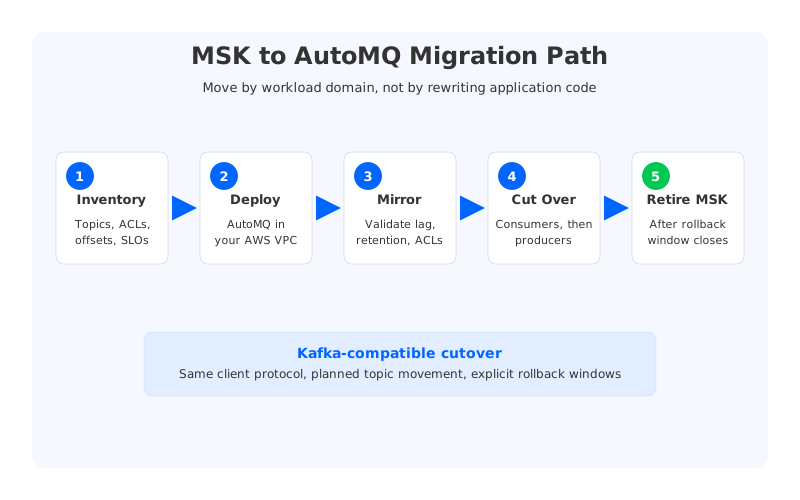
A practical migration usually starts with inventory. Identify topics, retention settings, compaction requirements, partition counts, producer throughput, consumer groups, ACLs, schema dependencies, lag behavior, and downstream service owners. This step is tedious, but it prevents the most common migration failure: discovering hidden dependencies after cutover.
The next step is a parallel AutoMQ deployment inside the same AWS security model the team already uses. That may mean the same VPC pattern, private connectivity, IAM review, observability export, and network isolation requirements. Then a small set of low-risk topics can be mirrored from MSK to AutoMQ. The goal is not only to copy data; it is to validate produce latency, consumer lag, retention behavior, ACLs, monitoring, alerting, and operational ownership under real traffic.
Cutover should move consumers before producers when possible. Let consumers read from AutoMQ while MSK remains the source of record, then shift producer traffic once the downstream behavior is stable. For critical topics, keep rollback windows explicit. Do not retire the MSK topic until throughput, tail latency, lag, and error budgets have been observed through a representative business cycle.
This staged approach is slower than a dramatic overnight migration, and that is a good thing. Kafka is usually shared infrastructure. A safe migration optimizes for boring progress: one domain, one topic group, one rollback plan at a time.
10Observability and Operations Still Matter
Architecture can remove structural bottlenecks, but it does not remove the need for operational discipline. A team replacing MSK should define the metrics that prove the replacement is working before the first production cutover. Those metrics should include producer request latency, end-to-end latency, broker CPU, network throughput, storage write path health, consumer lag, rebalance events, topic-level throughput, and error rates.
The difference is where the operational attention goes. In MSK, a large amount of attention is spent on broker placement, disk growth, replication traffic, partition reassignment, and migration side effects. In AutoMQ, the attention shifts toward the shared storage path, WAL health, stateless broker capacity, and workload-level balancing. That is still engineering work, but it is better aligned with cloud infrastructure: scale compute as compute, scale storage as storage, and avoid treating every capacity change as a data movement event.
Cost observability should be part of the same dashboard. If the business case for migration is lower Kafka infrastructure cost, the team should track the bill drivers directly: storage, cross-AZ traffic, compute, object-storage requests, and platform subscription. Otherwise the migration can succeed technically while failing to prove its economic value.
11When MSK Is Still a Reasonable Choice
MSK still makes sense for many teams. If the cluster is small, traffic is predictable, retention is short, and AWS-only deployment is a firm requirement, the managed experience can outweigh the architectural inefficiency. There is no virtue in migrating a workload whose cost and operations are already boring. Boring infrastructure is underrated.
The case for replacement gets stronger when the cluster has one or more of these symptoms:
- The monthly bill is dominated by EBS, replication, or cross-AZ traffic rather than application value.
- Broker additions are planned as maintenance events because reassignment risk is real.
- Traffic spikes force permanent peak provisioning.
- Storage only grows because shrinking it is not part of the operational model.
- Platform teams want a Kafka-compatible runtime across AWS and Kubernetes rather than an AWS-only service boundary.
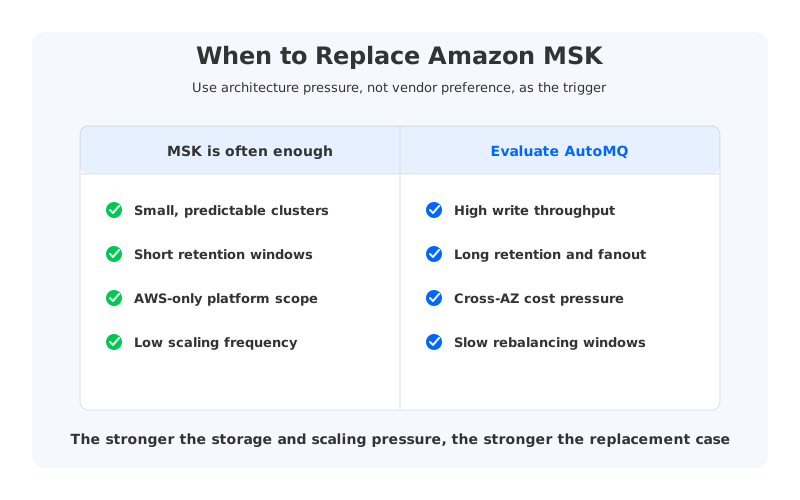
Those symptoms point to a storage architecture problem. Tuning broker types, retention, compression, partition counts, and client placement can help. They should usually be tried first because they are low-risk. But they do not change the fact that the cluster is stateful at the broker layer. AutoMQ is worth evaluating when the team wants the Kafka API without that broker-owned storage model.
12AutoMQ vs MSK: The Practical Comparison
The comparison is clearest when framed by decision criteria instead of feature checklists. MSK is an AWS-managed Kafka service. AutoMQ is a Kafka-compatible streaming runtime designed around diskless architecture. Both can run in AWS. Both speak Kafka. The difference is what each one assumes about storage, scaling, and cost.
| Decision area | Amazon MSK | AutoMQ |
|---|---|---|
| Application compatibility | Kafka-compatible because it is managed Kafka | Kafka-compatible runtime, designed to preserve client behavior |
| Broker state | Brokers own partition data on attached storage | Brokers are stateless compute nodes |
| Durable storage | Broker-attached EBS in provisioned clusters | Shared/object storage with WAL for the write path |
| Scaling model | Add brokers, then rebalance partition data | Add compute, then update assignments |
| Storage elasticity | Expand storage, but do not shrink in place | Storage scales separately from broker compute |
| Cross-AZ cost profile | Broker replication can generate data-transfer cost | Architecture reduces broker-to-broker data-plane replication |
| Deployment fit | AWS-native managed service | AWS deployment without tying the runtime to MSK's storage model |
The right choice depends on which row is causing pain. If your team mainly wants AWS to operate Kafka brokers and the workload is predictable, MSK is often enough. If your team is fighting storage cost, cross-AZ transfer, slow rebalancing, peak provisioning, and multi-environment consistency, then the rows where AutoMQ differs are exactly the rows that matter.
13Build the Business Case Before You Migrate
An MSK replacement project needs a sharper business case than "Kafka costs too much." That phrase may be true, but it is not actionable. The useful version breaks the bill into drivers, maps each driver to an architectural cause, and estimates which parts change after migration. Without that decomposition, the conversation becomes a vague platform preference debate. With it, the decision becomes much easier to defend.
Start with a monthly baseline. Pull the MSK broker cost, EBS cost, data transfer cost, NAT or PrivateLink cost if it appears in the path, CloudWatch and logging cost, and any third-party tooling cost that exists only because the cluster is hard to operate. Then map each item to workload behavior: sustained write throughput, read fanout, retention, partition count, peak-to-average ratio, and number of availability zones. The goal is to avoid a misleading average. A cluster with moderate write throughput but high read fanout can look very different from a write-heavy observability cluster with low read fanout.
The second step is to separate cost that can be tuned from cost that is structural. Compression, retention cleanup, partition right-sizing, client rack awareness, and broker type selection are tuning levers. They are worth doing before migration because they reduce waste and clarify the baseline. But broker-attached replicated storage and cross-AZ broker replication are structural levers. If they dominate the bill, tuning can improve the symptoms while leaving the main cause intact.
| Business-case input | Why it matters | What to compare |
|---|---|---|
| Write throughput | Drives replication traffic and write path capacity | Average, peak, and growth rate |
| Read fanout | Can multiply broker and cross-AZ traffic | Consumers per topic and zone placement |
| Retention | Drives storage footprint and EBS expansion | Hot retention vs long-term retention |
| Peak-to-average ratio | Shows how much idle capacity is paid for | Provisioned broker capacity vs actual use |
| Rebalance frequency | Captures operational cost, not only cloud bill | Planned scaling, hot partition fixes, maintenance |
| Topic criticality | Determines rollout order and rollback window | Low-risk domains before core business paths |
This is also where teams should be careful with savings claims. A published benchmark comparison is useful because it shows a reference workload under stated assumptions. It is not a substitute for your own bill. If your cluster is tiny, the migration may not pay back quickly. If your cluster is large, multi-AZ, and retention-heavy, the payback can be obvious. The business case should say which one you are.
14Design the Rollout Around Risk, Not Around Cluster Count
Kafka estates are rarely organized cleanly. One MSK cluster may contain topics owned by several teams, with different SLAs, different retention settings, different consumer lag tolerance, and different operational habits. Migrating by cluster is tempting because the infrastructure boundary is visible. Migrating by workload domain is usually safer because the application boundary is where risk actually lives.
The first migration candidate should not be the largest cluster or the loudest complaint. It should be a workload that is representative enough to test the architecture but low-risk enough to tolerate rollback. A good candidate has steady traffic, known owners, clear dashboards, manageable retention, and consumers that can be validated without ambiguous business impact. Once that workload proves the path, the platform team can move to higher-throughput topics, then shared domains, then critical paths.
A solid rollout plan answers these questions before production traffic moves:
- What is the source of truth during each phase: MSK, AutoMQ, or a controlled dual-running window?
- Which consumer groups move first, and how will offsets be validated?
- What lag threshold blocks the next step?
- Which metrics define success: produce latency, end-to-end latency, error rate, throughput, cost, or all of them?
- What rollback action is available, and how long will the rollback window stay open?
- Who owns the final decision to retire each MSK topic?
This may sound heavy, but it is lighter than debugging a cross-team Kafka migration after a rushed cutover. The architecture can reduce the need for broker data movement; it cannot remove the need for ownership, observability, and staged execution. The healthiest migrations treat AutoMQ as a Kafka-compatible runtime change and still respect Kafka as critical shared infrastructure.
15What a Successful Replacement Looks Like After Cutover
The strongest signal of success is not a launch announcement. It is a boring month after cutover. Producers keep writing. Consumers keep reading. Lag stays inside normal bounds. Tail latency does not surprise application owners. Platform engineers are not watching partition reassignment jobs late at night. The cost dashboard shows that storage and cross-AZ transfer are no longer growing in the same pattern.
The operational rhythm should change as well. Capacity planning should move away from "how many stateful brokers do we need for the next peak?" and toward "how much compute does this workload need now, and how much durable storage does retention require?" Those are different questions. The first bundles compute and storage into broker planning. The second treats them as separate dimensions, which is how cloud infrastructure is supposed to be operated.
There should also be fewer irreversible decisions. In MSK, storage expansion is a one-way operation, and scaling actions often leave behind a larger steady-state footprint. In a diskless architecture, the team should have more room to adjust compute around active traffic and storage around retention. That does not mean every action is automatic or free. It means the platform is no longer forced to treat durable data as something physically owned by a fixed broker fleet.
The final test is whether application teams notice the right things. Ideally, they notice compatibility, stable latency, and fewer capacity incidents. They should not have to learn a different messaging model to benefit from a different runtime architecture. If the platform team can reduce the infrastructure burden while application teams keep their Kafka mental model, the migration has done the job it was supposed to do.
16The Bottom Line
MSK is a rational first move away from self-managed Kafka. It removes a lot of undifferentiated setup work, and for stable workloads that may be enough. The trouble starts when "managed Kafka" is expected to behave like cloud-native streaming infrastructure. Stateful brokers, local durable storage, cross-AZ replication, one-way storage expansion, and data-heavy rebalancing are still there.
An Amazon MSK alternative should be judged by whether it changes those mechanics without creating application-level migration pain. AutoMQ's answer is to keep Kafka compatibility while moving durability and scaling away from broker-attached disks. If your MSK pain is mainly provisioning convenience, stay with MSK. If your pain is the bill, the rebalance window, and the amount of state attached to every broker, the architecture underneath is the part to replace.
The first MSK cluster usually feels like less Kafka work. The third or fourth large MSK cluster often reveals the real question: do you want managed brokers, or do you want a Kafka-compatible architecture built for cloud economics?


