
Table of Contents
Table of Contents
Redpanda has earned serious attention in the Apache Kafka ecosystem, and for good reason. A ground-up C++ rewrite of Kafka with a thread-per-core architecture and Direct IO bypassing the page cache, it delivers sub-millisecond write latencies on bare metal. If you've been evaluating Redpanda as a Kafka alternative, you've probably seen the benchmarks. They're real.
But here's the question that benchmarks don't answer: if your core pain is cloud cost and operational overhead, not raw latency, is a faster engine on the same chassis actually what you need? AutoMQ vs Redpanda isn't a performance shootout. It's a question about whether you want to optimize Kafka's existing architecture or replace the architecture entirely. For teams searching for a Redpanda alternative that addresses cloud cost at the architecture level, the distinction matters more than any benchmark number.
1Redpanda: A C++ Rewrite of Kafka
Redpanda took on one of the hardest engineering challenges in the streaming space: rewriting Kafka from scratch in C++ with a modern, thread-per-core execution model. The result is a system that eliminates the JVM's garbage collection pauses, uses Direct IO to bypass the OS page cache, and delivers sub-millisecond tail latencies under controlled conditions. For teams running on bare metal with dedicated NVMe drives, that's a real improvement over stock Kafka, especially for latency-sensitive workloads.
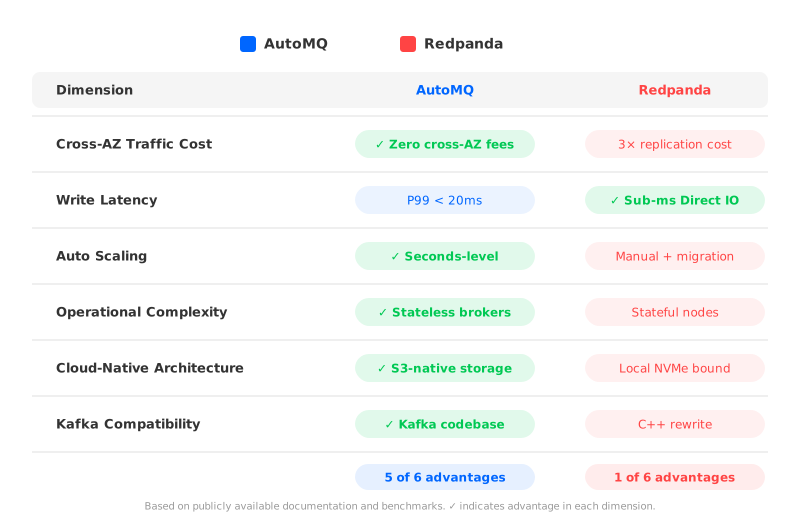
What Redpanda didn't change is the storage model underneath. Data still lives on local disks. NVMe instead of spinning rust, but local disks nonetheless. Durability in production typically requires replicating every byte across three brokers, spanning multiple availability zones (AZs). Brokers are stateful: each one owns a set of partitions and the data that goes with them. Scaling the cluster means adding nodes and waiting for partition data to migrate, a process that can take hours at scale. Redpanda optimized Kafka's engine, but it kept Kafka's chassis. In a data center, that chassis works fine. In the cloud, it's the chassis, not the engine, that drives your bill.
2The Cost Model Problem: Why NVMe ≈ EBS in the Cloud
The streaming community often frames Redpanda as a cost-effective Kafka alternative because it runs on fewer nodes. Fewer nodes is real: the C++ rewrite is more resource-efficient per core. But node count is only one line item on your cloud bill, and usually not the biggest one.
Consider a typical mid-size observability pipeline: 300 MiB/s sustained write throughput, 2× read fanout, 72-hour retention across three AZs. Running this on self-managed Apache Kafka, which shares Redpanda's storage model of local disks plus 3× replication, costs roughly $103,000 per month. The same workload on AutoMQ costs approximately $21,800 per month. That's a 79% difference, and it doesn't come from squeezing more out of each CPU core.
The gap breaks down across five cost categories:
- Cross-AZ replication traffic: $61,594/mo on Kafka, near zero on AutoMQ. Every message written to a leader broker gets replicated to two followers in different AZs. AWS charges $0.02/GB for cross-AZ data transfer in both directions. With 300 MiB/s of writes and 2× read fanout, the replication and consumer traffic alone generates over $61,000 in monthly cross-AZ fees. AutoMQ writes to S3, which handles cross-AZ durability internally at no additional transfer cost.
- Storage: $36,450/mo on Kafka vs $1,722/mo on AutoMQ. Kafka stores three full copies of every byte on EBS (or local NVMe, which AWS prices similarly for persistent storage). AutoMQ stores one copy on S3 at $0.023/GB with 11-nines built-in durability. No replicas needed.
- Compute: $5,151/mo on Kafka vs $1,430/mo on AutoMQ. Kafka needs 28 r5.xlarge instances to handle the throughput with headroom. AutoMQ's stateless brokers need 3 m7g.4xlarge instances because they don't carry storage responsibilities.
- AutoMQ subscription fees: $17,373/mo. AutoMQ BYOC uses pay-as-you-go pricing for data ingress ($10,259), egress ($6,178), and storage ($636), plus a $300/mo cluster uptime fee. These subscription costs are the largest component of AutoMQ's bill, but they replace the cross-AZ and storage replication costs that dominate the Kafka bill.
- S3 API and WAL costs: $1,280/mo on AutoMQ. S3 PUT/GET operations and a small EBS allocation for WAL buffering add a modest overhead.
Redpanda's C++ efficiency reduces the compute line. You'd likely need fewer nodes than Kafka for the same throughput. But the cross-AZ and storage lines remain structurally identical because the architecture is the same: local disks, 3× replication, stateful brokers. The engine is faster, but the big cost lines don't change when you swap the runtime.
Cost data generated using the AutoMQ Pricing Calculator with AWS us-east-1 pricing as of April 2026. Kafka figures represent the disk-based architecture shared by both Apache Kafka and Redpanda.
3Architecture Deep Dive: Diskless vs Disk-Bound
3.1Storage: S3 vs Local NVMe
Redpanda stores data on local NVMe drives attached to each broker. This gives it excellent sequential read/write performance and predictable latency, the same advantages that made NVMe popular in database workloads. The tradeoff is that storage capacity is coupled to compute instances. You can't scale storage independently, and you're paying for three copies of every byte across your cluster.
AutoMQ takes a different approach: data goes directly to S3 (or compatible object storage). There are no local data replicas. S3 provides 11-nines durability out of the box, across AZs, without application-level replication. A pluggable WAL (Write-Ahead Log) layer, supporting S3, EBS, or NFS, handles the gap between write acknowledgment and S3 persistence. The result is storage that costs roughly $0.023/GB instead of $0.08–0.10/GB per replica, with better durability guarantees and zero operational overhead for disk management.
3.2Elasticity: Stateless Brokers vs Stateful Nodes
Picture your e-commerce platform on Black Friday. Traffic spikes 5× in an hour. With Redpanda, scaling follows the same pattern as Kafka: add new broker nodes, then rebalance partitions by migrating data from existing nodes to new ones. Redpanda's rebalancer is more automated than Kafka's, but the constraint is the same: data has to physically move between nodes. For a cluster holding terabytes of data, this takes hours and consumes significant network bandwidth during the migration. By the time the cluster finishes rebalancing, the traffic spike may already be over.
AutoMQ brokers are stateless. They don't own data; they own partition assignments, which are metadata pointers to objects in S3. Scaling from 3 to 30 brokers means reassigning partition metadata, not moving terabytes of data. The process completes in seconds. Scaling back down is equally fast, which means you can right-size your cluster to match real-time traffic rather than provisioning for peak and wasting capacity the rest of the time.
3.3Cross-AZ Traffic: The Hidden Cost Multiplier
As the cost breakdown above showed, cross-AZ traffic is the single largest line item in a disk-based streaming deployment, often exceeding compute and storage costs combined. What makes this particularly painful is that it's structural: every multi-AZ Kafka or Redpanda cluster generates cross-AZ traffic by design, because replication requires moving data between brokers in different AZs.
AutoMQ eliminates this at the architecture level. Producers and consumers connect to brokers in their own AZ through built-in AZ-aware routing. Data durability comes from S3, which replicates across AZs internally without charging data transfer fees. The result: the cross-AZ line on your bill drops to near zero. For high-throughput workloads, this single architectural difference can save more per month than the entire AutoMQ deployment costs.
3.4Kafka Compatibility: Both 100%, Different Paths
Both AutoMQ and Redpanda are fully compatible with the Kafka protocol. Your producers, consumers, Kafka Streams applications, and Kafka Connect connectors work with either system without code changes. The difference is maintenance burden.
AutoMQ is built on the Apache Kafka codebase itself. It extends Kafka's storage layer to use S3 instead of local disks while keeping the rest of the Kafka code intact. Protocol compatibility isn't a feature that needs to be maintained; it's inherited directly from the Kafka source. When the Kafka community adds a new protocol version or feature, AutoMQ picks it up as part of its normal codebase integration.
Redpanda rewrote Kafka entirely in C++. Every protocol feature, every client interaction, every admin API had to be reimplemented and tested for compatibility. Redpanda's team has done this thoroughly, but it's an ongoing effort: each new Kafka protocol version requires Redpanda to implement and validate the changes independently. For teams that depend on bleeding-edge Kafka features or niche protocol behaviors, this distinction matters.
4When Redpanda Makes Sense
Redpanda is a strong choice in specific scenarios:
- Ultra-low latency requirements. If your workload demands sub-millisecond P99 write latency, think high-frequency trading or real-time bidding, Redpanda's Direct IO path on dedicated NVMe hardware is hard to beat. AutoMQ delivers P99 under 20ms with EBS or NFS WAL configurations, which covers most streaming use cases, but it won't match bare-metal NVMe for the most latency-sensitive workloads.
- Bare-metal or on-premises deployments. If you're not in the cloud, the cost advantages of S3-native storage don't apply. Redpanda's efficient C++ runtime makes excellent use of dedicated hardware.
- Existing NVMe infrastructure investments. If your team has already invested in NVMe-optimized infrastructure and your workloads are stable (no need for elastic scaling), Redpanda delivers strong performance on that hardware.
- Stable, predictable workloads. If your traffic patterns don't vary much and you can accurately provision capacity upfront, the elasticity advantage of stateless brokers matters less.
5When AutoMQ Is the Better Fit
AutoMQ's architecture advantages compound in cloud-native environments, and the savings scale with throughput.
For cloud-first deployments where cost is the primary concern, the 70–80% cost reduction comes from architectural differences that apply to every cloud workload: zero cross-AZ fees, S3-native storage, and right-sized compute. A team running 100 MiB/s saves thousands per month; a team running 500 MiB/s saves tens of thousands. The math gets more compelling as throughput grows.
Elastic workloads are where the stateless broker architecture really pays off. E-commerce traffic spikes, observability pipelines with variable log volumes, gaming events with unpredictable player counts: any workload where traffic varies significantly benefits from seconds-level scaling instead of hours-long rebalancing. You stop paying for idle capacity, and you stop worrying about whether your cluster can handle the next spike.
On the operational side, stateless brokers mean no disk management, no rebalancing operations, no capacity planning for storage growth. Your platform team spends time on product features instead of Kafka cluster maintenance.
There's also a licensing difference worth noting. AutoMQ Open Source is licensed under Apache License 2.0, fully open source. Redpanda's enterprise features are gated behind a Business Source License (BSL), with the community edition offering a more limited feature set.
6Conclusion
The AutoMQ vs Redpanda decision isn't about which system is "better." It's about which architecture matches your environment. Redpanda built a faster Kafka engine, and that engine is fast on bare metal. AutoMQ replaced the chassis entirely with one designed for the cloud, where the rules of cost and operations look nothing like the data center.
If you're already running on AWS, GCP, or Azure, the question isn't whether you want a faster Kafka. It's whether you want a Kafka built for the infrastructure you're already paying for. Run your own numbers with the AutoMQ Pricing Calculator and the gap is hard to argue with.


