
Table of Contents
Table of Contents
1The Two Pioneers of Diskless Kafka
In the second half of 2023, two startups independently arrived at the same conclusion: Kafka's local-disk storage model was fundamentally incompatible with the economics of the cloud. Both shipped diskless Kafka platforms within months of each other. AutoMQ and WarpStream became the two pioneers of a new architectural category — Kafka without disks, running natively on object storage.
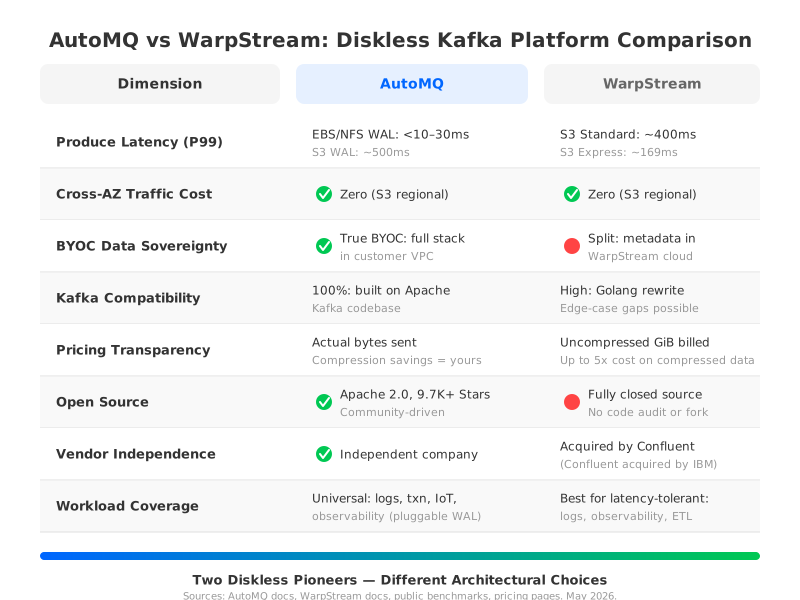
Two years later, these platforms have diverged sharply. WarpStream chose to rewrite Kafka from scratch in Golang, building entirely on S3. AutoMQ took a different path: extending the Apache Kafka codebase with a new cloud-native storage engine and a pluggable write-ahead log (WAL) that can target S3, EBS, or NFS. The divergence goes beyond code. WarpStream was acquired by Confluent in September 2024, and Confluent itself was subsequently acquired by IBM for $11 billion in March 2026. AutoMQ remains independent and fully open source under the Apache 2.0 license.
The divergence spans architecture, deployment model, pricing, and long-term risk — and for anyone evaluating a warpstream alternative or comparing diskless kafka platforms, these differences matter more than the shared "no disks" label suggests.
2Architecture: Two Different Paths to Diskless
Both platforms eliminate local disks and broker-attached storage. But the engineering choices underneath are fundamentally different, and those choices ripple through every dimension that matters to operators.
2.1WarpStream: A Ground-Up Rewrite in Golang
WarpStream replaced the entire Kafka codebase with a Golang implementation that speaks the Kafka protocol and writes directly to S3. The architecture is elegant in its simplicity: stateless "Agents" handle produce and consume requests, while a cloud-hosted metadata store provides global ordering and coordination.
This design has real strengths. Agents are truly stateless — any Agent can serve any request, making horizontal scaling and failure recovery straightforward. There are no local disks to manage, no partition rebalancing storms, and no cross-AZ replication traffic.
The trade-off is that every produce request depends on the cloud metadata store for sequencing. The metadata service is not just a coordination layer — it sits in the critical write path. If the metadata store is slow or unavailable, produce latency increases or writes stall entirely. WarpStream's own documentation notes a P99 produce latency of approximately 400ms in the default S3 Standard configuration. With S3 Express One Zone, WarpStream has demonstrated P99 produce latency of 169ms — a significant improvement, but at higher infrastructure cost and limited to single-AZ durability.
The complete rewrite also introduces a compatibility gap. Reimplementing the Kafka protocol from scratch means continuously chasing upstream evolution. Complex features like Transactions and Compaction historically lagged the Apache Kafka implementation, and every new KIP requires independent engineering effort to support.
2.2AutoMQ: Cloud-Native Evolution of Apache Kafka
AutoMQ took the opposite approach. Rather than rewriting Kafka, AutoMQ extends the Apache Kafka codebase by replacing only the lowest-level LogSegment storage implementation with S3Stream — a cloud-native streaming storage engine built on object storage. Everything above the storage layer remains unchanged: the broker logic, the protocol handling, the KRaft metadata controller, the ecosystem integrations.
The architectural signature of AutoMQ is its pluggable WAL. Instead of forcing all writes through S3 (and accepting hundreds of milliseconds of latency), AutoMQ introduces a small, fixed-capacity write-ahead log that absorbs writes at low latency and flushes to object storage asynchronously. The WAL backend is configurable:
- Regional EBS WAL: P99 produce latency under 10–30ms, recommended for most workloads
- NFS WAL (AWS FSx for NetApp ONTAP): Sub-10ms latency with multi-AZ durability, for latency-critical workloads like transaction matching
- S3 WAL: ~500ms latency, lowest cost, ideal for log aggregation and batch ETL
This pluggable design means a single AutoMQ deployment can serve both latency-sensitive transaction processing and cost-optimized log aggregation — without running two separate systems.
2.3Key Architectural Difference: Metadata Dependency
The most consequential architectural difference is how each platform handles metadata in the write path.
WarpStream's Agents must communicate with the cloud metadata store on every produce request for global sequencing. The metadata service's availability directly determines the overall SLA. If the metadata store experiences degraded performance, every producer in the cluster feels it.
AutoMQ reuses Kafka's native KRaft controller for metadata. Critically, the message write path does not pass through the metadata service. Producers write to the WAL and receive acknowledgment without any metadata service involvement. Metadata failures affect partition leadership elections and administrative operations, but they do not stall or slow down in-flight data writes. This is the same isolation model that Apache Kafka operators already understand and trust.
3BYOC Deployment: True Data Sovereignty vs Split Architecture
The metadata dependency described above is not just a latency concern — it also determines where your infrastructure state physically resides. Both AutoMQ and WarpStream offer Bring Your Own Cloud (BYOC) deployment, but the term means different things for each platform.
WarpStream's BYOC runs the data plane — the Agents and object storage — inside the customer's VPC. However, the control plane, including the critical metadata store that sequences every write, runs in WarpStream's own cloud infrastructure. Your topic data stays in your account, but partition assignments, consumer offsets, and the global ordering metadata live outside your control. WarpStream's documentation describes this as separating "data from metadata" and "data plane from control plane," positioning it as a security benefit. For teams that need to know exactly where every byte of their infrastructure state resides, this split creates a dependency on an external service they cannot audit, monitor, or failover independently.
AutoMQ's BYOC deploys the entire stack — data plane and metadata plane — inside the customer's VPC. There are no externally hosted components. The KRaft controllers, the brokers, the WAL, and the object storage all run in infrastructure the customer owns and controls. For organizations in regulated industries — financial services, healthcare, government — this distinction is not academic. Compliance frameworks often require that all components processing or coordinating data reside within controlled boundaries. A metadata service running in a vendor's cloud account, even if it never touches the raw data, can complicate audit trails and sovereignty certifications.
4Pricing: Transparent vs Unpredictable
Deployment model determines where your data lives. Pricing model determines what you pay for it. Both platforms use consumption-based pricing, but the metering methodology creates a significant cost difference for many workloads.
AutoMQ charges based on actual data volume — the bytes your producers send over the wire. If your application compresses data before producing (which most do), you pay for the compressed size. Compression savings belong entirely to you.
WarpStream meters on "Uncompressed GiB written" — the logical data size after decompression. Even if your producers send highly compressed payloads, WarpStream's billing system measures the uncompressed volume. With structured data like JSON logs or Avro events that commonly achieve 4:1 to 5:1 compression ratios, this means you could be billed for four to five times the data you actually transmitted.
To put concrete numbers on this, consider a workload with 300 MiB/s peak write throughput, 2× read fanout, and 72-hour retention — a representative mid-scale streaming deployment. Running the AutoMQ pricing calculator against public pricing data:
| Platform | Monthly Cost | Key Cost Drivers |
|---|---|---|
| AutoMQ (BYOC) | $21,804 | Compute $1,430 + S3 $2,997 + Subscription fees $17,073 + Cluster $300 |
| WarpStream | $24,161 | Compute $2,439 + S3 $3,127 + Ingress fee $15,442 + Storage fee $2,653 + Cluster $500 |
| Apache Kafka (self-managed) | $103,195 | Compute $5,151 + EBS $36,450 + Cross-AZ $61,594 |
These numbers assume uncompressed billing for WarpStream at the calculator's default parameters. For workloads with high compression ratios, the gap widens further because WarpStream's ingress fee scales with the uncompressed volume. A team sending 300 MiB/s of compressed JSON logs with a 5:1 ratio would see WarpStream meter 1,500 MiB/s of logical throughput for billing purposes, while AutoMQ meters the actual 300 MiB/s.
Both diskless platforms deliver dramatic savings over self-managed Apache Kafka — roughly 77–79% in this scenario — primarily by eliminating cross-AZ replication traffic and EBS storage costs. The difference between AutoMQ and WarpStream is more nuanced and depends heavily on compression ratios and workload characteristics.
5Open Source and Vendor Lock-In
Cost is a near-term concern. The longer-term question is what happens to your platform when the vendor's priorities change.
5.1Open Source vs Closed Source
AutoMQ is fully open source under the Apache License 2.0, with over 9,700 GitHub stars and an active contributor community. The entire storage engine, broker logic, and operational tooling are available for inspection, modification, and self-hosting. If AutoMQ the company disappeared tomorrow, the codebase would remain.
WarpStream is entirely closed source. The Agent binary is distributed as a proprietary artifact. Users cannot audit the code for security vulnerabilities, cannot fix bugs independently, and cannot fork the project if the product direction changes. The metadata store — the component that sequences every write — is a proprietary service running in WarpStream's infrastructure, inaccessible to customer inspection.
For platform engineering teams evaluating long-term risk, this is a meaningful asymmetry. Open source does not guarantee a product will be maintained forever, but it does guarantee that the option to self-maintain exists. Closed source means your only option is the vendor.
5.2The Acquisition Factor
WarpStream's independence ended in September 2024 when Confluent acquired the company. Eighteen months later, IBM acquired Confluent for $11 billion. WarpStream is now a product line within a product line within IBM.
Acquisitions are not inherently negative — they can bring resources and stability. But they also introduce uncertainty. Pricing strategies may shift to align with the parent company's revenue targets. Product roadmaps may be redirected to serve the acquirer's strategic priorities. Integration with the broader Confluent/IBM ecosystem may take precedence over independent innovation. These are not speculative fears — they are the documented pattern of enterprise software acquisitions.
AutoMQ remains an independent company. Its roadmap is driven by its own customers and community, not by the strategic calculus of a $11 billion acquisition.
5.3Migration and Exit Strategy
How you get out matters as much as how you get in.
AutoMQ supports zero-downtime migration through AutoMQ Linking — an offset-preserving replication mechanism that requires only a rolling restart of client applications. Consumer offsets are preserved end-to-end, which means Flink jobs and stateful consumers continue from exactly where they left off. No data loss, no reprocessing, no coordination downtime window.
WarpStream offers Orbit for migration, which replicates data from source Kafka clusters into WarpStream. For the reverse direction — migrating away from WarpStream — the path is less straightforward. Without open-source tooling or offset-preserving export, teams typically face a harder cutover with the associated risks of downtime and offset discontinuity. When evaluating any platform, the exit strategy deserves as much scrutiny as the onboarding experience.
6Use Case Coverage: Universal vs Niche
WarpStream's pure S3 architecture makes it a strong fit for workloads where latency is not a primary concern: log aggregation, observability pipelines, batch ETL, and data lake ingestion. For these use cases, the simplicity of a zero-disk, S3-only architecture is genuinely appealing, and WarpStream's engineering team deserves credit for proving that this model works at scale.
The limitation surfaces when the same organization also runs latency-sensitive Kafka workloads — real-time fraud detection, dynamic pricing, IoT command-and-control, or microservice event buses where P99 produce latency needs to stay under 30ms. WarpStream's S3 Express One Zone option brings latency down to ~169ms P99, but that is still an order of magnitude above what EBS or NFS-backed WAL can deliver.
AutoMQ's pluggable WAL architecture covers both ends of the spectrum with a single platform:
- S3 WAL for cost-optimized, latency-tolerant workloads (logs, metrics, ETL) — the same territory WarpStream serves
- Regional EBS WAL for general-purpose streaming with P99 under 10–30ms
- NFS WAL for latency-critical workloads requiring sub-10ms P99 with multi-AZ durability
This means a platform team can standardize on one streaming infrastructure for all Kafka use cases, rather than running WarpStream for logs and a separate Kafka cluster for everything else. The scale this enables is not theoretical. JD.com, China's largest retailer by revenue, runs AutoMQ across 4,000+ pods processing 13 trillion messages per day at peak throughput exceeding 100 GiB/s — spanning e-commerce transactions, logistics tracking, and real-time analytics on a single platform. Production deployments at Grab (ride-hailing), Tencent Music, and HubSpot further validate that AutoMQ handles the full range of streaming scenarios — from high-throughput log pipelines to latency-sensitive transactional workloads.
7Which Diskless Kafka Is Right for You?
Both AutoMQ and WarpStream represent genuine innovation in the Kafka ecosystem. They share the same insight — that cloud object storage should replace local disks as the primary data layer — but they made fundamentally different engineering and business decisions along the way.
WarpStream may be the right choice if:
- You are already deeply invested in the Confluent/IBM ecosystem and want a unified vendor relationship
- Your workloads are predominantly log aggregation, observability, or ETL where hundreds of milliseconds of produce latency is acceptable
- You prefer the operational simplicity of a fully stateless, zero-WAL architecture with no local capacity planning
- You are comfortable with a closed-source platform and metadata hosted outside your VPC
AutoMQ is likely the better fit if:
- You need a universal Kafka platform that covers both latency-sensitive and cost-optimized workloads with a single architecture
- Data sovereignty and compliance require that all components — including metadata — run inside your VPC (True BYOC)
- You value open source, transparent pricing, and the ability to inspect, modify, and self-host the entire stack
- 100% Kafka compatibility is non-negotiable, and you cannot afford edge-case protocol gaps from a ground-up rewrite
The two diskless pioneers that launched within months of each other in 2023 have charted very different courses. One is now part of IBM. The other is open source and independent. The architecture you choose today will shape your streaming infrastructure for years to come.
Ready to compare costs for your workload? Try the AutoMQ Pricing Calculator to see the difference.
Want to understand True BYOC? Learn how AutoMQ deploys entirely inside your VPC.
Explore the code: AutoMQ on GitHub — Apache 2.0, 9,700+ stars.


