
Table of Contents
Table of Contents
When a Kafka bill looks wrong, the first reaction is usually to check broker count, instance size, and storage retention. That is reasonable, because those line items are visible and easy to map to a cluster. The harder part is traffic. A production Amazon MSK deployment can move the same byte through several network boundaries before it becomes a durable Kafka record, a replicated follower copy, a consumer response, a connector payload, or a mirrored stream in another cluster.
That is why the search phrase traffic costs Amazon MSK usually comes from a team that has already moved past a simple pricing-page check. They are trying to answer a more operational question: which traffic is intrinsic to Kafka semantics, which traffic comes from an AWS network boundary, and which traffic comes from an architecture decision that can be changed?
1Start With The Traffic Paths, Not The Service Name
Amazon MSK is a managed service for running Apache Kafka data-plane operations while AWS handles many control-plane operations such as creating, updating, and deleting clusters. That distinction matters in a cost review. The managed service boundary changes who operates the cluster, but it does not remove Kafka's core mechanics: producers write records, brokers store topic partitions, consumers fetch records, and replication keeps partition copies available.
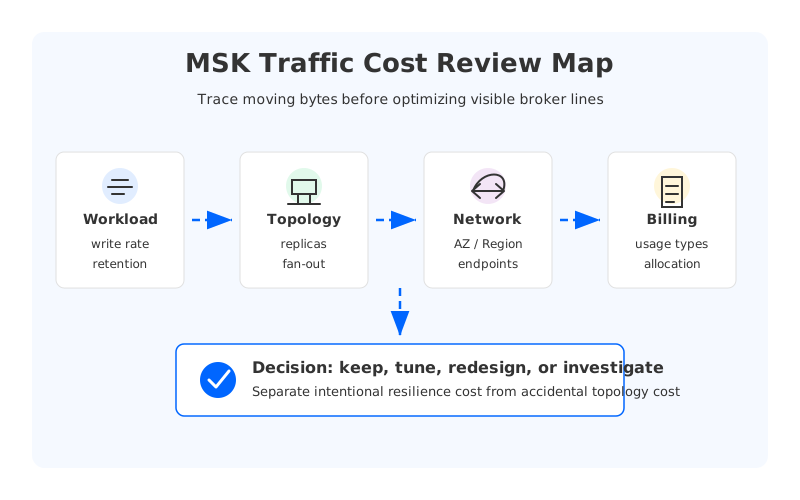
The clean way to review MSK traffic costs is to map data movement before arguing about pricing. A workload with the same broker count can have very different network charges depending on producer placement, consumer fan-out, replication factor, connector placement, PrivateLink use, and cross-region replication. Two teams can both say "three-AZ MSK cluster" and still produce different traffic profiles.
The first pass should identify five paths:
- Producer ingress: where clients run, which subnets they use, and whether traffic enters through VPC peering, transit gateways, public endpoints, or PrivateLink.
- Replication traffic: how many partition replicas are maintained and whether followers are placed across Availability Zones.
- Consumer egress: how many independent consumer groups read the same data, where they run, and whether catch-up reads concentrate in a different zone.
- Operational flows: rebalancing, broker replacement, partition reassignment, schema/connect traffic, monitoring, and backups.
- Inter-cluster movement: replication across clusters, Regions, accounts, or clouds for migration, disaster recovery, or data sharing.
This list is deliberately not an AWS bill taxonomy. It is a systems taxonomy. Billing data tells you where charges landed; the traffic map tells you why they happened.
2The Kafka Mechanics That Create Network Volume
Kafka is efficient at sequential writes and fan-out, but it is not magic. If a topic uses multiple replicas, the leader broker must make data available to follower replicas. If those replicas are distributed across Availability Zones for availability, replication creates cross-zone network movement. If ten consumer groups independently read the same topic, Kafka serves ten logical reads even when the underlying records are the same. If consumers fall behind and catch up from retained data, historical fetches can become a material traffic path rather than a small background detail.
This is where cost reviews often go sideways. A FinOps export may show regional data transfer usage, but it will not tell you whether the cause was replication, consumer placement, a migration tool, or a connector running in the wrong subnet. Kafka platform teams see the application topology; cloud finance teams see the bill. The review works only when both views are joined.
| Input | Why It Changes Traffic Cost | What To Measure |
|---|---|---|
| Write throughput | Replication multiplies bytes after producer ingress. | Sustained MiB/s by topic and replication factor. |
| Consumer fan-out | Each independent group can create another read path. | Number of active groups and fetch volume by group. |
| AZ placement | Cross-AZ boundaries can turn normal Kafka movement into billable transfer. | Client, broker, connector, and replica placement by AZ. |
| Retention and catch-up | Old reads can bypass hot caches and amplify storage/network paths. | Catch-up read rate, lag recovery windows, and retention tiers. |
| Migration or DR | Replicators can double-write or copy history across clusters. | Replication scope, Region boundary, and backfill duration. |
The table also shows why average throughput is not enough. Cost reviews need peak and sustained rates, but they also need topology. A low-throughput topic with many consumer groups in other zones may be more expensive than a higher-throughput topic consumed locally.
3Where AWS Network Boundaries Enter The Review
AWS documents several data transfer categories that matter to Kafka deployments. Transfer between Availability Zones in the same Region is represented in cost and usage data with regional data transfer usage types. Transfer between Regions has its own source and destination logic. Transfer through PrivateLink adds endpoint-hour and data-processing dimensions. These are cloud network facts rather than MSK-specific behavior, but MSK traffic can exercise them continuously.
That is the uncomfortable part of streaming infrastructure: the meter does not sleep. A batch job may move a large file once. A Kafka cluster can move smaller records all day, every day, through replication and fetch paths. A minor placement mistake can become a steady cost source because the workload is always active.
The practical review sequence looks like this:
- Build a Kafka data-flow map from producers to brokers to consumers, including connectors and replicators.
- Overlay the AWS network map: VPC, subnet, Availability Zone, Region, endpoint type, and account boundary.
- Match the map to billing usage types, especially regional data transfer, inter-region data transfer, and endpoint processing lines.
- Separate baseline Kafka semantics from avoidable topology choices.
- Re-run the model under expected growth, not only current traffic.
This prevents a common false conclusion: "MSK is expensive because brokers are expensive." Sometimes that is true. Sometimes the broker line is well understood, while the traffic line is the part that scales faster than the team expected.
4Architecture Choices That Move The Cost Curve
Once the traffic map is clear, the design discussion becomes more concrete. Managed Kafka, self-managed Kafka, and Kafka-compatible shared-storage systems all expose different trade-offs. A respectful comparison should not pretend that one option dominates every workload. The right question is whether the workload's dominant cost driver is operational labor, broker compute, local storage, cross-AZ movement, retention, fan-out, or migration risk.
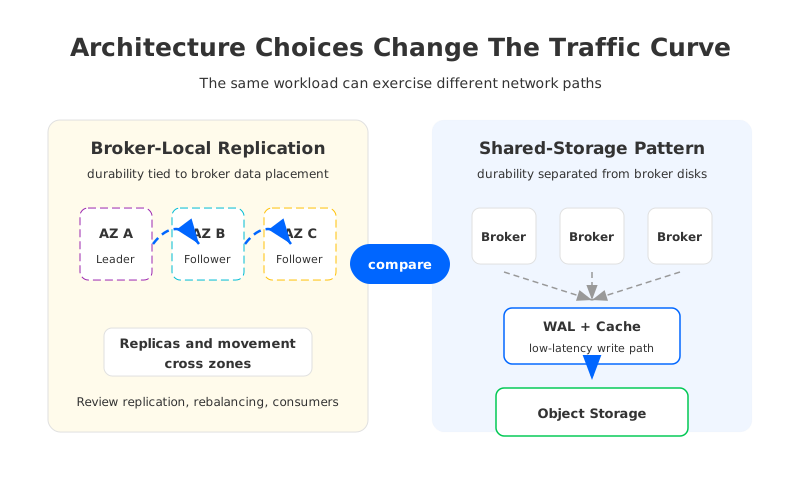
Traditional Kafka couples broker ownership with local log storage. That model is well understood, mature, and compatible with a broad ecosystem. It also means that availability, scaling, and recovery often involve broker-local data placement. Tiered storage can reduce pressure on local disks for older data, but the active log and replication model still matter for hot traffic and operational movement.
A shared-storage Kafka-compatible architecture changes the cost discussion because durable data is no longer primarily tied to broker-local disks. Brokers can focus more on protocol processing, routing, caching, and leadership, while object storage holds the durable stream data. That does not eliminate network engineering; it changes which paths dominate. It also moves the evaluation from "how many brokers and disks?" toward "which storage layer, WAL design, cache behavior, and network boundary does the workload exercise?"
For MSK reviews, this distinction is useful even when the team stays on MSK. It helps separate tactical improvements from structural ones. Tactical work includes colocating clients, correcting connector placement, trimming unnecessary replication jobs, right-sizing broker types, and revisiting retention. Structural work asks whether the workload should continue to bind durability, scaling, and recovery to broker-local storage.
5The Inputs Most Cost Reviews Miss
The missing inputs are usually not obscure. They are ignored because no single team owns all of them. Application teams know producer and consumer behavior. Platform teams know Kafka topics, partitions, and broker placement. Network teams know VPC and endpoint topology. Finance teams know CUR exports and allocation tags. A useful MSK cost review forces these inputs into one worksheet.
At minimum, capture these fields for each major workload:
- Topic family and business owner, so cost can be assigned to a system rather than a shared platform bucket.
- Write throughput, peak-to-average ratio, record size distribution, and compression setting.
- Replication factor, partition count, and broker/AZ placement assumptions.
- Consumer groups, consumer locations, lag recovery behavior, and historical read expectations.
- Retention period, tiered storage settings if used, and expected growth rate.
- Network access pattern: same VPC, peering, transit gateway, PrivateLink, public endpoint, cross-account, or cross-region.
- Migration and disaster recovery flows, including backfill windows and steady-state replication.
The worksheet should also include a "can change?" column. Some traffic is a deliberate reliability choice. Cross-AZ replication may be exactly what the business wants. Other traffic is accidental, such as a consumer fleet pinned to one Availability Zone while brokers span three zones. Cost optimization should not erase resilience requirements; it should make the trade-off explicit.
6How AutoMQ Fits The Evaluation
After the neutral model is in place, AutoMQ belongs in the conversation as one architectural option, not as a shortcut around analysis. AutoMQ is a Kafka-compatible cloud-native streaming platform that replaces Kafka's broker-local log storage with a shared storage architecture based on S3-compatible object storage and a WAL layer. The goal is to preserve Kafka protocol and ecosystem compatibility while making brokers stateless and separating compute from storage.
That design is relevant to traffic-cost reviews for three reasons. First, stateless brokers reduce the need to treat every scaling or recovery action as a data movement project. Second, object-storage-backed durability changes how teams think about retained data and broker-local capacity. Third, AutoMQ's architecture is designed to avoid cross-AZ traffic in the data path for supported deployment patterns, which is directly relevant when regional data transfer is a recurring line item.
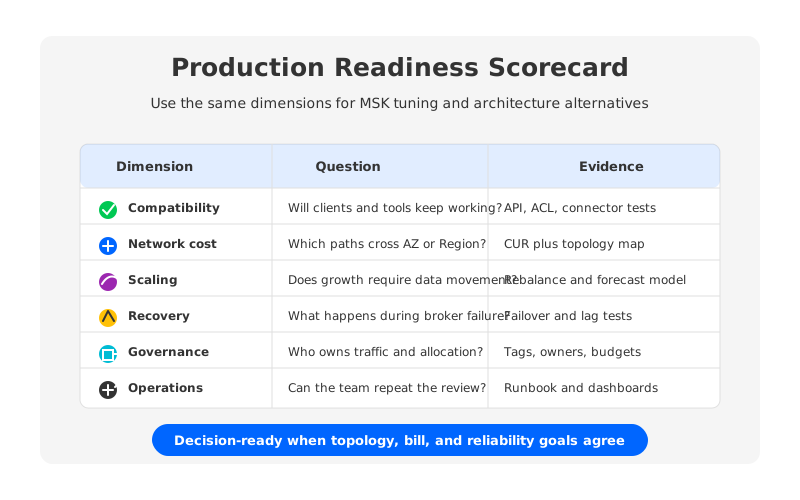
The evaluation still needs workload-specific validation. Teams should test producer latency, consumer catch-up behavior, connector compatibility, security controls, observability, failure recovery, and operational processes. They should also validate which AutoMQ deployment model fits their boundary requirements: open source self-managed usage, BYOC in the customer's cloud account, or software deployment in private environments.
The important point is not that every MSK workload should move. The point is that a serious traffic costs Amazon MSK review should include architecture as a variable. If the review only tunes broker size and ignores the storage/replication model, it may optimize around the edges while leaving the largest cost driver intact.
7A Review Pattern That Works In Practice
A good cost review ends with decisions, not a spreadsheet that only finance understands. For each workload, classify findings into four buckets: keep, tune, redesign, and investigate. "Keep" means the cost is intentional and tied to a resilience or product requirement. "Tune" means the architecture is sound but placement, retention, or capacity needs adjustment. "Redesign" means the current model scales poorly against forecast traffic. "Investigate" means the bill and topology do not yet reconcile.
The review should be repeated after any material topology change. Adding a new consumer group, enabling a connector, introducing a replicator, changing endpoint access, or moving an application to another VPC can alter traffic economics without changing the MSK cluster itself. In streaming systems, topology changes are cost changes.
That brings the discussion back to the original bill. The data transfer line is not noise around the Kafka platform; it is evidence of how the platform is wired. Once teams can trace that line back to producers, replicas, consumers, endpoints, and Regions, they can decide whether to accept it, reduce it, or choose a different architecture.
If your next MSK review shows that traffic cost is tied to broker-local replication, scaling movement, or cross-AZ data paths rather than a one-time configuration mistake, compare the model with AutoMQ's shared-storage architecture and validate it against your workload. Start with the AutoMQ overview and architecture docs at go.automq.com, then run the same worksheet against your own traffic profile.
8References
- AWS, Amazon Managed Streaming for Apache Kafka Developer Guide
- AWS, Amazon MSK pricing
- AWS, Understanding data transfer charges
- AWS, AWS PrivateLink pricing
- Apache Kafka, Documentation
- AutoMQ, Architecture overview
9FAQ
9.1Does Amazon MSK charge separately for every Kafka byte?
No single statement covers every deployment. MSK pricing includes service-specific dimensions such as broker and storage choices, while AWS network pricing can apply when traffic crosses boundaries such as Availability Zones, Regions, endpoint services, or the internet. The review should map Kafka traffic paths to AWS billing categories instead of assuming all traffic is included in one MSK line item.
9.2Is cross-AZ traffic always bad for Kafka?
No. Cross-AZ placement is often part of the availability model. The problem is not that cross-AZ traffic exists; the problem is unmanaged cross-AZ traffic that the team did not intend or quantify. Reliability choices should be explicit, measured, and tied to business requirements.
9.3Can consumer placement materially change MSK traffic costs?
Yes. Multiple consumer groups, consumers located in different Availability Zones, and catch-up reads can all change network volume. Consumer traffic is easy to underestimate because teams often focus on producer ingress and broker replication first.
9.4Does tiered storage remove the need to review network traffic?
No. Tiered storage can change storage economics for older data, but hot writes, replication, consumer fetches, and operational movement still need review. It is a storage strategy, not a complete traffic-cost model.
9.5When should AutoMQ enter an MSK cost review?
AutoMQ should enter after the team has mapped workload traffic and identified structural cost drivers. If the main issue is accidental placement, fix that first. If the issue is tied to broker-local storage, scaling movement, or persistent cross-AZ data paths, a Kafka-compatible shared-storage architecture is worth evaluating.


