
Table of Contents
Table of Contents
Most teams searching for an AWS Kafka alternative are not trying to abandon Kafka. They are trying to escape the parts of Kafka that become expensive or slow-moving when the platform is operated the traditional way on AWS: broker-local disks, replica placement, partition rebalancing, overprovisioned capacity, and a long tail of operational work that sits between application teams and the data they need.
That distinction matters. Apache Kafka is still the interface many organizations have standardized on. Its producer and consumer APIs, topic model, offsets, replication, connectors, and stream processing ecosystem are often embedded deep inside application architecture. The question is rarely "Should we replace every Kafka client?" A more useful question is: "Which part of the AWS Kafka architecture do we need to replace?"
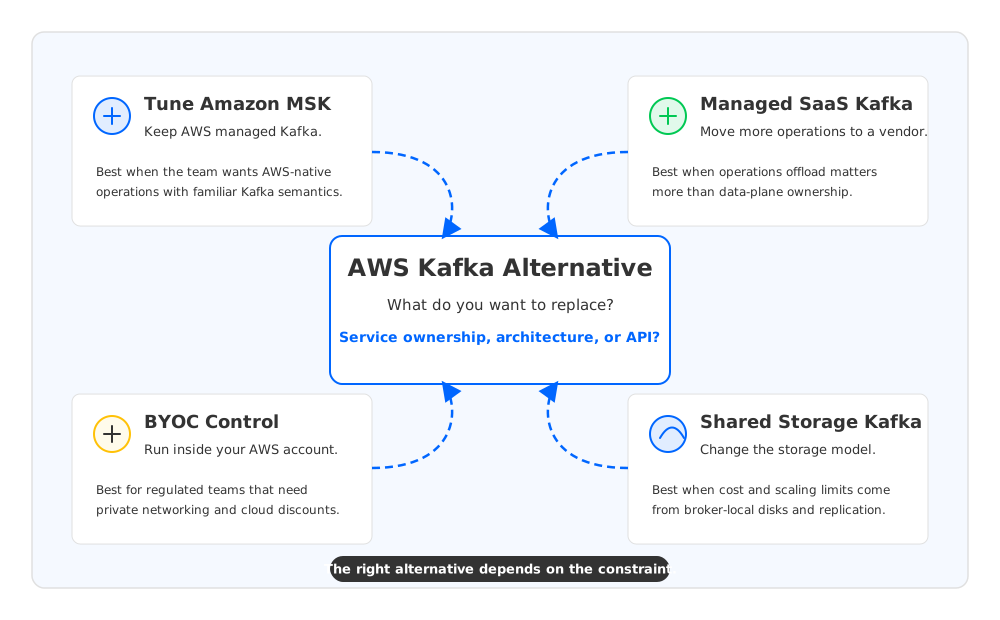
There are several valid answers. Amazon MSK can reduce the work of running Apache Kafka yourself. Confluent Cloud can move more of the platform into a managed SaaS model. Redpanda can be evaluated as a Kafka-compatible engine. WarpStream-style systems move Kafka-compatible workloads toward object storage. AutoMQ fits a related but distinct path: keep Kafka compatibility while replacing the broker-local storage model with shared cloud storage and stateless brokers.
The right AWS Kafka alternative is not the one with the longest feature checklist. It is the one that removes the constraint you actually have.
1Do You Need an Alternative to Kafka or to Kafka's AWS Architecture?
Kafka's semantics are valuable because they sit at the boundary between many systems. A change to the messaging API can affect client libraries, retry behavior, ordering assumptions, schemas, Connect pipelines, stream processing jobs, monitoring, ACLs, and runbooks. If those dependencies are widespread, protocol replacement may cost more than the infrastructure problem.
Apache Kafka's own documentation frames Kafka as a distributed event streaming platform with topics, partitions, producers, consumers, offsets, and replicated logs. Those concepts are not surface-level details; they define how applications reason about replay, ordering, fan-out, and failure recovery. A good AWS Kafka replacement therefore starts by separating compatibility requirements from infrastructure preferences.
Use this decision split before comparing vendors:
- If applications depend on Kafka clients, Kafka Connect, Kafka Streams, Schema Registry integrations, or offset-based replay, shortlist Kafka-compatible alternatives first. You can still change the runtime architecture without rewriting the application contract.
- If Kafka is used only as a generic queue and few clients depend on its semantics, a broader event platform evaluation may be reasonable. Include migration work, SDK maturity, ordering, retention, replay, and tooling in the comparison.
- If the main pain is cost, scaling speed, or day-2 operations on AWS, the target is usually not "replace Kafka." The target is to replace the traditional way Kafka binds compute, storage, and replication together.
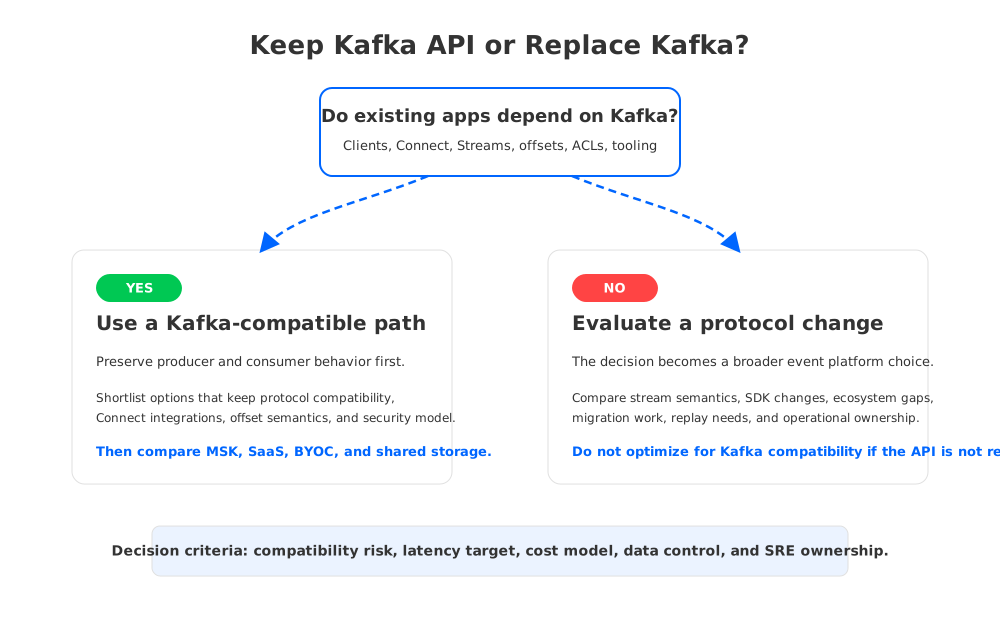
This is why a simple "Kafka vs alternative" table is often misleading. One option may be managed Apache Kafka. Another may be a Kafka-compatible implementation. A third may keep the protocol but change storage architecture. Those are different decisions, even when the keyword is the same.
2Common AWS Kafka Options
AWS gives teams several ways to run Kafka-like workloads, but each path optimizes for a different ownership boundary. The practical comparison is not just latency or price. It is who owns the data plane, where data is stored, how scaling happens, and whether Kafka compatibility is preserved for your existing estate.
| Option | What It Replaces | What Usually Stays | Strong Fit | Watch Carefully |
|---|---|---|---|---|
| Amazon MSK | Self-managed broker operations | Apache Kafka semantics | AWS-native teams that want managed Kafka | Capacity planning, storage model, cluster limits, pricing shape |
| Confluent Cloud | Much of Kafka platform operations | Kafka ecosystem and Confluent services | Teams wanting SaaS, governance, connectors, managed stream processing | Data-plane ownership, networking, enterprise cost model |
| Redpanda | Kafka implementation | Kafka protocol compatibility for many clients | Teams evaluating an alternative engine | Feature compatibility details and operational model |
| WarpStream-style shared storage | Broker-local disk architecture | Kafka-compatible access pattern | Workloads that benefit from object storage economics | Latency profile, protocol coverage, vendor architecture |
| AutoMQ | Kafka storage architecture on cloud | Kafka compatibility and AWS data control | AWS workloads needing elastic Kafka-compatible streaming | Fit against latency, deployment, and operational requirements |
| Self-managed Kafka on EC2/EKS | Managed service dependency | Full control of Apache Kafka | Specialized teams with deep Kafka SRE maturity | Highest operational burden |
2.1Amazon MSK
Amazon Managed Streaming for Apache Kafka is the natural first stop because it keeps Apache Kafka while offloading much of the cluster management to AWS. AWS describes Amazon MSK as a service that makes it easier to build and run applications that use Apache Kafka. For teams standardized on AWS IAM, VPC networking, CloudWatch, and private connectivity, that alignment is valuable.
The pricing model also shows why MSK is not a complete answer for every team. In MSK Provisioned, AWS charges for broker instance usage, provisioned storage, and optional provisioned storage throughput; for MSK Serverless, AWS charges for cluster hours, partition hours, data written, data read, and consumed storage. Standard AWS data transfer charges may also apply. That is a clean managed-service model, but architects still need to reason about brokers, partitions, storage, throughput, and traffic shape.
MSK is a strong choice when your pain is self-managed Kafka operations rather than Kafka's underlying architecture. If your bottleneck is rebalancing data across stateful brokers, scaling down idle capacity, or making storage economics work for long retention, MSK tuning may reduce toil without eliminating the architectural constraint.
2.2Confluent Cloud
Confluent Cloud is a mature managed SaaS path for organizations that want Kafka plus a broader streaming platform. Confluent's documentation positions it as a fully managed data streaming platform with a cloud-native Kafka engine, managed connectors, governance, stream processing, and enterprise controls. That makes it attractive when the goal is not just "Kafka brokers on AWS" but a managed ecosystem around Kafka.
The trade-off is the ownership boundary. SaaS can remove a large amount of operational work, but FinOps and security teams still need to evaluate networking, data residency, private connectivity, audit requirements, and commercial predictability. For teams that must keep the data plane inside their own AWS account, SaaS may not match the control model.
2.3Redpanda
Redpanda is often considered when teams want a Kafka-compatible alternative engine rather than Apache Kafka itself. Redpanda's official compatibility documentation says it is compatible with Apache Kafka versions 0.11 and later, with documented exceptions. Compatibility should still be tested against your client versions, admin operations, security model, Schema Registry usage, and workflows.
Redpanda can be a serious candidate for teams that want a different broker implementation. Do not evaluate it from claims alone. Use a compatibility test suite, replay representative workloads, validate consumer group behavior, and check the operational APIs your SREs use.
2.4WarpStream-Style Shared Storage
WarpStream represents a different category: Kafka-compatible streaming built directly on top of cloud object stores such as S3, according to its official documentation. This shifts the center of gravity from broker-attached disks to object storage economics and cloud-native elasticity.
That architecture is compelling where traditional Kafka's local disk model creates cost and scaling friction. The evaluation point is latency and feature coverage. Teams should test p99 latency, fan-out, small-message behavior, compaction requirements, and recovery paths before standardizing.
2.5AutoMQ
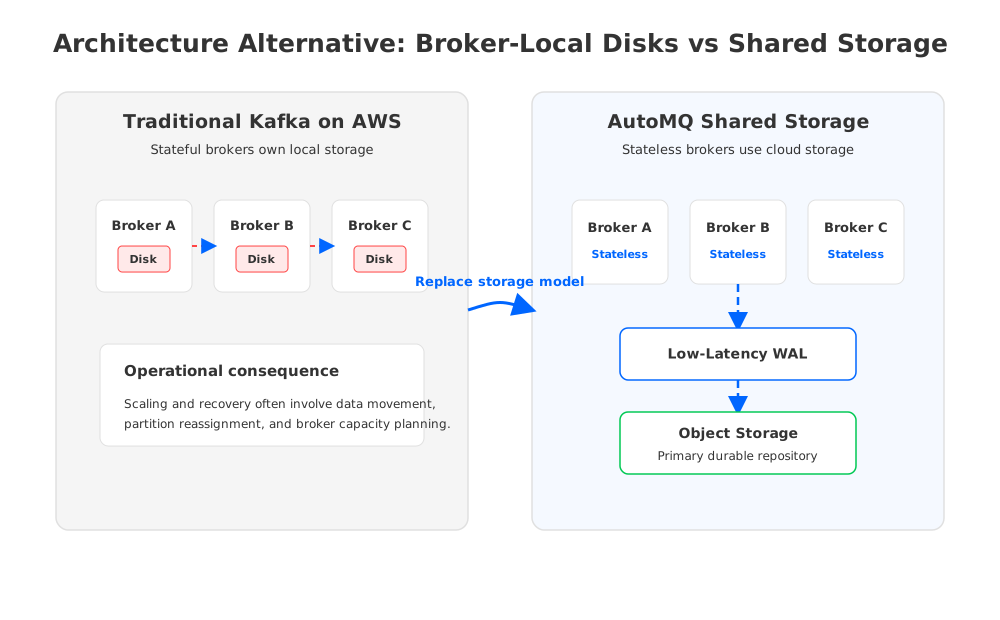
AutoMQ also belongs in the architecture-alternative bucket, but its design is framed around Kafka compatibility with shared storage. AutoMQ documentation describes an architecture in which Kafka's native log storage is replaced by S3Stream; brokers become stateless, data is stored near real time into object storage, and a write-ahead log layer handles low-latency persistence before data is committed to object storage.
That makes AutoMQ different from simply adding tiered storage to Kafka. In Kafka tiered storage, broker-local primary storage and the traditional replication model still matter for the active data path. In AutoMQ's model, cloud storage becomes the primary durable repository while brokers are treated more like elastic compute. For AWS teams, that difference can change scaling, recovery, and cost planning because capacity is no longer dominated by moving partitions between stateful broker disks.
AutoMQ is not the right answer to every "AWS Kafka alternative" query. If your team wants a pure SaaS platform with a large managed connector catalog, Confluent Cloud may be a better initial shortlist. If your main requirement is staying on AWS-managed Apache Kafka with minimal vendor change, MSK should remain on the table. AutoMQ becomes more relevant when you want Kafka-compatible behavior, BYOC-style data control, object-storage economics, and faster elasticity.
3How to Shortlist AWS Kafka Alternatives
The most useful shortlist starts with constraints, not products. A CTO may care about vendor risk and data control. An SRE may care about recovery time. A data engineer may care about Connect compatibility and consumer lag. A FinOps lead may care about the cost curve when throughput, retention, and fan-out grow at different rates.
Ask these questions in order:
- Do you need Kafka API compatibility? If yes, avoid non-Kafka services unless you have budgeted application migration work.
- Is the primary pain operational toil, infrastructure cost, scaling speed, or compliance control? Each points to a different alternative.
- Where must the data plane live? SaaS, AWS-managed, and BYOC models create different security and procurement conversations.
- What is your dominant cost driver: brokers, storage, data transfer, reads, partitions, connectors, or engineering time?
- How does the platform scale down? Idle capacity is where recurring waste hides.
- What happens during broker failure, AZ impairment, and partition movement? Architecture choices show up most clearly during failure.
- Which Kafka features are mandatory? Test transactions, compaction, consumer groups, ACLs, quotas, Schema Registry, Connect, and admin tooling explicitly.
For featured-snippet simplicity: choose Amazon MSK for AWS-managed Apache Kafka; Confluent Cloud for managed SaaS streaming; Redpanda for a Kafka-compatible alternative engine; WarpStream-style systems when object storage is central; and AutoMQ for Kafka compatibility with shared storage, stateless brokers, and BYOC control on AWS.
4Why AutoMQ Fits Kafka-Compatible AWS Workloads
The architectural argument for AutoMQ starts with a cloud mismatch. Traditional Kafka was designed around brokers that own local log storage. That model made sense when disks were attached to servers and replication was the application's responsibility. On AWS, storage, networking, and availability zones are priced and operated differently. When every broker is both compute and storage, operational decisions become coupled: scale compute and you disturb storage; recover a broker and you move data.
AutoMQ's shared storage model separates those concerns. The broker handles Kafka-compatible compute. The WAL absorbs the low-latency write path. Object storage becomes the durable layer. Because brokers are stateless, scaling and recovery can be treated more like cloud compute operations than storage migrations.
That is the reason AutoMQ should be evaluated as an AWS Kafka architecture alternative, not merely as another Kafka-branded service. Teams want to keep the parts of Kafka that applications depend on while changing the parts of Kafka operations that no longer fit their AWS cost and elasticity goals.
A practical AutoMQ evaluation should include:
- Compatibility testing with your existing producers, consumers, admin tools, Connect pipelines, and security settings.
- Workload testing for p50, p95, and p99 latency under both steady traffic and burst traffic.
- Failure testing for broker loss, AZ disruption assumptions, and client retry behavior.
- Cost modeling that includes broker compute, storage, retention, read fan-out, data transfer, and SRE time.
- Deployment review for VPC layout, IAM, private connectivity, observability, backup expectations, and change-management ownership.
Do not accept "lower cost" as a generic claim from any vendor, including AutoMQ. Build a model from your own throughput, retention, partition count, read fan-out, and AWS region. The architecture can create a better cost curve, but the business case should still be calculated from your workload.
5A Practical Recommendation
If your team is happy with Kafka semantics and mostly unhappy with operating Kafka on EC2 or EKS, start with Amazon MSK. If your organization wants a managed streaming platform rather than an AWS-resident Kafka cluster, include Confluent Cloud early. If your team is open to Kafka-compatible engines, include Redpanda. If your real constraint is the broker-local storage model, include shared storage Kafka architectures such as WarpStream-style systems and AutoMQ.
For many AWS teams, the final decision is not a single winner. A central platform team may use MSK for conservative AWS-managed use cases, SaaS for teams that value managed ecosystem features, and shared storage Kafka for workloads where elasticity and storage economics dominate.
The important move is to stop treating "AWS Kafka alternative" as a brand query. Treat it as an architecture query. Once the constraint is clear, the shortlist becomes smaller and the proof-of-concept becomes more honest.
If your workload needs Kafka compatibility but your AWS architecture is constrained by stateful brokers, local disks, and slow scaling, review the AutoMQ shared storage architecture and test it against your workload model.
6FAQ
6.1What is the best AWS Kafka alternative?
There is no universal best alternative. Amazon MSK is the most direct AWS-managed Apache Kafka option. Confluent Cloud is a managed SaaS platform. Redpanda is a Kafka-compatible alternative engine. WarpStream-style systems and AutoMQ are architecture alternatives for cloud object storage. The right choice depends on operations, cost, compatibility, data control, and scaling.
6.2Is Amazon MSK an alternative to Kafka?
Amazon MSK is not an alternative to Kafka in the protocol sense. It is a managed AWS service for Apache Kafka. It can be an alternative to running Kafka yourself on EC2 or Kubernetes, but it generally preserves the Kafka model rather than replacing the storage architecture entirely.
6.3When should I keep Kafka compatibility?
Keep Kafka compatibility when existing applications depend on Kafka clients, consumer groups, offsets, Kafka Connect, Kafka Streams, Schema Registry integrations, ACLs, or tooling. Replacing the protocol can be worthwhile, but it should be treated as an application migration rather than an infrastructure-only change.
6.4How is AutoMQ different from Kafka tiered storage?
Kafka tiered storage moves older log segments to lower-cost storage while the active path still depends on broker-local primary storage. AutoMQ replaces Kafka's native log storage with a shared storage architecture that uses WAL storage plus object storage, making brokers stateless. That difference changes scaling and recovery behavior.
6.5Should FinOps teams evaluate Kafka alternatives differently from SRE teams?
Yes. SREs often start with reliability, recovery, scaling operations, and observability. FinOps teams should model broker compute, storage, retention, read fan-out, data transfer, private connectivity, and idle capacity. A good evaluation combines both views because the architecture that is easiest to run is not always the one with the most predictable cost curve.


