
Table of Contents
Table of Contents
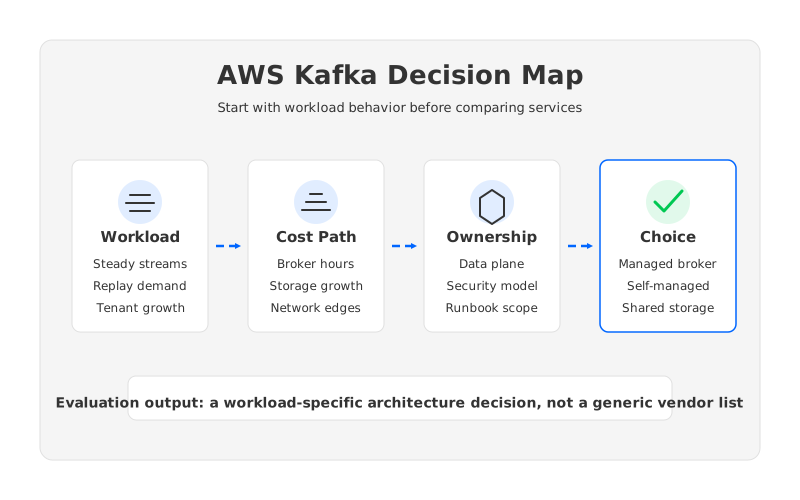
Teams do not search for msk alternatives because Amazon Managed Streaming for Apache Kafka is a bad service. They search because the first production year often teaches a harder lesson: managed brokers remove a meaningful slice of Kafka operations, but they do not remove the architecture choices behind Kafka. You still own topic design, partition growth, client placement, data retention, replay economics, security boundaries, and the bill that appears when traffic crosses network or service edges.
That distinction matters on AWS. Amazon MSK runs open-source Apache Kafka versions and handles control-plane operations such as creating, updating, deleting, and recovering clusters. The data plane remains Kafka: producers write to brokers, consumers read from brokers, partitions live somewhere, and replication or remote storage choices shape cost and failure behavior. A useful alternatives discussion starts from those mechanics rather than from a vendor shortlist.
1Why teams look beyond a managed broker
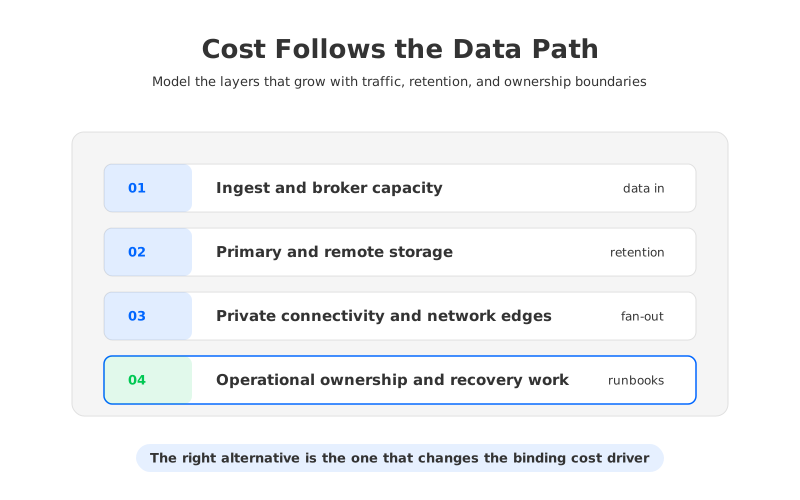
The first reason is usually cost, but the root cause is rarely a single line item. A Kafka platform bill is a combination of broker hours, provisioned or consumed storage, data written, data read, private connectivity, replication, and data transfer. MSK pricing reflects that variety: Standard brokers, Express brokers, Serverless clusters, Connect, and Replicator each charge along different dimensions. A team that asks "Which service has a lower broker price?" misses the parts of the workload that grow faster than broker count.
The second reason is elasticity. Kafka was designed around brokers that own local log segments. That model is reliable and familiar, but it makes scaling a stateful operation. Adding capacity can involve partition movement, disk planning, and operational coordination. Tiered storage improves the retention side by moving older data to a lower-cost tier, yet the hot path still depends on broker primary storage and topic-level constraints. For many workloads, that is a reasonable compromise. For replay-heavy, bursty, or multi-tenant platforms, it may still leave too much state attached to the broker.
The third reason is ownership. Managed services reduce undifferentiated administration, but they also define service boundaries. Some teams want AWS-native operations with fewer knobs. Others need customer-controlled deployments, Kubernetes placement, deeper network policy control, or a streaming layer that can run consistently across clouds. Those are architecture requirements, not preference points.
2The shortlist should start with workload shape
Before comparing MSK with another Kafka-compatible platform, classify the workload. The same service can be a strong fit for a stable, moderate-retention application and a poor fit for a bursty platform that replays weeks of data for multiple downstream teams. A practical review usually separates four workload patterns:
- Steady operational streams. These are payment events, service logs, product telemetry, or CDC feeds with predictable traffic and short retention. Managed Kafka is often attractive because the operational surface is bounded and the workload does not force constant capacity changes.
- Replay-heavy analytics streams. These workloads keep longer histories and expect downstream consumers to reprocess old data. Tiered storage, object-storage-backed systems, and retrieval charges become central to the decision.
- Multi-tenant internal platforms. These clusters serve many application teams. The hard problems are quota management, noisy-neighbor isolation, governance, and scaling without making every team wait for a broker maintenance window.
- Regulated or data-residency-sensitive systems. Here the deployment model matters as much as the Kafka API. Procurement and security teams care where data sits, who can access the control plane, and whether private networking introduces hidden processing charges.
Once the workload shape is visible, the phrase msk alternatives becomes less vague. You might be comparing MSK Standard against self-managed Kafka, MSK Serverless against a SaaS Kafka service, or a broker-centric architecture against a Kafka-compatible shared-storage engine. Those are different decisions.
3Cost is an architecture model, not a price table
AWS cost analysis for Kafka has to follow the data path. A write enters a broker, is acknowledged according to producer and topic settings, may be replicated across brokers, may later move to a remote tier, and may be read many times by consumers. Each stage can create a different cost driver. MSK Standard charges for broker instance usage and provisioned broker storage, with optional provisioned storage throughput. MSK Express adds a per-GB data-in component. MSK Serverless charges for cluster hours, partition hours, data in, data out, and consumed storage.
That variety is not a criticism; it is a signal. AWS is exposing different operating models for different Kafka use cases. The buyer's job is to map a workload to the right model and then test the edges:
| Decision area | What to model | Why it changes the answer |
|---|---|---|
| Retention | Hot retention, remote retention, and replay frequency | Long retention can move the center of gravity from broker disks to remote storage and retrieval behavior. |
| Fan-out | Number of consumer groups and full-topic readers | A platform with many readers can spend more on reads and network movement than on ingestion. |
| Connectivity | Same VPC, multi-VPC, cross-account, or cross-region paths | Private connectivity and data transfer can become material when producers and consumers sit outside the cluster VPC. |
| Scaling | Peak-to-average ratio and partition growth | Stateful scaling makes capacity planning a reliability concern as much as a cost concern. |
| Recovery | Broker replacement, partition reassignment, and failover behavior | Faster control-plane recovery helps, but data placement still determines how much movement is required. |
This is where managed brokers and alternative architectures diverge. A managed broker service can automate cluster operations while preserving Kafka's broker-owned storage model. A shared-storage Kafka-compatible system changes the cost model by reducing how much durable state belongs to each broker. The evaluation should name that difference explicitly.
4Tiered storage helps, but it is not the same as diskless Kafka
Tiered storage is an important step for Kafka on cloud infrastructure. In MSK Standard, tiered storage can move older segments from primary storage into a lower-cost storage tier, reduce the need to provision broker storage for long retention, and accelerate some rebalancing scenarios because data already offloaded to the remote tier does not need to be copied across broker disks. It is especially useful when the workload keeps data longer than the hot processing window.
The trade-off is that tiered storage remains a two-tier architecture. Recent writes still land on broker primary storage first, and several constraints apply at the cluster or topic level. AWS documents requirements around Kafka client versions, supported broker versions, topic cleanup policy, and feature availability. That is acceptable when the goal is lower-cost retention. It is less complete when the goal is to make brokers largely stateless.
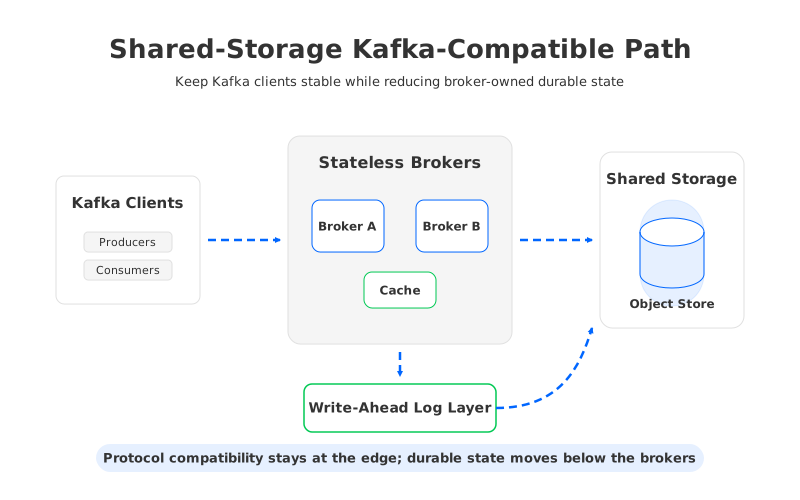
Diskless or shared-storage Kafka-compatible architecture starts from a different premise: the broker should handle protocol, coordination, caching, and serving traffic, while durable log storage lives in object storage or another shared storage layer. That shift changes scaling and recovery. A broker replacement does not need to own a local copy of every partition it serves, and scaling decisions can focus more on compute and cache pressure than on moving durable data between disks.
5Migration risk is mostly semantic risk
Kafka platform owners care about API compatibility because the application estate is usually larger than the broker estate. A migration that requires every producer, consumer, connector, stream processor, and operations dashboard to change at once is not an infrastructure project; it is an organizational rewrite. That is why any MSK alternative should be tested against Kafka semantics before price.
The minimum migration checklist is concrete:
- Client behavior. Validate producer acknowledgments, idempotent producers, consumer group rebalancing, offset commits, transactional reads if used, and client library versions.
- Ecosystem tools. Test Kafka Connect, Schema Registry integration, stream processors, UI tools, metrics collectors, and alert rules in the target deployment model.
- Operational contracts. Rebuild runbooks around broker replacement, partition changes, quota enforcement, certificate rotation, and disaster recovery.
- Rollback paths. Decide whether migration is topic-by-topic, mirror-based, dual-write, or cutover-based. The rollback path must preserve offsets and consumer progress assumptions.
This is also where vendor claims should be treated carefully. "Kafka-compatible" can mean protocol-compatible for common clients, ecosystem-compatible for a tested toolchain, or semantically compatible across advanced behaviors. A serious proof of concept should include the workload's awkward cases, not a happy-path produce-consume benchmark alone.
6How AutoMQ fits the evaluation
After the neutral framework is in place, AutoMQ belongs in the category of Kafka-compatible shared-storage streaming systems. It keeps the Kafka protocol and ecosystem compatibility as the entry requirement, then replaces Kafka's broker-local storage layer with S3Stream shared storage. In AutoMQ's architecture, object storage is the primary durable repository, while a write-ahead log layer absorbs the latency and I/O characteristics that object storage alone would not handle well for streaming writes.
That design is relevant for teams evaluating MSK alternatives because it changes the evaluation from "Who manages my brokers?" to "How much durable state should each broker own?" Stateless brokers make elasticity and recovery less dependent on partition data movement. Shared storage can also reduce inter-zone replication traffic patterns that appear in traditional multi-AZ Kafka deployments. AutoMQ documents a specific inter-zone traffic reduction model for cloud deployments, including broker and client configuration considerations.
The fit is not universal. If a team wants the most AWS-native managed Kafka service with minimal architectural change, MSK may remain the right answer. If the team needs a Kafka-compatible platform where compute and storage scale independently, where object storage is the durable log foundation, and where customer-controlled deployment is part of the requirement, AutoMQ is worth testing alongside MSK rather than after every broker-centric option has already been exhausted.
7A procurement-ready scorecard
The strongest Kafka architecture decision memo is short, but it is not shallow. It should let engineering, SRE, security, FinOps, and procurement argue about the same facts. A scorecard helps because it separates hard requirements from negotiable trade-offs.
| Criterion | Questions to answer | Evidence to collect |
|---|---|---|
| Compatibility | Which Kafka APIs, client versions, and ecosystem tools must work unchanged? | Test matrix, client logs, connector tests, offset and transaction checks. |
| Cost model | Which line items grow with retention, fan-out, private connectivity, or replication? | One-month bill model using production traffic and retention assumptions. |
| Elasticity | Can compute scale without copying durable partition data? | Scale-out and scale-in tests during load, with consumer lag and latency recorded. |
| Network boundary | Where do producers, consumers, brokers, and storage live? | VPC diagrams, cross-AZ and cross-region paths, PrivateLink assumptions. |
| Operations | What remains on the platform team's pager? | Runbooks for broker failure, partition growth, certificate rotation, and quota events. |
| Control and governance | Who controls data plane placement, IAM, encryption, audit, and upgrades? | Security review, deployment model, change-management process. |
This table also prevents false comparisons. MSK Serverless, MSK Provisioned, self-managed Kafka, SaaS Kafka, and shared-storage Kafka-compatible systems can all be reasonable answers. They are not interchangeable answers. The right choice depends on which constraints are binding for the workload.
AutoMQ fits when the decision includes Kafka compatibility, object-storage-backed durability, independent compute and storage scaling, customer-controlled deployment, and reduced broker-local state. For a hands-on next step, review the AutoMQ architecture documentation and test a workload whose cost or elasticity limits are already visible in your AWS environment.
8References
- Amazon MSK Developer Guide: What is Amazon MSK?
- Amazon MSK pricing
- Amazon MSK tiered storage for Standard brokers
- AWS EC2 On-Demand pricing and data transfer
- Apache Kafka documentation
- AutoMQ overview
- AutoMQ compatibility with Apache Kafka
- AutoMQ architecture overview
- AutoMQ inter-zone traffic overview
9FAQ
9.1Is MSK still a good choice if we are evaluating alternatives?
Yes. MSK is often a strong fit when a team wants managed Kafka on AWS, open-source Kafka compatibility, and AWS-operated control-plane workflows. Evaluating alternatives does not mean rejecting MSK; it means testing whether the workload needs a different deployment model, storage architecture, or cost profile.
9.2What is the main difference between tiered storage and shared storage?
Tiered storage keeps recent data on broker primary storage and moves older segments to a remote tier. Shared storage makes the remote or object-storage-backed layer the durable storage foundation, with brokers acting more like stateless compute and cache nodes. That difference affects scaling, recovery, and how much data must move when capacity changes.
9.3Should cost comparison start with broker instance price?
No. Broker price is visible, but it is not the whole system. Model retention, read fan-out, private connectivity, cross-region replication, storage throughput, replay behavior, and the operational cost of scaling. Those factors often determine whether an alternative architecture is meaningful.
9.4How should we test a Kafka-compatible alternative?
Start with production-like clients and topic settings. Include idempotent writes, consumer group rebalances, offset management, Kafka Connect or stream-processing tools, security configuration, observability, and failure scenarios. A produce-consume benchmark is useful, but it is not enough for migration approval.
9.5Where does AutoMQ fit in an MSK alternatives review?
AutoMQ fits when the decision includes Kafka compatibility, object-storage-backed durability, independent compute and storage scaling, customer-controlled deployment, and reduced broker-local state. Evaluate it with the same workload, cost, recovery, and migration evidence you use for MSK and other alternatives.


