
Table of Contents
Table of Contents
The moment a Kafka team searches for “MSK Cost” is usually not the moment they are learning what Amazon MSK is. It is the moment a cluster is about to grow. A product workflow is increasing write traffic, a retention window has moved from days to weeks, a downstream analytics team wants another read, or procurement has noticed that the streaming bill is no longer small enough to ignore. The next action looks operational: add brokers, increase storage, enable a feature, or choose a larger instance family. The real question is architectural: what exactly will multiply after the next traffic step?
Amazon MSK is a fully managed AWS service for running applications that use Apache Kafka. It handles cluster lifecycle operations while preserving Kafka data-plane operations such as producing and consuming records. That convenience does not remove the need for cost modeling. MSK pricing depends on deployment mode and configuration, and workload shape can turn a small expansion into a recurring cost slope. The useful review is not “what is the broker price?” It is “which workload variable is causing the bill to grow?”
1Start With the Expansion Trigger
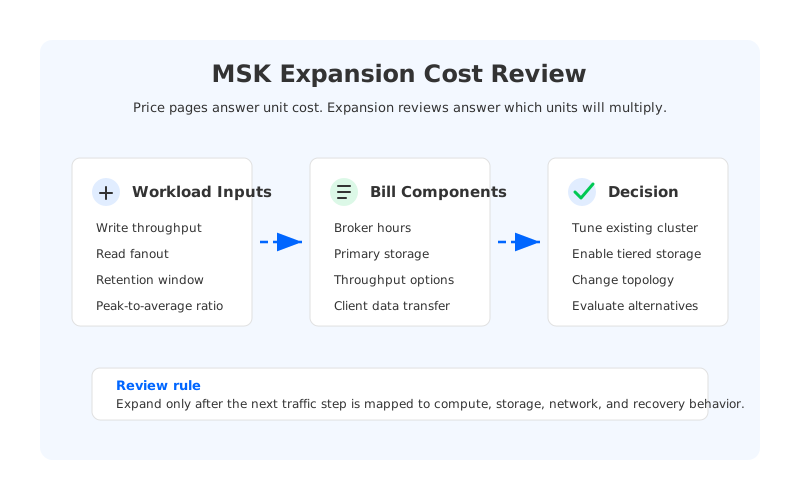
An MSK cost review should begin with the change request, not the price table. Price tables tell you what AWS charges for units such as broker hours, provisioned storage, optional storage throughput, data processed in serverless mode, tiered storage, or private connectivity. They do not tell you whether the next six months of workload growth will be dominated by compute, retention, replay, cross-VPC access, or operational recovery. That distinction matters because Kafka costs rarely grow along one clean axis.
Increasing write throughput may require larger brokers or more brokers, but it can also increase storage footprint if retention stays constant. Raising retention may not require more CPU, but it can change local disk pressure and recovery behavior. Adding another consumer group may not change broker count immediately, but it can expose throughput or network limits. Expanding across teams or VPCs may add private connectivity and data transfer considerations that were invisible when producers and consumers lived close to the cluster.
A practical review starts with four workload inputs:
- Sustained write rate and peak write rate. Kafka clusters are sized for peaks, not only daily averages.
- Read fanout. One topic with five independent consumer groups is a different cost shape from one topic read by one application, even when write volume is identical.
- Retention and replay behavior. Long retention for audit or backfill changes storage economics, while frequent historical reads change the value of local versus remote storage.
- Network boundaries. Producers, consumers, connectors, replicated clusters, and analytics jobs may sit in different AZs, VPCs, accounts, or regions, and those boundaries affect the bill.
Once those inputs are explicit, the team can look at MSK pricing with the right mental model.
2What Shows Up on the MSK Bill
MSK has multiple operating modes and related features, so the first accounting task is to classify the cluster. With provisioned Standard brokers, AWS charges for broker instance usage and provisioned storage, with optional provisioned storage throughput. AWS also documents that data transfer used for replication between brokers or between metadata nodes and brokers is not charged as an MSK data-transfer line item, while standard AWS data transfer charges can apply for data moved in and out of MSK clusters. Tiered storage adds a lower-cost storage tier and retrieval considerations. MSK Serverless has its own model, including cluster-hours, partition-hours, storage, and per-GB data in and out.
The expansion review should therefore split the bill into categories that map back to workload behavior:
| Bill category | Main driver | Review question |
|---|---|---|
| Broker hours | Broker count, type, and uptime | Are brokers being added for CPU, partitions, storage pressure, or recovery headroom? |
| Primary storage | Retention and replication footprint | Is local broker storage still the right place for retained data? |
| Storage throughput | High disk throughput requirements | Is the bottleneck storage bandwidth, broker CPU, or client behavior? |
| Tiered storage | Long retention and historical reads | Which topics fit remote-tier characteristics and constraints? |
| Data transfer and connectivity | Client placement and boundaries | Which producer and consumer paths cross a billable boundary? |
| Migration and operations | Rebalances, recovery, maintenance work | How much engineering risk does the expansion create? |
This table is not a price calculator. Exact numbers depend on region, broker family, deployment mode, traffic volume, and AWS pricing changes. What it gives you is a way to avoid treating an increase in broker count as the root cause when it is only the symptom. Sometimes the cluster needs more brokers because CPU is saturated. Sometimes it needs more brokers because local storage and partition placement have trapped the team into scaling compute and storage together.
3The Hidden Multiplier Is Often Storage Coupling
Traditional Kafka keeps the log on broker-attached storage and uses replication across brokers for durability and availability. This model is familiar and operationally understandable. It also means the broker is doing several jobs at once: serving client traffic, storing hot data, participating in replication, handling leader movement, and recovering after broker changes. When the cluster grows, those responsibilities can amplify one another.
The most important cost question before expansion is whether broker-local storage is forcing a compute decision. If retention grows, you may need more disk. If more disk is tied to broker instances, you may add brokers even when CPU does not need them. If a broker fails or partitions are rebalanced, operational time can become part of the cost even when it never appears on the AWS invoice.
Tiered storage changes part of this equation. MSK tiered storage moves older data from the performance-optimized primary storage tier into a lower-cost storage tier, and AWS describes it as a way to scale retention without provisioning all of that storage on brokers. That is useful for long retention and replay-heavy workloads, but it is not the same as making brokers stateless. Primary storage, topic eligibility, and remote-read behavior still matter.
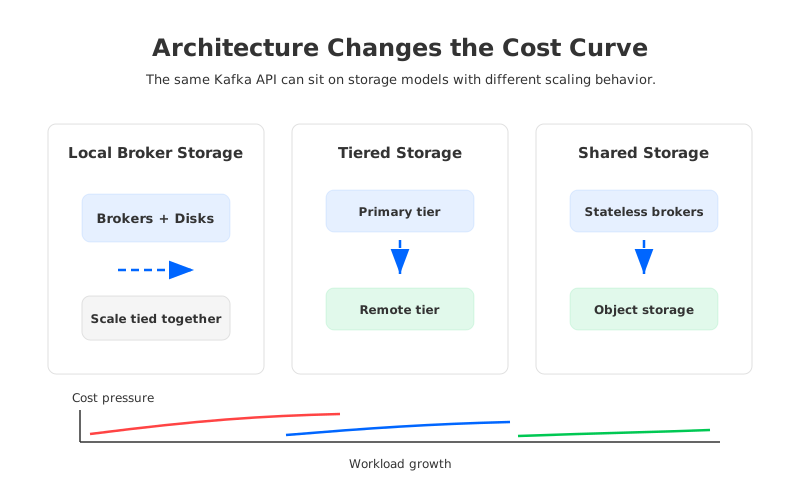
The review becomes more precise when the team separates compute, retained data, and recovery. CPU, network throughput, request rate, and partition leadership can justify more or larger brokers. Retention growth should be modeled separately from compute growth, especially for audit, replay, and analytics use cases. Recovery should be reviewed separately because broker replacement, partition movement, and service restoration can dominate the human side of Kafka expansion.
This is where many MSK cost discussions become too narrow. A unit price comparison can be accurate and still miss the architecture decision. If the next growth phase is mostly compute, tune or resize the cluster. If it is mostly retention, tiered storage may be enough. If compute, storage, network, and recovery keep moving together, the storage architecture itself may be the constraint.
4Network Cost Needs Its Own Pass
Kafka teams often spend a lot of time on broker sizing and less time on network paths, even though streaming systems are deliberately chatty. Producers write continuously. Consumers may read the same data many times. Connectors and replication tools move streams across services, regions, accounts, or VPCs. Each path has a location, and cloud location matters.
AWS guidance on data transfer costs emphasizes that charges depend on traffic direction and architecture. For MSK specifically, the pricing page distinguishes broker replication traffic from standard data transfer charges for data transferred in and out of MSK clusters, and it also describes private connectivity charges when clients connect from other VPCs or accounts. That does not mean every Kafka workload has a network-cost problem. It means network cost should be reviewed with the same discipline as broker and storage cost.
A clean network review traces the hot paths:
- Producer to cluster. Check whether producers sit in the same VPC and AZ pattern as the brokers.
- Cluster to consumers. Read fanout can multiply traffic faster than write rate.
- Cluster to downstream systems. Connectors and processors often cross service boundaries.
- Cluster to cluster. Same-region and cross-region replication have different implications.
The goal is not to avoid every cross-boundary byte. High availability, disaster recovery, and organizational boundaries often require them. The goal is to know which bytes are intentional. If a large share of traffic crosses boundaries by accident, the fix may be placement, client configuration, topic routing, or architecture rather than a larger MSK broker.
5A Production Readiness Scorecard
A useful time to review platform architecture is before the expansion request becomes urgent. Once the cluster is close to saturation, teams tend to choose the fastest low-risk change, which is often “add capacity now and revisit later.” That is sometimes the right call, but repeated emergency expansions create a pattern: every quarter the platform is larger, more expensive, and harder to move.
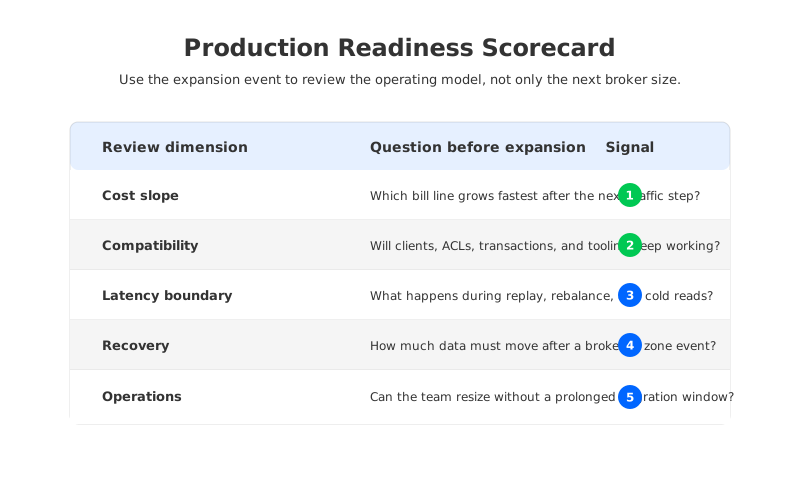
Use the expansion event as a readiness checkpoint. Platform owners, SREs, FinOps, and architects should answer these questions together because no single team sees the whole cost surface.
| Dimension | Green signal | Warning signal |
|---|---|---|
| Compatibility | Clients, ACLs, transactions, schemas, and tooling are tested. | The team assumes compatibility without checking real clients. |
| Cost slope | Write, read, retention, and transfer growth are modeled separately. | Broker count is used as a proxy for all growth. |
| Latency boundary | Hot-path latency, cold reads, replay, and rebalances are measured. | Averages hide replay and recovery behavior. |
| Recovery | Broker replacement and zone events have tested runbooks. | Recovery depends on untested large data movement. |
| Governance | Ownership, budgets, lifecycle, and retention policies are enforced. | Topics grow because no one owns retention or fanout. |
| Migration path | Alternatives can be tested without a long rewrite. | Every client and policy is tightly coupled to the current deployment. |
The scorecard is broader than cost. A lower monthly invoice is not helpful if it creates a migration cliff, weakens compatibility, or adds an operational model the team cannot run. The useful output is a clear explanation of what the current architecture is optimized for and what it is beginning to resist.
6Where AutoMQ Fits the Evaluation
After the workload and cost drivers are visible, a different architecture category becomes relevant: Kafka-compatible streaming with shared object storage underneath the log. AutoMQ belongs in that category. It keeps Kafka protocol compatibility as the application-facing contract, while its storage design separates broker compute from durable data stored on object storage. The point is not to claim that every MSK workload should move. The point is to evaluate whether the cost slope is coming from coupling that shared storage is meant to remove.
In AutoMQ’s architecture, brokers are designed to be more stateless, with durability backed by object storage and a write-ahead log layer for the hot write path. This changes the expansion conversation. If compute and storage can scale more independently, teams can reason about broker capacity, retained data, and recovery separately instead of treating every growth signal as a broker-sizing problem. AutoMQ also documents approaches for reducing cross-AZ traffic in multi-AZ deployments.
That said, the evaluation should stay disciplined. Kafka compatibility needs to be tested with real clients, ACLs, connectors, transactional behavior if used, observability pipelines, and failure runbooks. Object storage changes the operational model, so teams should validate latency, replay behavior, and recovery under their own traffic profile. The strongest case for AutoMQ is a workload where retention, recovery, broker elasticity, and network placement are all becoming part of expansion cost.
For teams reviewing MSK cost, the next step is a side-by-side model:
- Baseline the current MSK bill by broker, storage, connectivity, and transfer categories.
- Project the expansion using write rate, read fanout, retention, and placement assumptions.
- Identify which cost line grows fastest and why.
- Test whether tiered storage, client placement, governance, or shared storage addresses that driver.
If the answer is “we need more managed Kafka capacity and our cost slope is acceptable,” MSK may remain the right fit. If the answer is “we are adding brokers because storage, recovery, and network behavior are locked together,” AutoMQ is worth evaluating as an architectural alternative.
7Review Before You Resize
The next MSK expansion request reveals whether the cluster is growing because the business is growing, retention and fanout were not governed, network paths are accidental, or the architecture is coupling resources that should scale independently. Those are different problems, and they should not all be solved with the same broker change.
If you are reviewing MSK cost and want to test a Kafka-compatible shared-storage option, start with AutoMQ’s architecture documentation, then compare it against your workload model. You can also contact AutoMQ to discuss a review using your traffic, retention, and network assumptions.
8References
- Amazon MSK pricing
- Amazon MSK Developer Guide: What is Amazon MSK?
- Amazon MSK tiered storage for Standard brokers
- AWS Architecture Blog: Overview of data transfer costs for common architectures
- Apache Kafka documentation
- Apache Kafka KIP-405: Kafka Tiered Storage
- AutoMQ architecture overview
- AutoMQ compatibility with Apache Kafka
- AutoMQ guidance for cross-AZ traffic costs
9FAQ
9.1Is MSK always more expensive than self-managed Kafka?
No. MSK includes managed control-plane operations that can reduce operational burden compared with self-managed Kafka. The right comparison includes infrastructure, engineering time, recovery risk, compliance, and delayed platform work.
9.2When should a team enable MSK tiered storage?
Tiered storage is worth evaluating when retention growth is the main pressure and older data does not need the same access pattern as hot data. Teams should check topic eligibility, Kafka version requirements, feature constraints, retrieval behavior, and latency expectations before enabling it broadly.
9.3What is the most common mistake in MSK cost reviews?
The common mistake is reviewing only broker instance pricing. Broker count is visible, but it may be a symptom of storage pressure, partition placement, recovery headroom, read fanout, or network boundaries. A better review models those drivers separately before deciding whether to resize.
9.4How does AutoMQ differ from MSK in this evaluation?
MSK is AWS’s managed Apache Kafka service. AutoMQ is a Kafka-compatible streaming system that uses shared object storage as a core part of its architecture. In a cost review, AutoMQ becomes relevant when the team wants to test whether separating broker compute from durable storage can reduce pressure from coupled compute, storage, and recovery paths.
9.5Can a team migrate from MSK without changing applications?
It depends on the applications and Kafka features they use. Kafka protocol compatibility can reduce application changes, but a migration test should include client versions, authentication and authorization, ACLs, schemas, connectors, transactions if used, consumer groups, monitoring, and rollback behavior. Treat compatibility as a test plan, not a slogan.


