
Table of Contents
Table of Contents
The phrase msk alternatives usually appears after Amazon MSK has already done useful work. A team moved Kafka operations closer to AWS, got out of broker installation chores, and gave application teams a managed endpoint for producers and consumers. The replacement discussion starts later, when the Kafka estate becomes large enough that broker sizing, retained data, replication traffic, governance, and migration windows are no longer local infrastructure details. They become platform strategy.
That is why a replacement project should not begin with a vendor matrix. It should begin with an estate review. Amazon MSK, self-managed Apache Kafka, fully managed Kafka platforms, Kafka-compatible engines, and shared-storage streaming systems are not interchangeable rows in a shopping table. They represent different answers to the same hard question: which part of the Kafka operating model is causing enough pressure to justify change?
1Why the estate review comes first
MSK is an AWS managed service for Apache Kafka and Kafka-compatible workloads. That boundary matters because many teams are not trying to leave AWS. They are trying to decide whether the current Kafka estate still matches their cost model, security model, and operational tolerance. A direct "MSK versus alternative" comparison can miss the important distinction between replacing a service and changing an architecture.
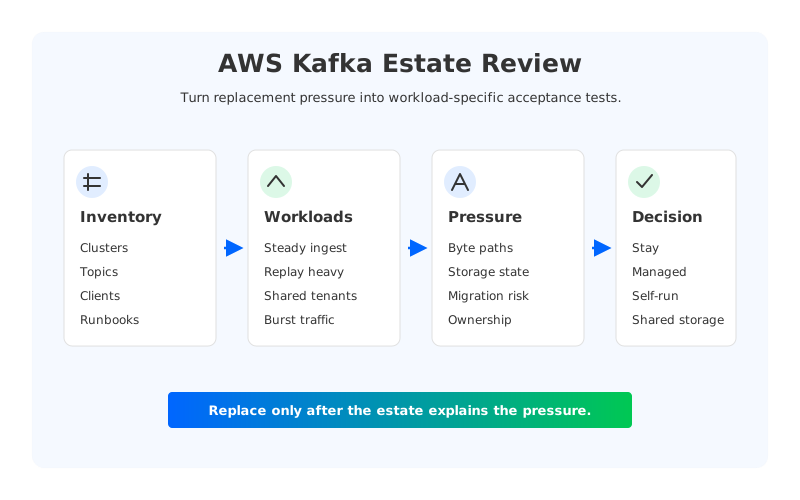
An estate review gives the platform team a shared language before procurement begins. It separates symptoms from root causes. A high bill may come from broker capacity, storage, cross-Availability Zone movement, PrivateLink, consumer fan-out, connector egress, observability export, or human operations. Slow scaling may come from partition movement, storage rebalancing, change controls, or client placement. A managed service can reduce some of those costs while leaving others intact.
The first pass should classify every production cluster into a few workload groups:
- Steady ingestion platforms. These clusters have predictable write traffic and stable consumers. The replacement question is usually cost control and operational simplicity, not peak elasticity.
- Replay-heavy analytical streams. These clusters have long retention, cold reads, many consumer groups, or backfills. Storage architecture and historical read behavior matter more than headline write throughput.
- Tenant-heavy shared platforms. These clusters carry many application teams, ACL patterns, quotas, schema policies, and incident runbooks. Migration safety and governance parity matter as much as price.
- Burst-sensitive pipelines. These clusters handle campaign traffic, AI feature refreshes, fraud windows, market events, or seasonal peaks. Elasticity, recovery speed, and over-provisioning become central.
The categories are not academic. They prevent a common failure mode: choosing an alternative because it looks strong for one workload, then discovering that the estate has four different workload shapes. A replacement candidate should be evaluated against the dominant pain in each group, not against a generic Kafka checklist.
2Build the current-state model
The current-state model should be boring on purpose. List the clusters, topics, retention settings, client zones, consumer groups, connector paths, security controls, and operational owners. Then attach cost and failure behavior to those facts. The goal is not to prove that MSK is wrong. The goal is to understand what the estate is asking the platform to do.
For AWS estates, byte paths deserve special attention. A record may be produced from one subnet, acknowledged by brokers in multiple Availability Zones, retained on broker storage, fetched by several consumer groups, exported through a connector, mirrored to another region, and inspected by monitoring tools. AWS publishes Amazon MSK pricing separately from broader AWS pricing surfaces such as data transfer and PrivateLink because those costs depend on the surrounding architecture.
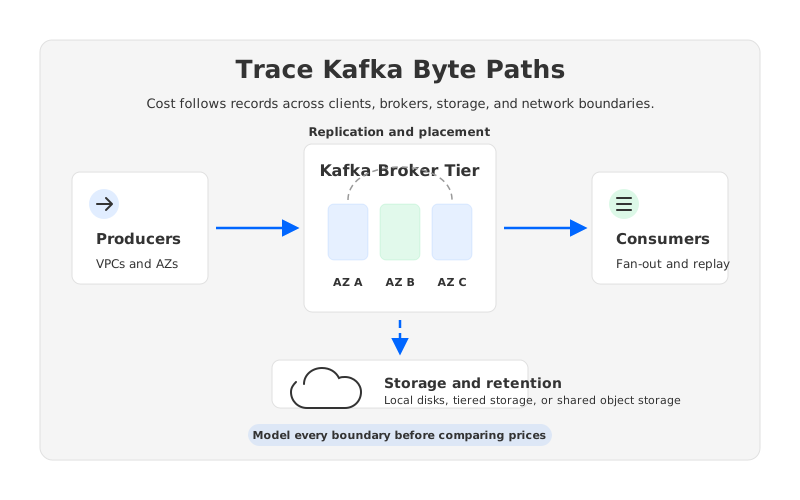
The review should therefore model events rather than products. A useful worksheet follows the record:
| Estate layer | What to inventory | Replacement implication |
|---|---|---|
| Client placement | Producer and consumer VPCs, subnets, zones, private endpoints | Determines whether the alternative changes network cost or only moves it |
| Kafka semantics | Client versions, transactions, idempotent producers, ACLs, quotas, Connect, Streams | Determines whether the project is a platform migration or an application migration |
| Storage behavior | Retention, hot partitions, replay windows, tiered storage use, restore expectations | Determines whether broker-local storage is the real pressure |
| Operations | Upgrades, broker changes, partition movement, incident diagnosis, audit controls | Determines what work should disappear after replacement |
| Cost ownership | AWS line items, vendor invoices, support, labor, allocation tags | Determines whether FinOps can compare options on the same basis |
This table makes the alternative search more disciplined. If the largest pressure is private connectivity across many accounts, a storage-focused replacement may not solve the main problem. If the largest pressure is long retention attached to broker-local capacity, a service wrapper around traditional Kafka may not go far enough. If the largest pressure is team expertise, a self-managed path may be technically elegant and organizationally wrong.
3Separate service packaging from architecture change
Many MSK alternatives improve the service experience without changing Kafka's core storage model. That can be valuable. A team may want better managed operations, a broader event-streaming platform, a different support model, multi-cloud deployment, or a simpler procurement path. Those are legitimate reasons to evaluate alternatives, especially when the organization wants more provider-owned responsibility.
The architecture question is narrower and deeper. Traditional Kafka binds durable log data to brokers and protects availability through broker replication. Apache Kafka's tiered storage direction helps offload older log segments to remote storage, but it does not make the active broker tier disappear. If the estate review shows that broker-local state is driving slow scaling, recovery work, storage headroom, or avoidable network movement, the replacement evaluation should include architectures that change where durable data lives.
That distinction changes the proof of concept. A service-packaging evaluation asks whether the provider can operate Kafka more cleanly than the team can. An architecture-change evaluation asks whether the platform can preserve Kafka behavior while reducing the coupling between compute, durable storage, and failure recovery. Both evaluations are valid, but mixing them creates bad decisions.
The shortlist should be built around the reason for change:
- Stay with MSK when AWS-native managed Apache Kafka fits the workload, governance model, and cost shape. Replacing a working service without a specific pressure can create more risk than value.
- Evaluate another managed Kafka platform when the team wants more provider-operated ecosystem services, multi-cloud reach, or a different commercial and support boundary.
- Evaluate self-managed Kafka when implementation control is more important than operational offload and the team has durable Kafka operations capacity.
- Evaluate Kafka-compatible shared-storage platforms when the estate pressure comes from broker-local state, retention growth, cross-zone movement, scaling windows, or recovery mechanics.
This is also the point where vendor respect matters. MSK is not a failed product because a team evaluates alternatives. It is a managed AWS service with a specific boundary. Other platforms are not automatically superior because they use different architecture. The estate review should expose fit, not produce a slogan.
4Migration risk is part of the architecture
A Kafka replacement is not finished when a benchmark passes. The migration has to preserve application behavior, security expectations, observability, incident response, and rollback options. Platform teams often underestimate this because Kafka clients make a happy-path produce-and-consume demo look easy. Production estates are less forgiving.
The migration review should start with the applications that would hurt the most if the cutover failed. Pick representative topics, not convenient ones. Include a workload that uses real authentication, real ACLs, real schemas, real consumer lag patterns, and real operational dashboards. If transactions, idempotent producers, compacted topics, Kafka Connect, Kafka Streams, or strict offset continuity matter, they belong in the first proof of concept.
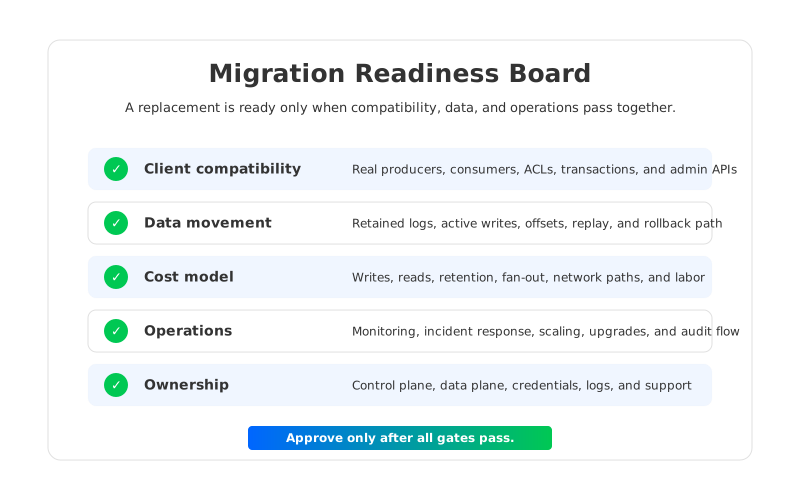
The migration plan should answer five questions before the team assigns a production date. Can existing clients move without code changes? Can topic configuration, ACLs, quotas, and monitoring be reproduced with enough fidelity for incident response? How will retained data and active writes move? What is the cutover boundary for producers and consumers? What is the rollback path if the target platform passes throughput tests but fails a security, governance, or operational test?
These questions often change the shortlist. A platform with strong cost economics but weak migration tooling may be a poor first target for a tenant-heavy estate. A platform with excellent managed operations may still require application-side changes that the business cannot absorb. A platform with Kafka compatibility should be tested against the estate's specific API usage rather than assumed to be drop-in.
5How AutoMQ fits after the review
The estate review points to AutoMQ only when the problem is architectural. If the team is satisfied with broker-local storage and mainly wants AWS to operate Apache Kafka, MSK can remain the practical answer. If the team wants a broad managed streaming suite, another managed platform may be the right comparison. AutoMQ becomes relevant when the review shows that the estate wants Kafka compatibility but not the traditional coupling between durable log data and broker-local disks.
AutoMQ is a Kafka-compatible cloud-native streaming platform built around Shared Storage architecture. Its S3Stream design moves persistent stream storage to object storage while brokers focus on protocol handling, scheduling, caching, and active traffic. WAL storage and cache behavior sit in the write and read paths so the platform can keep Kafka-compatible behavior while reducing how much durable state is tied to each broker.
That architecture changes the evaluation variables. Instead of asking only how many brokers the estate needs, the team can separately examine broker compute, WAL, cache, object storage, network locality, recovery behavior, and operational automation. AutoMQ also documents an inter-zone traffic optimization model for S3-based shared storage, which is relevant when the estate review shows that multi-AZ byte movement has become a material cost or design constraint.
Deployment boundary is part of the fit. AutoMQ BYOC is designed for teams that want the data plane in their own cloud environment while using a managed operating model. AutoMQ Software is relevant for teams that need customer-operated private infrastructure. Those models do not remove the need for a proof of concept. They make the right proof of concept clearer: validate Kafka compatibility, byte paths, recovery behavior, migration tooling, and governance in the same AWS context that created the replacement discussion.
6Turn the review into a replacement decision
A good replacement memo should be shorter than the spreadsheet that produced it. It should state the reason for change, the workload groups affected, the operating model required, the cost model used, the migration constraints, and the acceptance tests for the final shortlist. If the memo cannot name the pressure precisely, the team is not ready to replace MSK.
The acceptance tests should be concrete:
- Run representative producers and consumers with current client versions and security settings.
- Recreate topic configuration, ACLs, quotas, monitoring, alerting, and audit workflows.
- Model write throughput, read fan-out, retention, replay, network paths, private connectivity, and operational labor with current AWS prices.
- Test failure and recovery behavior, including broker loss, consumer catch-up, scaling, and rollback.
- Validate who owns the control plane, data plane, credentials, logs, support escalation, and change approval.
The result may still be to stay on MSK. That is a valid outcome if the estate review shows that the managed AWS boundary fits the workload. The result may be a different managed Kafka platform if provider-operated ecosystem services matter most. The result may be a shared-storage Kafka-compatible platform if the estate has outgrown the economics and recovery behavior of broker-local storage. The point is to make the replacement decision traceable to architecture and operations, not to a generic alternatives search.
If your MSK alternatives review is really an AWS Kafka estate review, start by tracing the bytes, the state, and the ownership boundaries. When broker-local storage, scaling windows, and cross-zone traffic are the pressure points, a Kafka-compatible shared-storage architecture is worth testing. Review the AutoMQ architecture documentation or contact AutoMQ through go.automq.com with your workload groups, retention targets, and AWS deployment boundary.
7References
- AWS documentation: What is Amazon MSK?
- AWS pricing: Amazon MSK pricing
- AWS pricing: Amazon EC2 On-Demand pricing
- AWS pricing: AWS PrivateLink pricing
- Apache Kafka documentation: Apache Kafka documentation
- Apache Kafka KIP: KIP-405: Kafka Tiered Storage
- AutoMQ documentation: Architecture overview
- AutoMQ documentation: S3Stream Shared Streaming Storage
- AutoMQ documentation: Eliminate inter-zone traffic
8FAQ
8.1What is the first step before replacing Amazon MSK?
Start with an AWS Kafka estate review. Inventory clusters, topics, client placement, retention, security controls, consumer groups, connector paths, operational runbooks, and cost ownership. Then decide whether the pressure comes from MSK service packaging, Kafka architecture, migration risk, or organizational ownership.
8.2Are MSK alternatives always lower cost?
No. Cost depends on workload shape, region, retention, read fan-out, network paths, private connectivity, support, and labor. Published pricing pages are necessary inputs, but the credible comparison follows the events that create cost: writes, reads, replay, retention, movement across boundaries, and operations.
8.3When does shared storage matter in a Kafka replacement?
Shared storage matters when the estate review shows that durable data tied to brokers is creating scaling friction, recovery work, storage headroom, or network movement. It is less important when the workload is small, steady, and already fits the managed Kafka service boundary.
8.4Can applications move from MSK without code changes?
They can when the target preserves the Kafka protocol and the application's specific API usage, but the team should test that directly. Validate client versions, producer settings, consumer offsets, ACLs, schemas, transactions if used, connectors, monitoring, and rollback before treating any platform as a drop-in replacement.
8.5When should AutoMQ be evaluated as an MSK alternative?
Evaluate AutoMQ when the review shows a need for Kafka compatibility plus a different storage and scaling model. It is most relevant when broker-local storage, cross-zone traffic, long retention, scaling windows, or customer-controlled deployment boundaries are part of the replacement case.


