
Table of Contents
Table of Contents
AWS managed Kafka is a deceptively broad search term. Some teams mean "I want Kafka without patching brokers." Others mean "I need a Kafka API, but I do not want to own disks, rebalancing, cross-AZ traffic, and a surprise storage bill." Those buying motions lead to different architectures.
Apache Kafka remains the reference point because the core abstraction has not changed: producers write records to topics, topics are split into partitions, and consumers read those partitions by offset. The Apache Kafka documentation still frames Kafka around brokers, topics, partitions, producers, and consumers. Managed Kafka on AWS does not remove those concepts. It changes who operates each layer, where the data plane runs, how storage is paid for, and how much control the AWS team keeps.
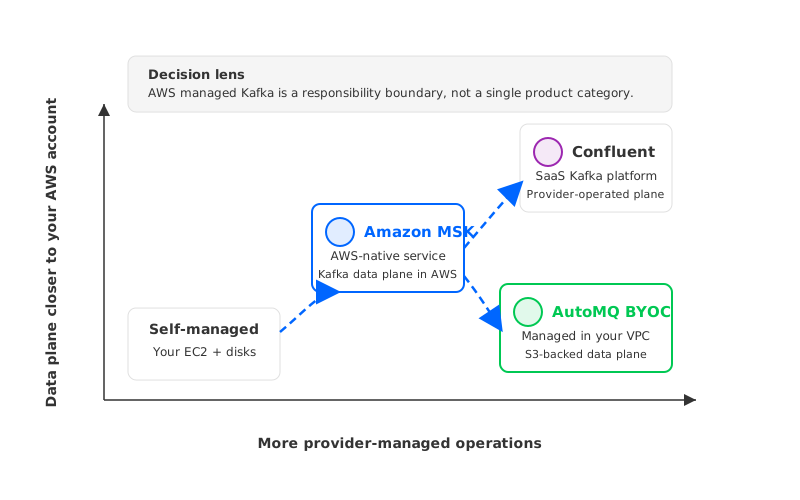
For AWS teams, the real comparison is not "which Kafka service is managed?" It is this: which responsibility boundary fits your security model, cost model, and operational tolerance? Amazon MSK, Confluent Cloud, and AutoMQ BYOC all reduce self-managed Kafka work, but not the same work.
1What Counts as Managed Kafka on AWS?
The term managed Kafka usually hides four categories. Self-managed Kafka on Amazon EC2 gives the team maximum infrastructure control and operational responsibility. Amazon MSK is the AWS-native managed service for Apache Kafka. Confluent Cloud is a fully managed data streaming platform that runs on cloud providers, including AWS. AutoMQ BYOC is a Kafka-Compatible, cloud-native streaming platform where the control plane and data plane run in the customer's cloud account.
This category split matters because "managed" can refer to the control plane, the data plane, or both. A service can manage cluster creation and upgrades while leaving capacity sizing, partition strategy, and traffic economics largely in your hands. Another service can abstract more of the data plane but place the workload in a provider-operated environment. A BYOC model can provide managed operations while keeping infrastructure, data, and network boundaries inside the customer's AWS account.
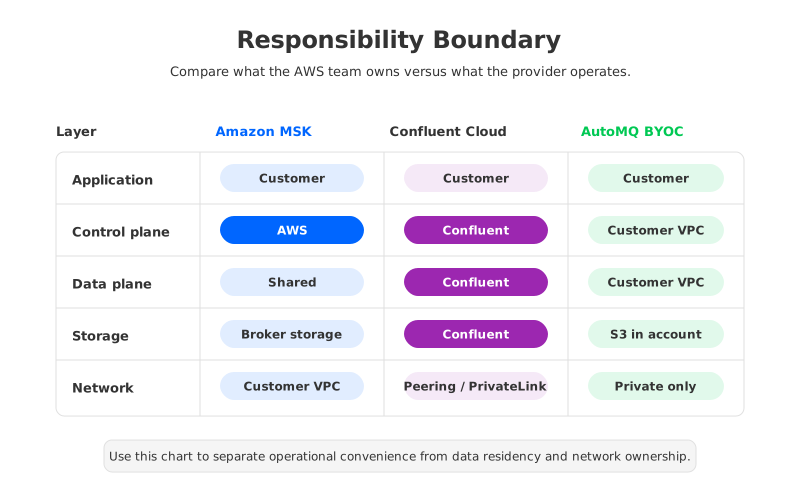
The decision is easier if you separate five layers:
- Application layer: client code, producers, consumers, schemas, connectors, and deployment pipelines.
- Control plane: cluster lifecycle, upgrades, user access, observability, and administrative APIs.
- Data plane: brokers or broker-equivalent runtime that handles Kafka reads and writes.
- Storage layer: local disks, attached volumes, tiered storage, or object storage.
- Network layer: VPC placement, private connectivity, cross-AZ traffic, and egress paths.
Once those layers are visible, the trade-off becomes concrete. MSK feels familiar to AWS teams because it aligns with AWS networking and security. Confluent Cloud is attractive when the team wants a broad managed streaming platform, including ecosystem services beyond Kafka clusters. AutoMQ BYOC is relevant when the team wants managed Kafka operations but still wants the control plane and data plane deployed in its own AWS environment.
2Option 1: Amazon MSK
Amazon describes Amazon Managed Streaming for Apache Kafka as a fully managed service for building and running applications that use Apache Kafka. The same documentation is precise about the boundary: MSK provides control-plane operations such as creating, updating, and deleting clusters, and it lets customers use Kafka data-plane operations such as producing and consuming data. It also runs open-source versions of Apache Kafka, which is important for compatibility-sensitive teams.
That makes MSK a natural first stop for AWS managed Kafka. It avoids much of the undifferentiated work of installing Kafka, replacing failed brokers, integrating with CloudWatch, and managing security controls through AWS-native primitives. For teams with strong AWS governance, procurement, IAM patterns, VPC design, audit processes, and incident response often already assume AWS services.
The harder question is what MSK does not change. With MSK Provisioned, the team still makes choices about broker type, broker count, storage, throughput, retention, and partition layout. AWS offers MSK Serverless for teams that want AWS to manage and scale capacity at a cluster level, but that is a service-mode decision with its own fit criteria. In provisioned deployments, Kafka's familiar capacity math remains visible.
Amazon MSK pricing also follows AWS infrastructure economics. Depending on the mode and configuration, teams may pay for broker instances, storage, provisioned throughput, data transfer, tiered storage, or serverless dimensions. That transparency helps FinOps teams model costs with AWS-native line items, but it also means replication, Availability Zone placement, retention, and client traffic patterns can surface directly in the bill.
MSK is often the right choice when the team wants Apache Kafka as AWS runs it. It is less compelling when the core problem is the traditional Kafka storage and elasticity model itself: broker-local storage, slow data movement during scaling events, and planning around durable capacity rather than workload demand.
3Option 2: Confluent Cloud on AWS
Confluent Cloud sits in a different category. Confluent's own documentation describes Confluent Cloud as a fully managed data streaming platform, and the platform includes Kafka clusters plus services such as connectors, stream governance, Schema Registry, Flink, and networking options. For teams that want more than a Kafka cluster, that broader platform surface is the reason to consider it.
The strongest argument for Confluent Cloud is operational offload. The provider operates the streaming platform and exposes a managed experience across cluster types and services. Confluent also documents multiple cluster types, including Basic, Standard, Enterprise, Dedicated, and Freight clusters, so teams can select different operational and networking profiles. That breadth is useful when the organization wants one managed streaming platform across several cloud environments.
The responsibility boundary is not the same as MSK. With Confluent Cloud, the customer connects applications to a provider-operated cloud service. Private networking options exist, including AWS PrivateLink and other networking patterns, but the data plane is not the same thing as a Kafka runtime deployed inside the customer's own VPC. For regulated environments, that difference affects security review, data residency interpretation, and incident response procedures.
The cost model is also service-specific. Confluent's pricing page states that Kafka clusters are billed for eCKUs or CKUs, networking, and storage, with additional billing dimensions for connectors, Flink, governance, and support. FinOps teams should model expected throughput, storage retention, network traffic, connector usage, and commitments before treating the comparison as a cluster-to-cluster price exercise.
Confluent Cloud is a strong fit when the buyer wants a managed streaming platform and values managed ecosystem services as much as the Kafka API. It is a weaker fit when the Kafka control plane, data plane, and storage must remain inside the customer's AWS account.
4Option 3: AutoMQ BYOC on AWS
AutoMQ BYOC enters the comparison from another angle. It is not an AWS-native service in the same category as MSK, nor a provider-hosted SaaS data plane in the same category as Confluent Cloud. AutoMQ BYOC is a Kafka-Compatible deployment model where the control plane and data plane run in the customer's cloud account, while AutoMQ provides managed operations around that environment.
AutoMQ's documentation describes the BYOC environment as one where the underlying resources belong to the user, and the user authorizes AutoMQ to provide maintenance and management. In the AutoMQ environment overview, the BYOC section states that both the environment console and Kafka service cluster are deployed in the user-defined network environment, and that the data plane supports private network access. That boundary is the central design point.
The architectural difference is storage. AutoMQ uses a Shared Storage architecture: brokers are stateless, and data is stored in S3-compatible object storage rather than being permanently tied to broker-local disks. In practical AWS terms, compute and storage can be scaled more independently. A broker can be replaced or scaled without moving the full history of its partitions from one local disk to another.
The cost implication should be stated carefully. AutoMQ does not make AWS infrastructure free, and every real workload still needs a bill-of-materials review. The point is that object storage changes the cost drivers. Instead of sizing durable broker disks around retention and replication, the architecture pushes durable data into object storage and keeps brokers closer to stateless compute.
AutoMQ BYOC is most relevant when an AWS team wants three things at the same time: Kafka protocol compatibility, managed operations, and customer-account data control. It may be less natural for teams that want a pure AWS service procurement path or a provider-hosted SaaS platform with many bundled streaming services.
5Decision Criteria for AWS Teams
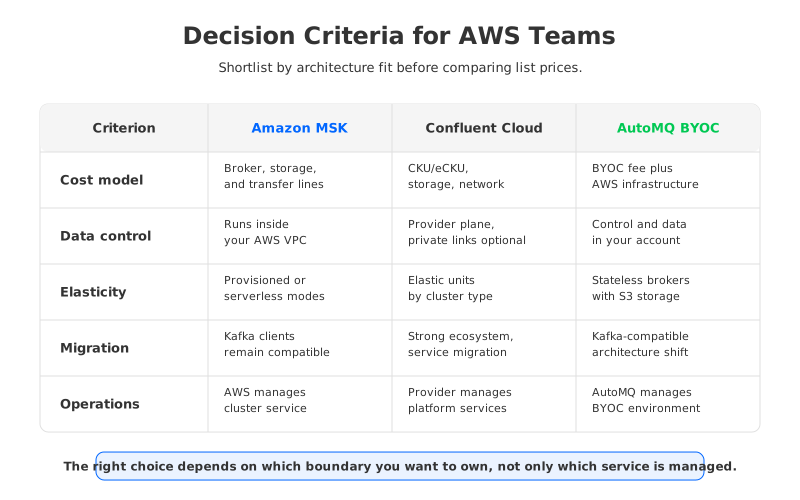
The first decision criterion is not feature count. It is the operating model your organization can defend during an architecture review. A platform team may love a fully managed service, while the security team asks where the data plane runs. A FinOps team may prefer AWS-native line items, while the SRE team wants fewer broker-level decisions. Those tensions should not be collapsed into a generic "managed Kafka" checkbox.
5.1Cost Model
Cost comparison starts with the billing unit. MSK maps closely to AWS infrastructure and service dimensions. Confluent Cloud maps to Confluent usage units, storage, networking, and platform services. AutoMQ BYOC combines AutoMQ commercial terms with AWS infrastructure consumed inside the customer's account. None of those models is universally lower cost.
For FinOps, the practical model should include:
- Write throughput and replication behavior, because they affect broker load and traffic.
- Retention period and retained data size, because they determine whether disk-heavy or object-storage-heavy economics dominate.
- Read fan-out and catch-up reads, because historical reads can change storage and network assumptions.
- Cross-AZ and egress paths, because Kafka traffic rarely stays inside one tidy box.
- Operational labor, because a lower infrastructure bill can be offset by recurring engineering work.
This is where architecture matters more than list price. A small Kafka deployment with stable throughput may not expose the same trade-offs as a multi-TB, multi-AZ event backbone with high retention and frequent scaling events.
5.2Data Control and Networking
Data control is often framed as compliance, but the engineering question is more specific: who can access the runtime, where do packets flow, and which account owns the durable data? MSK keeps the Kafka service in AWS and integrates with AWS VPC patterns. Confluent Cloud uses provider-operated infrastructure with documented private networking options. AutoMQ BYOC places the control plane and data plane in the customer's environment.
Networking deserves its own review because Kafka is a chatty system. Producers, consumers, replication paths, connector workers, and observability agents can all create traffic. In AWS, cross-AZ and egress economics can become material at scale.
5.3Elasticity and Storage Architecture
Elasticity is about what must move when capacity changes. Traditional Kafka ties partitions to broker storage, so scaling and reassignment can involve moving data and rebalancing load. MSK reduces operational burden around the managed service, but provisioned Kafka still exposes many planning concerns. Confluent Cloud abstracts more of the service operation, depending on the selected cluster type and workload profile.
AutoMQ's argument is architectural: if brokers are stateless and durable data lives in object storage, scaling compute no longer requires the same broker-local data movement. Partition count, client behavior, quotas, and workload isolation still matter, but the failure and scaling mechanics change in a way AWS teams should evaluate if their current Kafka pain is dominated by slow expansion, storage growth, or disk-bound operations.
5.4Operations and Migration
Operations includes incident diagnosis, change windows, rollback paths, observability ownership, support escalation, and how fast teams can provision a production-like environment. MSK fits teams that already operate AWS services deeply. Confluent Cloud fits teams that want the provider to operate a broader streaming platform. AutoMQ BYOC fits teams that want managed operations while retaining account-level infrastructure ownership.
Migration risk depends on how much of the Kafka surface your applications use. Basic producers and consumers are easier to move than workloads with complex ACLs, custom broker configs, Kafka Connect estates, strict offset continuity requirements, or specialized observability tooling. Kafka compatibility reduces application change, but it does not remove migration planning.
6A Practical Shortlist
Choose Amazon MSK when your team wants AWS-native managed Apache Kafka, strong alignment with AWS governance, and a familiar Kafka operating model. It is usually the cleanest starting point when the requirement is "Kafka as an AWS service."
Choose Confluent Cloud when the organization wants a managed data streaming platform beyond a Kafka cluster. The broader ecosystem can matter more than broker-level control if teams need managed connectors, governance, stream processing, and a cross-cloud operating model.
Evaluate AutoMQ BYOC when the hard problem is Kafka's cloud architecture. If your team wants Kafka compatibility, private deployment in your AWS account, object-storage-backed durability, and more independent compute-storage scaling, AutoMQ BYOC belongs on the shortlist. The next step is a workload model: throughput, retention, traffic paths, growth pattern, migration constraints, and who must own each layer.
The phrase "AWS managed Kafka" starts as a search query, but it ends as an ownership decision. Draw the boundary first. To evaluate the BYOC path with your own workload assumptions, review the AutoMQ documentation or start from the AutoMQ project on GitHub.
7References
- Apache Kafka Documentation — Kafka concepts, operations, and architecture reference.
- Amazon MSK Developer Guide: What is Amazon MSK? — AWS definition of MSK, control-plane and data-plane wording, broker nodes, KRaft controllers, producers, consumers, and cluster operations.
- Amazon MSK Pricing — AWS pricing dimensions for MSK modes, broker/storage/network-related costs, and service-specific billing.
- Confluent Cloud Documentation — Confluent Cloud managed streaming platform documentation.
- Confluent Cloud Networking Documentation — Confluent networking options, including private connectivity patterns.
- Confluent Pricing — Confluent billing dimensions for Kafka clusters, networking, storage, connectors, Flink, governance, and commitments.
- AutoMQ Cloud Environment Overview — AutoMQ BYOC environment model, resource location, network exposure, and maintenance authorization.
- AutoMQ Documentation — AutoMQ architecture, deployment, and operations documentation.
8FAQ
8.1Is Amazon MSK the same as Apache Kafka?
Amazon MSK is a managed AWS service that runs open-source versions of Apache Kafka. It manages important service operations, but Kafka concepts such as topics, partitions, producers, consumers, and offsets still apply.
8.2Is Confluent Cloud better than MSK for AWS teams?
It depends on the boundary you want. Confluent Cloud is stronger when you want a provider-managed streaming platform with a broader ecosystem. MSK is stronger when you want AWS-native managed Kafka inside AWS service patterns.
8.3What makes AutoMQ BYOC different from MSK and Confluent Cloud?
AutoMQ BYOC runs the control plane and data plane in the customer's cloud account and uses a Shared Storage architecture with stateless brokers and S3-compatible object storage. The main distinction is the combination of BYOC ownership and a different Kafka storage architecture.
8.4Which managed Kafka option is most cost-effective on AWS?
There is no universal answer. Model write throughput, retained data, read fan-out, cross-AZ traffic, storage growth, support needs, and operational labor. The pricing unit differs across MSK, Confluent Cloud, and AutoMQ BYOC, so list prices alone are not enough.
8.5Can Kafka applications migrate between these options without code changes?
Kafka protocol compatibility reduces application changes, but migration still requires validation. Test client versions, authentication, ACLs, topic configs, offsets, connectors, monitoring, performance, and rollback before committing to a production migration.


