
Table of Contents
Table of Contents
MSK multi AZ is one of the first things architects check before putting Kafka on AWS. The reason is sound: a Kafka cluster that depends on one Availability Zone (AZ) is not a serious production design for most businesses. The harder question comes after that box is checked. Once Amazon MSK is spread across AZs, where does high availability actually come from, which bytes move across zone boundaries, and why does a design built for resilience sometimes become a FinOps problem?
The short answer is that Amazon MSK inherits Apache Kafka's availability model. Brokers run in multiple AZs, partitions have replicas, producers write to leaders, and followers keep in-sync copies. That design is mature and operationally familiar, but it also means the cluster pays for availability with storage copies and replication traffic. Shared storage alternatives do not remove the need for high availability. They change the layer that provides durable storage, which changes the cross-AZ data path.
1Why Kafka Needs Multi-AZ on AWS
Kafka is usually not a sidecar service. It sits between payment systems, observability pipelines, CDC streams, personalization systems, fraud models, fulfillment services, and analytics platforms. If it stops accepting writes, business systems queue up behind it. If it loses acknowledged data, downstream state becomes hard to reason about. That is why production Kafka designs normally separate brokers across failure domains and configure replication so a single broker or AZ event does not take a topic offline.
AWS gives you AZs as isolated locations inside a Region. Amazon MSK uses that regional infrastructure to place broker nodes across AZs for provisioned clusters. AWS's own MSK best practices recommend a three-AZ cluster, a replication factor of at least 3, and min.insync.replicas set so a three-way replicated topic can remain available when one replica is offline during broker replacement or rolling updates. Those recommendations are not cosmetic. They are the operating envelope in which Kafka can keep accepting writes while one copy is unavailable.
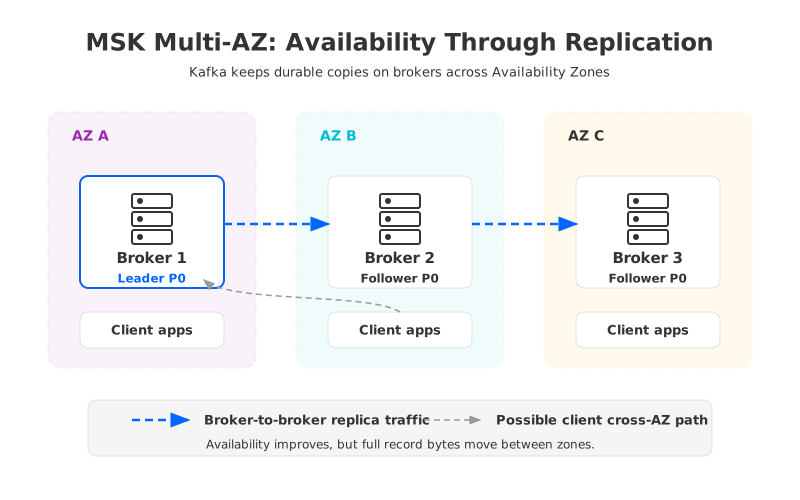
The tradeoff is that Kafka's durability boundary is still the broker replica set. In a common replication.factor=3 topic, one partition has a leader replica and two follower replicas. When a producer writes to the leader, Kafka must get enough replicas into the in-sync replica (ISR) set to satisfy the topic and producer durability settings. The result is a healthy production pattern, but also a data path where full record bytes move from broker to broker.
2How Amazon MSK Multi-AZ Works at a High Level
Amazon MSK Provisioned lets you choose the number of broker nodes, storage settings for Standard brokers, broker types, and cluster configuration. AWS manages much of the infrastructure lifecycle: provisioning, replacement, version upgrades, integration with AWS monitoring, security features, and operational automation. The Kafka mechanics remain recognizable to anyone who has operated Apache Kafka.
At a high level, a multi-AZ MSK cluster has four moving parts that matter for availability and cost:
- Broker placement. Brokers are distributed across AZs so a single zone event does not remove the whole cluster.
- Partition replication. Kafka stores multiple replicas of each partition on different brokers, ideally across racks or AZs.
- ISR and acknowledgments.
min.insync.replicasand produceracksdetermine how many in-sync copies are needed before a write is considered successful. - Leader election and failover. If a broker fails, Kafka can elect another in-sync replica as leader, depending on the partition state and cluster settings.
This is the right mental model for MSK high availability: AWS manages the service wrapper and infrastructure operations, while Kafka's replicated log model provides topic-level durability and failover behavior. MSK does not magically make Kafka broker storage stateless. A broker still has local responsibilities. It owns replicas, participates in leader election, serves produce and fetch requests, and uses attached storage in the provisioned model.
That distinction matters when architects compare MSK to "cloud-native Kafka" claims. Multi-AZ placement improves resilience, but the durable log is still distributed as broker-owned replicas. As long as that is true, HA has a cost shape: more copies, more inter-broker traffic, more failure headroom, and more operational attention around partition placement.
3The Cost of Kafka Replication Across AZs
The cost is not a single line item called "Kafka replication." It is spread across storage, network transfer, and capacity headroom. AWS MSK pricing covers broker usage, storage, and related service meters, while AWS data transfer pricing depends on Region, source, destination, direction, and service path. Use the current AWS pricing pages and Cost and Usage Report for the account and Region you actually run.
The mechanism, however, is stable. Multi-AZ Kafka creates cost in three places.
| Cost driver | Why it appears in MSK Multi-AZ | What to measure |
|---|---|---|
| Storage duplication | Each partition has multiple broker replicas. RF=3 means three broker-side copies before operational headroom. | Retained logical bytes, RF, compaction behavior, and provisioned storage |
| Inter-AZ replication | Leaders replicate records to followers in other AZs. This can generate regional data transfer charges depending on the AWS path. | Write throughput, leader placement, follower placement, and data transfer categories |
| Client locality | Producers and consumers may connect to leaders or brokers in another AZ. Consumer read fanout can amplify the effect. | Client AZ, broker AZ, leader distribution, follower fetching, and network routing |
Storage duplication is the easiest to understand: durable Kafka data grows by replica count, then by operational headroom. Inter-AZ replication is the part that often surprises FinOps teams. In a three-AZ deployment, a leader in AZ A may replicate to followers in AZ B and AZ C. Those bytes are not optional waste; they are the mechanism that lets Kafka survive broker or AZ loss. Client locality adds a workload-specific layer because producers and consumers may cross AZ boundaries when their application placement does not match leader or replica placement.
4Replication Settings Are Availability Decisions
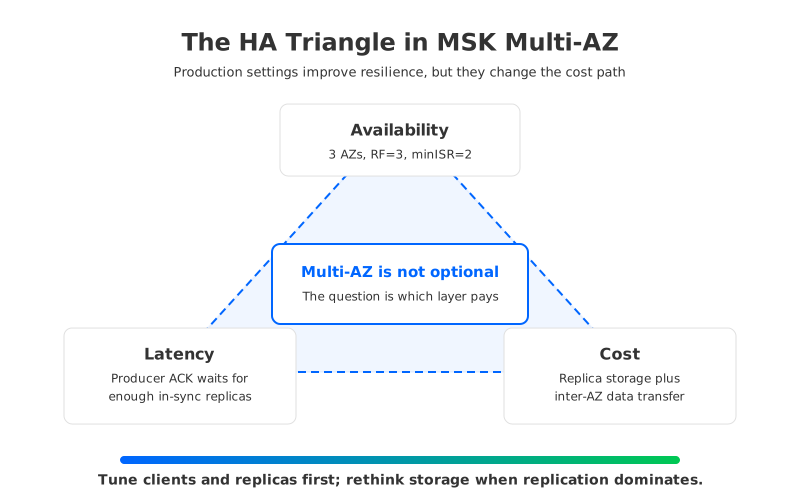
The settings that protect Kafka are also the settings that shape cost. replication.factor controls how many partition replicas exist. min.insync.replicas controls how many replicas must remain in the ISR for writes to proceed when producers use the appropriate acknowledgment level.
That is why RF=3 and minISR=2 are common for production topics across three AZs. The cluster can tolerate one replica being offline while still accepting acknowledged writes, assuming enough brokers and healthy ISR state. If minISR equals RF, a single offline replica can stop writes during rolling maintenance. If RF is too low, the cluster has less room to survive failures without data loss or unavailability.
The important point is not that every topic deserves the same settings. Some internal telemetry topics can tolerate lower durability than payment events. Some workloads need low write latency more than long retention. Some topics are compacted, while others are append-heavy observability streams. A serious MSK design treats replication settings as part of the application SLO, not a cluster-wide default copied forever.
5What You Can Tune Before Changing Architecture
Before replacing architecture, teams should take the practical tuning path. There is usually low-risk waste to remove. The question is whether tuning changes the largest cost driver or only polishes the edges.
Start with placement and configuration:
- Use AWS and Kafka guidance for HA. Validate the three-AZ layout, RF, and
minISRagainst the workload's recovery objectives. - Check client locality. Place producers and consumers in the same AZ as the brokers they use where possible. Evaluate Kafka rack awareness and follower fetching for read-heavy workloads.
- Right-size retention. Long retention on broker-attached storage is expensive. Separate compliance retention from operational replay needs when possible.
- Audit topic settings. Not every topic should inherit the most expensive durability and retention profile.
- Read the AWS bill by data path. Separate broker replication from client traffic before modeling alternatives.
These controls are worth doing even if you later evaluate alternatives. "MSK is expensive" is not enough. "Inter-AZ traffic and replicated storage dominate this cluster under this workload profile" is a decision-grade statement.
6Shared Storage Alternatives for HA Kafka
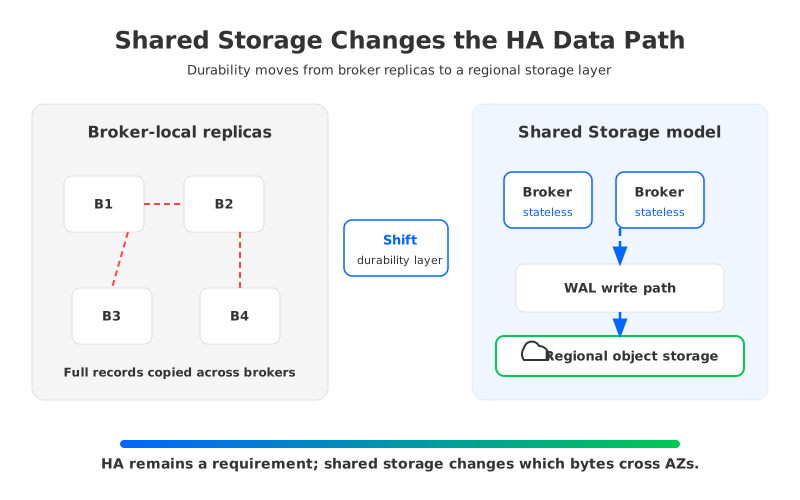
A shared storage architecture changes the central assumption. Instead of making broker-to-broker replicas the primary durable storage layer, brokers write to a shared durable layer such as S3-compatible object storage, with a write path that preserves Kafka semantics. Brokers still do important work. They handle Kafka protocol requests, authorization, partition ownership, buffering, caching, and fetch serving. What changes is that durable record history is not trapped on the local disk of the broker that happens to own a replica.
That shift matters for HA because it changes what must be rebuilt after failure. In broker-local Kafka, replacing capacity often means moving or rebuilding partition data. In a shared storage model, a replacement broker can take over work by using metadata and shared durable data. It also changes the network bill: if full record data does not need to be replicated between brokers across AZs for durability, the largest cross-AZ component can shrink or disappear. Shared storage is not free, but its cost model is different from Kafka's shared-nothing broker replica model.
7Where AutoMQ Fits
AutoMQ is one example of a Kafka-compatible Shared Storage architecture. Its documentation describes AutoMQ as a cloud-native streaming platform compatible with Apache Kafka and built on object storage. The architecture keeps Kafka protocol compatibility while replacing the broker-local storage layer with S3Stream, WAL storage, and shared object storage. Its stateless broker documentation is explicit about the operational goal: brokers do not hold durable data locally, so scaling and replacement avoid broker-disk data migration.
For an MSK multi-AZ discussion, the relevant point is not "MSK bad, AutoMQ good." MSK is a strong AWS-managed Kafka service for teams that want managed operations and can live with Kafka's broker-owned storage economics. AutoMQ enters the evaluation when the bottleneck is architectural: replicated broker storage, cross-AZ data-plane traffic, slow partition movement, and permanent over-provisioning for peak or failure headroom.
AutoMQ's public materials also discuss reducing cross-AZ traffic by routing data through shared storage and keeping client access zone-aware. Test that in your own AWS account with a workload replay or pilot that compares producer latency, consumer lag, object storage request behavior, data transfer categories, recovery behavior, and operational runbooks.
8Decision Framework: Stay on MSK, Tune MSK, or Evaluate Shared Storage
The decision is less dramatic when framed as a cost and reliability review.
| Situation | Practical recommendation |
|---|---|
| Small or stable workload, short retention, predictable traffic | MSK Multi-AZ is often reasonable. Keep the HA settings boring and monitor cost. |
| Cost issue comes mostly from client placement or excessive retention | Tune MSK first. Improve locality, retention, topic settings, and quota discipline. |
| Cost is dominated by replicated storage and inter-AZ replication traffic | Evaluate shared storage alternatives because the largest driver is structural. |
| Scaling and broker replacement are operational events | Test stateless broker behavior and reassignment speed in a pilot. |
| Strict low-latency writes and complex compliance requirements | Benchmark with real producers and consumers before committing to any architecture change. |
For SREs, the question is whether the system can meet error budgets during broker maintenance and AZ impairment. For FinOps, it is whether each GiB of business data is being multiplied into storage and transfer charges that the architecture could avoid. For CTOs, it is whether Kafka is becoming a platform constraint rather than a platform capability.
9Conclusion
MSK Multi-AZ is the right default instinct for production Kafka on AWS, but it is not the end of the design review. It gives Kafka the failure domains it needs, then asks broker replication to do the hard work of durability. That work has a cost: replicated storage, inter-AZ data movement, client locality issues, and operational headroom.
If those costs are modest, keep MSK boring and tune the basics. If they dominate the bill, the next question is not whether to weaken HA. It is whether the durable data layer should still live inside broker replicas. Shared storage alternatives such as AutoMQ are worth evaluating when you want Kafka compatibility but no longer want cross-AZ broker replication to be the main price of availability. Run the workload math against current AWS pricing, then test the data path with real traffic. For teams ready to compare architectures, start with the AutoMQ technical overview and validate it against your own MSK baseline.
10FAQ
10.1Is Amazon MSK multi-AZ by default?
Amazon MSK supports multi-AZ cluster designs, and AWS recommends a three-AZ setup for highly available MSK Provisioned clusters. Verify the actual cluster topology, broker count, and Region support.
10.2What replication factor should I use for MSK Multi-AZ?
AWS best practices recommend a replication factor of at least 3 for highly available MSK Provisioned clusters. Many production teams pair RF=3 with min.insync.replicas=2, assuming producers use appropriate acknowledgment settings.
10.3Does MSK charge separately for cross-AZ replication?
Broker replication can create traffic that appears under AWS data transfer categories rather than as a Kafka-specific line item. The exact charge depends on Region, service path, direction, and current AWS pricing.
10.4Can Kafka follower fetching remove MSK cross-AZ cost?
Follower fetching can reduce consumer-side cross-AZ reads when consumers can fetch from closer replicas. It does not remove broker-to-broker replication traffic, which is often the larger structural component in a multi-AZ replicated Kafka cluster.
10.5Is shared storage less available than Kafka replication?
Not automatically. It is a different availability model. Kafka replication relies on broker replicas and ISR. Shared storage systems rely on the durability and availability of the storage layer plus the correctness of the broker, WAL, metadata, and cache design. The right comparison is workload-specific testing, not a slogan.
10.6Is AutoMQ a drop-in replacement for Amazon MSK?
AutoMQ is Kafka-compatible, but replacing MSK is still an infrastructure migration. You need to validate clients, ACLs, topic settings, consumer offsets, observability, latency, networking, rollback, and cost. The appeal is that application teams can keep the Kafka protocol while platform teams evaluate a different storage architecture.
11References
- Amazon MSK Provisioned overview
- Amazon MSK best practices for highly available clusters
- Amazon MSK pricing
- AWS Data Exports: understanding data transfer charges
- Amazon S3 pricing
- Apache Kafka broker configuration: min.insync.replicas
- Apache Kafka operations: rack awareness
- AutoMQ documentation: What is AutoMQ
- AutoMQ documentation: architecture overview
- AutoMQ documentation: stateless broker
- AutoMQ blog: Kafka Cross-AZ Replication Cost on AWS


