
Table of Contents
Table of Contents
Kafka retention looks deceptively simple in a topic configuration. You set retention.ms, retention.bytes, or both, and Kafka keeps records until old segments can be deleted. On Amazon Managed Streaming for Apache Kafka (Amazon MSK), the bill is less abstract. Retained bytes become broker storage, tiered-storage bytes, request patterns, and operational headroom.
The uncomfortable part is that Kafka's logical retention window is not the same thing as the physical storage footprint. Each replica is a separate log copy, each partition produces segments and indexes, and each broker needs spare room for churn and rebalancing. MSK makes Kafka easier to operate than self-managed clusters, but it does not repeal those storage mechanics.
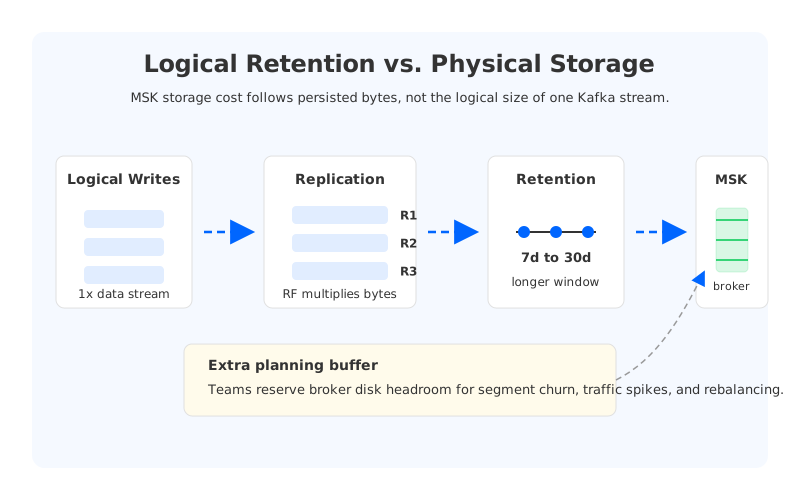
That distinction matters because storage is rarely isolated. Retention affects recovery objectives, audit requirements, replay, consumer independence, and incident response. Cutting retention may lower the next bill, but it can also remove the operational cushion that made Kafka valuable in the first place. The better question is not "how do we store less data?" It is "why does the architecture require so much broker-attached storage to preserve Kafka semantics?"
1Why Kafka Retention Gets Expensive on MSK
Amazon MSK pricing depends on cluster mode and configuration, but storage-related costs generally come from broker storage, optional tiered storage, and the AWS storage services behind the workload. AWS documents MSK pricing separately from Amazon EBS and Amazon S3 pricing, so a serious cost review should check the current region-specific pages before committing to any estimate. The point here is the mechanism, not a frozen price table that will age badly.
In a provisioned MSK cluster, brokers use attached storage, and you configure storage capacity for brokers. That creates a capacity-planning loop. Kafka brokers are not stateless request routers; they own partition replicas on local disks. More retention means more bytes per replica. More replicas mean more disk pressure. More pressure means larger disks, more brokers, partition movement, or tiered storage. Each option has a different cost and operational profile.
Kafka itself gives teams several knobs, but those knobs are not independent:
retention.mscontrols how long Kafka can retain log segments before they are eligible for deletion.retention.bytescaps retained data by partition size, which can be useful but dangerous when replay windows are business-critical.segment.bytesand related segment settings affect when files roll and become eligible for cleanup or tiering.replication.factorcontrols how many copies of each partition Kafka stores for durability and availability.
The first multiplier is replication. A replication factor of 3 is common for production Kafka because it allows the cluster to tolerate broker failures while maintaining availability, depending on ISR health and client settings. From a storage perspective, it also means the cluster stores three copies of the log. This is Kafka's durability model, and it becomes expensive when long retention turns broker disks into long-term storage.
The second multiplier is time. A 7-day retention window and a 30-day retention window do not differ by a small tuning parameter. Holding daily ingest constant, the longer window stores more historical data across every replica. The effect is visible in event-sourcing, CDC, observability, fraud detection, and ML feature pipelines, where replay is not a rare disaster operation. The business asks for longer retention because it improves resilience and data reuse; the infrastructure bill grows because Kafka keeps those historical bytes on storage attached to brokers.
The third multiplier is headroom. Operators do not size Kafka disks at exactly the expected retained bytes. They reserve space for traffic bursts, uneven partition placement, segment churn, index files, maintenance, and rebalancing. When brokers run close to disk limits, cost becomes a reliability issue.
2The Storage Multipliers in Kafka
The simplest mental model is this:
physical storage footprint
  ~= daily ingest
   x retention window
   x replication factor
   + indexes, segment overhead, and operational headroom
This formula is not a pricing calculator. It ignores compression ratio, compaction behavior, partition skew, tiered-storage eligibility, deleted-record cleanup, and read patterns. It is still useful because it forces the right conversation. If the largest terms are retention and replication, then optimizing instance sizes alone will not change the storage curve.
| Driver | What It Changes | Why It Matters for MSK Storage Cost |
|---|---|---|
| Retention window | How long Kafka keeps data eligible for reads and replay | Longer windows keep more log segments alive across partitions. |
| Replication factor | How many broker-side copies exist | Higher durability and availability usually mean more physical bytes. |
| Partition count | How data and files are spread across brokers | More partitions can add metadata, index, and balancing complexity. |
| Broker headroom | Spare disk capacity reserved for operations | Under-sizing creates reliability risk; over-sizing increases idle storage. |
| Tiered storage | Whether older closed segments move to a remote tier | It can reduce hot broker storage pressure, but it adds another storage model to manage. |
Replication is the multiplier that surprises non-Kafka stakeholders most often. A FinOps dashboard may show "storage" as one category, but Kafka's storage model is also an availability design. Lowering the replication factor can reduce bytes, but it changes failure tolerance. For most production systems, that is a reliability trade-off, not a routine cost optimization.
Retention creates a different tension. Data teams often increase retention because downstream consumers are less predictable than producers. A consumer can be paused during a deployment, a backfill may need older events, or an audit process may require a replayable log. Kafka is attractive because it decouples producers and consumers through retention. The bill grows when that decoupling is implemented through broker-local disks.
Broker headroom is where the clean formula understates reality. Kafka does not distribute every partition perfectly forever. Some topics grow faster than expected, and maintenance events move data around. On broker-local storage, those operational realities require spare disk capacity in the same place that serves reads and writes.
3Broker-Local Storage Turns Retention into Capacity Planning
When storage and compute live on the same broker, every retention decision has a placement consequence. A team that wants to keep 30 days instead of 7 days is not merely changing a topic policy; it may be changing disk size, broker count, partition distribution, and the blast radius of future rebalances. MSK reduces the undifferentiated operational work of running Kafka, but the cluster still has to store partition replicas somewhere.
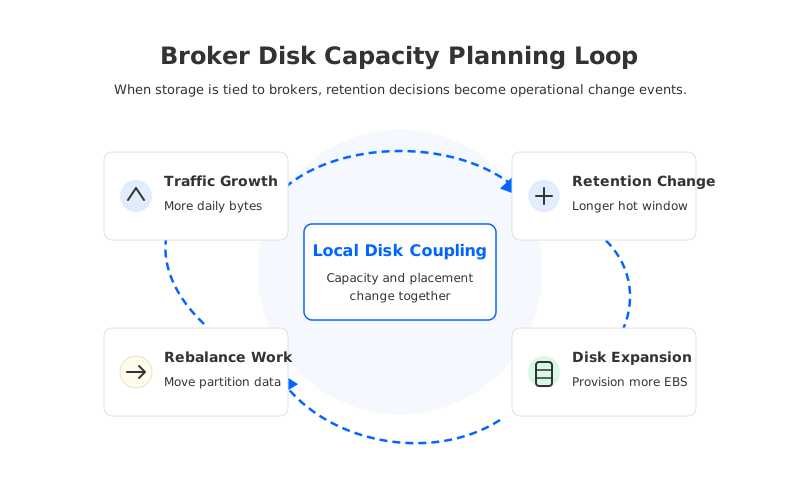
That coupling matters because Kafka capacity is lumpy. You cannot always add exactly the storage a topic needs at the broker where pressure appears. You may expand broker storage, add brokers, rebalance partitions, change retention by topic, or enable tiered storage. Each path has a different mix of cost, time, and risk.
For SREs, the operational risk is disk saturation. For platform architects, it is the loss of elasticity: storage-heavy workloads force compute scaling decisions. For FinOps, it is idle capacity that exists because the cluster must be ready for the next traffic spike or rebalance. The organization may be paying for storage that is not currently storing useful retained data, but removing it would make the platform fragile.
4MSK Tiered Storage as an Optimization
Amazon MSK tiered storage is designed to reduce the amount of data that must remain on high-performance broker storage. In broad terms, Kafka keeps recent active log data locally, while older closed log segments can be moved to a lower-cost remote storage tier. AWS positions tiered storage as a way to retain data for longer periods without scaling broker storage in direct proportion to the full retention window.
This is a meaningful improvement for many workloads. It separates part of the historical retention burden from local broker disks, which can reduce hot storage pressure and make longer retention more practical. It also aligns with an important Kafka reality: recent data and historical replay data do not always need the same storage profile.
Tiered storage is still not the same as a fully shared-storage architecture. The active log remains broker-local, and brokers still own partitions and local storage. Tiering changes where older segments live after they become eligible; it does not make brokers stateless. That distinction is easy to miss because both approaches mention object storage, but their failure modes and scaling mechanics are different.
The practical way to evaluate MSK tiered storage is to ask three questions:
- How much of the retained data is old enough and cold enough to benefit from a remote tier?
- What read patterns will hit historical data, and how does that affect latency, request cost, and operational expectations?
- Does the team mainly need lower-cost long retention, or does it need an architecture where storage and compute scale independently?
The first two questions are about optimization. The third is about architecture.
5Shared Storage Kafka as an Architecture Change
A shared-storage Kafka architecture changes the premise. Instead of treating object storage as a cold tier behind broker-local logs, the durable log is built around shared object storage from the start. Brokers continue to speak Kafka protocol and coordinate reads and writes, but they no longer have to be the long-term owners of all retained bytes on local disks.
That shift changes the storage cost conversation in three ways. Retention capacity moves toward object storage economics. Broker scaling can follow compute, network, and cache demand more closely instead of being dominated by long-retention disk size. Recovery and elasticity improve because retained data is not trapped on a particular broker's local volume.
There is a real engineering challenge behind that sentence. Object storage is durable and elastic, but it is not a drop-in replacement for a broker's local append path. Kafka writes need low-latency commit behavior, ordered logs, consumer reads, and failure handling. A credible shared-storage design needs a write-ahead log or equivalent commit path, metadata coordination, caching for hot reads, and careful object layout.
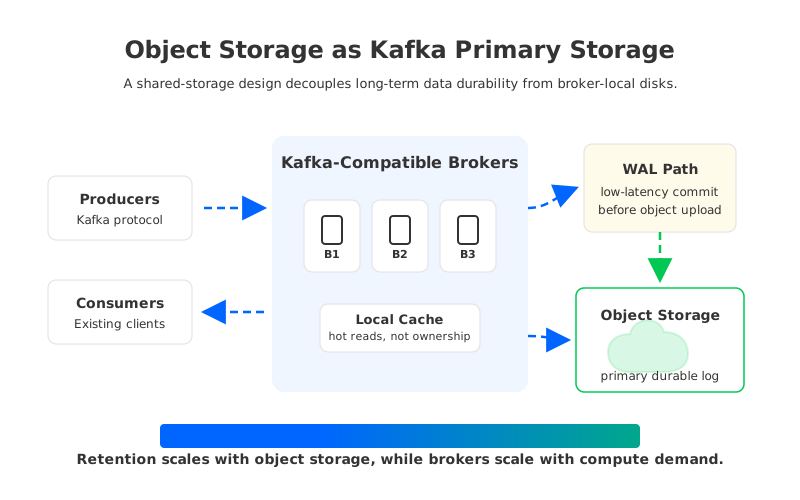
This is where AutoMQ enters the discussion naturally. AutoMQ is a Kafka-compatible streaming system that reimplements Kafka storage around object storage, with S3Stream as the shared storage layer and a WAL path for low-latency writes. The important point is not that it mentions S3. The important point is that object storage is the primary durable storage model, while brokers can be treated more like stateless compute and cache nodes.
6How AutoMQ Reduces Storage Pressure
AutoMQ's storage model is relevant to MSK storage cost discussions because it attacks the multiplier problem at the architecture layer. Traditional Kafka and MSK provisioned clusters make retained replicas live with brokers. MSK tiered storage moves closed segments to a remote tier. AutoMQ starts from a different design goal: keep Kafka protocol compatibility while moving persistent stream data to shared object storage.
That difference can reduce storage pressure in several practical ways. Long retention no longer has to imply equally large broker-local disks. Cache can be sized for hot reads, while durable history lives in object storage. The architecture is especially relevant when Kafka is used less like a short buffer and more like a long-lived event store.
The trade-off is that teams must evaluate a different set of system properties: write latency, object storage request patterns, cache hit rates, failure recovery, Kafka API compatibility, and operational tooling. A shared-storage Kafka-compatible system is not a magic discount code for an AWS bill. It is a way to stop treating broker disks as the natural place for all durable retained data.
For teams already using MSK, a pragmatic path is to separate three categories of workloads:
- Short-retention, high-throughput topics that fit well in broker-local storage and benefit from MSK's managed operations.
- Long-retention topics where MSK tiered storage may reduce hot disk pressure without changing the overall platform.
- Storage-dominant streaming workloads where retention, replay, and growth patterns justify evaluating an object-storage-primary Kafka architecture.
That segmentation keeps the conversation grounded. Not every Kafka topic needs a different architecture. But when storage cost is repeatedly driven by retention and replication, and broker sizing follows historical data more than current compute demand, the architecture is asking for a different design.
7A Practical Cost Review Checklist
Before changing retention or migrating platforms, teams should build a cost review around verified facts. Start with current AWS pricing pages for the target region: Amazon MSK pricing, MSK tiered storage pricing, EBS volume pricing, and S3 storage and request pricing. Then map those prices to actual workload behavior rather than average cluster size.
Use a concise checklist:
- Measure daily ingest per topic after compression, not only producer-side payload size.
- Record replication factor, partition count, retention time, and any size-based retention caps.
- Identify which retained data is read frequently, rarely, or almost never.
- Quantify broker disk headroom and explain why that buffer exists.
- Separate hot operational storage from long-term replay storage in the cost model.
- Compare MSK tiered storage and shared-storage alternatives against the same retention and read-pattern assumptions.
A good review does not begin by cutting inherited retention settings. It begins by making the physical storage consequences visible, then choosing the architecture that matches the retention promise the business actually needs.
8Conclusion
MSK storage cost grows when Kafka's useful abstraction, a retained distributed log, meets the physical reality of replicated broker storage. Retention, replication, partitions, segment behavior, and headroom all push the bill upward for understandable engineering reasons. Tiered storage can reduce the pressure for older data, but it remains an optimization inside a broker-owned storage model.
If your AWS bill keeps pointing back to long Kafka retention, the next review should not stop at "reduce retention" or "add lower-cost storage." Ask whether broker-local disks are the right long-term home for the data. For teams evaluating that question, AutoMQ's Kafka-compatible, object-storage-primary architecture is worth testing alongside MSK tiered storage, with the same workload, retention window, and read patterns. You can start from the AutoMQ documentation or product overview and validate the design against your own cost model before making a platform decision.
9FAQ
9.1What drives AWS MSK storage cost the most?
For long-retention workloads, the largest drivers are usually retained ingest volume, replication factor, retention window, and broker headroom. Pricing details depend on region, cluster mode, storage configuration, and whether tiered storage is enabled, so always verify current AWS pricing before estimating.
9.2Does MSK tiered storage eliminate broker storage cost?
No. MSK tiered storage can reduce the amount of older data that remains on broker-local storage by moving eligible closed segments to a remote tier, but the active log and broker-local storage still matter. It is an optimization, not the same thing as stateless brokers with object storage as primary storage.
9.3Why does replication factor affect storage cost?
Kafka stores separate replicas of each partition for durability and availability. A replication factor of 3 means there are three log copies across brokers, subject to the exact topic and cluster configuration. That increases physical storage footprint compared with the logical stream size.
9.4Is reducing Kafka retention a good way to reduce MSK cost?
It can reduce storage footprint, but it may also reduce replay capability, consumer recovery windows, and audit flexibility. Treat retention reduction as a business and reliability decision, not only a cost decision.
9.5How is AutoMQ different from MSK tiered storage?
MSK tiered storage keeps Kafka's broker-owned active storage model and moves older eligible data to a remote tier. AutoMQ is Kafka-compatible but uses object storage as the primary durable storage layer, with brokers acting more like compute and cache nodes. The difference is architectural, not only a storage-price comparison.
9.6Should every MSK workload move to shared storage Kafka?
No. Short-retention and operationally stable workloads may fit MSK well. Shared-storage Kafka is most relevant when storage growth, long retention, replay, and broker disk planning dominate the platform's cost and operational risk.
10References
- Amazon MSK Pricing
- Amazon MSK Developer Guide: Tiered Storage
- Amazon EBS Pricing
- Amazon S3 Pricing
- Apache Kafka Documentation: Topic Configurations
- Apache Kafka Documentation: Broker Configurations
- Apache Kafka Documentation: Tiered Storage
- AutoMQ Documentation: S3Stream Shared Streaming Storage
- AutoMQ Documentation
- AutoMQ Product Overview


