
Table of Contents
Table of Contents
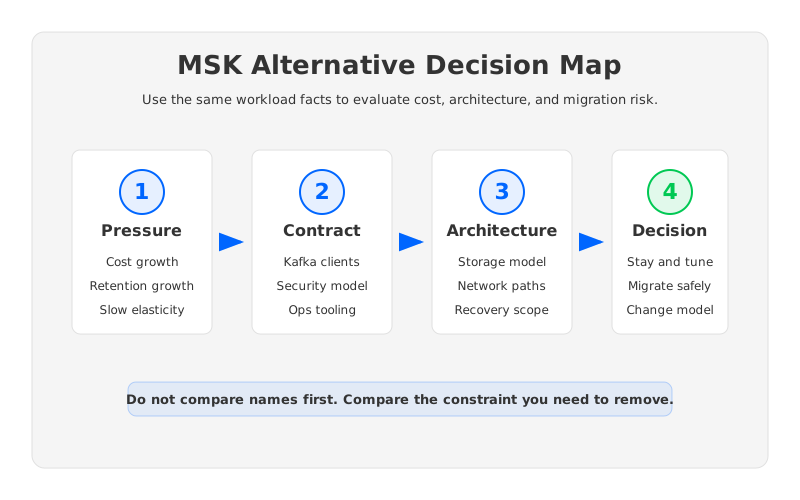
Teams usually do not search for msk alternatives because Amazon MSK failed at the first cluster. They search when Kafka has become important enough that the managed-service boundary starts to matter. The cluster is larger, more applications depend on it, retention is longer, audit expectations are higher, and the AWS bill has more line items than the platform team can explain in one meeting. At that point, the question is no longer "Can we run Kafka on AWS?" The sharper question is "Which parts of this Kafka operating model should still be tied to a managed broker service?"
That distinction matters because leaving MSK is rarely a single replacement exercise. Amazon MSK gives teams a familiar managed Kafka path, and for many workloads that is the right starting point. Growing workloads expose a wider decision surface: broker sizing, storage growth, cross-AZ movement, client compatibility, access control, disaster recovery, migration windows, and the amount of operational control the platform team wants to regain. A serious shortlist has to evaluate architecture, not only product names.
1Why Teams Start Looking Beyond MSK
The first symptom is usually cost, but the root cause is often architectural fit. Kafka was designed around broker-local logs and replica placement. In a cloud environment, that model maps to compute instances, block storage, availability zones, and network billing boundaries. A managed service can simplify provisioning, patching, and baseline operations, but it cannot remove every cost or scaling behavior that comes from Kafka's storage and replication model.
The second symptom is operational friction. A platform team may want faster elasticity, more direct control over instance families, stricter network isolation, or a deployment model that fits an existing Kubernetes and Terraform practice. Procurement may want a clearer cost curve before approving higher retention or more fan-out consumers. SREs may care less about the service label and more about whether recovery, rebalancing, and observability are predictable under pressure.
These drivers are different, so the exit questions should be different too:
- Is the current constraint cost, control, or architecture? A cost-only problem may be solved with tuning, tiered storage, better topic hygiene, or workload placement. An architecture problem usually needs a different storage and scaling model.
- Which Kafka semantics are non-negotiable? Existing producers, consumers, Kafka Connect jobs, ACL patterns, transactions, offset behavior, and operational tools may define the real migration boundary.
- Where does the team want AWS-native integration? Some teams want the service fully abstracted. Others want data, compute, networking, and IAM to remain inside their own account and automation model.
- What failure mode is driving the change? AZ-level failures, broker loss, overloaded consumers, slow reassignment, and runaway network charges each point to different evaluation criteria.
The common mistake is to compare alternatives as a catalog category. That framing creates a list, but it does not tell you what must be true for your workload to run better after migration.
2The Architecture Questions Behind the Shortlist
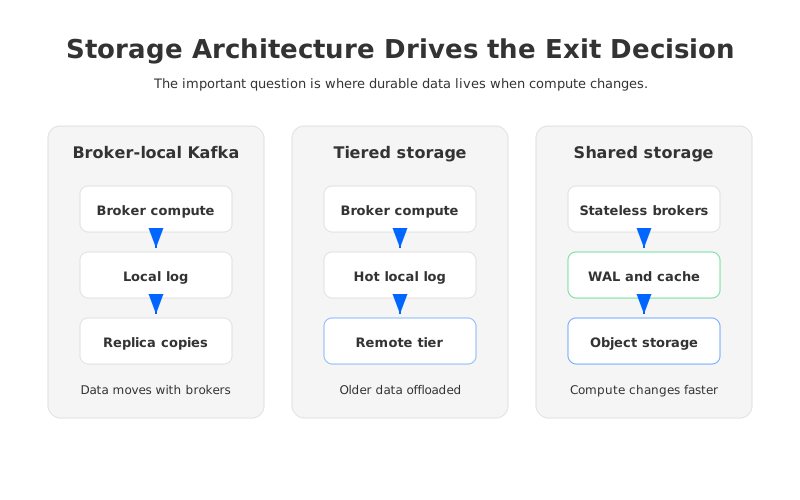
The first architecture question is storage ownership. In conventional Kafka, the broker owns local log segments and coordinates replication with other brokers. That design keeps the Kafka abstraction clean, but it also makes storage movement a broker-level concern. When capacity changes, partitions and replicas often have to be moved or rebalanced across brokers. When retention grows, the data footprint grows alongside broker storage planning.
Apache Kafka has added tiered storage capabilities to move older log data to remote storage, which can help with retention economics. Tiering is not the same as a fully shared-storage streaming architecture. With tiering, brokers still participate in the hot log path and local storage remains part of the production design. With shared storage, durable data is designed to live outside the broker as the primary storage layer, so the broker becomes closer to a compute and protocol node.
That difference changes the questions a buyer should ask:
| Evaluation area | Managed Kafka baseline | Stronger exit question |
|---|---|---|
| Storage growth | Add broker or storage capacity as log footprint grows | Can storage scale independently from broker compute? |
| Availability zones | Replication and placement protect availability | How much inter-AZ traffic does replication and access create? |
| Elasticity | Resize or add brokers through managed workflows | Does scaling require large partition data movement? |
| Compatibility | Kafka protocol and ecosystem support | Which clients, tools, ACLs, and operational behaviors are proven? |
| Ownership | AWS-managed service boundary | Which resources stay in the customer's account, VPC, and IaC model? |
Network cost deserves special attention because it is easy to under-model. Multi-AZ Kafka designs intentionally move data across fault domains. That movement can come from replica traffic, clients in different AZs, PrivateLink paths, consumer fan-out, or cross-region patterns. AWS publishes pricing pages for MSK and network services, but every bill depends on region, traffic direction, deployment mode, and workload behavior. The practical takeaway is simple: evaluate alternatives with your real write rate, read fan-out, retention, and placement assumptions instead of relying on a generic price comparison.
3Compatibility Is a Risk Budget, Not a Checkbox
Kafka compatibility sounds binary until the migration plan reaches real applications. A simple producer and consumer may move quickly. A platform with transactions, idempotent producers, schema tooling, Kafka Connect, MirrorMaker, consumer lag automation, ACL templates, and compliance dashboards has a broader contract. The candidate platform has to preserve the parts of Kafka behavior that the organization actually uses.
The compatibility review should start with workload inventory rather than vendor claims. List client languages and versions, authentication mechanisms, authorization patterns, message sizes, partition counts, retention policies, compaction topics, Connect connectors, stream processing jobs, and operational tools. Then separate the inventory into "must preserve on day one" and "can change after cutover." This prevents a common failure mode: selecting a platform for a cost target, then discovering that the hardest part of the project is not moving bytes but preserving operating assumptions.
There is also a governance angle. MSK sits inside AWS, which can be an advantage for organizations standardized on AWS controls. An alternative should be assessed against the same operational bar: VPC placement, encryption, IAM or credential management, auditability, observability exports, upgrade cadence, support model, and emergency access. If a team is leaving a managed service to gain control, it should be specific about which controls it wants back.
4A Production Readiness Scorecard
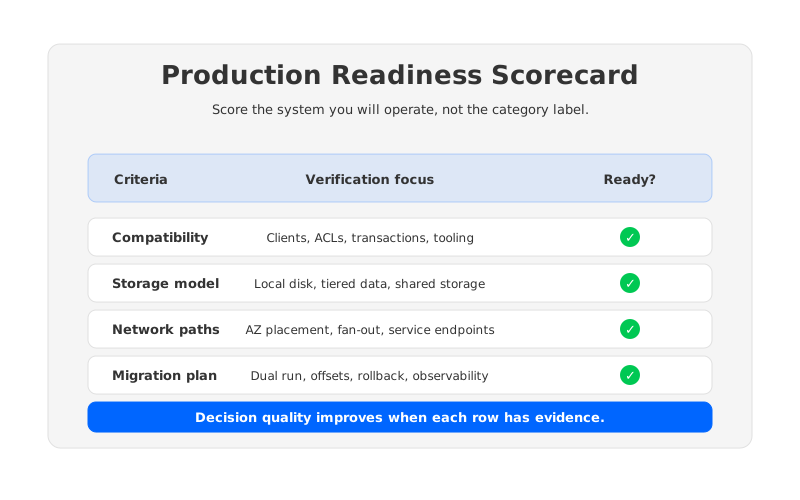
The cleanest evaluation method is to score each option against production behavior. Avoid scoring the brochure. Score the system you would actually run.
| Criterion | What to verify | Why it matters |
|---|---|---|
| Protocol and client fit | Producer, consumer, admin, transactions, security, and tooling behavior | Compatibility failures appear late and are expensive to unwind |
| Storage architecture | Local disk, tiered storage, or shared object storage design | Storage design determines elasticity and recovery boundaries |
| Network model | AZ-aware routing, replication paths, PrivateLink, and consumer placement | Network charges often scale with both writes and reads |
| Migration path | Dual write, mirroring, cutover, rollback, and offset validation | A good target still fails if the transition is unsafe |
| Operations | Metrics, logs, scaling, upgrades, balancing, and incident workflows | Platform teams inherit what the service does not abstract |
| Ownership boundary | Who owns compute, storage, data path, metadata, and control plane resources | Security and procurement teams need a clear responsibility map |
This scorecard also protects the incumbent option. Sometimes the answer is to stay on MSK and tune. If the pain is topic sprawl, inefficient consumers, incorrect retention, or poor placement, changing platforms may only move the same problem somewhere else. The exit decision is strongest when the team can point to a structural mismatch: compute and storage cannot scale the way the workload grows, data movement is too expensive, or recovery and elasticity remain too slow for the business.
5Migration Questions That Decide the Project
The target architecture gets most of the attention, but migration mechanics decide whether the project survives contact with production. Kafka migration has two clocks: the data clock and the application clock. The data clock asks how topics, offsets, and retained history move. The application clock asks when producers and consumers can safely change endpoints, credentials, and operational expectations.
A credible plan answers five questions before the first production topic moves. First, what is the source of truth during the transition? Second, how will consumer offsets be validated? Third, what happens to compacted topics and long-retention topics? Fourth, how will rollback work if a downstream application behaves differently? Fifth, which team owns incident response during the overlap period?
These are not paperwork questions. They determine whether the migration is a controlled cutover or a distributed debugging session. A phased path often works best: start with low-risk topics, validate client behavior, run parallel observability, then move higher-value workloads after the rollback path has been exercised. The best platform choice is the one that makes this discipline easier, not the one that promises migration will be effortless.
6How AutoMQ Fits the Evaluation
If the evaluation points to an architectural mismatch rather than a tuning problem, Kafka-compatible shared storage becomes relevant. AutoMQ is a Kafka-compatible cloud-native streaming platform that keeps Kafka protocol semantics while moving durable streaming storage to an object-storage-backed architecture. Its brokers are designed to be stateless compute nodes, while S3Stream, WAL storage, cache, and object storage handle the durable data path.
That design is most relevant to three exit questions. The first is independent scaling: if brokers no longer own long-lived local log data, adding or replacing compute does not have to mean moving the same volume of partition data. The second is network cost control: AutoMQ documents an architecture for reducing inter-zone traffic by changing how data is stored and accessed across zones. The third is ownership: AutoMQ BYOC and software deployment models are designed for teams that want Kafka-compatible streaming inside their own cloud account, VPC, and operational boundary.
This does not make AutoMQ the answer for every MSK workload. If your current pain is mostly operational convenience, staying with a managed service may be the simpler choice. If your workload is growing into a storage, elasticity, and network-cost problem, then shared-storage Kafka-compatible architecture deserves a place in the shortlist because it changes the underlying cost and recovery mechanics.
7The Practical Decision Path
Start with the bill, but do not stop there. Break the cost into write traffic, read fan-out, retention, broker compute, storage, inter-AZ movement, cross-region movement, and operational labor. Then map each cost component to an architecture decision. Some line items respond to tuning. Others respond only when the storage or network model changes.
The same discipline applies to risk. A lower monthly estimate is not useful if it increases migration uncertainty or weakens a compliance boundary. A managed service is not automatically safer if the team cannot explain scaling and recovery behavior during incidents. The right MSK alternative is the one whose architecture makes your dominant constraint easier to reason about.
For teams evaluating Kafka-compatible shared storage as part of that path, the next useful step is to compare your own workload shape against the architecture rather than against a generic checklist. AutoMQ's overview and contact path are a reasonable starting point for that discussion: review the AutoMQ documentation or talk with the AutoMQ team with your write rate, read fan-out, retention, AZ placement, and migration constraints.
8References
- Amazon MSK Developer Guide: What is Amazon MSK?
- Amazon MSK pricing
- AWS PrivateLink documentation
- Apache Kafka documentation: Tiered storage
- AutoMQ architecture overview
- AutoMQ zero inter-zone traffic overview
9FAQ
9.1What are the main reasons teams evaluate MSK alternatives?
The most common reasons are cost transparency, faster scaling, more control over deployment and networking, specific Kafka compatibility requirements, and concern about how broker-local storage behaves as retention and traffic grow. The strongest reason is usually a structural mismatch between workload growth and the current operating model.
9.2Is an MSK alternative always lower cost?
No. Cost depends on workload shape, region, traffic placement, retention, read fan-out, operational labor, and support requirements. A platform change should be modeled against real traffic and failure assumptions, not a generic monthly estimate.
9.3Does tiered storage solve the same problem as shared storage?
Not exactly. Tiered storage can move older data to remote storage and improve retention economics. Shared storage changes the primary ownership model so durable data is not bound to broker-local disks in the same way. Both are useful ideas, but they create different scaling and recovery behavior.
9.4What should be tested first in a migration proof of concept?
Start with client compatibility, security configuration, topic behavior, consumer offset validation, observability, and rollback. Throughput tests are useful, but a migration usually fails on operational assumptions before it fails on headline throughput.
9.5Where does AutoMQ fit among MSK alternatives?
AutoMQ fits when a team wants Kafka-compatible streaming with a cloud-native shared-storage architecture, stateless brokers, object-storage-backed durability, and deployment models that keep the data plane in the customer's environment. It is most relevant when the MSK evaluation is driven by storage growth, elasticity, network cost, or ownership boundaries.


