
Table of Contents
Table of Contents
The hard part of using Kafka with Azure Databricks is rarely the first read. Spark Structured Streaming can consume from Kafka, Azure Databricks documents Kafka as a streaming source, and Azure Event Hubs exposes an Apache Kafka endpoint for many Kafka clients. The harder decision is architectural: should the streaming source for a Lakehouse pipeline be Event Hubs through its Kafka endpoint, or should the team run a Kafka-compatible streaming platform on Azure?
That choice changes more than a connection string. It affects replay, retention, fan-out, schema workflows, consumer isolation, cost modeling, operational ownership, and how much Kafka ecosystem control remains available to data engineering teams. A Databricks pipeline that only needs managed Azure ingestion has a different answer from a platform that must support Kafka Connect, Kafka Streams, long replay windows, multiple analytics consumers, and production SRE runbooks.
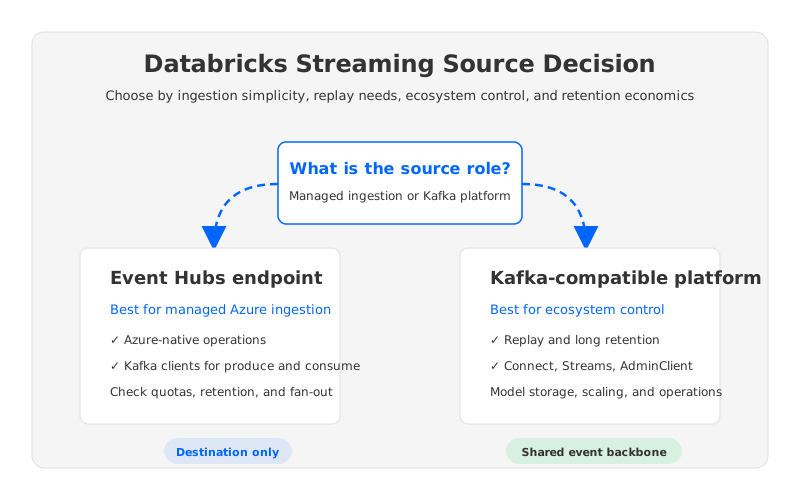
AutoMQ enters this discussion as one example of the Kafka-compatible platform path. It keeps Kafka protocol compatibility while using shared object storage and stateless brokers, which can matter when Databricks and Spark workloads need Kafka semantics without putting every retention and scaling decision onto broker-local disks. It is not the automatic answer to every Azure Databricks workload; it is relevant when the Lakehouse is only one consumer of a broader Kafka data plane.
1What Databricks Teams Need from a Streaming Source
Azure Databricks users often start with an ingestion question: "How do I stream data into Delta Lake?" That is a reasonable first question, but it is too narrow for platform design. A streaming source for Databricks must satisfy both the Spark job and the surrounding data platform.
For the Spark job, the requirements are concrete:
- The source must expose partitions that can be read in parallel.
- The pipeline needs stable offsets or positions so checkpoints can resume after failure.
- Backpressure, micro-batch sizing, and latency targets must match the workload.
- Security configuration must work from Databricks clusters or serverless compute.
- The data format and schema path must be reliable enough for production Delta tables.
For the platform, the requirements are wider. Data teams need to know whether events can be replayed for backfills, how long history remains available, whether several consumer groups can read independently, how topic or stream permissions are governed, and whether non-Databricks applications use the same event backbone. CTOs and SRE leaders also care about the blast radius of a streaming outage: can the source absorb producer spikes, recover consumers, and support debugging without turning every incident into a manual reconstruction exercise?
This is where the Event Hubs Kafka endpoint and a Kafka-compatible platform separate. Both can feed Databricks. They place responsibility in different locations.
2Event Hubs Kafka Endpoint for Azure-Native Ingestion
Azure Event Hubs is attractive for Databricks teams because it is an Azure-native event ingestion service. It integrates with Azure networking, monitoring, identity patterns, and managed capacity models. Its Kafka endpoint allows applications built with Kafka clients to communicate with Event Hubs by using Kafka protocol support, which can reduce application changes when the goal is to land event streams in Azure.
For many Lakehouse pipelines, that is enough. If producers are Azure applications, the analytics path is mostly Databricks, retention windows are modest, and the team prefers a managed ingestion boundary, Event Hubs is often the cleanest operational fit. Databricks can read events through supported streaming integrations, the platform team avoids managing brokers, and Azure handles much of the service reliability surface.
The tradeoff is that Event Hubs is still Event Hubs, not an Apache Kafka cluster wearing a different label. The Kafka endpoint is a compatibility interface to an Event Hubs service model. That distinction matters when the workload expects Kafka-native operational behavior:
| Decision area | Event Hubs Kafka endpoint is strong when | It needs extra validation when |
|---|---|---|
| Ingestion | Azure-native producers need managed event intake | Producers rely on Kafka-specific broker behavior |
| Replay | Short to moderate replay windows are enough | Backfills require long retained Kafka logs |
| Operations | The team wants Azure-managed capacity | The team needs Kafka-native broker and topic control |
| Ecosystem | Kafka clients are used for basic produce and consume | Kafka Connect, Streams, AdminClient, or custom tooling is central |
| Cost | Capacity is predictable and service simplicity matters | Long retention and many consumers dominate the workload |
The most common mistake is treating "Databricks can read it" as equivalent to "the platform can support every Kafka workflow." Databricks may only be the visible consumer. The same stream may also serve fraud detection, operational alerting, search indexing, reverse ETL, ML feature pipelines, and application services. If those consumers expect Kafka semantics, the source becomes a shared platform, not merely a Databricks input.
3Kafka-Compatible Platform for Replay and Ecosystem Control
A Kafka-compatible platform is the stronger option when Kafka is part of the architecture contract. Spark Structured Streaming's Kafka source is designed around Kafka topics, partitions, offsets, starting positions, and consumer behavior. That makes Databricks a natural Kafka consumer when the organization already uses Kafka as the event backbone.
The platform path is especially relevant when the following requirements are non-negotiable:
- Long replay windows for backfills, incident recovery, or model reprocessing.
- Multiple independent consumer groups with different latency and retention needs.
- Kafka Connect and connector lifecycle control for sources and sinks.
- Kafka Streams applications with internal topics and state restoration.
- Schema governance tied to Kafka topics and application evolution.
- Portability across Azure, another cloud, or a hybrid environment.
- Platform automation based on Kafka APIs and mature SRE runbooks.
These requirements do not imply that a team must run traditional Kafka on virtual machines. The important question is what kind of Kafka-compatible architecture the team wants. Classic Kafka binds compute and storage tightly: brokers own local log segments, scaling can trigger data movement, and long retention increases storage pressure on the broker fleet. That design is well understood, but it can become heavy for analytics workloads where retained history is large and active compute needs fluctuate.
Shared-storage Kafka-compatible systems change the shape of that decision. AutoMQ, for example, keeps Kafka protocol compatibility while moving durable log storage to object storage and making brokers comparatively stateless. In an Azure Databricks context, that means Spark can still consume Kafka-compatible streams, while the platform team can evaluate Azure object storage and broker compute as separate concerns. This is useful when Databricks jobs need long replay windows but the team does not want every retained byte to behave like broker-local disk state.
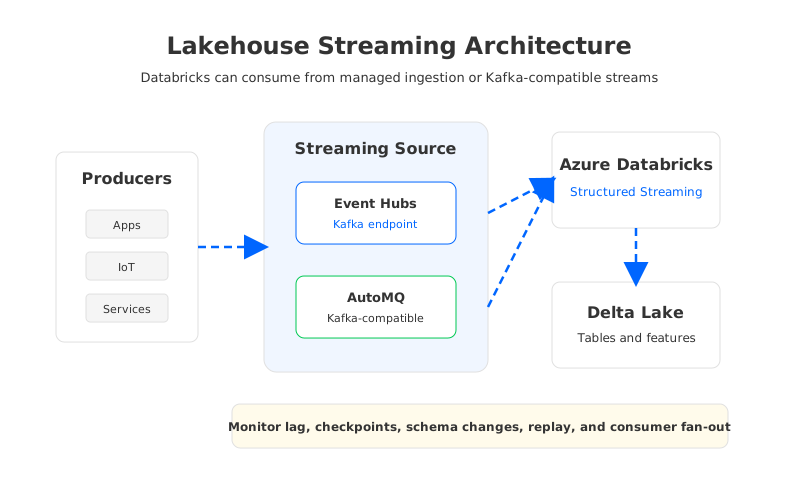
This is not a promise that one architecture erases all operational work. Networking, identity, encryption, monitoring, schema governance, cluster sizing, and failure drills still matter. The practical advantage is a different responsibility boundary: Event Hubs optimizes for managed Azure ingestion, traditional Kafka optimizes for Kafka-native control with broker-local storage, and shared-storage Kafka platforms aim to keep Kafka compatibility while reducing storage-driven scaling pressure.
4Cost, Retention, and Fan-Out Considerations
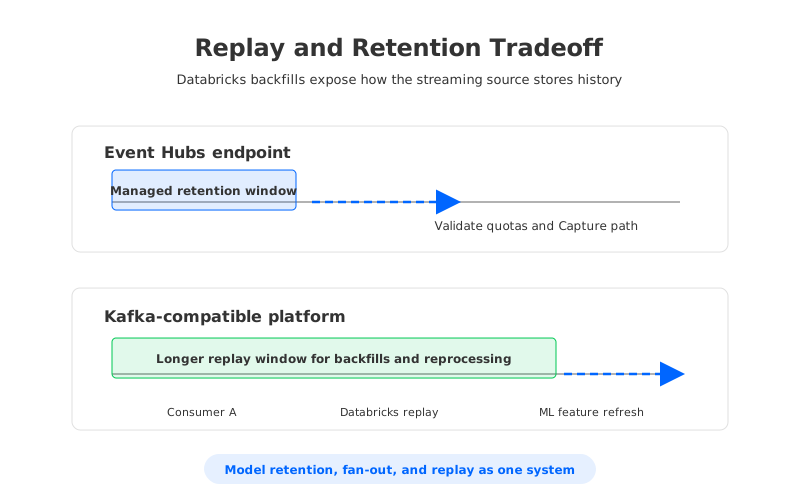
Databricks workloads can make streaming costs unintuitive because analytics consumers are often bursty. A daily backfill, ML feature refresh, or dashboard rebuild can read old data much faster than a real-time pipeline. If the stream is only sized for steady ingestion, these replay patterns expose the retention and fan-out economics of the source.
For Event Hubs, teams should model the service tier, throughput or processing capacity, partition count, consumer groups, retention limits, Capture usage, private networking, and downstream storage. The managed model is valuable, but it is still a model. Long retention, higher throughput, or many independent consumers should be checked against official quotas and pricing before treating the Kafka endpoint as a universal Kafka replacement.
For Kafka-compatible platforms, teams should model broker compute, storage, replication, network traffic, operations, and failure recovery. Traditional Kafka clusters can become expensive when long-retained data sits on broker-attached storage and scaling creates partition reassignment work. Shared-storage Kafka platforms such as AutoMQ shift durable data into object storage, so cost modeling can separate active serving capacity from retained history more cleanly. Databricks teams should still measure end-to-end latency and replay throughput, because Spark performance depends on partitioning, micro-batch settings, network paths, and consumer parallelism.
Schema is part of the same cost conversation. Bad schema governance increases pipeline failures, manual backfills, and reprocessing. Event Hubs may be sufficient when schema ownership is centralized and Databricks is the main consumer. Kafka-compatible platforms become more compelling when schemas are shared across services, connectors, real-time applications, and analytics consumers. The platform then needs clear compatibility rules, topic ownership, producer contracts, and observability around lag and malformed records.
5How to Choose for Azure Databricks
The decision should start from the workload, not from the service name. A useful shortcut is to ask whether Databricks is the destination or one participant in a streaming ecosystem.
Choose Event Hubs Kafka endpoint when the pipeline is primarily Azure-native ingestion into analytics, the team values managed service simplicity, Kafka clients are used mainly to reduce producer friction, and retention or replay needs fit Event Hubs constraints. This is a strong pattern for telemetry ingestion, application events that quickly land in Delta Lake, and teams that want fewer moving parts inside the data platform.
Choose a Kafka-compatible platform when Kafka semantics are part of the application contract. That includes cases where several teams share the same topics, consumers need independent replay, connectors are first-class infrastructure, Kafka Streams or AdminClient behavior matters, or long retention is a production requirement. This path asks for more platform thinking, but it gives data engineering teams a stronger Kafka ecosystem foundation.
Evaluate AutoMQ or another shared-storage Kafka platform when the team wants that Kafka foundation on Azure but is wary of broker-local storage pressure. It is particularly relevant when long retention, backfills from Databricks, elastic analytics demand, and multi-consumer fan-out dominate the architecture. The natural proof point is not a vendor checklist; it is a workload-shaped test with real producer rate, partition count, retention window, Databricks checkpointing, consumer fan-out, security configuration, and failure recovery.
6Decision Checklist
Before committing to Event Hubs Kafka endpoint or a Kafka-compatible platform, ask these questions in order:
| Question | If the answer is yes |
|---|---|
| Is Databricks the only important consumer? | Event Hubs may be sufficient. |
| Do multiple application teams depend on Kafka topics? | Prefer Kafka-compatible platform evaluation. |
| Do you need long replay for backfills or model reprocessing? | Model retention and replay cost carefully. |
| Do you rely on Kafka Connect, Streams, or AdminClient automation? | Validate Kafka-native compatibility, not only produce and consume. |
| Is operational simplicity more valuable than Kafka control? | Event Hubs is often the cleaner first option. |
| Is broker-local storage the scaling or cost pain? | Evaluate shared-storage Kafka such as AutoMQ. |
The best architecture is usually obvious after a small proof of concept. Run one Databricks Structured Streaming job from each candidate source. Use realistic event size, partition count, authentication, private networking, checkpoint location, schema evolution, and a forced restart. Then run a replay scenario and a second consumer. The result tells you whether the source behaves like a managed ingestion service, a Kafka platform, or something in between.
For Azure Databricks, the right streaming source is the one whose failure modes your team can operate. Event Hubs gives a managed Azure ingestion boundary. A Kafka-compatible platform gives Kafka ecosystem control. AutoMQ-style shared storage changes the Kafka option by reducing the coupling between retained stream data and broker state. The architecture choice should match the Lakehouse role: destination-only analytics pipeline, or one consumer in a wider event streaming platform.
7References
- Azure Databricks documentation: Kafka structured streaming
- Microsoft Learn: Azure Event Hubs for Apache Kafka
- Microsoft Learn: Azure Event Hubs quotas and limits
- Azure Event Hubs pricing
- Apache Spark documentation: Structured Streaming Kafka integration
- AutoMQ documentation: overview
- AutoMQ documentation: compatibility with Apache Kafka
- AutoMQ documentation: deploy AutoMQ to Azure AKS
8FAQ
8.1Can Azure Databricks read from Event Hubs through the Kafka endpoint?
Yes. Azure Databricks supports Structured Streaming with Kafka, and Event Hubs exposes an Apache Kafka endpoint for compatible clients. Teams should still validate authentication, consumer behavior, partitioning, checkpoint recovery, and quota limits for the exact Event Hubs tier and Databricks runtime they use.
8.2Is Event Hubs a replacement for Kafka in Databricks pipelines?
It can replace Kafka for Azure-native ingestion pipelines where the main requirement is managed event intake into Databricks. It is less likely to be a complete replacement when the organization needs Kafka-native operations, Kafka Connect, Kafka Streams, long replay windows, or platform automation based on Kafka APIs.
8.3When should a Databricks team choose a Kafka-compatible platform?
Choose a Kafka-compatible platform when Databricks is one consumer among many, when replay and retention are production controls, or when Kafka ecosystem components are part of the architecture. The decision is strongest when Kafka semantics are a platform contract rather than a convenience for ingestion.
8.4Where does AutoMQ fit with Azure Databricks?
AutoMQ fits when a team wants Kafka-compatible streams for Databricks and Spark while reducing the storage and scaling pressure of traditional broker-local Kafka. Its shared-storage architecture is most relevant for long retention, replay-heavy analytics, and workloads where broker elasticity matters.
8.5What should be tested before production?
Test realistic event size, throughput, partition count, authentication, private networking, schema evolution, checkpoint recovery, replay speed, multiple consumer groups, and failure restart behavior. The proof of concept should include both steady streaming and a backfill or reprocessing scenario.


