
Table of Contents
Table of Contents
Azure Kafka disaster recovery is often reduced to a feature question: does the platform support geo-replication? A streaming DR plan actually fails or succeeds on recovery point objective, recovery time objective, client endpoint discovery, and whether offsets, schemas, connectors, and application state still mean what engineers think they mean after failover.
This matters because Kafka is rarely a passive log by the time it becomes business-critical. It is the input to fraud systems, lakehouse ingestion, observability pipelines, payment workflows, operational data stores, and machine-learning feature feeds. Losing a few minutes of events may be acceptable for one pipeline and unacceptable for another. A manual DNS change may be fine for an internal analytics stream and disastrous for a customer-facing workflow with tight incident response targets.
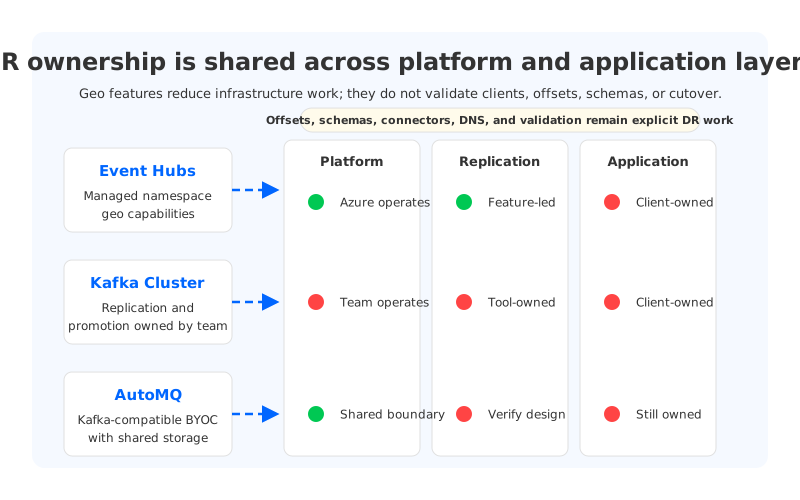
On Azure, the decision is usually framed as Event Hubs with its Kafka endpoint versus a Kafka-compatible cluster. Event Hubs gives teams a managed streaming service with Azure-native geo-disaster recovery and geo-replication options. A Kafka-compatible design keeps the Kafka operating model and ecosystem semantics, but it puts more responsibility on the platform team to design replication, failover, validation, and rollback.
Neither path removes DR engineering. Event Hubs can reduce operated infrastructure, but application cutover and semantic validation remain. Kafka-compatible DR gives platform owners more control, but control is not safety. The useful question is: which failure modes are covered, who owns the rest, and how will we prove failover before the incident?
1Start with RPO, RTO, and Failover Ownership
Before comparing Event Hubs geo-replication with Kafka replication on Azure, define the workload's recovery contract. RPO is the maximum data loss the business can tolerate. RTO is the maximum time the system can be unavailable or degraded. Both must be tied to specific topics, consumer groups, connectors, and downstream systems.
A useful first pass is to classify streams into four groups:
- Mission-critical command or transaction streams where the allowed event loss is minimal and failover must be rehearsed.
- Operational telemetry where some loss may be tolerable, but delayed visibility increases incident risk.
- Analytical ingestion where replay from source systems may be possible, but only if retention and source idempotency are designed.
- Integration streams where the hardest problem may be connector restart, schema compatibility, and duplicate handling rather than broker recovery.
The contract must also name the failover owner. In a managed service model, Azure may operate the service fabric, but the customer still owns application routing, dependency ordering, consumer behavior, and validation. In a Kafka-compatible cluster model, the platform team also owns more of the replication pipeline and runbook. That responsibility can be acceptable for enterprises that need Kafka semantics, private networking control, or cross-cloud portability, but it must be funded as engineering work.
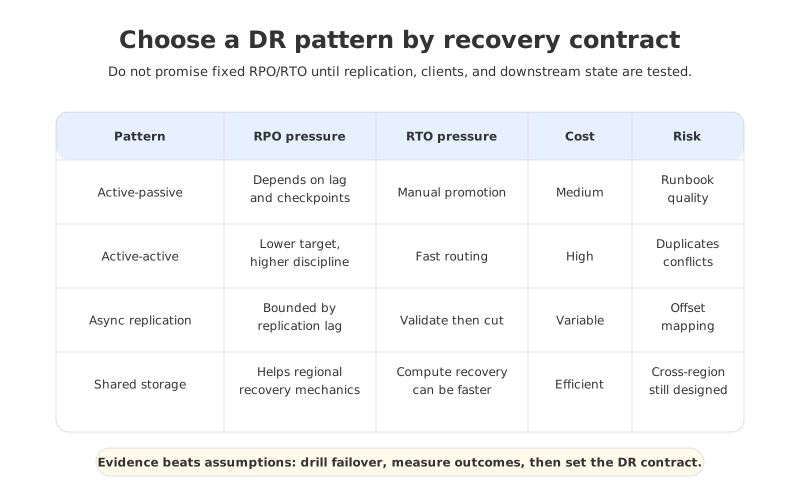
RPO and RTO should never be promised from a replication checkbox alone. Asynchronous replication can reduce expected data loss but cannot guarantee that every acknowledged event is already in the secondary region. Active-active designs can reduce cutover time, but they add conflict management, producer routing, duplicate consumption, and stricter idempotency requirements.
2Event Hubs Geo-Disaster Recovery and Geo-Replication
Azure Event Hubs provides two related but different geo capabilities that Kafka teams should not confuse. Geo-disaster recovery focuses on namespace-level continuity and metadata aliasing. Geo-replication is designed to replicate data and metadata across regions for supported Event Hubs configurations. Both are useful, but they answer different operational questions.
For Kafka endpoint users, the distinction is important. Event Hubs can expose a Kafka-compatible protocol endpoint so existing Kafka clients can connect without running Kafka brokers. That does not make every Kafka ecosystem assumption identical. Teams still need to check client behavior, API coverage, partitioning expectations, offset handling, administration workflows, authentication, private endpoint access, and bootstrap endpoint changes.
Event Hubs geo-disaster recovery is strongest when the workload can live within the Event Hubs service model and the DR requirement is primarily regional namespace continuity. Azure handles much of the managed service operation, while platform teams avoid broker-level replication design, ISR tuning, disk provisioning, and multi-region cluster management.
The tradeoff is responsibility boundary. Event Hubs is not a self-managed Kafka cluster running in Azure. If a team depends on broker-level tuning, Kafka Connect assumptions, deep Admin API behavior, or replication tooling built around Kafka clusters, those details must be tested rather than assumed.
Event Hubs DR planning should answer these checks:
| Design question | Why it matters |
|---|---|
| Is the workload using Event Hubs geo-disaster recovery or geo-replication? | The former emphasizes namespace continuity and alias failover; the latter is about data and metadata replication where supported. |
| What happens to consumer offsets during failover? | A reachable endpoint is not enough if consumer position cannot be interpreted safely. |
| Are producers idempotent at the application layer? | Cross-region recovery can create retries, duplicates, or reordered effects even when the platform is healthy. |
| How are schemas and connectors managed? | Schema Registry, Kafka Connect, and downstream sinks may sit outside the Event Hubs replication feature. |
| How do clients switch endpoints? | DNS, connection strings, private endpoints, firewall rules, and identity permissions must all be in the runbook. |
The practical conclusion: Event Hubs can reduce operational surface area for Azure-native streaming DR, but it does not eliminate application recovery design.
3Kafka-Compatible DR Patterns on Azure
Kafka-compatible DR on Azure usually means running two Kafka-capable environments and replicating topics from a primary region to a secondary region. The replication mechanism might be Apache Kafka MirrorMaker 2, another cluster linking technology, a managed Kafka-compatible platform feature, or a custom pipeline for selected topics. The design can be active-passive, active-active, or tiered by workload class.
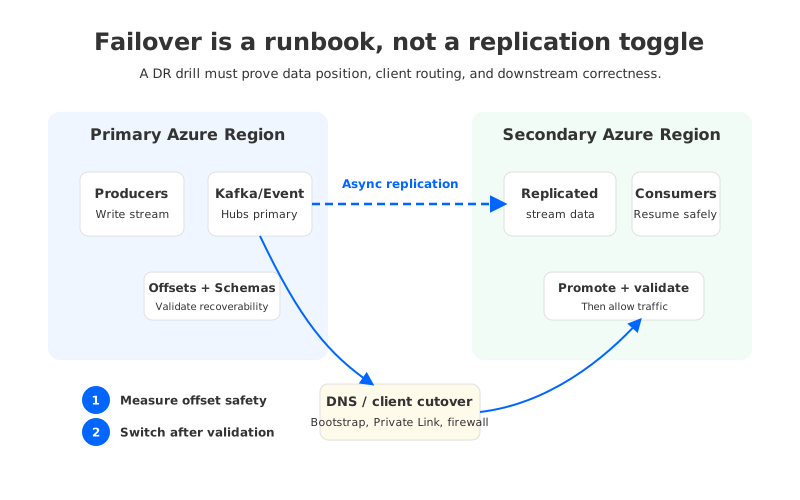
MirrorMaker 2 is a common baseline because it is part of the Apache Kafka ecosystem and was designed for replication between Kafka clusters. It can replicate topic data and supports cross-cluster replication patterns, but teams still need decisions about topic naming, offset synchronization, consumer group migration, ACLs, configuration drift, and promotion. Proprietary replication tools may automate pieces of the flow, but the enterprise still needs evidence that the recovered application is correct.
The most common mistake is treating replication lag as the whole DR metric. Lag is necessary, but not sufficient. A secondary cluster can be nearly caught up while consumers cannot resume because offsets were not translated as expected. Producers may reconnect while schemas, connectors, or sink idempotency still break the workflow.
Kafka-compatible DR is attractive when teams need one or more of these properties:
- Existing Kafka clients, Kafka Streams applications, Kafka Connect deployments, and operational tooling should remain central.
- The organization needs control over topic-level replication policy, retention, compaction, and promotion order.
- Compliance teams require clear data-plane boundaries, private networking, customer-owned infrastructure, or explicit evidence of where data is stored.
- The platform roadmap includes multi-cloud or hybrid DR where avoiding a single cloud service abstraction has strategic value.
That control comes with costs. Running two regions means paying for duplicate capacity, replicated storage, cross-region egress, monitoring, security policy management, and regular failover exercises. A Kafka DR plan that is not rehearsed is mostly documentation.
4Cross-Region Cost and Operational Risks
Azure cross-region Kafka DR has two cost dimensions that are easy to underestimate. Every replicated event may create cross-region network transfer, secondary storage writes, and compute load. The secondary region also needs recovery capacity; if it is sized only for replication, it may not handle production traffic during failover.
Storage redundancy also needs careful interpretation. Azure Storage offers locally redundant, zone-redundant, geo-redundant, and read-access geo-redundant options. These protect storage durability and availability at the storage layer. They do not automatically make Kafka clients, metadata, offsets, connectors, and application dependencies fail over correctly.
Private networking adds another layer. Azure Private Link and private endpoints are often required for regulated environments, but a private endpoint in the primary region does not automatically give every client a working path to the secondary region. Firewall rules, virtual network peering, DNS zones, managed identities, and route tables must be verified from the actual client subnets.
Offset consistency deserves its own runbook section. Consumers that restart in the secondary region need a safe position. Depending on the replication approach, that might require offset translation, an application checkpoint, an external state store, or a deliberate replay window.
Schemas and connectors are similar. A topic may replicate successfully while the schema registry, connector configuration, sink credentials, or target database permissions do not. If Kafka Connect is part of the workload, the DR plan should specify where connector configs live, how connector offsets are recovered, and how duplicate sink writes are handled.
5Where AutoMQ Fits in DR Planning
AutoMQ fits this discussion as a Kafka-compatible BYOC platform rather than as a generic replacement for DR design. Its architecture separates broker compute from persistent storage and uses object storage as the primary data foundation. That changes some failure-recovery mechanics inside a region: when durable data is not tied to broker-local disks, replacing broker compute and recovering metadata can be faster and less data-movement-heavy than traditional shared-nothing Kafka operations.
For Azure teams, the relevant architectural point is not "AutoMQ solves DR." Cross-region DR still has to be designed, verified, and aligned with the official capabilities of the deployed product version. The point is more specific: a Kafka-compatible platform with clearer data/control boundaries and shared-storage recovery can reduce certain single-region operational risks while preserving Kafka APIs.
That makes AutoMQ worth evaluating when a team wants Kafka semantics on Azure but does not want broker-local storage to dominate recovery and scaling work. In a BYOC model, the customer can reason about where data lives, how the control plane interacts with the environment, and which network boundaries are required.
The cross-region part still needs explicit architecture. Teams should ask:
- Which AutoMQ deployment model and version is being evaluated, and what public DR or replication guidance applies?
- Is the desired pattern active-passive, active-active, or workload-tiered?
- How are topics, offsets, schemas, ACLs, and connector states replicated or reconstructed?
- What Azure Blob Storage redundancy option is used for each region, and does it align with the application RPO?
- How will client failover work across DNS, private endpoints, firewall policy, and bootstrap configuration?
AutoMQ should therefore enter the DR conversation as an architecture candidate with Kafka compatibility and cloud-native storage separation, not as a shortcut around engineering validation.
6DR Decision Framework
This decision table connects architecture options to operating responsibilities.
| Option | Best fit | Main responsibility | Primary risk |
|---|---|---|---|
| Event Hubs geo-disaster recovery | Azure-native streaming where namespace continuity is the main goal | Configure aliasing, failover process, clients, and dependent services | Assuming metadata continuity equals application recovery |
| Event Hubs geo-replication | Azure-native workloads that need managed cross-region data replication where supported | Validate replicated data, offsets, client routing, and feature coverage | Confusing Kafka endpoint compatibility with full Kafka cluster semantics |
| Kafka clusters with MirrorMaker 2 | Teams that need Kafka ecosystem control and can operate replication | Topic replication, offset handling, configs, security, promotion | Underestimating lag, offset translation, and connector recovery |
| Kafka-compatible BYOC platform | Enterprises that need Kafka APIs with clearer cloud infrastructure boundaries | Product-specific replication design, Azure networking, failover validation | Treating shared storage recovery as a substitute for cross-region DR |
For SREs, the operating model should be documented as a runbook with measurable checks. For architects, the design should show dependency order: identity, networking, storage, cluster or service availability, topic readiness, offset readiness, connector readiness, producer cutover, consumer cutover, downstream validation, and rollback.
7Azure Kafka DR Checklist
Use this checklist before committing to Event Hubs, self-managed Kafka, or a Kafka-compatible platform on Azure:
- Define RPO/RTO per workload class, not per platform.
- Separate regional service recovery from application workflow recovery.
- Decide whether failover is active-passive, active-active, or manual promotion.
- Verify topic data replication and consumer offset behavior with real clients.
- Include schemas, Kafka Connect, stream processing state, and sink idempotency.
- Model cross-region bandwidth, secondary storage, standby compute, and incident scale-out.
- Validate DNS, bootstrap servers, private endpoints, firewalls, managed identity, and route tables from client networks.
- Test failover and failback on a schedule, then record evidence for audit and post-incident learning.
The best Azure Kafka disaster recovery plan is boring during an incident because the hard decisions were made earlier. Event Hubs can be right for Azure-native managed streaming. Kafka-compatible DR can be right when semantics, ecosystem continuity, and infrastructure control matter more. AutoMQ belongs in the evaluation when teams want Kafka compatibility with shared-storage architecture and BYOC boundaries. In every case, prove the design by failover drills, not product pages.
8References
- Azure Event Hubs geo-disaster recovery
- Azure Event Hubs geo-replication
- Azure Event Hubs for Apache Kafka ecosystems
- Apache Kafka documentation: geo-replication
- Azure bandwidth pricing
- Azure Storage redundancy
- Azure Private Link for Event Hubs
- AutoMQ documentation: What Is AutoMQ
- AutoMQ architecture overview
9FAQ
9.1Is Event Hubs geo-replication the same as Kafka disaster recovery?
No. Event Hubs geo-replication is an Azure managed-service capability for supported Event Hubs scenarios. Kafka DR is broader: offsets, clients, schemas, connectors, DNS, private networking, downstream systems, and validation.
9.2Can Kafka MirrorMaker 2 provide DR on Azure?
MirrorMaker 2 can be part of Kafka DR because it supports replication between Kafka clusters. It does not remove the need to design offset recovery, topic naming, config sync, security policy, connector restart, and cutover.
9.3Should Azure Kafka DR be active-active or active-passive?
It depends on the workload. Active-active can reduce cutover time but increases routing, duplicate handling, ordering, and conflict complexity. Active-passive is easier to reason about, but needs clear promotion steps and standby capacity.
9.4Does shared storage remove the need for cross-region DR?
No. Shared storage can improve regional recovery and scaling mechanics because durable data is less tied to broker-local disks. Cross-region DR still requires replication, client failover, network design, and validation.
9.5What should be tested in an Azure Kafka DR drill?
Test more than broker or service availability. A useful drill validates producer reconnection, consumer restart position, schema access, connector recovery, downstream idempotency, private network reachability, dashboards, alerting, rollback, and operator execution time.


