
Table of Contents
Table of Contents
Kafka failures on Azure often look like application failures until the first packet capture. A producer can authenticate successfully and then stall on metadata. A consumer can reach bootstrap but fail against one broker. A migration from public endpoints to Private Link can pass a smoke test from one subnet and fail from a peered VNet. These are not edge cases; they are the normal result of running a distributed broker protocol inside cloud network boundaries.
The first architectural decision is which connectivity contract your clients must satisfy. Azure Event Hubs with the Kafka endpoint presents a namespace endpoint. Apache Kafka presents a bootstrap endpoint that returns broker-specific advertised listeners. Self-managed Kafka on Azure VMs or AKS therefore exposes more network surface area than Event Hubs, even when both are private.
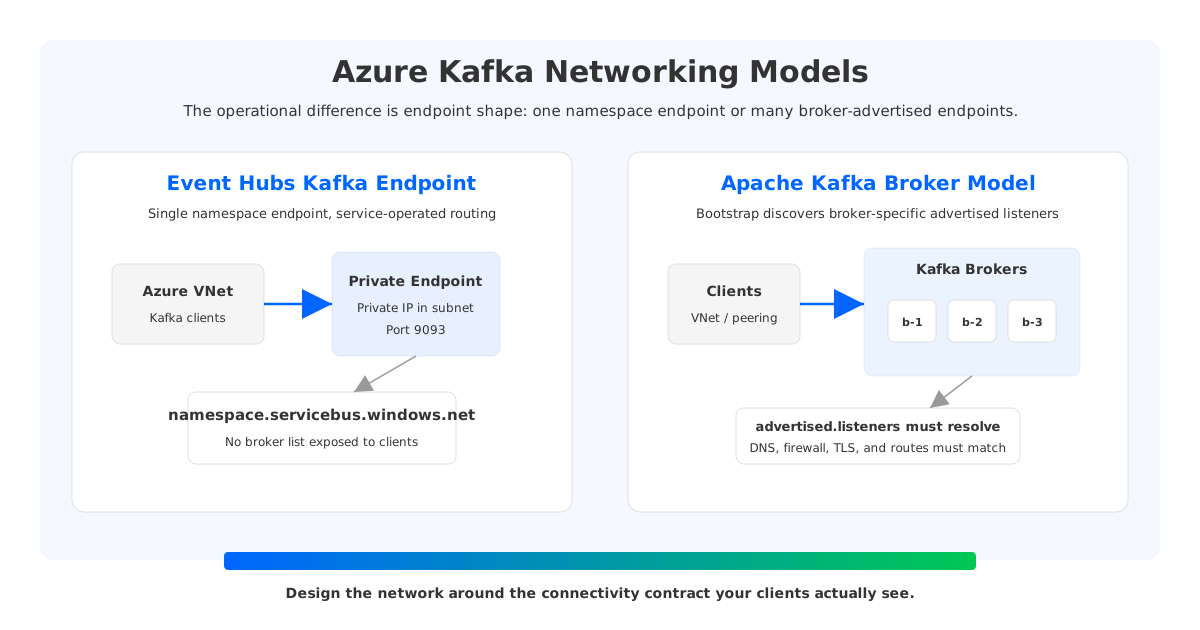
That difference drives Private Link design, DNS zones, VNet peering, firewall rules, TLS certificates, cross-region access, and incident response. Azure Kafka networking is less about opening a port and more about preserving the semantics that Kafka clients expect.
1The Two Endpoint Models You Must Not Confuse
Event Hubs supports Kafka clients by exposing a Kafka-compatible endpoint for an Event Hubs namespace. The typical client configuration points bootstrap.servers at <namespace>.servicebus.windows.net:9093 and uses SASL over TLS. From the client’s perspective, the namespace is the addressable unit. Azure operates the service behind that endpoint, so clients do not manage a list of individual brokers.
Apache Kafka behaves differently. A client connects to one or more bootstrap servers, asks for cluster metadata, and then connects directly to the brokers that lead the relevant partitions. The address returned in that metadata comes from broker listener configuration, especially advertised.listeners. If a client can reach bootstrap but cannot resolve or route to the advertised broker address, the cluster is functionally unavailable to that client.
That distinction matters more on Azure than it does in a flat lab network:
| Design area | Event Hubs Kafka endpoint | Apache Kafka broker model |
|---|---|---|
| Client-visible shape | One namespace endpoint | Multiple broker endpoints |
| Private connectivity | Private endpoint to the namespace | Private IPs, load balancers, or per-broker endpoints |
| DNS dependency | Namespace private DNS | Broker FQDNs returned in metadata |
| Firewall scope | Namespace-level access rules | Listener ports for every client-to-broker path |
| Failure mode | Endpoint or authorization failure | Bootstrap succeeds, broker connection fails |
Neither model is universally better. Event Hubs reduces broker connectivity work because Azure hides the broker topology. Kafka exposes the topology because that is how partition ownership, fetch routing, and protocol semantics work. The mistake is designing a Kafka broker network as if it were a single managed endpoint.
2Event Hubs Networking: Private Link, Firewalls, and Port 9093
For Azure-native ingestion, Event Hubs is attractive because the network surface is compact. Microsoft documents Kafka client configuration on port 9093 with SASL_SSL, and Event Hubs networking can be restricted with IP firewall rules, virtual network rules, or private endpoints. With Private Link, a private endpoint places a network interface with a private IP address in your VNet; traffic to the Event Hubs namespace can then traverse Microsoft’s private backbone instead of the public internet.
The main control points are straightforward:
- Use Private Link when clients should reach the Event Hubs namespace through a private endpoint in a subnet.
- Disable public network access when the namespace should be reachable only through private endpoints.
- Use IP firewall rules when access must be limited to known public IPv4 or IPv6 ranges.
- Use virtual network rules or service endpoints where that model fits the broader Azure architecture.
- Decide deliberately whether trusted Microsoft services may bypass the firewall, because that exception can change the effective boundary.
Private Link does not remove DNS from the design. The namespace name still needs to resolve to the private endpoint address from the client’s network view. If producers live in multiple VNets, subscriptions, or regions, private DNS zone links become part of production architecture. A test from the private endpoint subnet proves only one resolver path works.
Firewall behavior also deserves precision. Event Hubs namespace firewall rules apply at the namespace level and reject connections that do not match allowed IP or network rules. When teams enable selected networks, they should set the default action with intent and verify diagnostic and dependent service traffic.
3Kafka on Azure: Why Advertised Listeners Are the Real Contract
When teams deploy Kafka on Azure VMs, AKS, or a managed Kafka-compatible environment, the most common networking mistake is treating bootstrap.servers as the whole story. Bootstrap is only a directory lookup. The returned broker addresses are what producers, consumers, and admin clients actually use for partition I/O.
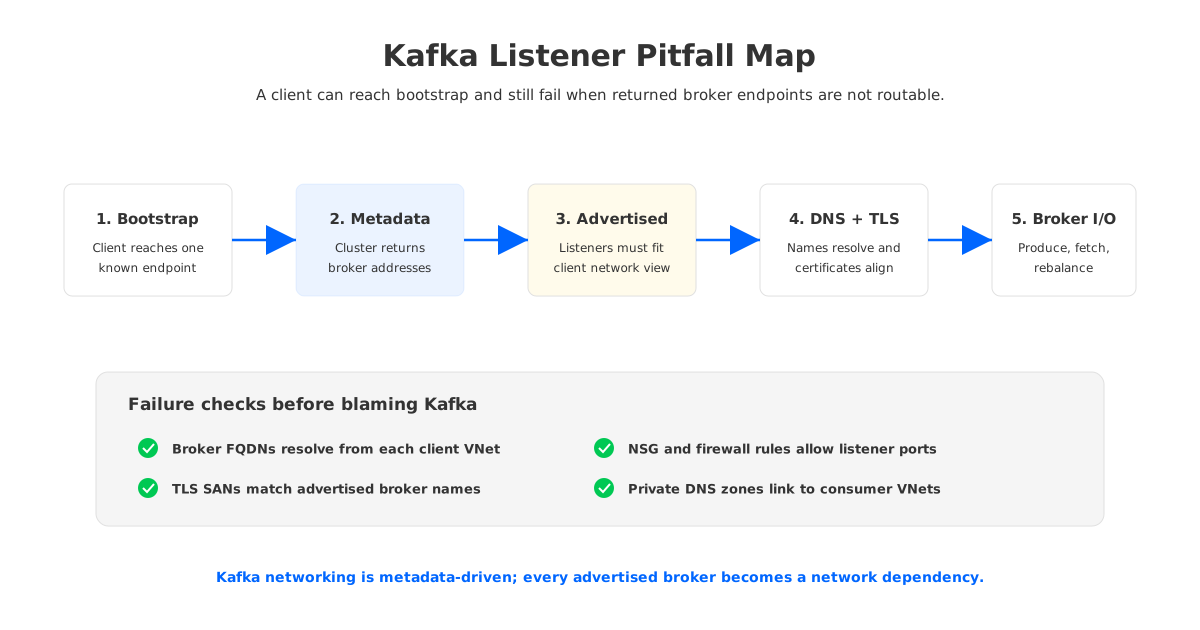
On Azure, each advertised listener must be true from the client’s point of view. “True” means all of the following at the same time:
- The broker FQDN resolves from that client network.
- The resolved IP is reachable through VNet peering, VPN, ExpressRoute, Private Link, or an approved routing path.
- NSGs, Azure Firewall, NVA rules, and host firewalls allow the listener port.
- TLS certificates match the advertised hostname.
- The listener maps to the intended security protocol, such as SSL or SASL_SSL.
- Load balancers preserve the broker identity requirement instead of hiding all brokers behind an address pattern that metadata cannot express.
Kafka on Kubernetes requires special care. Pods are ephemeral, nodes move, and internal service names may be meaningless from a peered VNet or on-premises network. Operators often solve this with per-broker services, internal load balancers, stable DNS names, and separate internal and external listeners. That is a Kafka protocol requirement, not a generic Kubernetes exposure problem.
The same logic applies to Azure VMs. A three-broker cluster in one VNet may work with private DNS names such as broker-1.kafka.internal, broker-2.kafka.internal, and broker-3.kafka.internal. The moment clients arrive from another VNet, another region, or on-premises, those names and routes must still be valid.
4Private Link Patterns for Kafka: Useful, but Not Magical
Private Link is excellent for exposing a private endpoint to a service, but Kafka’s broker model forces a design choice. Event Hubs maps naturally to Private Link because the namespace is the service endpoint. Kafka brokers are many endpoints. You can still use private ingress designs, but the client must receive broker addresses that route correctly.
Three patterns appear often in production Azure Kafka designs:
| Pattern | When it fits | Watch-outs |
|---|---|---|
| Same-VNet private brokers | Producers and consumers live near the cluster | Lowest complexity, but limited reach |
| Peered VNet access | Multiple application VNets consume shared Kafka | DNS zone links, NSG rules, route tables, and overlapping CIDRs |
| Private endpoint or per-broker exposure | Cross-tenant, cross-network, or stricter boundary needs | More endpoint objects, DNS mapping, certificates, and operational state |
The right answer depends on how many client network views you need to support. A platform team serving one AKS cluster can keep the design compact. A central streaming platform needs a published connectivity contract: bootstrap names, broker name patterns, listener ports, DNS ownership, certificates, firewall process, and supported cross-region paths.
Private connectivity also affects cost and failure domains. VNet peering, NAT Gateway, Azure Firewall, cross-region traffic, and Private Link each have pricing concepts that can matter for high-throughput streaming.
5DNS Is Part of the Kafka Control Plane
Kafka administrators often think of DNS as a network dependency. In production, it is closer to a control-plane dependency because Kafka metadata contains names clients must trust. A bad DNS change can make healthy brokers disappear.
For Event Hubs with Private Link, the key DNS task is ensuring that the namespace resolves to the private endpoint from every intended client location. Azure private DNS zones help automate this for linked VNets, but hybrid and multi-region environments still require resolver planning.
For Kafka brokers, the DNS design is broader:
- Broker names should be stable across restart, reschedule, and replacement.
- Internal and external listeners should not return names that are valid only inside the broker subnet.
- Split-horizon DNS should be used carefully, with tests from each client network.
- TLS certificate Subject Alternative Names should match the names clients receive.
- Runbooks should include DNS TTL, cache behavior, and rollback steps.
The operational test is simple: from every approved client segment, resolve every advertised broker hostname and open a TCP connection to the advertised listener port.
6Firewall and NSG Design: Think in Flows, Not Ports
Azure NSGs filter traffic using rules over source, destination, protocol, port, and direction. Azure Firewall or third-party NVAs may add application policy, logging, and centralized control. Kafka traffic needs this governance, but a rule like “allow 9092” is rarely sufficient.
A Kafka client flow includes bootstrap, metadata refresh, produce, fetch, consumer group coordination, admin operations, and sometimes schema registry or Connect traffic. On Event Hubs, Kafka clients commonly use port 9093 to the namespace endpoint. On self-managed Kafka, every broker listener returned in metadata must be allowed.
Security architects should separate three boundaries:
- Client-to-broker data plane: high-throughput Kafka protocol traffic.
- Operator-to-platform plane: admin APIs, SSH or Kubernetes API, metrics, logs.
- Broker-to-storage or broker-to-dependent-service plane: disks, object storage, identity, schema, monitoring.
Bundling these into one broad rule creates audit pain. Splitting them too aggressively without automation creates incident pain. The pragmatic middle ground is to publish named rule groups by flow and test connectivity in CI.
7Cross-VNet and Cross-Region Client Access
Shared Kafka platforms frequently begin in one VNet and later become regional infrastructure. That second phase exposes early shortcuts. A broker name that worked inside one VNet may not resolve from another. A route through Azure Firewall may introduce asymmetric paths. A peering topology may allow IP reachability but not DNS visibility.
Before adding remote clients, answer these questions:
- Is the access path supported for sustained Kafka throughput, not only health checks?
- Are brokers advertised with names routable from the remote client view?
- Is consumer fetch traffic expected to cross regions continuously?
- Are firewall logs sampled at a rate useful for debugging connection churn?
- Does the disaster recovery plan assume the same DNS names can move?
For Event Hubs, the single namespace endpoint simplifies the client contract. For Kafka, the checklist expands because every broker is a possible target.
8Where AutoMQ Fits in Azure Network Design
The network tradeoff is not only Event Hubs versus self-managed Kafka. Many teams want Kafka-compatible access patterns without inheriting the full operational burden of broker-local durability and manual data movement. This is where BYOC Kafka-compatible platforms such as AutoMQ enter the design conversation.
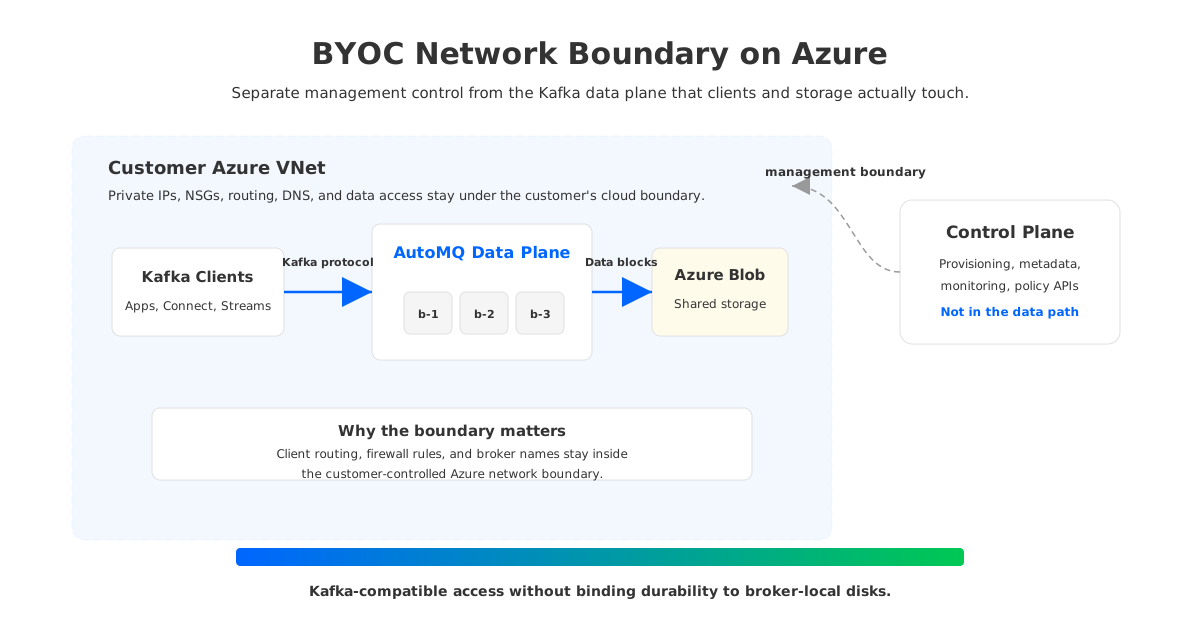
In a BYOC model, the data plane can run inside the customer’s Azure VNet while the control plane remains separated for provisioning and management. That boundary matters because Kafka clients, broker endpoints, storage access, NSGs, private routing, and data traffic can be designed within the customer-controlled network environment.
AutoMQ is relevant for a specific architectural reason: it keeps Kafka-compatible client behavior while moving durable stream data away from broker-local disks into shared cloud storage. That does not eliminate listener, DNS, or firewall design, but it reduces the migration and recovery complexity caused by binding large volumes of state to individual brokers.
For Azure architects, the practical evaluation is:
- Can existing Kafka clients, Connect jobs, and Streams applications use familiar Kafka endpoints?
- Does the data plane live in the customer VNet with clear security boundaries?
- Are broker endpoints and DNS patterns documented for every client network?
- Is storage access private, governed, and observable?
- Does scaling or replacing brokers require moving large local data sets across the network?
AutoMQ should not be treated as a firewall feature. It is a streaming architecture option that changes how much state the network has to carry during scaling, failover, and migration.
9Network Readiness Checklist
Before approving an Azure Kafka design, require evidence rather than diagrams alone.
| Check | Event Hubs Kafka endpoint | Kafka broker platform |
|---|---|---|
| Endpoint inventory | Namespace endpoint and private endpoint | Bootstrap plus all advertised brokers |
| DNS test | Namespace resolves privately | Every broker FQDN resolves from every client VNet |
| Firewall test | Port 9093 to namespace path | Listener ports to every broker path |
| TLS test | Namespace certificate trust | Certificate SANs match advertised hostnames |
| Cross-network test | Private DNS zone links and routes | Peering, routing, DNS, and metadata from each segment |
| Operations test | Diagnostics and trusted services | Admin, metrics, logs, storage, and recovery flows |
The best time to find a listener mismatch is before application teams onboard. The second best time is before a migration cutover. After that, every metadata timeout becomes a multi-team incident.
Azure gives teams strong primitives: VNets, Private Link, private DNS, NSGs, NAT Gateway, Azure Firewall, ExpressRoute, and managed Event Hubs endpoints. Kafka adds a distributed broker contract on top. A production-ready design respects both layers instead of assuming one hides the other.
10References
- Microsoft Learn: Azure Event Hubs for Apache Kafka developer guide
- Microsoft Learn: Allow access to Event Hubs namespaces via private endpoints
- Microsoft Learn: Configure IP firewall rules for Azure Event Hubs
- Microsoft Learn: Azure Private Endpoint DNS configuration
- Microsoft Learn: Azure network security groups overview
- Microsoft Learn: Azure NAT Gateway documentation
- Apache Kafka documentation: Broker configuration
- Apache Kafka documentation: Security
- AutoMQ Docs: Manage environments overview
11FAQ
11.1Does Event Hubs Kafka support Private Link?
Yes. Event Hubs namespaces can be accessed through Azure Private Link by creating a private endpoint in a VNet. Kafka clients still use the Event Hubs namespace endpoint, but DNS should resolve that endpoint to the private endpoint IP from the approved client networks.
11.2What port do Kafka clients use with Event Hubs?
Microsoft’s Kafka client examples for Event Hubs use port 9093 with SASL_SSL. Teams should verify firewall and private connectivity rules against their exact namespace, client library, and security configuration.
11.3Why can a Kafka client reach bootstrap but still fail on Azure?
Bootstrap only returns cluster metadata. The client must then connect to the broker addresses listed in that metadata. If advertised.listeners returns hostnames or IPs that the client cannot resolve, route to, or validate with TLS, the application can fail even though bootstrap was reachable.
11.4Is Private Link enough for self-managed Kafka on Azure?
Not by itself. Private Link can help expose private endpoints, but Kafka clients still need broker-specific addresses that match metadata, DNS, certificates, and firewall rules. A single private endpoint pattern must be reconciled with Kafka’s per-broker connectivity model.
11.5How should teams design Kafka across multiple Azure VNets?
Start with the client network views. For each VNet, verify DNS resolution for bootstrap and every advertised broker, route symmetry, NSG and firewall rules, TLS trust, and expected throughput. Private DNS zone links and VNet peering must be treated as part of the Kafka platform contract.
11.6Where does AutoMQ help in Azure Kafka networking?
AutoMQ can run a Kafka-compatible data plane inside the customer’s Azure VNet in a BYOC model, keeping client and data traffic within the customer-controlled boundary. Its shared-storage architecture also reduces the operational coupling between broker replacement and large broker-local data movement, which can simplify scaling and migration planning.


