
Table of Contents
Table of Contents
Banking data synchronization used to mean moving records between systems of record at a predictable cadence. Core banking, card processing, fraud models, CRM, risk engines, data warehouses, and regulatory reporting each had their own ingestion windows, reconciliation jobs, and ownership boundaries. That model breaks down when a payment authorization, account balance change, sanctions check, and mobile notification all need to react to the same event while the customer is still in the session.
That is why so many teams search for banking data synchronization kafka. They are not looking for a generic message queue definition. They are trying to decide whether a Kafka-compatible event stream can become the synchronization backbone between transactional databases, customer-facing applications, analytics systems, and operational risk controls without creating a new reliability problem in the middle of the bank.
The hard part is that banking synchronization is not a single pipeline. It is a set of promises: ordering where ordering matters, replay when a downstream system is late, auditability when a regulator asks how a value changed, isolation when workloads have different risk levels, and recovery when a deployment or region fails. Kafka is attractive because its log abstraction fits those promises. A durable event log gives producers and consumers a shared timeline, while consumer groups, offsets, and replay make downstream systems less tightly coupled than point-to-point integration.
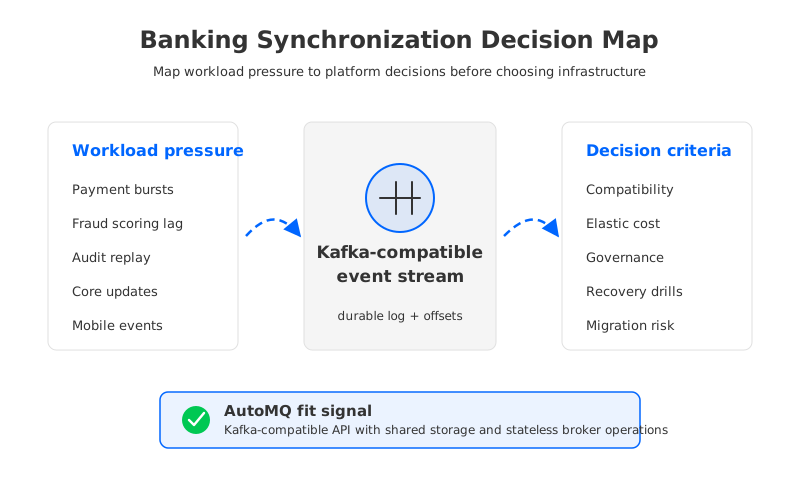
But the decision is not "Kafka or no Kafka." The real decision is which operating model can keep synchronization reliable when traffic grows, when retention expands, when a connector lags, when a broker fails, and when platform teams need to change infrastructure under live workloads.
1Why Banking Teams Use Kafka-Compatible Streams for Synchronization
Banks often start with a narrow use case: publish account events from a core platform, stream card transactions into fraud scoring, or feed near-real-time balances into mobile banking. The first success changes expectations quickly. Other teams ask for the same events, retention windows become longer, and audit teams want a clean answer for which system produced which version of a record.
Event streams help because they separate producers from consumers without turning data movement into a black box. A source system can publish a transaction event once. Fraud detection, AML monitoring, customer notifications, search indexing, reporting, and lakehouse ingestion can each consume at their own pace. If a consumer fails, it can resume from committed offsets instead of asking the source database to rebuild a custom export.
The synchronization architecture still needs explicit boundaries:
- System-of-record ownership. Events should describe committed business changes, not half-formed application state. The producer contract matters as much as the transport.
- Ordering scope. A bank may need strict ordering per account, card, customer, or ledger partition, but global ordering across all events is usually the wrong target.
- Replay policy. Retention and compaction choices should match recovery and audit needs, not a default disk budget.
- Consumer accountability. Offsets make progress visible, but the platform still needs lag alerts, runbooks, and clear ownership for stuck consumers.
This is where Kafka-compatible infrastructure earns its place. Existing Kafka clients, Kafka Connect connectors, schema tooling, and stream processing frameworks give banks an ecosystem instead of a one-off integration layer. Compatibility also reduces migration risk because teams can reuse known client behavior, operational patterns, and governance controls.
2The Production Constraint Behind the Architecture
Traditional Kafka was designed around a shared-nothing broker model. Each broker owns local log segments on attached storage, and replicas are distributed across brokers for durability and availability. The model is clear and battle-tested, but it ties compute, storage, network movement, and partition placement together. In a banking synchronization platform, that coupling becomes visible in the operational calendar.
When retention grows, storage grows on the brokers. When a broker is replaced, data has to move. When a topic becomes hot, partitions have to be reassigned. When a bank spreads brokers across availability zones, replication and consumer fetch patterns can create cross-zone traffic. None of these behaviors are surprising to experienced Kafka operators, but they become expensive when the streaming platform becomes shared infrastructure for many banking domains.
The painful cases are rarely the steady-state happy path. They show up during events that already carry risk: month-end processing, a fraud spike, a card campaign, a failed database connector, a compliance export, a cloud maintenance event, or a region-level incident drill. The platform team is asked to scale, rebalance, recover, and prove data integrity at the same time.
| Constraint | Why it matters in banking synchronization | Architecture question |
|---|---|---|
| Retention growth | Audit, replay, and downstream recovery often require longer data windows. | Does storage expansion force broker expansion? |
| Consumer lag | Risk, notification, and reporting consumers may fall behind independently. | Can catch-up reads avoid hurting hot traffic? |
| Broker replacement | Infrastructure failures and upgrades should not become long data-copy operations. | How much state is tied to each broker? |
| Multi-zone deployment | Availability requirements usually span zones or regions. | What traffic crosses zones, and who pays for it? |
| Governance | PII, account data, and payment events need strict access boundaries. | Can identity, network, and audit controls fit existing banking policy? |
The table is a useful filter because it shifts the conversation away from benchmark screenshots and toward operational truth. A synchronization backbone is only as good as its behavior under change.
3Architecture Options and Trade-Offs
Most platform teams end up evaluating three patterns. The first is conventional self-managed Kafka on local or attached disks. It gives maximum control and a familiar operational surface, but the team owns capacity planning, rebalancing, broker storage, upgrades, and disaster recovery mechanics. For organizations with mature Kafka SRE teams, this can be viable. For banks trying to make event streaming a standard platform across many application teams, the staffing model becomes part of the cost.
The second pattern is a managed Kafka service. This can reduce infrastructure work and accelerate adoption, especially when procurement and security teams already trust the cloud provider. The trade-off is that managed services still expose Kafka's underlying operational economics in some form: provisioned capacity, partition limits, storage tiers, networking, and service-specific constraints. The buyer gets less operational burden, but not automatically a different storage architecture.
The third pattern is Kafka-compatible streaming with shared storage. Instead of treating each broker as the long-term home of its local log, the platform moves durable stream storage into object storage and makes brokers more stateless. The design goal is not to change the Kafka API that applications see. The goal is to change what the platform team has to do when capacity, failures, and placement change.
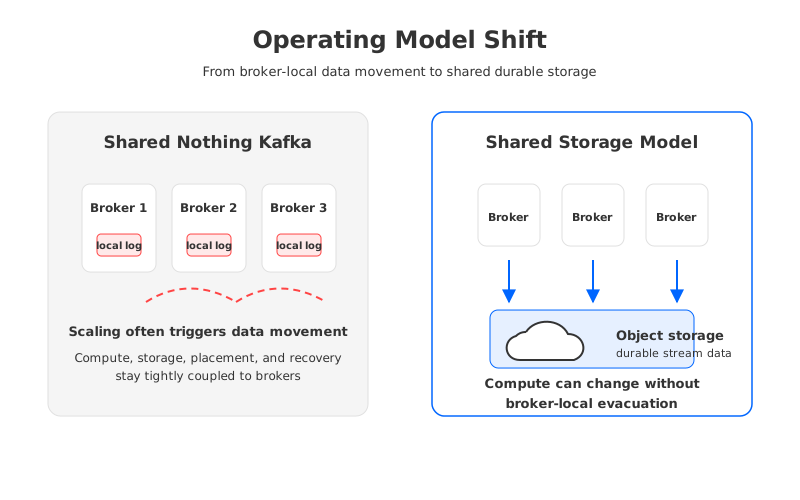
Shared storage does not remove every decision. Banks still need to decide how to isolate environments, how to encrypt data, how to connect private networks, how to model topics, and how to govern schemas. It changes the most stubborn operational constraint: durable data no longer has to be dragged around every time compute changes. That matters when synchronization workloads are bursty, when retention is long, and when recovery time matters more than hardware affinity.
4Evaluation Checklist for Platform Teams
A bank should evaluate Kafka-compatible synchronization as a production platform, not as a single integration project. The following checklist works well in architecture review because each item maps to a failure mode that will eventually appear in production.
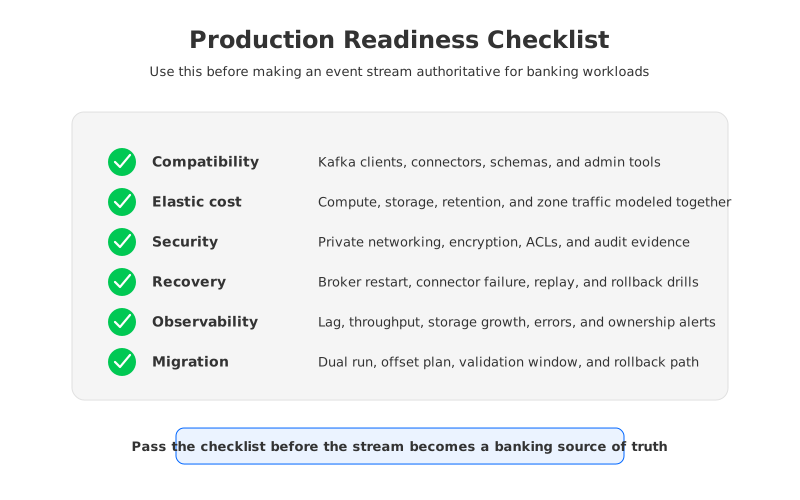
Start with compatibility. Client compatibility should cover producers, consumers, admin tools, common Kafka configurations, authentication mechanisms, schema tooling, Kafka Connect, and stream processing engines. A platform that forces every application team to rewrite client behavior is not a low-risk synchronization layer, even if the broker itself looks elegant.
Then test recovery, not throughput alone. A realistic proof of concept should include a failed connector, a slow consumer, a broker restart, a node replacement, a partition growth event, and a rollback drill. Throughput tells you whether the system can carry traffic. Recovery drills tell you whether the team can operate it when traffic is not the only problem.
Governance needs the same seriousness. Banking data synchronization touches regulated data, so the architecture should support encryption in transit and at rest, private networking, least-privilege access, audit trails, topic ownership, data retention policy, and environment separation. Cloud-native features such as private connectivity and object storage policies can be helpful, but they have to fit the bank's control model rather than bypass it.
Cost analysis should include more than broker compute. Storage retention, cross-zone traffic, connector workers, observability, recovery capacity, over-provisioned headroom, and engineer time all belong in the model. A platform that looks efficient at one-day retention can look different at months of replayable history. A design that scales compute and storage independently gives the finance and platform teams more room to tune the system without renegotiating the whole architecture.
5How AutoMQ Changes the Operating Model
If the evaluation points toward Kafka-compatible APIs plus a cloud-native storage model, AutoMQ is one implementation worth examining. AutoMQ is a Kafka-compatible streaming platform that uses a Shared Storage architecture backed by object storage. The important part for banking synchronization is not a slogan about storage; it is the operational consequence of making brokers stateless enough that compute changes do not require the same kind of data movement as a shared-nothing cluster.
In this model, Kafka clients continue to interact through Kafka-compatible protocols and semantics, while durable stream data is stored in cloud object storage through AutoMQ's storage layer. WAL storage handles low-latency persistence on the write path, and object storage provides scalable durability and capacity. The platform can then separate questions that traditional Kafka tends to bind together: how much compute is needed for traffic, how much storage is needed for retention, and where clients should connect to reduce cross-zone traffic.
For banking data synchronization, that separation affects day-two operations in practical ways. A fraud workload can spike without requiring the same long-term storage decision as a regulatory replay topic. A retention increase does not have to imply a proportional broker disk expansion. A node replacement can be treated more like compute recovery than a broker-local data evacuation. Inter-zone traffic controls can be designed around data locality and follower fetching instead of accepting every cross-zone byte as a tax of replication.
This is also where AutoMQ's BYOC and private deployment options matter. Many banking teams want cloud elasticity but still need customer-controlled network boundaries, cloud accounts, encryption policies, and compliance ownership. A Kafka-compatible platform deployed into the customer's cloud environment can preserve those boundaries while still shifting the storage model toward object storage.
AutoMQ should not be evaluated as a magic replacement for architecture discipline. Topic design, schema governance, producer idempotence, transaction usage, offset management, and connector operations still matter. The better question is whether the infrastructure gives the platform team more room to operate those disciplines under real production pressure.
6Migration Pattern: Reduce Risk Before Moving the Backbone
The safest migration path is usually incremental. Start with a synchronization domain that has high value but bounded blast radius, such as customer profile events, card authorization enrichment, or downstream analytics feeds. Define the event contract, run the Kafka-compatible platform in parallel, mirror or dual-write where appropriate, and compare consumer outputs before making the stream authoritative.
Cutover planning should treat offsets and rollback as first-class design objects. Producers need a clear switch path. Consumers need a known starting offset and validation process. Downstream teams need to know whether replay is allowed, whether duplicate events are possible, and how idempotency is enforced. The platform team needs a rollback path that does not depend on memory or manual reconstruction.
A practical readiness scorecard usually includes these checks:
- Contract readiness: event schemas, keys, ordering scope, and compatibility rules are approved by producers and consumers.
- Operational readiness: lag, throughput, errors, storage growth, and connector health are observable with alerts tied to owners.
- Recovery readiness: broker failure, connector failure, consumer replay, and region or zone drills have been rehearsed.
- Governance readiness: access control, encryption, network paths, retention, and audit evidence meet banking policy.
- Cost readiness: storage, compute, networking, and headroom are modeled for both normal and stress scenarios.
This scorecard keeps the migration conversation concrete. It also prevents a common failure: treating the first successful publish-consume test as proof that the synchronization platform is ready for banking workloads.
7Closing Perspective
The search for banking data synchronization kafka is really a search for a stable operating model. Kafka-compatible event streams can give banks a shared timeline for transactional events, a replayable substrate for downstream systems, and an ecosystem that application teams already understand. The risk is replacing database-to-database coupling with broker-to-operations coupling.
The architecture choice should therefore be judged by what happens during growth, lag, failures, audits, and migration. Shared-nothing Kafka, managed Kafka, and shared-storage Kafka-compatible systems can all work in the right context. For teams that need Kafka compatibility, long retention, cloud elasticity, and tighter control over cross-zone traffic, AutoMQ's Shared Storage architecture gives a concrete path to evaluate.
If you are designing a banking synchronization platform and want to test this operating model against your own workload, explore AutoMQ with your architecture questions, migration constraints, and recovery scenarios in hand.
8References
- Apache Kafka Documentation
- Apache Kafka Consumer Configuration
- Apache Kafka Connect Documentation
- AutoMQ Architecture Overview
- AutoMQ Compatibility with Apache Kafka
- AutoMQ Migration Overview
- AutoMQ Inter-Zone Traffic Overview
- AWS PrivateLink
- Amazon S3 Storage Classes
9FAQ
9.1Is Kafka a good fit for banking data synchronization?
Kafka-compatible event streams are a strong fit when multiple downstream systems need durable, ordered, replayable access to committed business events. They are less suitable as a substitute for database transactions inside one system of record. The clean boundary is to publish business events after the source system commits the change.
9.2What is the main architecture risk in banking Kafka deployments?
The main risk is operational coupling. In a shared-nothing Kafka model, broker compute, local storage, partition placement, replication, and recovery are tightly connected. That can make scaling, retention growth, and node replacement more complex as synchronization becomes a shared platform.
9.3How should banks handle ordering?
Ordering should be scoped to the business entity that needs it, such as account, card, payment, or customer. Designing for global ordering usually creates unnecessary bottlenecks. Partition keys, producer behavior, and consumer processing should all reflect the chosen ordering boundary.
9.4Where does AutoMQ fit?
AutoMQ fits when a team wants Kafka-compatible APIs with a cloud-native Shared Storage operating model. It is especially relevant when long retention, elastic scaling, broker recovery, and cross-zone traffic control are important evaluation criteria.


