
Table of Contents
Table of Contents
Teams searching for banking event architecture kafka are usually past the whiteboard stage. They already have payments, ledger updates, card authorizations, fraud signals, loan events, customer notifications, or audit trails moving through production systems. The question is no longer whether events are useful. The question is whether the event platform can keep latency predictable while more products start depending on the same stream of facts.
That pressure changes the architecture conversation. A retail notification pipeline can often tolerate a delayed batch. A banking data product has a tighter contract: downstream systems need fresh events, regulators need traceable history, and platform teams need a recovery path that does not turn every incident into a multi-day data movement project. Kafka is a natural fit for this shape of workload because its Topic, Partition, Offset, Consumer group, and transaction model give teams a common event log. But the operating model behind that log matters as much as the API.
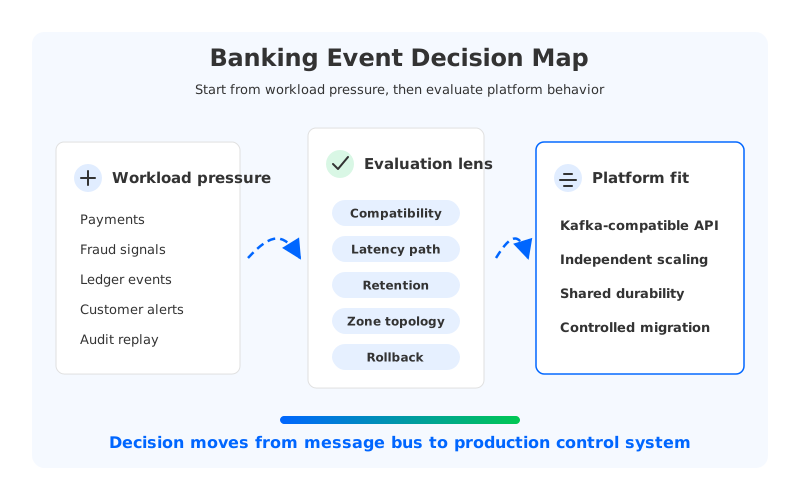
The practical thesis is simple: a banking event architecture should be evaluated as a production control system, not as a message bus. Latency is only one dimension. The stronger design question is whether the platform gives application teams stable contracts while letting the infrastructure team change capacity, storage, zones, and recovery posture without rewriting every service.
1Why Banking Event Architecture Is Harder Than a Generic Kafka Rollout
Banking systems produce many kinds of events, but the risky part is not event volume by itself. The risky part is dependency density. The same card authorization event may feed fraud scoring, customer mobile alerts, settlement workflows, operational monitoring, and a dispute investigation store. A delay or duplicate in one branch is annoying. A delay or duplicate across several branches becomes an incident with business, compliance, and customer-support consequences.
That density pushes teams toward Kafka-compatible streaming because it separates event producers from the growing list of consumers. Producers write facts once, consumers read at their own pace, and offsets make progress explicit. This is a good foundation, but it also creates a platform boundary. Once many banking products share the same event backbone, the platform has to absorb three kinds of change:
- Product change. New data products add consumers, retention requirements, replay needs, and access rules. The platform should not require every producer to understand those consumers.
- Operational change. Traffic shifts during payroll days, market events, app releases, fraud attacks, or batch windows. The platform needs headroom without permanently overprovisioning every broker.
- Governance change. Audit, retention, encryption, identity, and lineage requirements evolve. The architecture must keep records traceable without turning every topic into a special case.
This is where many Kafka programs stall. The first set of topics works. The second set adds more consumers. The third set brings data products that expect low latency, long retention, and controlled replay at the same time. By then, the architecture has moved from application integration into banking infrastructure.
2The Production Constraint Behind the Problem
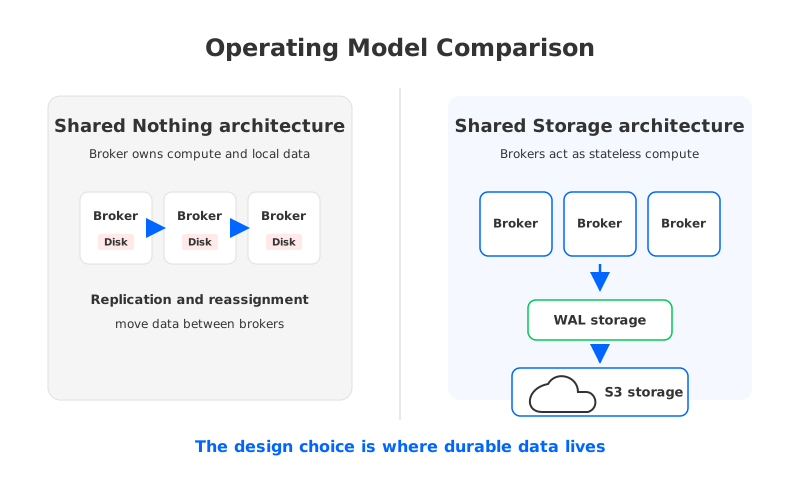
Traditional Apache Kafka uses a Shared Nothing architecture. Each broker owns local storage, and durability comes from replication across brokers through ISR (In-Sync Replicas). That model is mature and widely understood. It also ties the physical placement of data to the brokers that serve it, which is the source of many operational trade-offs in cloud deployments.
For a banking event platform, those trade-offs show up in familiar ways. Storage sizing becomes a broker sizing decision. A retention increase can require larger disks even if compute demand is unchanged. Rebalancing partitions during scale-out means moving data between brokers. Multi-AZ deployment protects availability, but it can increase inter-zone replication traffic. Long retention improves replay and audit posture, but it can make recovery and cluster changes heavier.
None of this means Kafka is the wrong abstraction. The abstraction is valuable precisely because banking teams need ordered logs, consumer groups, idempotent producers, transactions, and ecosystem compatibility. The question is whether the storage architecture underneath Kafka still matches the workload. A design that worked well when brokers and disks were planned as a fixed cluster can become awkward when product teams expect elastic capacity and cloud-native recovery.
3Architecture Options and Trade-offs
There are several ways to build a banking event backbone, and each one moves complexity to a different place. The right answer depends on latency budget, cloud strategy, team ownership, compliance controls, and migration appetite.
| Option | Where it fits | Main trade-off |
|---|---|---|
| Self-managed Apache Kafka | Teams with deep Kafka operations experience and strict control over every broker setting. | Full control, but the team owns capacity planning, rebalance operations, upgrades, and storage lifecycle. |
| Managed Kafka service | Teams that want to reduce routine cluster administration while keeping the Kafka API. | Less operational work, but cost, network topology, and platform boundaries depend on the service model. |
| Kafka plus Tiered Storage | Teams with long retention and replay needs that still run broker-local hot data. | Helps historical storage pressure, but recent data and broker operations still depend on local disks. |
| Kafka-compatible shared storage platform | Teams that want Kafka semantics with independent compute and storage scaling. | Requires architectural evaluation beyond a version upgrade because the operating model changes. |
Tiered Storage deserves a fair reading. Apache Kafka’s KIP-405 introduced a way to move older log segments to remote storage while keeping recent data local. That helps when the main problem is historical retention. It does not fully remove the broker-local storage model, because hot data, leadership, and many operational workflows still depend on brokers and their attached disks.
The architectural split is therefore not “Kafka or not Kafka.” A better split is whether your banking platform treats brokers as durable data homes or as compute nodes in front of a durable shared storage layer. That distinction affects how you scale, replace nodes, recover from failures, and reason about cost.
4A Neutral Evaluation Checklist for Platform Teams
Before introducing any vendor or product, evaluate the platform against the contracts your banking data products need. The checklist below is intentionally operational. It is designed for architects, SREs, data platform owners, and risk reviewers who need to compare options without getting pulled into feature marketing too early.
| Evaluation area | Question to ask | Why it matters in banking |
|---|---|---|
| Compatibility | Can existing Kafka clients, connectors, ACL patterns, and consumer group behavior continue with minimal change? | Rewriting application clients increases migration risk and audit scope. |
| Latency control | Which storage path is on the produce acknowledgement path, and how does it behave under load? | Payment, fraud, and notification workflows need predictable tail behavior, not only good averages. |
| Retention and replay | Can the platform retain enough history without forcing compute overprovisioning? | Data products, investigations, and backfills often need replay without disturbing live traffic. |
| Scaling | Can compute grow and shrink independently from stored data? | Seasonal or event-driven spikes should not require permanent broker and disk capacity. |
| Zone topology | How much inter-zone traffic is created by replication, producers, consumers, and connectors? | Cloud network cost and failure-domain design become material at banking scale. |
| Governance | Are encryption, identity, RBAC, auditability, and operational access boundaries clear? | The event platform becomes part of the regulated systems boundary. |
| Migration and rollback | Can topics, offsets, clients, and cutover be staged with a clear fallback path? | A data backbone migration should be reversible until production confidence is established. |
This checklist also exposes a useful decision rule. If your pain is mostly “we need longer history,” Tiered Storage may be enough. If your pain is “every operational change is tied to broker-local data,” then the architecture issue is deeper than retention.
5How AutoMQ Changes the Operating Model
Once the evaluation reaches storage ownership, AutoMQ becomes relevant as a Kafka-compatible cloud-native streaming platform rather than as a separate event API. It keeps Kafka protocol and semantics compatible for clients, but changes the storage layer underneath the brokers. AutoMQ uses a Shared Storage architecture where durable data lives in S3-compatible object storage, while brokers act as stateless compute nodes.
The important part is the operational consequence, not the product label. If persistent data is no longer bound to a broker’s local disk, adding or replacing brokers does not imply the same data movement profile as traditional Kafka. Partition reassignment becomes a metadata and ownership operation rather than a large broker-to-broker copy. Storage growth follows object storage capacity instead of broker disk sizing. Compute can be managed closer to workload demand.
AutoMQ’s S3Stream layer writes through WAL (Write-Ahead Log) storage for durability and recovery, then persists stream data in S3 storage. Different deployment profiles can use different WAL storage types, so platform teams still need to evaluate latency targets and failure domains. The architectural point is that WAL handles the low-latency persistence path while object storage becomes the durable shared data layer.
For banking teams, the model changes several operating decisions:
- Capacity planning moves from broker disks to workload contracts. Brokers are sized for request processing, cache, and network, while durable storage can grow independently.
- Recovery planning becomes less tied to data locality. A failed broker can be replaced without treating its local disk as the source of truth.
- Cross-zone cost analysis becomes explicit. Shared storage and zone-aware routing can reduce the replication traffic patterns that appear in traditional multi-AZ Kafka designs.
- Migration can be staged around compatibility. Existing Kafka clients and ecosystem tools remain central to the plan, which reduces the need for application rewrites.
This does not remove the need for banking-grade design. You still need topic ownership, schema discipline, least-privilege access, encryption, observability, SLOs, runbooks, and tested rollback. What it changes is the infrastructure layer’s degrees of freedom. The platform team can evaluate compute, storage, and zone topology separately instead of treating the broker as the unit that owns everything.
6A Readiness Scorecard for Banking Data Products
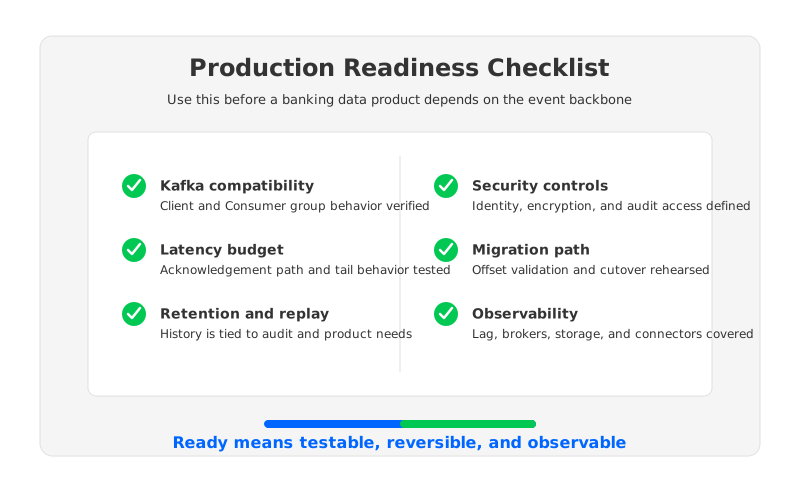
A useful readiness review should be short enough to run before a new data product goes live. Long questionnaires become shelfware. The scorecard below keeps the focus on decisions that determine whether a Kafka-backed banking event architecture will stay operable after the first few workloads succeed.
| Readiness item | Green signal | Red signal |
|---|---|---|
| Event contract | Topic ownership, schema evolution, and replay expectations are documented. | Producers and consumers rely on informal field meanings. |
| Latency budget | The team knows which consumers need tailing reads and which can tolerate catch-up reads. | All consumers claim “real time” without a measurable service target. |
| Retention policy | Retention is tied to product, audit, or recovery requirements. | Retention grows because no one owns deletion or compaction decisions. |
| Consumer isolation | Critical consumers have clear group ownership and lag alerts. | Batch, analytics, and transactional consumers compete without priority. |
| Failure drill | Broker, zone, connector, and downstream outages have tested runbooks. | Recovery exists only as a diagram. |
| Migration path | Cutover, offset validation, and rollback are rehearsed before production traffic moves. | The migration plan assumes a single irreversible switch. |
The scorecard has a second purpose: it stops the architecture debate from collapsing into one metric. Low latency matters, but latency without governance creates fragile systems. Lower cost matters, but cost reduction without rollback creates operational risk. Compatibility matters, but compatibility without a storage model that can evolve may only delay the next migration.
7CTA
If your team is evaluating a Kafka-compatible event backbone for banking data products, start with the scorecard above and then test the storage model against your real failure and replay scenarios. To evaluate AutoMQ BYOC in your own cloud boundary, use the AutoMQ console entry point: start a trial.
8References
- Apache Kafka Documentation
- Apache Kafka KIP-405: Kafka Tiered Storage
- AutoMQ Shared Storage architecture
- AutoMQ S3Stream WAL storage
- AutoMQ compatibility with Apache Kafka
- AutoMQ stateless broker architecture
- AutoMQ inter-zone traffic overview
9FAQ
9.1Is Kafka still a good foundation for banking event architecture?
Yes, when the team needs ordered logs, consumer groups, replay, offsets, transactions, and a large ecosystem of clients and connectors. The harder question is not whether Kafka semantics are useful. It is whether the deployment and storage model behind those semantics matches the bank’s latency, recovery, governance, and cost requirements.
9.2When is Tiered Storage enough?
Tiered Storage is a strong fit when the main pressure is historical retention and replay cost. It is less complete when the main pressure is operational elasticity, because recent data and many broker operations still depend on local broker storage. Teams should separate the retention problem from the compute-and-storage coupling problem.
9.3What should a bank test before moving a critical data product?
Test producer acknowledgement latency, consumer lag behavior, replay from retained history, connector failure, broker replacement, zone failure, access controls, offset migration, and rollback. A migration plan is not production-ready until the team has rehearsed how to stop, verify, and reverse the cutover.
9.4Where does AutoMQ fit in the evaluation?
AutoMQ fits when the team wants Kafka compatibility but needs a different operating model: stateless brokers, Shared Storage architecture, object-storage-backed durability, and independent compute and storage scaling. It should be evaluated after the bank defines its latency, governance, retention, and migration contracts.


