
Table of Contents
Table of Contents
Batch tuning in Kafka usually starts with a narrow symptom: producers spend too much time per record, brokers are busy but underutilized, consumers make too many fetches, or cloud costs keep rising even though application traffic has not changed. The first instinct is reasonable. Increase producer batches, wait a little longer before sending, fetch more data per request, compress harder, and see whether throughput improves. Those knobs often work, but they also move work across system boundaries. A producer-side improvement can become broker memory pressure. A consumer-side fetch change can become tail latency. A broker-side throughput gain can become a longer replay window after failure.
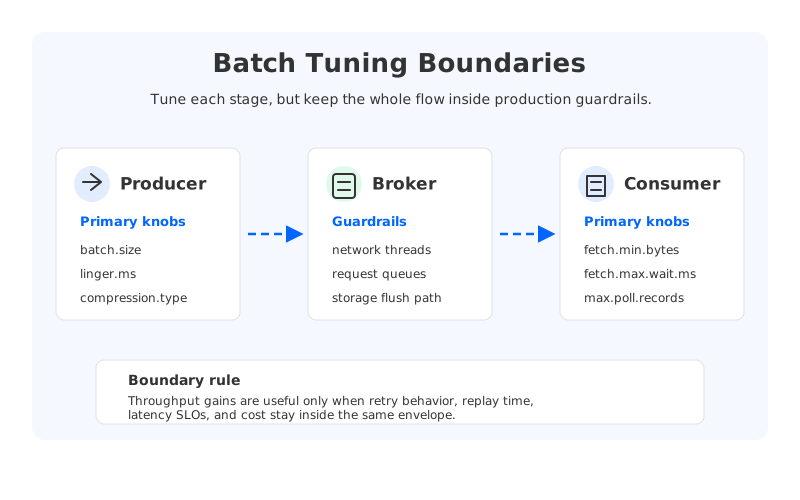
The useful question is not "What Kafka batch size should we use?" It is "Where is the boundary beyond which batching stops being a local optimization?" A Kafka-compatible streaming platform has three obvious batching surfaces: the producer batches records before sending, the broker batches network and disk work while preserving ordering and durability, and the consumer batches fetch and processing work while staying inside poll, commit, and lag constraints. Each surface has valid tuning space. The hard part is knowing when one team has optimized its own surface by exporting risk to another team.
1Why Batch Tuning Becomes a Boundary Problem
Batching improves throughput because it amortizes fixed costs. A request has protocol overhead, network overhead, broker scheduling overhead, and application callback overhead. Kafka exposes this idea clearly through producer settings such as batch.size and linger.ms, and through consumer settings such as fetch.min.bytes, fetch.max.wait.ms, and max.poll.records. The documentation gives the knobs; production decides the limits.
Those limits appear when the workload is not a clean benchmark. A payments pipeline may care about low p99 latency during business hours and high replay speed during incident recovery. A telemetry pipeline may tolerate seconds of delay but create extreme broker pressure when device fleets reconnect. A CDC pipeline may produce uneven bursts because upstream databases emit changes in transaction-shaped groups. In each case, larger batches improve one metric while making another metric more fragile.
The boundary is different for each side of the system:
- Producers own send efficiency, compression, retry behavior, and the amount of data that may be delayed before it becomes visible to the broker.
- Brokers own admission control, network queues, replication or storage writes, partition leadership, and the cost of serving both hot traffic and catch-up reads.
- Consumers own fetch shape, processing concurrency, offset commit cadence, rebalance sensitivity, and application-level backpressure.
The dangerous configuration is the one that looks successful in a single metric dashboard. A producer team may celebrate lower request rate while the broker team sees larger request bursts. A consumer team may reduce fetch overhead while application owners see longer time-to-detect for poisoned records. A platform team may increase throughput per broker while SREs inherit a slower recovery path. Batch tuning is a shared operating decision, even when the setting lives in one client library.
2Producer Boundaries: Throughput, Latency, and Retry Shape
Producer batching has the clearest mental model. batch.size defines the maximum data the producer will try to accumulate for a partition before sending, while linger.ms lets the client wait briefly so more records can join the batch. Compression usually becomes more effective as batches grow because repeated structure appears within the compressed block. These settings can reduce request count and network overhead, especially for high-volume topics with small records.
The boundary is the producer's promise to the application. If the application expects records to become visible quickly, linger.ms is part of end-to-end latency. If retries are enabled, the batch is also the unit of work that may be resent, delayed, or fail together. If the producer is configured for stronger delivery semantics, batching interacts with in-flight request limits, idempotence, acknowledgments, and transaction behavior. A larger batch is efficient when it succeeds, but it can be more expensive when the system is unstable.
For platform teams, the practical test is simple: producer tuning is acceptable when it reduces request overhead without hiding application backpressure. Watch producer buffer pool wait time, request latency, record queue time, retry rate, and delivery error patterns together. A low request rate is not a win if records are waiting in client buffers while the application still believes it is sending normally. The producer boundary is crossed when batching turns a visible broker-side constraint into an invisible application-side queue.
3Broker Boundaries: The Place Where Local Wins Collide
The broker sits at the convergence point. It receives batches from many producers, persists data, coordinates partition leadership, serves consumers, and responds to administrative work. Broker tuning often focuses on network threads, request queues, socket buffers, page cache behavior, disk flush paths, and quotas. These are real tuning levers, but they are also shared resources. Fewer producer requests can become heavier broker requests, while larger consumer fetches increase read-side pressure. The broker must make both sides true at the same time.
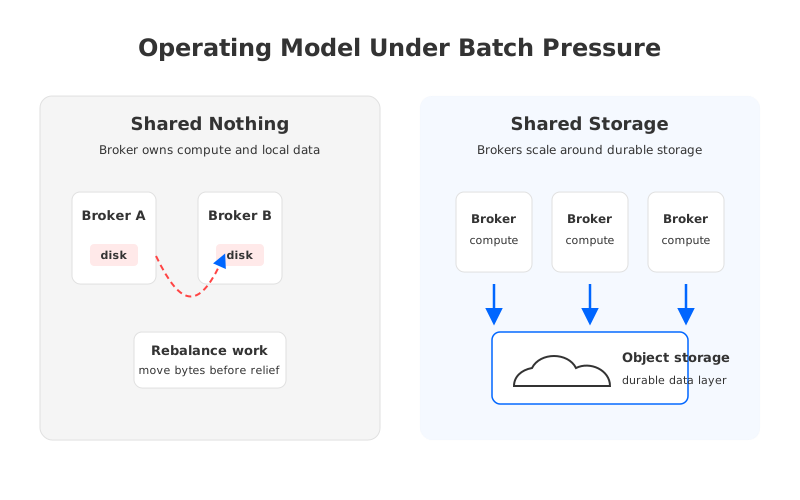
Traditional Kafka deployments add another constraint: broker compute and broker-local storage are tied together. When a broker is under pressure, adding capacity may require moving partition data, not only adding CPU or network headroom. Replication, storage placement, and inter-zone reads can all become part of the scaling path. Batch tuning can reduce per-record overhead, but it cannot remove the architectural coupling between compute, storage, and data movement.
That is why batch tuning boundaries often show up during incidents rather than during load tests. A load test proves the cluster can accept a steady flow. An incident asks whether the cluster can absorb a burst, fail over, catch up consumers, rebalance partitions, and preserve latency while operators are changing something else. If the answer depends on moving a large amount of broker-local data before capacity helps, batching has reached an architecture boundary.
4Consumer Boundaries: Fetch Efficiency Without Losing Control
Consumer batching is easy to underestimate because it looks like a read-side optimization. fetch.min.bytes asks the broker to wait until enough data is available before returning a fetch response, fetch.max.wait.ms caps that wait, and max.poll.records controls how many records the application receives from each poll. Together, these settings shape the trade-off between request efficiency, latency, memory, and processing fairness.
The boundary is not the broker response size. It is the consumer application's ability to process, commit, and recover. If max.poll.records is too high for the processing function, a single poll can monopolize a worker and increase rebalance risk. If fetch waits are too aggressive, low-volume partitions may see avoidable latency. If batches are large and processing is not idempotent, retrying after partial failure becomes a data correctness problem rather than a performance problem.
A useful consumer tuning review asks three questions. First, can the application process the largest expected poll within its normal poll interval and failure budget? Second, does offset commit behavior match the true unit of business completion rather than the unit of fetch? Third, can the team explain what happens when one record in a large batch fails? If the answers are vague, the consumer has crossed from efficient fetching into uncontrolled work aggregation.
5A Neutral Checklist for Batch Tuning Changes
Batch tuning should be reviewed like a production change, not like a local code optimization. The change may involve a single property in one service, but the effect moves through clients, brokers, storage, observability, and incident response. The following checklist is a compact way to keep teams aligned.
| Boundary | What to validate | Failure mode if ignored |
|---|---|---|
| Latency | p95 and p99 end-to-end latency under normal and burst traffic | Higher throughput hides slower user-visible delivery |
| Throughput | Broker CPU, request queues, network, and storage path saturation | Producers or consumers shift bottlenecks into the broker |
| Cost | Cloud network transfer, broker count, storage writes, and operational time | Per-record efficiency improves while total platform cost rises |
| Recovery | Replay duration, consumer catch-up speed, and rollback procedure | Larger batches stretch incident recovery windows |
| Governance | Topic-level limits, ownership, change approval, and audit signals | One team optimizes its service by creating shared risk |
| Migration | Compatibility, rollback, and client-specific defaults | Tuning becomes coupled to a platform migration path |
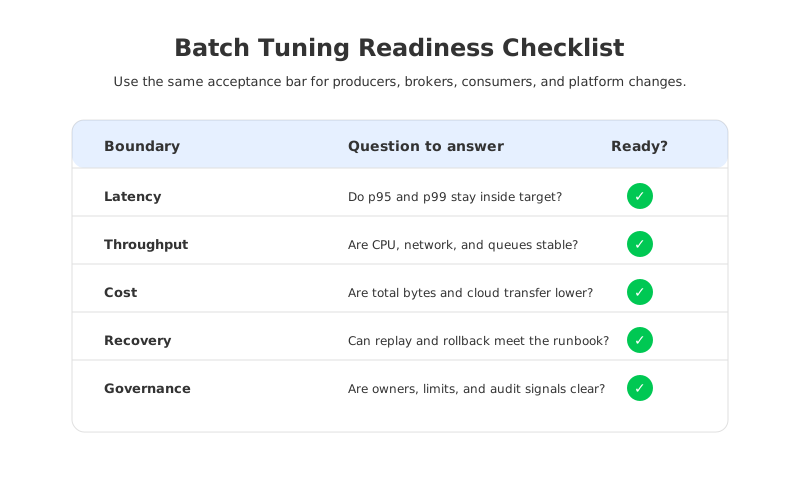
This table is intentionally cross-functional. Producers, brokers, and consumers should not be tuned by separate teams using separate definitions of success. A platform team can make batch tuning safer by publishing recommended profiles for low-latency streams, high-throughput telemetry, CDC pipelines, replay-heavy analytics, and connector-driven integration. Those profiles should include observability expectations, not only configuration values.
6When Architecture Matters More Than Another Knob
There is a point where batch tuning cannot compensate for the operating model. If adding brokers forces a long data movement cycle, batching may postpone the problem but not solve it. If read fan-out creates expensive cross-zone traffic, consumer fetch tuning can reduce request count but not change the placement economics. If broker-local storage determines recovery speed, producer compression can reduce bytes but not remove the coupling between state and compute.
The architecture requirement becomes clearer when stated without product language. A cloud Kafka platform should preserve Kafka protocol compatibility while allowing compute capacity, durable storage, and network placement to be managed with less coupling. It should let teams scale brokers for throughput without treating every capacity event as a storage migration. It should also keep deployment boundaries clear enough for security, governance, and procurement teams.
AutoMQ fits into that category as a Kafka-compatible streaming system built around shared storage and stateless brokers. Instead of treating broker-local disks as the durable center of the system, AutoMQ places the storage layer on object storage and keeps brokers focused on serving Kafka protocol traffic. Batching does not disappear; it becomes less entangled with broker-local data movement, overprovisioned disks, and some forms of inter-zone traffic.
This distinction matters for tuning because batch size is often a symptom of capacity anxiety. Teams increase batches because they want more throughput per broker, fewer requests, and lower cost per record. Those are valid goals. But if the underlying platform can scale compute and storage independently, the tuning conversation becomes less defensive. You can choose producer and consumer batch settings based on workload behavior instead of using them to work around slow infrastructure changes.
AutoMQ's architecture also gives platform teams a cleaner governance story. Kafka compatibility keeps existing clients, tools, and operational knowledge relevant. Shared storage changes the scaling and recovery model. Inter-zone traffic reduction can matter when cloud networking costs are part of the decision. None of this removes the need for measurement; it changes where the hard boundary sits.
7A Practical Rollout Pattern
The safest way to tune batching is to treat it as a staged rollout with explicit stop conditions. Start with one workload class, not the entire fleet. Capture the current request rate, end-to-end latency, broker queue metrics, consumer lag behavior, replay speed, and cost signals. Change one family of settings at a time, then observe the effect across all three surfaces. If the producer change improves send efficiency but increases broker request latency, pause before changing consumer fetches. If the consumer change improves throughput but delays error detection, reduce the batch envelope before scaling the pattern.
A good rollout document should name the owner of every boundary. Application teams own user-visible latency and correctness. Platform teams own broker capacity, quotas, and infrastructure cost. SRE teams own incident recovery time and rollback. Security and governance teams own deployment boundaries and auditability. Batch tuning fails when nobody owns the system-level consequence.
The final acceptance bar should be boring:
- The largest expected batch does not violate latency SLOs.
- Retries and partial failures are understood at the application level.
- Broker queues, network, and storage paths remain inside alert thresholds.
- Consumer lag and replay behavior are tested with realistic failure scenarios.
- Cost movement is measured as total platform cost, not only request count.
- Rollback is documented before the tuning profile is promoted.
If a proposed tuning profile cannot pass that bar, the answer may still be a configuration change, but it may also be an architecture change. The goal is not to make every batch smaller. The goal is to make batching a deliberate part of the operating model instead of an accidental source of shared risk.
Batch tuning starts with a local knob and ends with a platform boundary. When producers, brokers, and consumers are tuned against the same acceptance criteria, teams get the throughput benefit without losing control of latency, recovery, or cost. If your current Kafka estate has reached the point where every tuning discussion turns into a capacity or storage migration discussion, evaluate whether a cloud-native Kafka-compatible architecture would move the boundary itself. AutoMQ's docs are a useful next step for that evaluation: start with the AutoMQ overview.
8References
- Apache Kafka documentation: producer configuration and consumer configuration
- Apache Kafka documentation: consumer groups and offsets
- AutoMQ documentation: What is AutoMQ
- AutoMQ documentation: Apache Kafka compatibility
- AutoMQ documentation: architecture overview
- AutoMQ documentation: performance tuning for client
- AutoMQ documentation: eliminate inter-zone traffic
- AWS documentation: Amazon S3 user guide
9FAQ
9.1What is the safest first Kafka batch tuning change?
Start with the producer side if the workload sends many small records and has room in its latency budget. Increase batching gradually, then watch producer queue time, request latency, retry rate, broker request latency, and end-to-end p99 latency together. A safe change is one that improves efficiency without creating hidden client-side queues or broker-side bursts.
9.2Is a larger Kafka batch always better for throughput?
No. Larger batches can reduce per-record overhead and improve compression, but they can also increase latency, memory pressure, retry cost, and recovery complexity. Throughput matters only inside an envelope that includes application SLOs, broker health, consumer processing time, and incident recovery.
9.3Which consumer settings define the main batch boundary?
The common settings are fetch.min.bytes, fetch.max.wait.ms, and max.poll.records. The real boundary is application processing. If a consumer cannot process, commit, and retry the largest poll safely, the fetch profile is too aggressive even if broker request efficiency looks better.
9.4How does shared storage change batch tuning?
Shared storage does not remove producer and consumer tuning. It changes the infrastructure boundary around those decisions. When broker compute is less tightly coupled to broker-local durable data, capacity changes and recovery planning can become less dependent on moving partition data between brokers.
9.5When should batch tuning lead to a platform review?
Run a platform review when tuning is repeatedly used to compensate for broker saturation, storage migration time, replay windows, cross-zone traffic, or overprovisioned capacity. At that point, the limiting factor is the operating model behind the Kafka-compatible platform.


