
Table of Contents
Table of Contents
Benchmark numbers are attractive and hard to buy from. A platform can show impressive throughput, clean p99 latency, or a lower infrastructure bill in a controlled test, but the buyer still has to answer a less glamorous question: will those numbers survive the workload, governance model, failure modes, migration path, and cloud bill that already exist in production? Teams are not looking for another chart. They are trying to decide which evidence should change an architecture decision.
Kafka-compatible platform buyers usually arrive at this question after the initial vendor comparison is already too noisy. One benchmark emphasizes raw write throughput. Another focuses on tail latency. A third highlights storage cost, while a fourth tests replay or ingestion into analytics. Each result may be valid inside its own boundary, yet none automatically answers whether the platform is right for a regulated payment stream, long-retention IoT workload, multi-region analytics pipeline, or small SRE team that owns too many stateful systems.
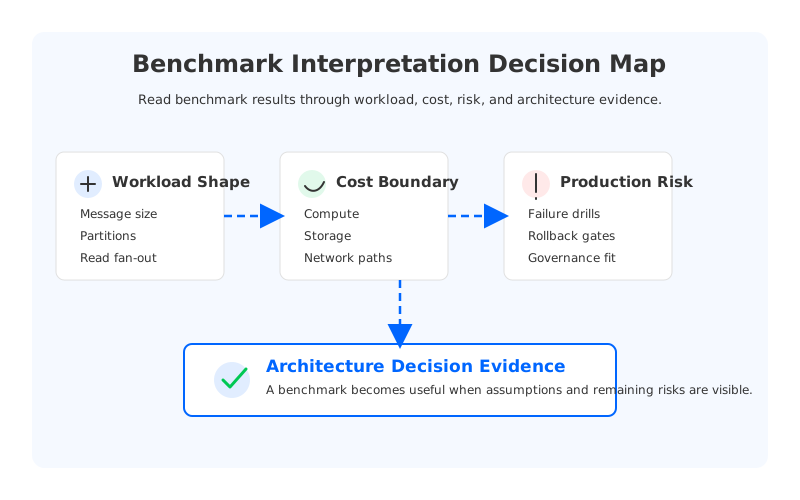
The useful move is to treat a benchmark as an input to a decision model, not as the decision itself. A buyer should ask what the benchmark measured, what it excluded, and which risks remain after the test passes. That discipline matters for Kafka-compatible systems because the API surface can look familiar while the storage, replication, cost, and operating model underneath may be very different.
1Why Benchmark Results Mislead Smart Buyers
A Kafka benchmark starts with a narrow promise: this workload, with this client configuration, on this instance type, in this region, under this retention profile, produced this result. The problem begins when the result gets detached from those conditions. A high-throughput test with short retention says little about backlog replay. A latency test with few partitions may not reveal reassignment pressure. A cost comparison that ignores inter-zone network paths can make a broker-local architecture look cleaner than it will on a real cloud invoice.
The trap is not that benchmarks are dishonest. The trap is that Kafka is a system of coupled bottlenecks. Producer batching, acknowledgment settings, partition count, broker CPU, disk throughput, page cache, replication traffic, consumer fetch behavior, compression, object storage requests, and network topology all influence the outcome. When a benchmark isolates one variable, it makes the chart readable while hiding variables that buyers must operate.
That is why the first interpretation step is to classify the benchmark before comparing numbers:
- Steady-state throughput tests show whether the platform can sustain a target write and read rate under stable conditions. They do not prove recovery behavior, governance fit, or migration safety.
- Latency tests reveal the hot path under a specific message size, batching profile, and acknowledgment mode. They do not explain how the same platform behaves during replay, scaling, or broker replacement.
- Cost benchmarks can be useful when they include compute, storage, network, request, license, and operational assumptions. They become misleading when they show only one line item.
- Failure and recovery tests are closer to production reality because they force the platform to expose how durable data, metadata, clients, and operators behave under stress.
Once a buyer separates these categories, the conversation becomes more concrete. The question becomes "which benchmark category maps to the risk we are trying to reduce?"
2The Workload Shape Matters More Than the Peak Number
Two Kafka-compatible platforms can both pass a peak throughput target and still be wrong for different reasons. A fraud detection stream with tight tail-latency SLOs cares about sustained produce latency, consumer lag, and failover behavior during traffic spikes. A lakehouse ingestion stream with long retention cares about write cost, replay throughput, object storage behavior, connector operations, and whether retained history turns every recovery event into a storage project. A customer-facing personalization system cares about freshness, fan-out, governance, and the ability to isolate experiments without turning partition counts into a capacity trap.
The benchmark should therefore start from workload shape. Buyers need a short profile before they look at any chart:
| Workload dimension | Why it changes interpretation | What to test |
|---|---|---|
| Write pattern | Bursty traffic stresses batching, broker CPU, WAL behavior, and network headroom. | Sustained writes plus peak bursts with production-like message sizes. |
| Read pattern | Fan-out and catch-up reads can dominate storage and network behavior. | Tailing consumers, delayed consumers, and replay consumers at the same time. |
| Retention | Longer retention changes storage economics and recovery expectations. | Hot reads, cold reads, and restore behavior across the retained window. |
| Partition count | Partition scale affects metadata, placement, balancing, and client behavior. | Target partition count, growth scenarios, and leadership movement. |
| Failure model | A happy-path chart says little about operator work during incidents. | Broker loss, zone impairment, client reconnect, and rollback drills. |
This table is deliberately operational. Buyers do not purchase benchmark results; they inherit the operating consequences of the architecture. If the benchmark does not resemble the production workload, the safest interpretation is modest: it proves the platform can pass that test, and little more.
3Cost Interpretation Has to Include Cloud Physics
Kafka cost analysis often starts with broker size and storage volume because those lines are visible. In cloud deployments, that is not enough. The network paths between producers, brokers, replicas, consumers, connectors, object storage, and analytics systems can become a major part of the bill. The exact pricing depends on provider and region, so a responsible benchmark should show the topology and require the buyer to apply the current cloud pricing page to the target environment.
Traditional Kafka's Shared Nothing architecture binds durable log storage to broker-local disks. This model can perform well, but it also makes replication, partition movement, and broker replacement part of the data movement story. When the cluster spans availability zones, the buyer has to understand which paths cross zones and which are local. When retention grows, the buyer has to understand whether storage is attached to compute, tiered behind the broker, or separated into a shared durable layer. A chart that reports only throughput per dollar may hide these topology differences.
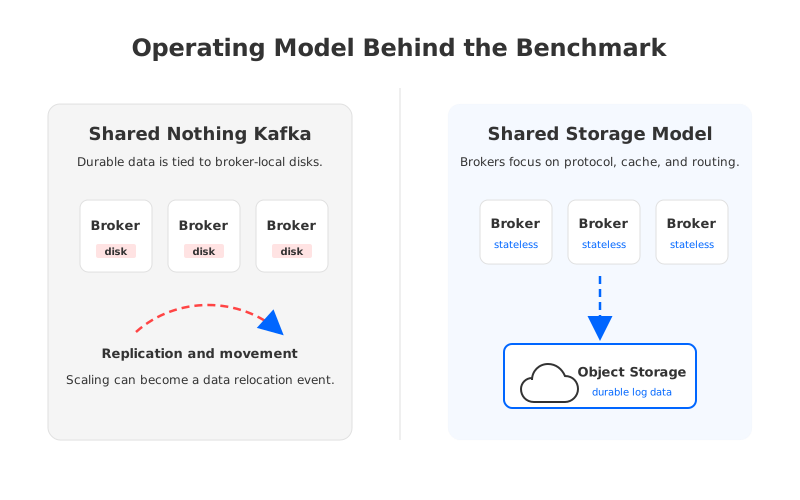
Cost interpretation should separate at least five lines:
- Compute cost for brokers, controllers, connectors, and supporting services.
- Storage cost for local disks, object storage, snapshots, and retained history.
- Network cost for inter-zone replication, consumer egress, connector paths, and private connectivity.
- Request and operation cost for object storage APIs, monitoring ingestion, and automation workflows.
- People cost for scaling events, incident response, capacity planning, upgrade windows, and migration work.
The last line is harder to price precisely. It is also where many platform decisions are won or lost. A benchmark that reduces infrastructure cost but increases operator burden may still be a poor fit for a lean platform team. A platform that is less impressive in a microbenchmark but removes recurring storage movement from scaling events may be the better production choice.
4Compatibility Is a Test Plan, Not a Label
"Kafka-compatible" is useful only when translated into workload-specific tests. Producers need to preserve delivery semantics, retries, batching, compression, idempotence, and authentication. Consumers need to preserve group behavior, offset commits, lag observability, and recovery after rebalance. Applications that use transactions, Kafka Connect, Schema Registry integrations, ACLs, quotas, or custom client versions need a compatibility matrix tied to the actual estate.
This is where benchmark interpretation and migration planning meet. A platform can publish a strong benchmark and still create unacceptable migration risk if the compatibility proof is too shallow. The buyer should not wait until procurement is finished to discover that a connector requires different tuning, a consumer group behaves differently under failover, or a dashboard loses the metric that the on-call team uses during incidents.
A practical compatibility benchmark includes three layers. The first is protocol behavior: clients produce and consume with the same versions, security configuration, and delivery semantics they use today. The second is ecosystem behavior: Connect jobs, schemas, monitoring, alerting, ACLs, and deployment automation continue to work or have documented replacements. The third is operational behavior: the team can upgrade, scale, fail over, roll back, and audit the platform without inventing runbooks during an incident.
The strongest compatibility result is not "the client connected." It is "the workload behaved the same way under the failure and migration events we already care about."
That statement turns a benchmark from a demo into evidence.
5A Buyer Scorecard for Kafka Benchmark Interpretation
Good interpretation is repeatable. If every stakeholder reads the same benchmark and reaches a different conclusion, the team probably lacks a shared scorecard. The scorecard should force every benchmark into the same buyer questions.
| Evaluation area | Good evidence | Weak evidence |
|---|---|---|
| Workload realism | Production-like message size, partition count, retention, security, and client versions. | Synthetic defaults with no explanation of client or topic settings. |
| Cost boundary | Compute, storage, network, object requests, licensing, and operations are separated. | A single blended cost number with no topology or pricing assumptions. |
| Failure behavior | Broker loss, zone impact, backlog replay, and rollback are measured. | Only happy-path throughput and latency are shown. |
| Governance fit | Deployment boundary, IAM, encryption, audit, and observability ownership are documented. | Vendor control model is treated as an afterthought. |
| Migration safety | Compatibility matrix, parallel run, cutover, rollback, and monitoring gates are defined. | Migration is assumed because the API is Kafka-compatible. |
The scorecard changes the role of a benchmark in a buying process. Instead of asking a vendor or internal team to "show better numbers," it asks them to fill evidence gaps. That makes the result fairer for self-managed Apache Kafka, managed Kafka, broker-local Kafka-compatible platforms, tiered-storage designs, and shared-storage Kafka-compatible platforms.
6How Shared Storage Changes the Operating Model
After the neutral scorecard is in place, architecture differences become easier to reason about. A Shared Nothing Kafka deployment keeps durable log segments on broker-local storage, so compute and storage lifecycle events are tightly coupled. Tiered Storage can reduce local retention pressure by moving older segments to remote storage, but the broker remains central to the hot path and local-log operating model. A Shared Storage architecture changes the premise: durable stream data lives in shared object storage, while brokers focus on protocol handling, caching, scheduling, and request routing.
AutoMQ belongs to this third category: it is a Kafka-compatible cloud-native streaming platform that uses shared object storage as the durable data layer, with WAL-backed persistence and stateless broker design. This does not remove the need for benchmark discipline. Object storage behavior, WAL placement, cache hit ratio, cloud region topology, and client workload shape still matter. The difference is that the benchmark should test a different operating model, not only a different implementation of the same broker-local assumptions.
For buyers, the practical questions are straightforward. If brokers no longer own durable log storage in the same way, does scaling require less retained-data movement? If object storage is the durable layer, how do write latency, recovery, and replay behave under the chosen WAL design? If the platform supports customer-controlled deployment boundaries, which operational data and network paths remain inside the customer's cloud environment?
These are better questions than "is shared storage faster?" Sometimes the workload cares most about hot-path latency. Sometimes it cares about long retention, elastic scaling, failure recovery, or reducing recurring cloud waste. Benchmark interpretation should reveal which trade-off matters for the buyer.
7Production Readiness Checklist
The final benchmark package should look less like a leaderboard and more like a readiness review. It should include measured results, assumptions, remaining risks, and the next test needed before production. This is where architects, SREs, FinOps, security, and procurement can have the same conversation without flattening every concern into a single performance number.
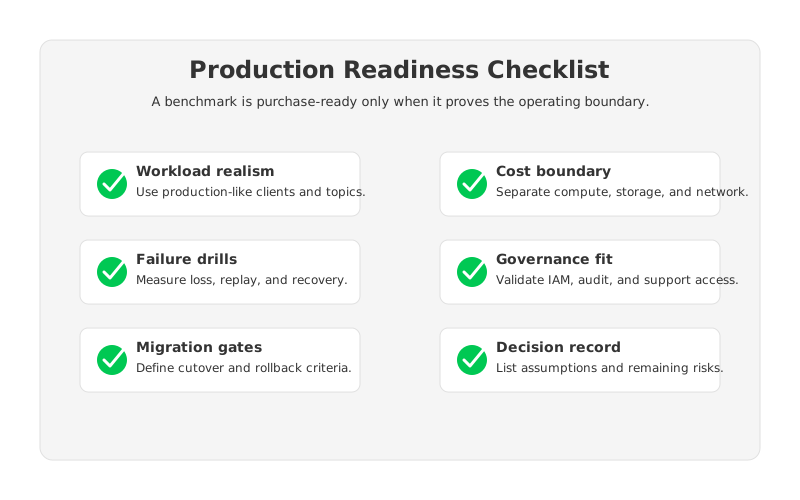
Use this checklist before treating any Kafka-compatible benchmark as purchase-ready:
- Define the production workload first. Include message size distribution, partition count, retention, producer and consumer concurrency, fan-out, replay expectations, and security configuration.
- Separate benchmark categories. Do not compare a latency microbenchmark with a cost benchmark or a recovery drill as though they answer the same question.
- Model the cloud topology. Draw producer, broker, storage, consumer, connector, and analytics paths across zones and accounts before interpreting cost.
- Run failure and rollback tests. Broker loss, zone impairment, backlog replay, and cutover rollback should be measured before the platform becomes business-critical.
- Validate governance and observability. Metrics, logs, audit events, IAM boundaries, encryption, and support access should be part of the benchmark evidence.
- Score migration risk. Compatibility is proven by workload behavior, not by a vendor label or a single client connection test.
The result is not a slower buying process. It is a cleaner one. Teams spend less time arguing about isolated charts and more time deciding whether the evidence is strong enough for the risk they are taking.
If your benchmark interpretation keeps returning to broker-local data movement, cloud network topology, and the cost of operating stateful Kafka at scale, evaluate whether a shared-storage Kafka-compatible architecture belongs in the test plan. For a customer-controlled deployment path, start with AutoMQ and bring your existing workload profile, not a synthetic default, into the benchmark.
8References
- Apache Kafka Documentation: https://kafka.apache.org/documentation/
- Apache Kafka Consumer Configuration: https://kafka.apache.org/documentation/#consumerconfigs
- Apache Kafka Producer Configuration: https://kafka.apache.org/documentation/#producerconfigs
- AWS EC2 instance network bandwidth documentation: https://docs.aws.amazon.com/AWSEC2/latest/UserGuide/ec2-instance-network-bandwidth.html
- AWS Amazon S3 storage classes: https://aws.amazon.com/s3/storage-classes/
- AutoMQ compatibility with Apache Kafka: https://docs.automq.com/automq/what-is-automq/compatibility-with-apache-kafka?utm_source=blog&utm_medium=content&utm_campaign=rpb-0070
- AutoMQ architecture overview: https://docs.automq.com/automq/architecture/overview?utm_source=blog&utm_medium=content&utm_campaign=rpb-0070
- AutoMQ deployment overview: https://docs.automq.com/automq/deployment/overview?utm_source=blog&utm_medium=content&utm_campaign=rpb-0070
9FAQ
9.1What is kafka benchmark interpretation?
Kafka benchmark interpretation is the process of reading benchmark results in context: workload shape, client settings, retention, partition count, cloud topology, cost assumptions, failure behavior, and migration risk. The goal is not to find the largest number. The goal is to decide whether the evidence applies to the production system you need to run.
9.2Which Kafka benchmark metric matters most?
There is no universal metric. Low-latency workloads may prioritize p99 produce and fetch latency. Long-retention workloads may prioritize storage cost, replay behavior, and recovery. Platform teams should define the production risk first, then choose the benchmark metric that proves or disproves that risk.
9.3How should buyers compare Kafka-compatible platforms?
Start with workload realism, compatibility tests, cost boundaries, failure drills, governance requirements, and migration safety. A platform that wins a narrow throughput benchmark may still be a poor fit if it creates unresolved risk in rollback, observability, security, or cloud network cost.
9.4Does AutoMQ remove the need for benchmarking?
No. AutoMQ changes the operating model by combining Kafka compatibility with shared object storage, WAL-backed persistence, and stateless brokers, but buyers should still benchmark with production-like workloads. The right test should include latency, replay, scaling, failure recovery, observability, and cloud cost assumptions.


