
Table of Contents
Table of Contents
Benchmark numbers are easy to read and hard to use. A chart can show a broker sustaining a certain write rate, a disk profile producing a clean latency curve, or a cluster reaching a headline throughput target. The hard part starts when a platform team asks whether that result says anything useful about its own estate: multi-tenant workloads, regional deployment rules, producer retries, retention growth, consumer lag, cloud network charges, operational headcount, and the awkward fact that a benchmark cluster rarely behaves like a production platform under change.
That is why kafka benchmark analysis should not start with the biggest number on the page. It should start with the buying decision behind the search. A FinOps team wants to know whether storage and network cost will scale linearly with adoption. An SRE team wants to know whether recovery and rebalancing will stay boring when brokers fail. A platform owner wants to know whether a Kafka-compatible service can preserve existing clients while changing the economics underneath. Those are benchmark questions, but they are not answered by throughput alone.
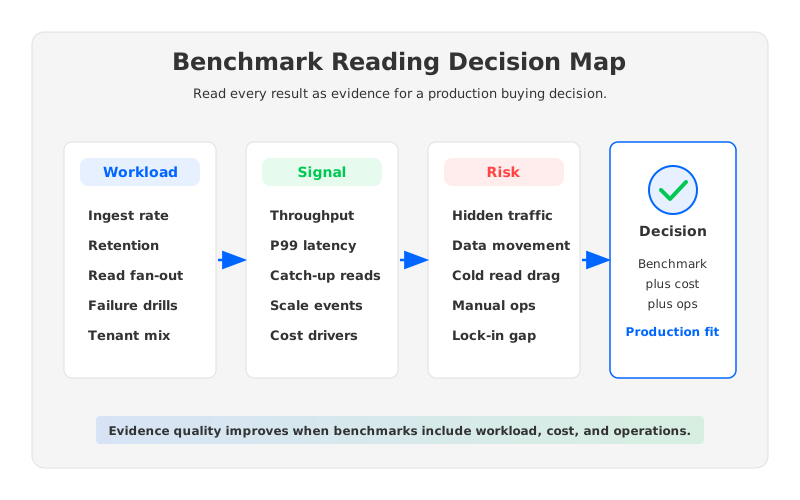
The useful habit is to treat every benchmark as a compressed story about architecture. What was measured, what was excluded, which constraints were fixed, and which cost centers were externalized? Read that way, the discussion moves from "which system is faster" to "which operating model remains predictable when workload, cloud bill, and failure modes change together."
1Why teams search for kafka benchmark analysis
Most teams do not search for Kafka benchmarks because Kafka is unfamiliar. They search because the familiar model has started to expose uncomfortable trade-offs. A cluster that worked well for a few high-value topics becomes harder to reason about when it supports hundreds of teams, mixed retention periods, bursty producers, catch-up consumers, and governance requirements that differ by business unit. The benchmark becomes a proxy for a larger question: can the platform absorb growth without forcing every team to become a Kafka capacity expert?
The search intent usually falls into four buyer questions:
- Can the platform keep up with write pressure? The reader wants to understand producer throughput, acknowledgement settings, batching, compression, replication, and disk behavior under sustained load.
- Can the platform absorb operational change? The concern is not steady state. It is broker failure, partition reassignment, scaling events, maintenance windows, and recovery after lag.
- Can the cost model survive cloud growth? Storage, replication, cross-zone traffic, overprovisioned compute, and reserved capacity can dominate the bill even when broker CPU looks healthy.
- Can migration happen without breaking existing systems? Kafka API compatibility, client configuration, offset continuity, connector behavior, and rollback paths matter as much as raw performance.
These questions are related, but they are not interchangeable. A benchmark that isolates write throughput may be useful for sizing one layer of the system. It does not automatically answer whether the platform is cost-efficient across availability zones, whether old data can be served without hurting hot traffic, or whether operators can rebalance the cluster during business hours.
2The production constraint behind the number
Traditional Apache Kafka couples compute and storage inside the broker. Each broker owns local log segments, serves reads, accepts writes, participates in replication, and carries part of the cluster's durability model. That design has served the ecosystem well because it gives Kafka a clear operational shape: partitions have leaders, followers replicate data, and clients talk to brokers that own the relevant log. The same design also means that storage placement, broker sizing, replication traffic, and recovery workflows are tightly connected.
This coupling is where benchmark interpretation gets tricky. A write-throughput chart may look clean when brokers are balanced and local disks are warm. Production rarely holds that shape for long. Retention grows, topic counts increase, consumers fall behind, brokers are replaced, instance families change, and platform teams need to scale a cluster without spending the next maintenance window moving large amounts of broker-local data.
The production constraint is not "Kafka cannot be fast." Kafka can be very fast when the workload is well understood and the cluster is sized for it. The constraint is that many cloud workloads need speed, elasticity, and cost isolation at the same time. If adding capacity requires data movement, if recovery competes with foreground traffic, or if replication creates repeated cross-zone transfer, the benchmark number is only the opening line.
| Benchmark signal | Useful question | What buyers should check |
|---|---|---|
| Peak write throughput | How much ingest can the cluster sustain? | Producer configs, replication factor, acknowledgement mode, batching, compression, disk type, and test duration. |
| Latency percentiles | What happens to tail latency under load? | P99 behavior during leader changes, consumer catch-up, background compaction, and storage pressure. |
| Rebalance time | How fast can the platform change shape? | Amount of data moved, impact on clients, operator steps, and whether scaling is compute-bound or storage-bound. |
| Cost per workload | Which resources drive spend? | Broker overprovisioning, storage replication, cross-zone traffic, object storage, support model, and reserved capacity assumptions. |
Good buyers read benchmark charts with these caveats in mind. They ask whether the test describes a stable lab condition or a production lifecycle. They also ask which parts of the system were made invisible. A benchmark can exclude network transfer, omit long-retention topics, avoid consumer catch-up reads, or assume a perfectly balanced partition layout. None of those choices make the benchmark useless. They define the boundary of what the benchmark can prove.
3Architecture options and trade-offs
The most important benchmark comparison is often architectural rather than vendor-specific. In a shared-nothing Kafka model, brokers hold local data and the cluster relies on replication and reassignment to protect and redistribute that data. In a tiered storage model, older log segments can move to remote storage while the broker still remains central to the hot path and local operational model. In a shared-storage model, the architecture goes further: durable log storage is moved out of broker-local disks so brokers can become closer to stateless compute nodes.
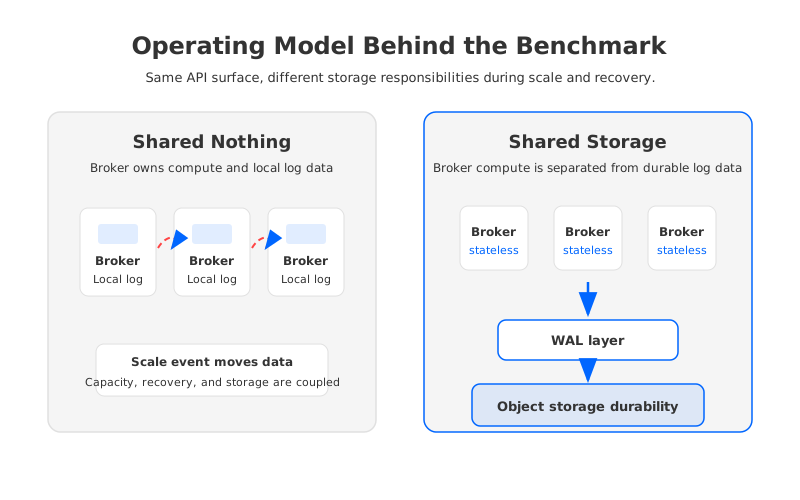
The distinction matters because each model changes what benchmark results mean. Shared-nothing benchmarks should be read with attention to disk capacity, replication bandwidth, broker replacement, and partition reassignment. Tiered storage benchmarks should separate hot-path behavior from remote-read behavior because old data and catch-up reads may follow a different path than current writes. Shared-storage benchmarks should focus on the write-ahead log, object storage layout, metadata coordination, cache behavior, and what happens when compute nodes scale or fail.
There is no free lunch hidden in the phrase "shared storage." Moving durability away from broker-local disks creates its own engineering requirements. The platform needs a write path that keeps latency predictable, a storage layout that serves catch-up reads efficiently, and a failure model that does not turn object storage into vague guarantees. A credible benchmark should make these mechanics visible.
The buyer habit is to map every benchmark to the resource it is really stressing:
- If the test stresses producer ingest, inspect the acknowledgement policy, batching, compression, network placement, and durability path.
- If the test stresses retention and catch-up reads, inspect storage layout, cache hit behavior, remote-read isolation, and the effect on foreground writes.
- If the test stresses elastic scaling, inspect whether adding brokers requires large partition movement or whether compute can scale independently.
- If the test stresses multi-zone deployment, inspect replication traffic, rack awareness, client routing, and cloud transfer charges.
This mapping prevents a common mistake: using one result to answer a different question. A strong ingest benchmark does not prove low migration risk. A storage-cost comparison does not prove stable tail latency. A fast recovery demo does not prove governance readiness. Buyers need a portfolio of evidence, not a single winning chart.
4Evaluation checklist for platform teams
A serious benchmark review should look more like a purchasing checklist than a lab report. The goal is not to punish simplified tests. Simplification is necessary. The goal is to identify which simplifications fit and which ones hide the risk your team is trying to reduce.
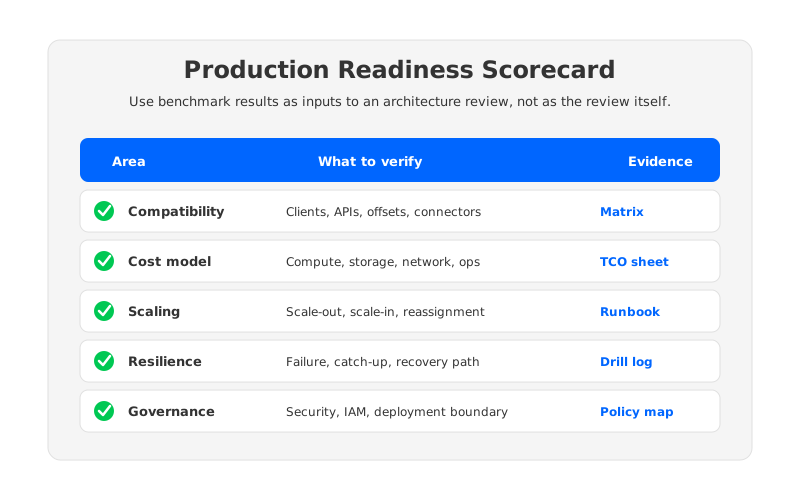
Start with compatibility because it defines the migration surface. Kafka-compatible infrastructure should be evaluated against the clients, connectors, authentication patterns, ACL usage, consumer groups, offset workflows, and operational tooling that already exist in your environment. Compatibility is not a slogan on a slide. It is the difference between testing a platform in isolation and running it under real client behavior.
Then examine the cost model as an engineering artifact. A benchmark that quotes lower infrastructure cost should explain which resources changed: broker count, disk size, storage class, replication traffic, network placement, reserved capacity, operational labor, or support boundaries. The more the benchmark depends on assumptions outside the chart, the more carefully buyers should reproduce those assumptions with their own traffic profile.
Governance deserves the same attention. Platform teams increasingly need environment isolation, identity integration, encryption, auditability, quota controls, and deployment boundaries that fit internal risk policies. A benchmark that ignores governance can still be technically interesting, but it cannot close a production purchase decision for regulated or multi-team environments.
The practical checklist is short enough to use in an architecture review:
| Review area | Benchmark reading habit | Buyer evidence to request |
|---|---|---|
| Compatibility | Verify actual Kafka semantics, not only protocol shape. | Client matrix, supported APIs, connector behavior, offset migration notes, and known restrictions. |
| Cost | Separate compute, storage, network, and operations. | Cost model with workload assumptions, cloud region, retention, replication, and read fan-out. |
| Elasticity | Test scale events, not only steady state. | Broker add/remove procedure, partition movement impact, recovery time, and automation boundaries. |
| Reliability | Include failure and catch-up behavior. | Broker failure tests, lag recovery, durability path, and operational runbooks. |
| Governance | Match the buyer's deployment model. | BYOC or private deployment boundaries, IAM/RBAC model, encryption, and observability integration. |
This checklist also changes how teams run their own proof of concept. Instead of reproducing a vendor benchmark line by line, teams should create a workload profile that mirrors their pressure points. A payments platform may care about strict latency and failover. A lakehouse ingestion platform may care about retention, catch-up reads, and storage cost. An AI feature platform may care about freshness, burst tolerance, and isolation between experimental and production topics.
5How AutoMQ changes the operating model
Once the evaluation framework is clear, AutoMQ fits into a specific architectural category: a Kafka-compatible cloud-native streaming platform that separates compute from storage and uses shared storage as the durability foundation. The point is not that every benchmark automatically favors this model. The point is that the model changes which operational costs and risks a benchmark should expose.
In AutoMQ, brokers are designed to be stateless relative to the durable log stored in shared cloud storage. The write path uses a WAL layer, while S3Stream stores log data in object storage. That separation lets compute capacity and storage capacity scale more independently than in a broker-local disk model. For benchmark readers, this shifts attention away from "how many disks are attached to each broker" and toward "how does the platform manage the WAL, object storage, cache, metadata, and client compatibility under real workload change?"
This is especially relevant for cloud cost analysis. In traditional deployments, replication and reassignment can create traffic patterns that are technically correct but financially noisy. Cross-zone transfer, oversized brokers, and local disk reservations may appear outside a simple throughput chart even though they shape the monthly bill. AutoMQ's shared-storage architecture and zone-aware traffic design are intended to reduce those hidden cost centers while keeping the Kafka API surface familiar to applications.
The migration argument should stay grounded. A buyer still needs to verify client behavior, operational restrictions, observability, security controls, and rollback strategy. AutoMQ's value is strongest when the current pain is not "Kafka is slow" but "Kafka's local-storage operating model makes cloud elasticity, cost control, and day-2 operations harder than they should be." That is the moment when benchmark reading becomes architecture evaluation.
For teams building a proof of concept, the better AutoMQ test is not a vanity race. Use the same topics, client libraries, retention targets, and failure drills that make the existing platform expensive or hard to operate. Measure steady-state throughput, but also measure scale-out time, catch-up reads, broker replacement, inter-zone traffic, and how much manual work the team performs during each event.
If your benchmark review keeps returning to the same operational questions, run the numbers with your own workload assumptions. The AutoMQ pricing page is a practical next step for translating benchmark pressure into a cost model before committing to a deeper proof of concept.
6References
- Apache Kafka documentation: Operations and benchmarking
- Apache Kafka documentation: Producer configurations
- Apache Kafka documentation: KRaft mode
- AutoMQ documentation: Shared Storage architecture
- AutoMQ documentation: WAL storage
- AutoMQ documentation: Compatibility with Apache Kafka
- AutoMQ documentation: Eliminate inter-zone traffic
- AWS documentation: Amazon S3 user guide
7FAQ
7.1What is Kafka benchmark analysis?
Kafka benchmark analysis is the process of reading benchmark results in context: workload shape, producer and consumer settings, storage architecture, replication, failure behavior, cloud cost, and operational procedures. The goal is to decide whether a result helps predict production behavior, not to admire a single throughput number.
7.2Which Kafka benchmark metric matters most?
There is no single metric that covers every buying decision. Write throughput, latency percentiles, recovery time, catch-up read behavior, rebalance duration, and cost per workload each answer different questions. The right metric depends on the constraint your platform is trying to remove.
7.3How should buyers compare shared-nothing, tiered storage, and shared-storage Kafka-compatible systems?
Compare the operating model first. Shared-nothing systems depend heavily on broker-local disks and data movement. Tiered storage can reduce pressure from older data, but the broker still matters for hot-path operations. Shared-storage systems move durable log storage outside broker-local disks, so buyers should focus on WAL design, object storage behavior, metadata, cache, and compatibility.
7.4Does a better benchmark mean lower production cost?
Not automatically. A benchmark may exclude cloud network transfer, long retention, read fan-out, support costs, governance requirements, or operator labor. Lower production cost needs a workload-specific model that separates compute, storage, network, and operations.
7.5Where does AutoMQ fit in a benchmark-driven evaluation?
AutoMQ is relevant when the benchmark discussion exposes limits in the broker-local storage model: overprovisioning, data movement during scaling, cross-zone traffic, slow recovery, or complex day-2 operations. Its Kafka-compatible shared-storage architecture gives buyers a different operating model to test against those constraints.


