
Table of Contents
Table of Contents
Teams usually do not search for a Redpanda alternative because Redpanda is a weak product. They search because an event-streaming platform that looked elegant during evaluation can become harder to defend once it is tied to real cloud bills, retention requirements, security boundaries, procurement rules, and on-call ownership. Redpanda's Kafka API compatibility, single-binary operational model, and latency profile are attractive. The harder question is whether those strengths still match the workload you are running now.
For cloud Kafka workloads, "alternative" is also a slippery word. It can mean a fully managed Apache Kafka service, a Kafka-compatible system with a different storage architecture, a BYOC deployment where data stays in your cloud account, or a return to open source Kafka because control matters more than service abstraction.
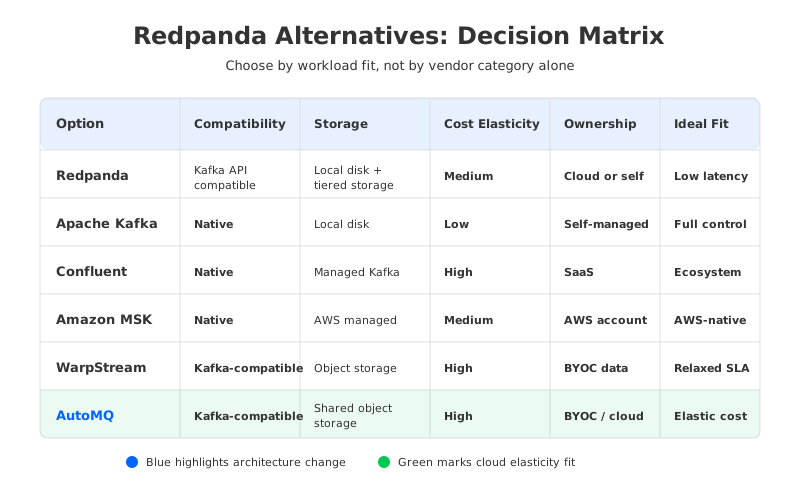
The practical comparison starts with six options: Redpanda, Apache Kafka, Confluent Cloud, Amazon MSK, WarpStream, and AutoMQ. They all serve Kafka-style streaming use cases, but they make different bets about storage, elasticity, and operational responsibility.
1Why teams look for a Redpanda alternative
Redpanda is often evaluated by teams that want Kafka protocol compatibility without operating a traditional Kafka cluster. Redpanda's own documentation says clients developed for Kafka versions 0.11 or later are compatible with Redpanda, with documented exceptions and limitations. That matters because Kafka client compatibility is the first migration gate: producers, consumers, Connect-based pipelines, observability tools, and security integrations all assume Kafka behavior at the protocol and operational edge.
The replacement pressure usually appears after production workloads settle in. A cloud team may discover that low-latency local storage is one dimension among several. Long retention changes the storage bill. Multi-AZ deployment changes the networking bill. Governance teams may ask whether the data plane can run inside the company's own VPC or cloud account. Finance may ask why bursty traffic has to be sized around peak capacity.
Those concerns do not all point to the same replacement. A latency-first fraud-detection workload has different needs from an observability pipeline retaining logs for replay. A platform team standardizing on AWS may prefer a native service, while a SaaS company with strict customer data controls may care more about BYOC than about who hosts the UI.
2What to compare before replacing Redpanda
The fastest way to make a bad platform decision is to compare logos before comparing failure modes. For Kafka workloads, the real evaluation has to cover compatibility, storage architecture, cloud cost behavior, operations, and migration risk.
Start with compatibility. Kafka compatibility is not a yes-or-no badge; it is a surface area. Client protocol support is the baseline, but production systems often depend on transactions, idempotent producers, ACLs, quotas, Connect, Streams, consumer group semantics, offset migration, and admin tooling. A replacement can be "Kafka-compatible" and still require careful testing if your workload uses edge features.
Then look at where durable state lives. Traditional Kafka places log data on broker-local disks and replicates across brokers. Redpanda uses a local-first model with tiered storage that can upload data to object storage and read it back later. Confluent Cloud and MSK abstract away much of the management but still expose different pricing and scaling units. WarpStream and AutoMQ are more explicit shared-storage designs: object storage is central to the architecture rather than an archive tier.
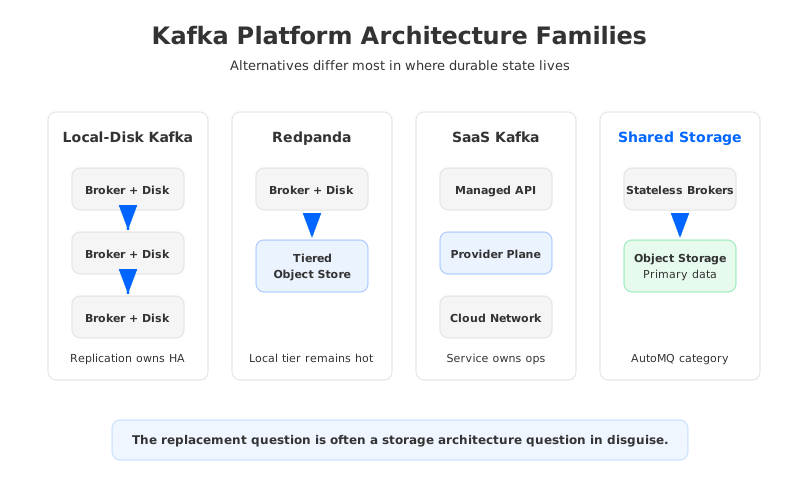
Cost follows architecture. A local-disk Kafka family makes you plan disk, broker count, replication factor, and reassignment windows. A SaaS Kafka family shifts that planning into provider-defined units such as eCKUs, CKUs, cluster hours, ingress, egress, storage, or add-on services. A shared-storage family shifts durable data into object storage and tries to make compute scale independently. None is automatically lower cost; each makes a different part of the bill visible.
3Redpanda alternatives compared
The table below is a workload-fit map for teams deciding whether Redpanda remains the right center of gravity.
| Option | Best fit | Main advantage | Watch carefully |
|---|---|---|---|
| Apache Kafka | Teams that want maximum control and can operate Kafka well | Native ecosystem behavior and no vendor abstraction | Broker-local storage, rebalancing, upgrades, and capacity planning remain your responsibility |
| Confluent Cloud | Teams that value managed Kafka plus a broad streaming ecosystem | Managed Kafka, connectors, governance, Flink, and multiple cluster types | Billing dimensions, feature availability by cluster type, and data/control-plane requirements |
| Amazon MSK | AWS-centered teams that want managed Apache Kafka | Native AWS integration and supported Apache Kafka versions | Storage, broker type, IAM/ACL differences, scaling model, and regional service constraints |
| WarpStream | BYOC teams with high-volume workloads and relaxed latency tolerance | Diskless, object-storage-backed architecture with data in the customer cloud | Kafka feature fit, control-plane dependency, and latency-sensitive workloads |
| AutoMQ | Kafka-compatible cloud workloads that need BYOC, data control, and elastic cost | Shared storage, stateless brokers, object storage as primary data layer | Validate feature compatibility and migration path for your Kafka version and tooling |
Apache Kafka is still the cleanest answer when you need the least abstraction and your team is prepared to own the system. That means more than running brokers. It means owning partition design, disk pressure, controller behavior, upgrades, quotas, security, monitoring, incident response, and cost attribution. For teams with deep Kafka experience and stable workloads, this can be rational. For teams trying to reduce operational load, it may recreate the pressure that led them to evaluate Redpanda.
Confluent Cloud is often the strongest alternative when the buying decision is not only about brokers. Confluent documents Basic, Standard, Enterprise, Dedicated, and Freight cluster types, with different scaling models and feature sets. It also layers in ecosystem services such as connectors, governance, Schema Registry, and Flink. That breadth helps when the platform team wants a streaming data platform rather than a broker endpoint. The trade-off is that cost analysis must account for cluster type, networking mode, usage dimensions, and add-on services.
Amazon MSK is the natural candidate for AWS-first teams. It gives you managed Apache Kafka rather than a Kafka-compatible reimplementation, and AWS documents supported Kafka versions, MSK Serverless, and Express brokers as distinct operating models. This matters for organizations that standardize around IAM, PrivateLink, CloudWatch, AWS Marketplace procurement, or existing VPC patterns. MSK can be a comfortable Redpanda replacement when staying close to Apache Kafka matters more than changing storage architecture.
WarpStream is the cleanest contrast to local-disk thinking. Its documentation describes stateless Agents that speak the Kafka protocol and communicate with object storage plus a cloud metadata service. Its pricing page also makes BYOC and consumption-based dimensions central to the story. That architecture can be attractive for high-volume workloads where object-storage economics matter more than ultra-low latency. Test producer acknowledgements, consumer latency, compaction behavior, governance requirements, and comfort with the control-plane model.
AutoMQ fits in the same architectural conversation, but with a different emphasis. It is a Kafka-compatible streaming platform that reuses Kafka's compute and protocol layer while replacing the storage layer with S3Stream and shared storage. AutoMQ documentation describes object storage as the primary repository, a WAL layer for write efficiency, and stateless brokers that can scale and recover without moving large broker-local logs. For teams comparing Redpanda alternatives, the important point is not that AutoMQ is another service. It changes the unit of scaling: brokers become compute, while durable data sits in shared object storage.
That distinction is especially relevant for BYOC and data-control discussions. If the data plane needs to run in the customer's cloud account, the architecture has to make data locality explicit. AutoMQ's documentation describes operation on public clouds and private environments that support S3-compatible storage, while its compatibility documentation frames it as an Apache Kafka-compatible distribution. Those properties make it worth evaluating when the goal is to keep Kafka clients and ecosystem tools while reducing local-disk operational drag.
4A decision framework by workload
The right Redpanda alternative removes your current bottleneck without creating a more expensive one somewhere else. A useful decision framework starts with the workload's dominant constraint.
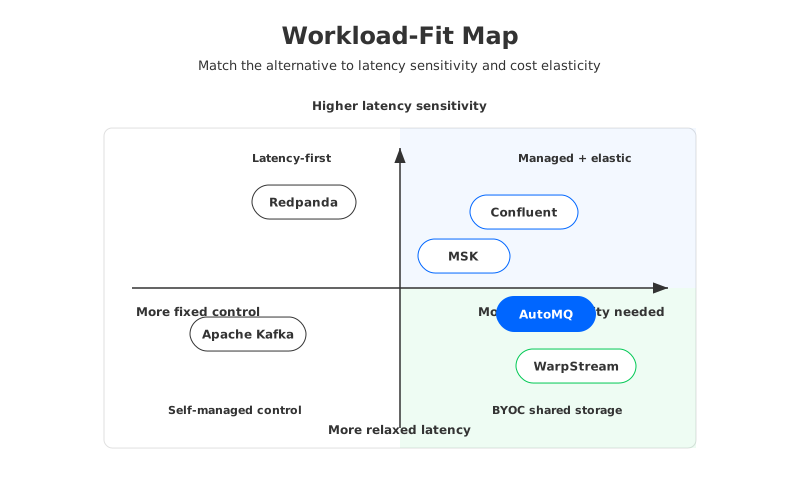
If the workload is latency-first and traffic is stable, Redpanda may still be a strong fit. Replacing it makes sense when another constraint has become more important than the original latency target: procurement, a specific Kafka feature, a managed-service mandate, or a data-control requirement that available deployment options do not satisfy.
If the workload is ecosystem-first, Confluent deserves a serious look. This is common when streaming is tied to managed connectors, governance workflows, Schema Registry, stream processing, and platform standardization. The more value you get from the surrounding platform, the less useful a broker-only comparison becomes. The cost review should still be rigorous, but the value side is broader than raw broker throughput.
If the workload is AWS-native, MSK is often the default comparison point. Teams invested in AWS security, networking, billing, and operations may prefer a service that fits existing control planes. MSK Serverless can reduce capacity planning for suitable workloads, while provisioned clusters and Express brokers offer different trade-offs. The key question is whether you want managed Apache Kafka inside AWS or a storage-architecture change.
If the workload is cost-elastic and retention-heavy, shared-storage Kafka-compatible systems become more interesting. Object storage changes the economics of retained data, and stateless compute changes the scaling conversation. WarpStream and AutoMQ both belong on this shortlist. WarpStream leans into diskless Kafka with Agents and a cloud metadata service. AutoMQ leans into Kafka compatibility with shared storage, stateless brokers, and BYOC-friendly deployment patterns.
If the workload is control-first, be careful with any answer that hides ownership behind the word "managed." Managed operations, customer-owned infrastructure, customer-controlled data, private networking, and open-source escape hatches are different things. Ask where the data plane runs, where metadata lives, who can access it, how upgrades happen, and how incident response works.
5Migration risk: what to test before you commit
A Redpanda replacement project should begin with a compatibility lab, not a pricing spreadsheet. Pricing determines whether the project is worth exploring; compatibility determines whether it survives production.
Test the client surface first. Use the same producers, consumers, serializers, authentication, retry policies, idempotence settings, and transactions that production uses. Do not settle for a happy-path produce-and-consume demo. Kafka workloads fail in the corners: consumer group rebalances, broker restarts, ACL mismatches, stale metadata, backpressure, compaction, large messages, and lag recovery.
Then test the operational path. Create topics at production-like partition counts. Run retention and compaction scenarios. Scale traffic up and down. Kill nodes or compute units if the service model allows it. Measure recovery behavior and consumer lag after disruption. Watch the bill during the test, because streaming platforms reveal their real shape under sustained read, write, storage, and networking load.
Finally, test migration mechanics. MirrorMaker 2, Cluster Linking, vendor tools, or dual-write patterns can all work, but they have different implications for offsets, ordering, rollback, and cutover windows. If a system claims Kafka compatibility, it should prove that compatibility against your operational contracts.
6So, which Redpanda alternative should you choose?
Choose Apache Kafka when control is the product requirement and your team can absorb the operational cost. Choose Confluent Cloud when managed platform breadth matters more than minimizing architectural abstraction. Choose Amazon MSK when AWS-native managed Apache Kafka is the cleanest fit for your organization. Choose WarpStream when BYOC, object storage, and high-volume cost efficiency are the dominant concerns and your latency requirements match its architecture.
Evaluate AutoMQ when the problem is the coupling between Kafka-compatible compute and broker-local durable state. Its shared-storage architecture, stateless broker model, and BYOC/data-control posture make it relevant for cloud Kafka workloads where elasticity and cost structure matter as much as protocol compatibility. Test it with your clients, traffic profile, retention rules, and incident model.
The key is to avoid turning "Redpanda alternative" into a beauty contest. Redpanda may still be right for a latency-sensitive workload with a clean operating model. But if your search began with cloud cost, scaling friction, data control, or renewal risk, the replacement decision is really about architecture. Once you name that constraint, the shortlist gets much smaller.
7FAQ
7.1Which Redpanda alternative fits Kafka-compatible workloads?
There is no single answer for every Kafka workload. Confluent Cloud is strong for managed platform breadth, Amazon MSK for AWS-native Apache Kafka, Apache Kafka for self-managed control, WarpStream for BYOC diskless streaming, and AutoMQ for Kafka-compatible shared-storage architecture with stateless brokers.
7.2Is Redpanda fully compatible with Apache Kafka?
Redpanda documents compatibility with Kafka clients developed for Kafka 0.11 or later, with exceptions and unsupported features listed in its compatibility documentation. Treat compatibility as a test plan, especially if your applications use transactions, quotas, admin APIs, or less common client libraries.
7.3When should I replace Redpanda instead of optimizing it?
Consider replacement when the main issue is architectural rather than configuration-level: cloud cost structure, data-control requirements, scaling model, managed-service fit, ecosystem compatibility, or procurement risk. If the issue is topic design, client tuning, or capacity sizing, optimization may be lower risk.
7.4Is AutoMQ a Redpanda competitor?
AutoMQ can be evaluated as a Redpanda alternative for Kafka-compatible cloud workloads, but it approaches the problem from shared storage and stateless brokers rather than a local-first streaming engine. It is relevant when teams want Kafka protocol compatibility, object-storage-backed durability, elastic scaling, and BYOC or data-control options.
7.5How should FinOps teams compare Redpanda alternatives?
FinOps teams should compare total cost by workload shape: ingress, egress, retained data, replication, cross-AZ traffic, compute units, storage API calls, idle capacity, support tier, and operational labor. Headline storage or throughput prices are not enough, because the expensive line item often moves when the architecture changes.
7.6Can I migrate from Redpanda to another Kafka-compatible platform without changing applications?
Possibly, but it depends on client features, security configuration, topic settings, and migration method. Kafka protocol compatibility can reduce application changes, but you still need to validate offsets, ordering expectations, authentication, ACLs, transactions, compaction, monitoring, and rollback.
8References
- Redpanda Docs: Kafka Compatibility
- Redpanda Docs: Use Tiered Storage
- Redpanda Cloud Docs: Cloud Overview
- Apache Kafka: Documentation
- Confluent Docs: Kafka Cluster Types in Confluent Cloud
- Confluent Docs: Manage Billing in Confluent Cloud
- AWS Docs: Supported Apache Kafka versions in Amazon MSK
- AWS Docs: What is MSK Serverless?
- AWS Docs: Amazon MSK Express brokers
- AWS: Amazon MSK Pricing
- WarpStream Docs: Architecture
- WarpStream: Pricing
- AutoMQ Docs: Compatibility with Apache Kafka
- AutoMQ Docs: Architecture Overview
- AutoMQ Docs: Stateless Broker
- AutoMQ GitHub: AutoMQ


