
Table of Contents
Table of Contents
Teams searching for a WarpStream alternative usually have already accepted the main premise: traditional Kafka clusters can become expensive and operationally heavy when every broker owns local storage, replication, rebalancing, and capacity planning at the same time. The open question is not whether object storage can change the economics of streaming. It is which Kafka-compatible architecture preserves enough Kafka behavior, gives the buyer enough control, and leaves a credible exit path if the platform, pricing model, or vendor roadmap changes.
That distinction matters because "Kafka-compatible BYOC streaming" is not one product category. It spans self-managed Apache Kafka, managed Kafka services, diskless systems that put data in object storage, and cloud-native Kafka-compatible systems that separate compute from durable storage. A useful shortlist compares those patterns before it compares logos.
1Why teams look for a WarpStream alternative
WarpStream popularized a very specific buyer promise: keep a Kafka-compatible surface while moving the data plane into the customer's cloud account and using object storage as the durable storage layer. Its documentation describes an agent-based architecture in which agents run in the customer's environment while WarpStream's control plane manages metadata and coordination. WarpStream's pricing pages also expose a usage-based model with dimensions such as cluster minutes, uncompressed write volume, retained data, and query activity, so cost analysis cannot stop at broker instance count.
The search for an alternative often starts for one of five reasons:
- Procurement control: the platform team wants a BYOC or private data-plane model but needs to understand who operates the control plane, who can access metadata, and how contractual terms change over time.
- Acquisition risk: Confluent announced its acquisition of WarpStream on September 9, 2024, which can make buyers ask how WarpStream fits into a broader Confluent portfolio and commercial motion.
- Kafka semantics: teams want more than a compatible produce-and-consume API. They care about consumer groups, offset behavior, transactions, ACLs, connectors, MirrorMaker-style migration, and operational tooling.
- Cost predictability: object storage can reduce the pressure to over-provision broker disks, but the bill can move into write, read, retention, metadata, network, and query dimensions.
- Exit path: a platform that stores data in the customer's cloud account is easier to trust when the data format, migration path, and operational boundary are clear.
None of these concerns imply that WarpStream is the wrong choice. They do imply that alternatives should be evaluated as production streaming architectures, not as a generic "top tools" list.
2What a real WarpStream alternative must preserve
The minimum bar is Kafka compatibility, but compatibility has layers. Apache Kafka is not only a wire protocol; production Kafka estates also include topic configuration, partitioning assumptions, consumer group coordination, security models, schema workflows, Kafka Connect, stream processing jobs, observability dashboards, and incident muscle memory. A replacement that supports basic clients but breaks surrounding workflows may still create a migration project large enough to erase the expected savings.
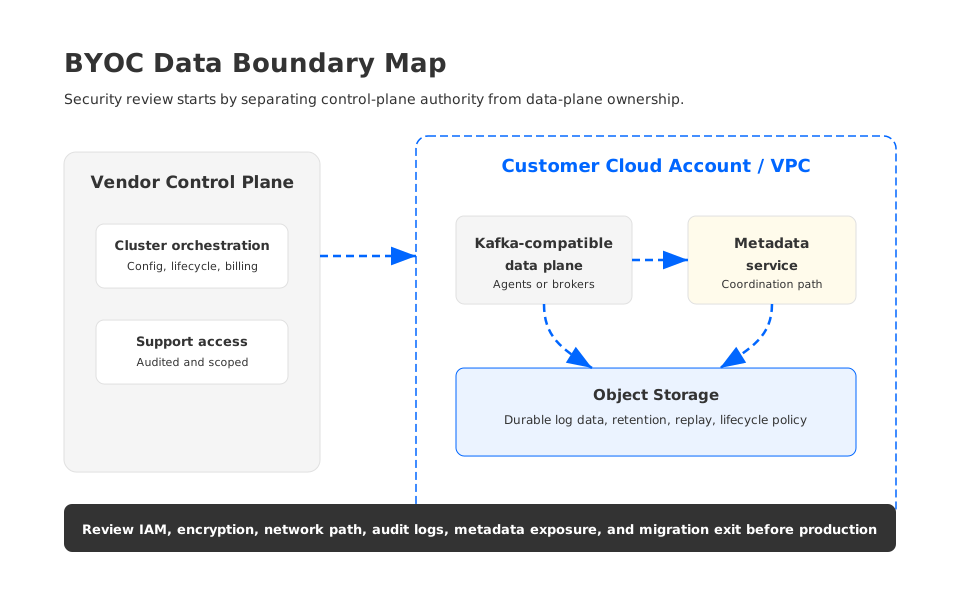
The second bar is deployment control. BYOC should mean more than "some component runs in your account." Buyers should map the control plane, data plane, object storage, metadata service, networking path, encryption boundary, IAM roles, logs, metrics, and support access. This map becomes the basis for security review and for answering a harder question: what happens if the team later needs to migrate again?
The third bar is cost transparency. Object storage changes Kafka cost because durable retention no longer has to be tied to broker-local disks. An alternative still has to explain compute, storage requests, retained bytes, inter-AZ traffic, egress, metadata operations, read amplification, compaction, and support fees.
| Evaluation dimension | What to verify | Why it matters |
|---|---|---|
| Kafka compatibility | Client APIs, consumer groups, ACLs, transactions, Connect, Streams, schema dependencies | Prevents "compatible" from hiding application rewrites |
| Deployment model | SaaS, BYOC, private control plane, self-managed, marketplace | Defines data boundary and operational responsibility |
| Storage architecture | Local disk, tiered storage, object storage as primary storage, shared storage | Determines recovery, retention, and scaling behavior |
| Cost model | Compute, storage, requests, network, support, retained data, reads | Moves the discussion from list price to workload TCO |
| Operations | Scaling, broker failure, partition movement, upgrades, observability | Shows whether day-2 operations improve or merely change shape |
| Exit path | Data location, format, migration tooling, open source availability, contract terms | Reduces strategic lock-in |
3The main alternative categories
The market splits into several architecture categories. Comparing them as categories first keeps the decision grounded.
Self-managed Apache Kafka remains the control baseline. It gives maximum ecosystem familiarity and broad operational transparency, backed by Apache Kafka's own documentation and a mature ecosystem. It is often the right choice for teams that already have deep Kafka operations expertise, stable workloads, and a strong reason to own the full stack. The tradeoff is familiar: local broker storage, replication, rebalancing, and capacity planning remain the team's responsibility unless they add tiered storage or managed tooling around it.
Managed Kafka services such as Confluent Cloud and Amazon MSK reduce operational burden by moving more responsibility to the provider. Confluent Cloud positions itself as a fully managed Apache Kafka service with multiple cluster types, while Amazon MSK provides AWS-managed Apache Kafka clusters and serverless options. These services can be strong choices when procurement prefers a cloud service contract, but BYOC boundaries and data-plane control vary by offering, and cost modeling must include the provider-specific dimensions.
Diskless or object-storage-first systems are closer to the WarpStream design center. They treat object storage as the durable layer and try to make compute easier to scale, replace, or operate. This category is attractive when teams want to reduce disk-heavy Kafka operations, but it demands careful validation of latency, compaction, metadata behavior, fetch-heavy workloads, and failure recovery.
Kafka-compatible shared-storage systems keep the Kafka protocol and ecosystem compatibility goal while decoupling brokers from durable local disks. This is where AutoMQ fits: it is a Kafka-compatible streaming system that uses object storage as the persistent storage layer and stateless brokers to reduce data movement during scaling, recovery, and reassignment. It should be evaluated alongside other object-storage-backed options, not as a drop-in answer for every Kafka estate.
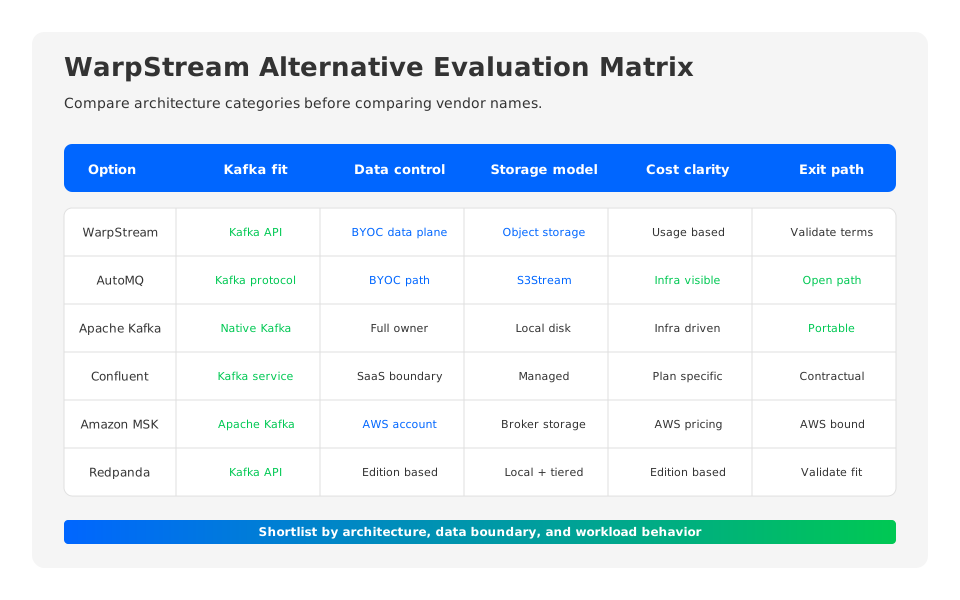
4Comparison matrix: WarpStream, AutoMQ, Kafka, Confluent, MSK, and Redpanda
The table below is a buyer's starting point, not a substitute for a PoC. Each row should be tested against your own traffic pattern, retention policy, consumer fan-out, compliance boundary, and migration constraints.
| Option | Primary fit | Storage pattern | Deployment/control model | Watch-outs |
|---|---|---|---|---|
| WarpStream | Kafka-compatible BYOC streaming with object-storage economics | Object storage primary storage via agents in customer environment | BYOC data plane with vendor control plane | Validate post-acquisition roadmap, pricing dimensions, and operational boundary |
| AutoMQ | Kafka-compatible shared-storage streaming with stateless brokers | S3-compatible object storage as persistent storage through S3Stream | BYOC and self-managed/open-source paths depending on edition | Validate workload latency, feature compatibility, and operational maturity for your use case |
| Apache Kafka | Maximum ecosystem standardization and full self-management | Broker-local disks, optionally extended with tiered storage in supported versions/distributions | Self-managed | Requires Kafka operations expertise and capacity planning |
| Confluent Cloud | Fully managed Kafka ecosystem and enterprise platform features | Managed by Confluent; storage model depends on cluster type and features | SaaS managed service, with enterprise/private networking options | Cost and data boundary depend on selected cluster type and contract |
| Amazon MSK | AWS-native managed Kafka for teams standardizing on AWS | Apache Kafka broker storage and AWS-managed infrastructure; serverless option available | AWS managed service in the customer's AWS environment | AWS-specific operations, pricing dimensions, and Kafka version support need review |
| Redpanda | Kafka API-compatible streaming with a non-JVM broker architecture | Local storage-centric design with tiered storage options | Self-managed, BYOC, or cloud options depending on edition | Validate compatibility edge cases and commercial terms |
Two patterns stand out. First, WarpStream and AutoMQ are closer to each other architecturally than traditional managed Kafka services because both are designed around object storage rather than broker-local disks as the central durability mechanism. Second, "managed Kafka" and "BYOC Kafka-compatible streaming" solve different governance problems. Managed services reduce operational toil; BYOC systems try to keep the data plane closer to the buyer's cloud boundary.
5How to evaluate cost without fooling yourself
Cost comparisons become unreliable when they compare a broker count from one system with a list price from another. Kafka workloads generate cost through several paths at once: writes, reads, retained bytes, inter-zone replication, compaction, tiered storage movement, control-plane charges, monitoring, and support. For WarpStream alternatives, the most important question is where the cost moved after local disks were removed from the center of the architecture.
Build the model from workload facts:
- Peak and sustained produce throughput, using the same MiB/s or GiB/day unit throughout the model.
- Consumer fan-out, because read-heavy workloads can make object storage request and network patterns more important.
- Retention period by topic class, including compacted topics and replay-heavy topics.
- Replication or durability model, including cross-AZ traffic and object storage durability assumptions.
- Operational events, such as broker failure, scaling, partition reassignment, backfill, and disaster recovery tests.
- Support and enterprise feature charges outside raw infrastructure math.
This is where "lower cost" should be treated as a hypothesis rather than a slogan. Object storage can be structurally attractive for long retention and elastic scaling, but high read amplification, strict tail-latency goals, or heavy compaction may stress the architecture differently. A serious PoC should include a normal day, a peak traffic window, a failure test, a replay test, and a retention-growth projection.
6Where AutoMQ fits as an alternative
After the evaluation matrix is in place, AutoMQ's role becomes clearer. It belongs in the shortlist when the buyer wants Kafka protocol compatibility, an object-storage-backed durability layer, and a deployment model that can keep the data plane in the customer's cloud environment. Its architecture is designed around stateless brokers and S3Stream storage, so scaling and recovery are intended to avoid the large data movement that makes traditional Kafka operations painful.
That architecture creates a different operational thesis from WarpStream's agent-centered model. With AutoMQ, the broker remains the Kafka-compatible compute surface, while durable log data is persisted to object storage. The expected benefit is not only storage cost reduction; it is also reducing the blast radius of broker-local disk ownership.
The right way to test AutoMQ against WarpStream is therefore not "which one is cheaper on a slide." The better test is:
- Can existing clients, connectors, stream processors, ACLs, topic settings, and monitoring workflows move with acceptable change?
- Does the data-plane boundary satisfy security, compliance, and audit requirements?
- How does the system behave under consumer replay, hot partitions, broker failure, and rapid scale-out?
- Can the team explain every major cost driver before signing a production contract?
- Is there a credible path to leave the platform if future requirements change?
AutoMQ should not be the automatic answer for every WarpStream evaluation. It is most relevant when the team wants the Kafka ecosystem, shared object storage, stateless broker operations, BYOC-style data control, and an open technical path that can be inspected during architecture review.
7Shortlist checklist for a production PoC
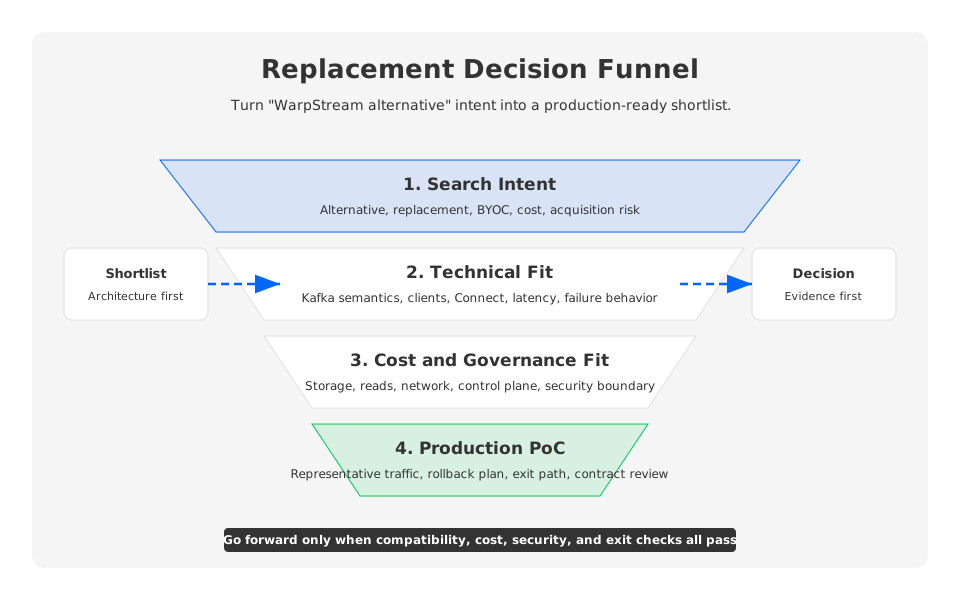
A shortlist should end with experiments, not adjectives. The following checklist is practical enough to run before procurement locks the team into a narrow vendor path.
| PoC gate | Pass condition |
|---|---|
| Compatibility | Critical producers, consumers, connectors, and stream processors run without semantic surprises |
| Latency | p95 and p99 produce/fetch latency meet workload SLOs under normal and peak traffic |
| Recovery | Broker, agent, or node failure does not create unacceptable unavailability or data loss risk |
| Retention | Storage growth, replay behavior, and compaction match the cost model |
| Security | IAM, encryption, network path, audit logs, and support access pass review |
| Observability | Existing dashboards and alerts can explain lag, throughput, errors, storage, and failures |
| Exit | Data location, migration tooling, and contractual terms support a future move |
One useful forcing function is to write the rollback plan before the PoC begins. If a vendor cannot explain how to migrate topics, offsets, credentials, and consumers away from the platform, the team has learned something important before it has moved production traffic.
8Recommended decision path
Start with architecture fit. If the organization wants less operational burden and is comfortable with a managed service boundary, Confluent Cloud or Amazon MSK may belong at the top of the list. If it wants full ownership and already operates Kafka well, Apache Kafka remains the baseline. If the team wants object-storage-first economics with a Kafka-compatible interface and BYOC-style data control, WarpStream, AutoMQ, and similar shared-storage designs deserve a deeper PoC.
Then narrow by risk. A platform that looks attractive on storage cost can still fail the decision if it weakens Kafka semantics, obscures the control-plane boundary, or makes exit too difficult. Conversely, a platform with a higher apparent unit price can be justified if it eliminates operational toil, accelerates incident response, and reduces migration risk.
The safest procurement posture is architecture-driven: one managed Kafka option, one object-storage-first BYOC option, one self-managed baseline, and one Kafka-compatible shared-storage alternative such as AutoMQ. That mix makes tradeoffs visible to engineering, security, FinOps, and procurement.
9References
- WarpStream Documentation
- WarpStream Pricing
- Confluent: Confluent Completes Acquisition of WarpStream
- Apache Kafka Documentation
- Confluent Cloud Pricing
- Amazon MSK Pricing
- Redpanda Documentation
- AutoMQ Documentation
- AutoMQ GitHub Repository
10FAQ
10.1What is the closest WarpStream alternative?
The closest alternatives are usually Kafka-compatible systems that use object storage as a primary durability layer and support a BYOC or customer-controlled data-plane model. AutoMQ belongs in that group because it keeps a Kafka-compatible interface while using object storage-backed shared storage and stateless brokers. Traditional managed Kafka services can still be strong alternatives, but they solve a different problem.
10.2Is Apache Kafka itself a WarpStream alternative?
Yes, but it is a different architecture choice. Apache Kafka gives maximum ecosystem standardization and control, while the operating team keeps responsibility for broker storage, replication, scaling, upgrades, and recovery. It is a good baseline for comparison even when the final shortlist focuses on managed or shared-storage systems.
10.3Is BYOC the same as self-managed?
No. BYOC usually means some or all data-plane infrastructure runs in the customer's cloud account, but the vendor may still operate a control plane, provide automation, or manage upgrades. Self-managed means the customer operates the full stack. Security teams should review the boundary component by component.
10.4How should we compare WarpStream and AutoMQ?
Compare them through workload tests rather than claims. Validate Kafka compatibility, object storage behavior, latency, replay, failure recovery, data boundary, cost drivers, observability, and exit path. The architectural difference matters: WarpStream documents an agent-based model, while AutoMQ emphasizes Kafka-compatible stateless brokers backed by S3Stream shared storage.
10.5What should a PoC include before replacing WarpStream?
A production-oriented PoC should include representative producers and consumers, connector or stream processing dependencies, peak throughput, replay tests, retention growth, failure injection, observability integration, security review, and a written rollback plan. The goal is to discover operational surprises before contract and migration decisions become hard to reverse.


