
Table of Contents
Table of Contents
The phrase bigquery streaming handoff kafka usually appears when a team has outgrown a tidy pipeline diagram. Product events and CDC streams already move through Kafka or a Kafka-compatible API. BigQuery is where analysts, machine learning teams, and business users expect fresh tables. The uncomfortable part is deciding which system owns replay, schema changes, backpressure, late data, and recovery after a failed table write.
That decision is harder than it looks because BigQuery is not a Kafka consumer with SQL attached. It is an analytical warehouse with ingestion APIs, table semantics, quotas, governance model, and cost profile. Kafka is a durable event log with partitions, offsets, and consumer groups. A production handoff has to respect both sides instead of treating one side as a thin adapter around the other.
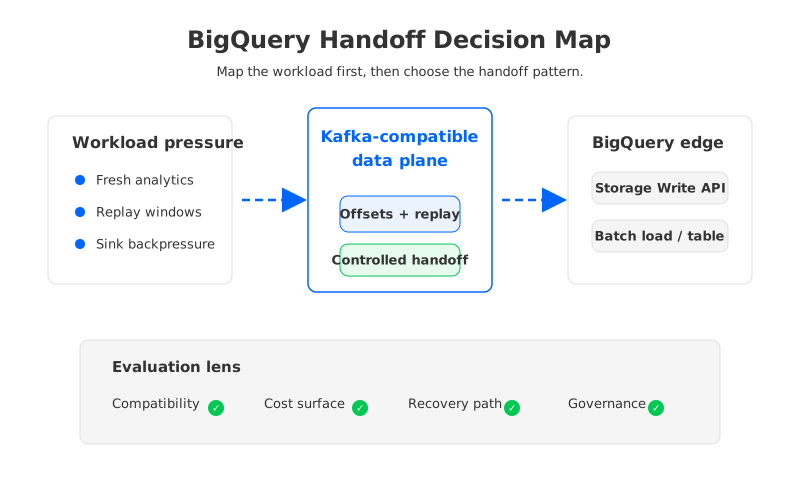
The cleanest designs start by naming the boundary. Is Kafka the reusable system of record, or only a buffer before BigQuery? Does the data plane also serve Flink, Spark, object storage, search, or operational services? Can BigQuery ingestion slow down without affecting producers? Those questions decide the architecture before connector choice does.
1Why teams search for bigquery streaming handoff kafka
Most teams reach this search from one of three situations. The first is a dashboard freshness problem: batch loads are reliable, but the business wants minutes-level data for operations, personalization, or risk decisions. The second is a CDC consolidation problem: database changes must land in BigQuery while the same stream feeds caches, search indexes, or services that cannot be coupled to the warehouse. The third is a platform modernization problem: a team wants Kafka compatibility without carrying the full operational profile of broker-local disks, partition reassignments, and storage planning.
The common thread is that the handoff is no longer a single sink connector. It is a production contract between an event backbone and an analytical table. That contract includes ordering, replay windows, dead-letter handling, schema evolution, access control, and an answer for partial BigQuery acceptance.
Kafka gives platform teams a useful abstraction for this contract because offsets make progress explicit. A consumer group can lag, restart, replay, or move to updated processing code without forcing producers to know the destination. Kafka Connect and stream processors build on that model. BigQuery, meanwhile, gives teams several ingestion routes, including the Storage Write API, streaming inserts, batch loads through Cloud Storage, and upstream services such as Dataflow. Each route changes the failure mode.
| Handoff pattern | Where it fits | Main risk to design around |
|---|---|---|
| Kafka Connect sink to BigQuery | Standard event-to-table loading with manageable transformations | Connector task failures, schema drift, and duplicate handling |
| Stream processor to BigQuery Storage Write API | Enrichment, joins, filtering, or stateful quality checks before the table | Checkpoint alignment, write idempotency, and partial acceptance |
| Kafka to object storage, then BigQuery load or external table | Large replay windows, audit trails, or lakehouse-first architecture | File layout, partitioning, and table freshness expectations |
| Kafka-compatible table topic or lakehouse handoff | Teams that want streams and tables to share object-storage-backed data | Catalog governance, table format support, and query-engine fit |
This table is not a ranking. A low-latency dashboard and a finance reconciliation table may both start with Kafka and end in BigQuery, but they should not share the same handoff contract.
2The lakehouse freshness constraint behind the workload
BigQuery handoff pressure is usually described as a latency target, but freshness is the visible symptom of a deeper constraint. Analytical tables need records to arrive quickly enough to be useful, consistently enough to be trusted, and cost-effectively enough that replay does not become a budget incident. Streaming directly into BigQuery can satisfy the first goal while making the second and third harder. Batch loading can make cost and governance easier while pushing freshness outside tolerance.
The real design question is where to put the elasticity buffer. If the buffer sits only inside the BigQuery writer, then warehouse-side throttling, schema errors, or downstream maintenance quickly turn into producer pressure. If the buffer sits in Kafka, producers can continue writing while the sink catches up. That is valuable, but it also means the Kafka-compatible data plane must hold retained bytes, serve catch-up reads, isolate hot consumers from cold replay, and scale without turning every lag event into a broker storage exercise.
Traditional Kafka deployments were built around brokers that own local disks. That model is well understood and battle-tested, but it makes storage and compute scale together. When retention grows for replay safety, broker disks grow. When catch-up consumers read old segments, broker I/O competes with live ingest. When brokers are added or replaced, partition movement becomes operational work. For a BigQuery handoff, these mechanics become practical questions: how long can we retain data for reprocessing, and how fast can we recover a failed sink?
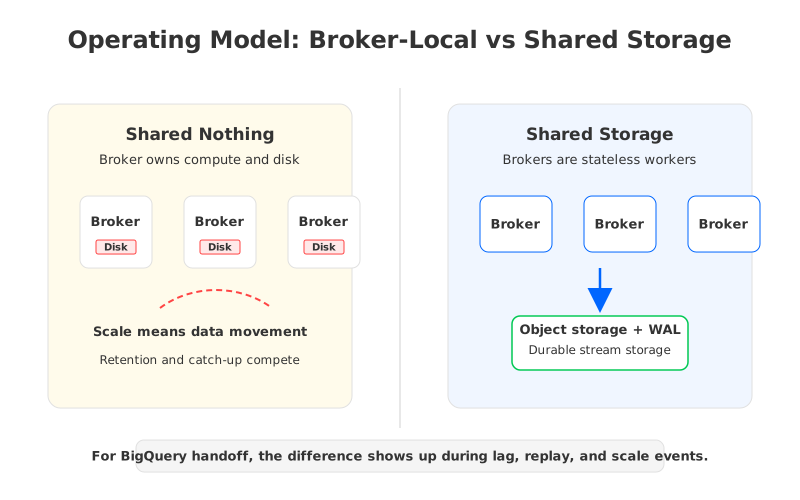
This is why platform teams should evaluate the streaming plane as part of the BigQuery architecture, not as a pre-existing box labeled "Kafka." The warehouse can only be as fresh and correct as the upstream contract allows. If the event backbone cannot absorb lag, provide deterministic replay, and scale around bursts, the BigQuery layer inherits instability from a system it does not control.
3Stream-to-table architecture options
The most direct path is a Kafka Connect sink that writes Kafka records to BigQuery. This works well when records already match the target table shape, transformations are light, and connector configuration is the operating unit. The consumer group offset is the progress boundary. Connector task count, error tolerance, dead-letter queues, schema mapping, and BigQuery write behavior become the control surface. Treat connector offsets and DLQ records as first-class recovery data, not as logs you inspect only after an incident.
A stream processor gives more control. Flink, Spark Structured Streaming, Kafka Streams, or a similar runtime can validate events, enrich records, deduplicate by business key, route rejects, and write to BigQuery through the appropriate API. The benefit is that the handoff becomes application logic with checkpointing and state. The cost is that the processor now owns where Kafka offsets, processing state, and BigQuery writes line up. If those positions are not observable together, a restart can become a duplicate-write or data-gap investigation.
The object-storage path is less glamorous and often more robust. Kafka records are written to Cloud Storage or another object store in partitioned files, and BigQuery loads or queries those files through a table-oriented mechanism. This pattern fits audit-heavy workloads, large backfills, or lakehouse-first teams. Its weakness is freshness: small files, partition layout, compaction, and table metadata become part of the streaming system.
There is also a hybrid pattern: keep Kafka compatibility for producers and operational consumers, but let selected topics materialize into object-storage-backed tables. In AutoMQ terminology, Table Topic is aimed at this kind of stream-to-table convergence for data lake ingestion. It does not remove the need to evaluate BigQuery's supported table and ingestion choices. It changes the question from "which sink connector do we run?" to "where should the stream become a governed table?"
4Evaluation checklist for platform teams
Before choosing a connector, processor, or table path, write down the contract the handoff must satisfy. The exercise exposes the operational promises that otherwise get buried inside a YAML file.
- Compatibility: Confirm the Kafka protocol features, client libraries, consumer group behavior, transactions if used, and schema registry expectations that existing producers and consumers depend on. A Kafka-compatible endpoint is useful only if the surrounding client behavior survives the move.
- Cost surface: Separate broker compute, retained storage, catch-up reads, inter-zone traffic, connector runtime, BigQuery ingestion, and BigQuery query cost. The largest surprise is often not the sink itself, but the replay and network path around it.
- Elasticity: Define what happens when producers spike, BigQuery slows down, or a backfill competes with live ingest. Scaling should not require a risky data shuffle during the incident you are trying to absorb.
- Governance: Map IAM, private connectivity, encryption, schema ownership, PII handling, and audit logs across Kafka, stream processing, object storage, and BigQuery. The handoff crosses security domains even when all services sit inside the same cloud account.
- Recovery: Test malformed events, partial writes, connector restarts, processor checkpoint restore, BigQuery table rollback, and full replay from an earlier offset. A design that has not replayed real production-shaped data has not proven its correctness.
- Migration: Plan dual-run, comparison queries, producer cutover, consumer group offset handling, and rollback. The migration path should be simpler than the steady-state architecture, not a special-case system no one can rehearse.
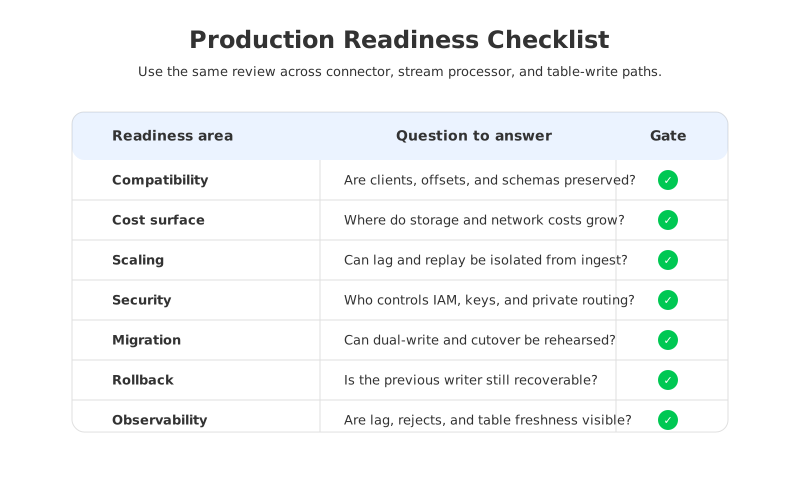
The checklist should end in a decision matrix, not a yes-or-no answer. A Kafka Connect sink may fit standard event loading. A stream processor may fit stateful correctness logic. A table/lakehouse path may fit a broader analytical data layer. What matters is that failure stays visible and recoverable.
5How AutoMQ changes the operating model
Once the evaluation framework is clear, the streaming data plane itself becomes a design variable. AutoMQ is a Kafka-compatible, cloud-native streaming platform that separates broker compute from durable stream storage. Its shared storage architecture uses object storage with a write-ahead log layer, while brokers act more like stateless workers than owners of local durable data. For BigQuery handoff workloads, lag, retention, and scaling pressure move away from broker-local disk as the central bottleneck.
That architectural shift changes several operating assumptions. Retention for replay no longer forces the same broker sizing conversation as live ingest. Replacing or scaling brokers is less tied to moving local log segments. Catch-up reads and historical replay can be planned around shared storage behavior rather than around which broker owns old data. AutoMQ's documentation describes Kafka compatibility, shared storage, stateless brokers, and inter-zone traffic reduction as core architecture areas, which are the dimensions that matter when a warehouse sink falls behind.
The BigQuery side still needs careful design. AutoMQ does not make bad schemas safe, make BigQuery quotas irrelevant, or turn a connector into a data quality system. It can change the streaming-platform work required to keep the upstream buffer elastic and recoverable. If a team is committed to Kafka semantics but wants a more cloud-native operating model, it belongs beside self-managed Kafka, managed Kafka services, and native GCP messaging in the evaluation.
There is also a deployment-boundary angle. BigQuery handoff pipelines often carry sensitive operational data, and enterprise teams care where credentials, networks, object storage, and logs live. AutoMQ's BYOC and software deployment models are relevant when the platform team wants Kafka compatibility while keeping the data plane close to its own cloud account, VPC, storage policies, and governance controls.
For teams exploring stream-to-table designs, AutoMQ Table Topic is worth reviewing as a separate pattern. It is not a generic promise that every BigQuery architecture becomes connector-free. It is a way to think about topics that also participate in object-storage-backed analytical tables, which may reduce the distance between streaming and table governance.
6A practical migration scorecard
A useful migration plan gives every stakeholder one question they can answer. Data engineers prove record-level correctness. SREs prove lag and restart behavior. Security teams prove access boundaries. Finance sees where cost grows under replay. Architects explain why the chosen handoff pattern fits the workload instead of merely matching a preferred tool.
| Scorecard item | Green signal | Red signal |
|---|---|---|
| Replay model | A tested offset or file-based replay path exists | Replay depends on manual table edits |
| Duplicate control | The write path has a documented idempotency or deduplication strategy | Duplicate handling is left to dashboard queries |
| Schema evolution | Compatible and breaking changes have different workflows | A table write failure is the first schema alert |
| Backpressure | Kafka lag, connector lag, and BigQuery errors are monitored together | Each team watches a different dashboard |
| Rollback | The previous writer and table state can be restored | Cutover is a one-way operation |
| Cost review | Retention, network, processing, and ingestion are modeled separately | The estimate treats streaming as one flat line item |
The scorecard also helps decide when not to stream directly. If the table is used for daily financial close, a governed object-storage load may be more appropriate than a low-latency streaming write. If the data feeds fraud scoring, personalization, and operations dashboards, Kafka should probably remain a reusable event backbone rather than a private pipe into BigQuery. If the workload needs both, separate the paths: use the stream for live consumers and a table-oriented route for analytical durability.
Back at the original search phrase, the hard part is not connecting Kafka to BigQuery. The hard part is deciding what the connection may forget, retry, duplicate, delay, and replay. If your team is evaluating a Kafka-compatible data plane for this boundary, review AutoMQ's architecture and Table Topic documentation, or talk with the AutoMQ team about a BYOC deployment model here: contact AutoMQ.
7References
- Apache Kafka Documentation: https://kafka.apache.org/documentation/
- Apache Kafka Connect Documentation: https://kafka.apache.org/documentation/#connect
- Google BigQuery Storage Write API: https://cloud.google.com/bigquery/docs/write-api
- Google BigQuery Streaming with the Storage Write API: https://cloud.google.com/bigquery/docs/write-api-streaming
- AutoMQ Architecture Overview: https://docs.automq.com/automq/architecture/overview
- AutoMQ S3Stream Shared Streaming Storage: https://docs.automq.com/automq/architecture/s3stream-shared-streaming-storage/overview
- AutoMQ Compatibility with Apache Kafka: https://docs.automq.com/automq/what-is-automq/compatibility-with-apache-kafka
- AutoMQ Table Topic Overview: https://docs.automq.com/automq/table-topic/overview
8FAQ
8.1What is a BigQuery streaming handoff from Kafka?
It is the boundary where Kafka or a Kafka-compatible data plane passes records into BigQuery through a connector, stream processor, API writer, object-storage load path, or table-oriented pattern. The handoff defines offset progress, retries, duplicates, schema changes, rejected records, and recovery.
8.2Should Kafka write directly to BigQuery?
Direct writes can work when data matches the target table and the failure mode is understood. If the pipeline needs enrichment, joins, deduplication, or strict quality gates, a stream processor may be safer. If replay, audit, or lakehouse governance matters more than low latency, object storage before BigQuery may be better.
8.3How should teams handle duplicate records?
Do not leave duplicates as an informal dashboard problem. Pick a strategy before production: connector-level guarantees where available, application-created BigQuery write streams with offsets, business-key deduplication in a processor, or table-level merge logic. The right answer depends on whether duplicates are harmless, expensive, or legally unacceptable.
8.4Where does Kafka-compatible infrastructure matter most?
It matters most during lag, replay, scaling, and recovery. A steady low-volume pipeline can hide weak infrastructure decisions for a long time. A failed connector, a large backfill, or a BigQuery-side slowdown exposes whether the upstream data plane can retain data, serve catch-up reads, and isolate producers from sink instability.
8.5Is AutoMQ a replacement for BigQuery ingestion design?
No. BigQuery ingestion design still needs clear table schemas, write semantics, quotas, governance, and observability. AutoMQ is relevant when the upstream Kafka-compatible data plane needs cloud-native elasticity, shared storage, stateless brokers, and deployment boundaries that fit enterprise cloud operations.


