
Table of Contents
Table of Contents
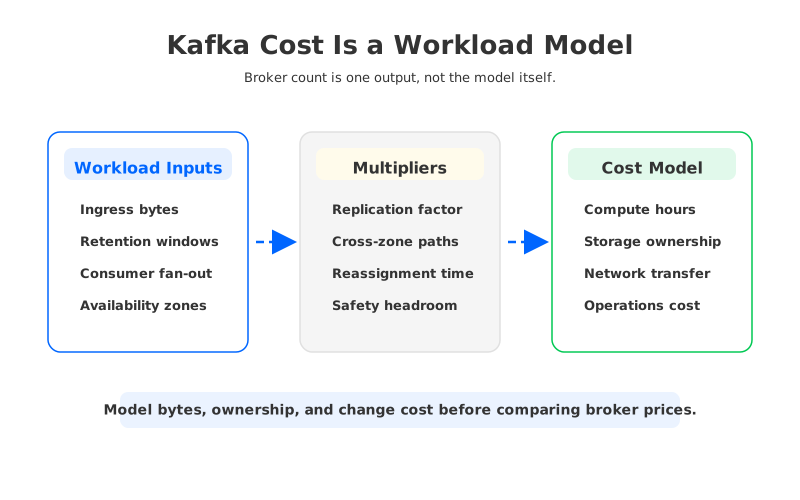
Most Kafka cost conversations start in the wrong place. A team opens a pricing page, counts brokers, picks a storage size, and tries to turn that into a monthly number. That can be useful for a first procurement estimate, but it is not a production cost model. Kafka cost is shaped by workload behavior, retention, replication, network topology, operational change rate, and the amount of capacity you reserve for failure rather than traffic.
The broker count still matters. It tells you how many compute units you are paying for and it gives procurement a line item they can compare. The problem is that Kafka brokers are not pure compute nodes in the traditional Apache Kafka architecture. They also carry local storage, replica placement, partition leadership, catch-up traffic, and recovery work. When one number tries to represent all of those jobs, it hides the part of the bill that usually surprises teams later.
1Why Teams Search for Kafka Cost
The search usually happens at one of three moments. A team may be planning an event streaming platform and needs a budget before architecture is final. Another team may already run Kafka and is trying to explain why the bill grows faster than throughput. A third team may be comparing managed Kafka, self-managed Kafka, and Kafka-compatible systems because the current platform is reaching a scaling or operating limit.
Those moments look similar in a search box, but they need different answers. An early budget can tolerate broad assumptions. A cost investigation needs to isolate the expensive path. A platform replacement decision needs to include migration risk, client compatibility, support model, and behavior under higher traffic or changed retention. A single per-broker price cannot answer all of those questions.
The useful first move is to separate billable resources from architectural amplifiers. Billable resources are the visible units: broker instances, storage volumes, object storage, load balancers, data transfer, support plans, and managed service fees. Architectural amplifiers are the mechanics that multiply those units: replication factor, cross-zone placement, partition movement, hot reads, retention, compression ratio, and recovery behavior after a broker or zone failure.
| Cost Layer | What Finance Sees | What Engineering Must Model |
|---|---|---|
| Compute | Broker or instance hours | CPU headroom, leader distribution, rebalance frequency |
| Storage | Disk, volume, or object storage charges | Retention, replica factor, segment layout, compaction, overprovisioning |
| Network | Data transfer line items | Producer path, replication path, consumer path, cross-AZ routing |
| Operations | Staff time and tooling | Upgrade windows, partition reassignment, incident recovery, capacity planning |
| Migration | One-time project cost | Client compatibility, cutover path, rollback path, data validation |
The table is deliberately more boring than a calculator. That is the point. Kafka cost becomes manageable when each line has an owner and a measurement strategy. It becomes political when the bill arrives as a bundle of infrastructure charges that no team can map back to a workload decision.
2The Workload Inputs Most Cost Pages Skip
The minimum Kafka cost model starts with throughput, but throughput alone is not enough. Write volume determines the first copy of the data. Replication determines how many times that write is transmitted and stored inside the cluster. Retention determines how long the data stays on paid media. Consumer fan-out determines whether reads are a minor add-on or a cost center of their own.
A practical model needs these inputs before any architecture comparison is meaningful:
- Ingress and egress by byte, not event count. Event count is useful for application thinking, but infrastructure bills follow bytes. Compression ratio, record size, batch size, and protocol overhead can move the actual byte rate far away from the business event rate.
- Retention by workload class. A fraud topic with seven days of retention and a replay-heavy analytics topic with 30 days of retention should not be averaged into one "Kafka retention" number. They create different storage and read patterns.
- Consumer fan-out and replay behavior. A topic consumed by one service behaves differently from a topic consumed by 20 teams, especially when downstream jobs perform backfills or reprocess historical windows.
- Availability topology. Multi-AZ deployment is a reliability requirement for many production systems, but it also changes where data moves. Cross-zone producer, replica, and consumer paths deserve their own line in the model.
- Change rate. Clusters that frequently add topics, repartition workloads, scale brokers, or move tenants pay operational cost even when the steady-state bill looks fine.
This is where many estimates understate the real number. They price the happy path: steady traffic, stable partition count, no backfills, no broker failures, no retention surprises. Production Kafka spends a lot of its life outside that happy path. It absorbs traffic spikes, recovers replicas, catches up followers, rebalances leaders, and serves consumers that are not always local to the leader that owns their partitions.
3Broker Count Hides Storage and Network Multipliers
Traditional Apache Kafka uses a shared-nothing architecture. Each broker owns local log segments for its partitions, and durability is achieved by replicating those segments across brokers. This design is mature and widely understood. It also means the broker is not a disposable compute worker; it is part of the storage system.
That coupling creates two cost multipliers. The first is storage multiplication. If a topic is replicated across three brokers, the cluster stores multiple broker-side copies before any cloud block storage replication or snapshot policy is considered. The second is network multiplication. Data is not only written from producer to broker; it is also copied between brokers for replication and later read by consumers, often across zones when clients and leaders are not co-located.
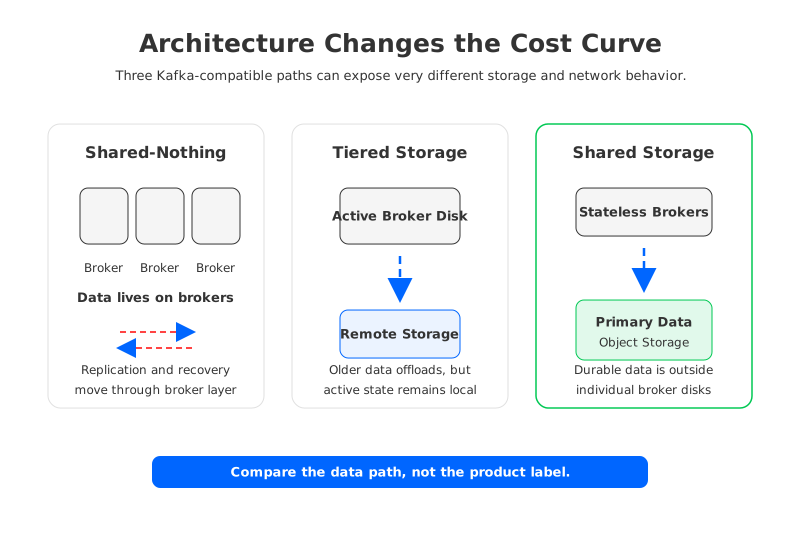
Cloud infrastructure makes these multipliers visible. In a private data center, internal replication traffic might be treated as sunk network capacity. In a public cloud, cross-zone transfer is a billable resource. In a self-managed cluster, oversized disks may look like conservative capacity planning. In a managed service, storage and broker classes become commercial packaging decisions. Neither model is automatically wrong, but both need the same architectural accounting.
Apache Kafka's tiered storage changes part of the equation by offloading older log segments to remote storage. That can reduce local storage pressure for retention-heavy workloads, and it is an important direction in the Kafka ecosystem. It does not make brokers stateless. Recent data still lands on broker-local storage first, partition placement still matters, and reassignment still moves active responsibility through the broker layer.
The distinction matters for cost modeling because "uses object storage" is not the same as "object storage is the primary storage layer." Tiered storage reduces some storage pressure after data cools. A shared-storage design changes the ownership boundary: brokers can become more compute-oriented because the durable data layer lives outside individual broker disks. Those two architectures have different failure recovery, scaling, and network profiles.
4A Practical Kafka Cost Framework
The best cost model is not the most detailed spreadsheet. It is the one that tells you which architectural decision changes the curve. Start with a workload unit that finance and engineering can both understand, such as one TiB written per day with a defined retention period and consumer fan-out. Then model what happens to that unit as it moves through the system.
Use four questions as the backbone:
- How many durable copies are created, and where are they paid for? Separate Kafka-level replication from cloud storage durability. If both layers replicate data, the cost model should show both layers instead of hiding one inside a generic storage line.
- Which bytes cross an availability-zone or region boundary? Producer routing, broker replication, consumer reads, and replication between clusters can each create transfer charges. Treat network as a first-class cost, not an afterthought.
- What capacity is reserved for safety rather than used by traffic? Disk headroom, broker CPU headroom, spare partitions, and recovery bandwidth may be necessary. They should still be visible as risk reserves.
- How expensive is change? Scaling, broker replacement, partition reassignment, tenant growth, and upgrades all consume engineering time. A platform that looks inexpensive at steady state can become costly if every change requires long rebalancing windows.
This framework also prevents a common procurement mistake: comparing a self-managed cluster, a managed Kafka service, and a Kafka-compatible engine as if they were only different prices for the same broker. They are different operating models. Managed Kafka may reduce staffing cost while keeping the same core Kafka storage mechanics. Self-managed Kafka may offer more control but push more burden onto the platform team. A Kafka-compatible shared-storage engine may change the compute, storage, and network relationship enough that broker count is no longer the right center of gravity.
| Decision | Cost Question | Architecture Signal |
|---|---|---|
| Replication factor | How many broker-side copies are paid for? | Shared-nothing designs store durability inside brokers |
| Tiered storage | How much local disk remains required for active data? | Object storage may be secondary, not primary |
| Multi-AZ routing | Which paths generate transfer charges? | Cross-zone producer, replica, and consumer flows need measurement |
| Elastic scaling | How long does capacity change take? | Stateful brokers usually require data movement |
| Compatibility | What must change in applications? | Kafka protocol support reduces migration cost |
5How AutoMQ Fits the Evaluation
Once the evaluation reaches architecture rather than line-item pricing, AutoMQ becomes relevant as a Kafka-compatible shared-storage option. AutoMQ keeps Kafka protocol compatibility while replacing Kafka's broker-local log storage with S3Stream, a storage layer that uses object storage as the primary repository and a write-ahead log layer for efficient writes and recovery. In practical terms, the evaluation question changes from "how many stateful brokers do we need?" to "how much compute, durable storage, and network movement does this workload require?"
That distinction is useful when cost pressure comes from storage growth, cross-zone replication, or slow operational change. In AutoMQ's architecture, brokers are designed to be stateless because durable data is stored in shared cloud storage rather than tied to local broker disks. That can reduce the operational weight of scaling and partition movement. It also gives teams a different way to reason about retention-heavy workloads: object storage is not a cold archive bolted onto broker storage; it is the main storage layer.
AutoMQ's documentation also describes a zero inter-zone traffic design for supported deployments. The core idea is to avoid broker-to-broker replica traffic across zones and route producer and consumer paths so clients can communicate locally where possible. The exact savings depend on workload, cloud, and configuration, so the disciplined way to evaluate it is to measure current cross-zone producer, replication, and consumer bytes first. If those bytes are a large part of the bill, the architecture is worth a serious look.
Compatibility is the other half of the cost conversation. A platform that lowers infrastructure cost but forces a large application rewrite may still be expensive. AutoMQ positions itself as compatible with Apache Kafka protocols and ecosystem components, which means the migration assessment should focus on version compatibility, client configuration, connectors, security policies, operational runbooks, and cutover mechanics rather than a wholesale application redesign.
The useful question is not whether a Kafka-compatible system has a lower sticker price. The useful question is whether its architecture removes the cost multiplier that is hurting your workload.
6Buyer Checklist: What to Ask Before You Commit
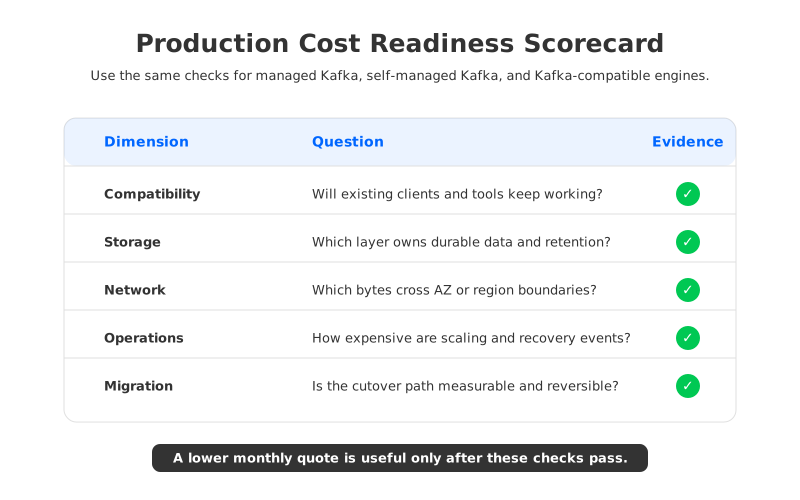
A good Kafka cost review ends with evidence, not adjectives. Before committing to a platform, ask vendors and internal platform teams for answers that can be measured in your environment.
- Show the byte path. For one TiB of produced data, document how many bytes are written to brokers, replicated between brokers, written to object storage, read by consumers, and transferred across zones.
- Separate steady-state and change-state cost. Include normal traffic, broker replacement, scale-out, partition reassignment, consumer backfill, and zone failure behavior.
- Model storage by temperature and ownership. Identify what stays on local or block storage, what moves to object storage, and which layer is authoritative for recovery.
- Validate Kafka semantics and ecosystem fit. Check producers, consumers, Kafka Connect, stream processors, ACLs, transactions if used, monitoring, and operational tooling.
- Put migration into the same model. Include mirroring duration, validation cost, rollback plan, data retention overlap, and team training.
The strongest teams turn this checklist into a small benchmark and billing exercise. They run a representative workload, inspect cloud bills and metrics, then compare the result against the model. The goal is not perfect prediction. The goal is to expose the hidden multiplier before the platform becomes a dependency for hundreds of applications.
Compare the workload architecture, not only the service price. Measure durable storage ownership, network paths, operational change time, Kafka compatibility, migration effort, and support requirements. If your current cost curve is driven by stateful broker storage and cross-zone movement, review AutoMQ's BYOC deployment model as the next evaluation step.
7References
- Apache Kafka documentation, including replication and tiered storage: https://kafka.apache.org/documentation/#replication and https://kafka.apache.org/documentation/#tiered_storage
- Apache Kafka KIP-405: Tiered Storage: https://cwiki.apache.org/confluence/display/KAFKA/KIP-405%3A+Kafka+Tiered+Storage
- AWS Managed Streaming for Apache Kafka pricing: https://aws.amazon.com/msk/pricing/
- AWS EC2 data transfer pricing: https://aws.amazon.com/ec2/pricing/on-demand/#Data_Transfer
- AWS S3 pricing: https://aws.amazon.com/s3/pricing/
- AutoMQ Apache Kafka compatibility: https://docs.automq.com/automq/what-is-automq/compatibility-with-apache-kafka?utm_source=blog&utm_medium=reference&utm_campaign=gs100-0072
- AutoMQ architecture overview: https://docs.automq.com/automq/architecture/overview?utm_source=blog&utm_medium=reference&utm_campaign=gs100-0072
- AutoMQ inter-zone traffic overview: https://docs.automq.com/automq/eliminate-inter-zone-traffics/overview?utm_source=blog&utm_medium=reference&utm_campaign=gs100-0072
8FAQ
8.1Is broker count useless for Kafka cost planning?
No. Broker count is a useful starting point for compute and managed-service packaging. It becomes misleading when it is treated as the whole model because Kafka brokers often carry storage, replication, recovery, and reassignment responsibilities.
8.2What is the biggest hidden Kafka cost?
It depends on the workload, but cross-zone data transfer, overprovisioned storage, and operational change cost are common surprises. Teams should measure producer, replication, and consumer byte paths separately instead of relying on aggregate throughput.
8.3Does tiered storage solve Kafka cost issues?
Tiered storage can help retention-heavy workloads by moving older data to remote storage. It does not automatically make brokers stateless or remove the need to model active local storage, replication, reassignment, and network paths.
8.4When should a team consider a Kafka-compatible shared-storage architecture?
It is worth evaluating when cost pressure comes from storage growth, cross-zone replication traffic, slow scaling, or high operational overhead around stateful brokers. Client and ecosystem compatibility still need to be validated before migration.
8.5How should AutoMQ be evaluated against managed Kafka services?
Compare the workload architecture, not only the service price. Measure durable storage ownership, network paths, operational change time, Kafka compatibility, migration effort, and support requirements before choosing a managed service, self-managed deployment, or Kafka-compatible shared-storage platform.


