
Table of Contents
Table of Contents
Teams usually search for object backed event retention kafka after Kafka retention has stopped looking like a storage setting and started looking like a production risk. Brokers are not out of disk every day, but enough warning lights appear to make the platform team uneasy: partition reassignment takes longer than expected, recovery consumes network budget, cold consumer reads disturb hot traffic, and the next retention increase requires another capacity review. The cluster still works, yet disk ownership has become the hidden constraint behind release planning.
That is the moment when object-backed retention becomes a serious architecture topic. The question is not whether object storage can hold bytes durably. Cloud object storage has already become the default durable substrate for many data platforms. The harder question is whether a Kafka-compatible streaming system can use object storage in a way that preserves producer and consumer semantics, keeps operational failure modes understandable, and avoids turning every broker replacement into a data movement exercise.
Broker disk pressure is a useful place to start because it exposes the difference between storage capacity and storage coupling. A cluster can have enough raw GiB and still be fragile if data ownership, leadership, cache locality, and failure recovery are all bound to the same broker fleet. Object-backed retention should be evaluated as a change to that coupling, not as a larger bucket attached to the side of Kafka.
1Why teams search for object backed event retention kafka
The search intent is almost always operational. A data platform team wants longer replay windows for backfills, audit, fraud review, feature recomputation, or lakehouse ingestion. An SRE team wants broker replacement to be a routine event, not a weekend operation. A FinOps owner wants to understand why the same topic data appears to drive block storage, replica traffic, inter-zone movement, and emergency headroom at the same time.
Traditional Kafka made a sensible trade-off for its original environment. A broker stores local log segments, replicates them to other brokers, and serves consumers from those segments. That design gives Kafka excellent sequential I/O behavior and clear per-partition ownership. It also means storage and compute scale together unless additional architecture is introduced.
The cloud changes the cost and failure model around that trade-off. Local disks, cloud block volumes, inter-zone traffic, and object storage are separate services with separate durability, pricing, and operational behaviors. When Kafka keeps durable topic data tied to brokers, the platform team has to plan capacity for the busiest combination of retention, replication, leader placement, reads, and recovery. Most clusters do not fail because one number was wrong. They become expensive or brittle because several numbers must be right at the same time.
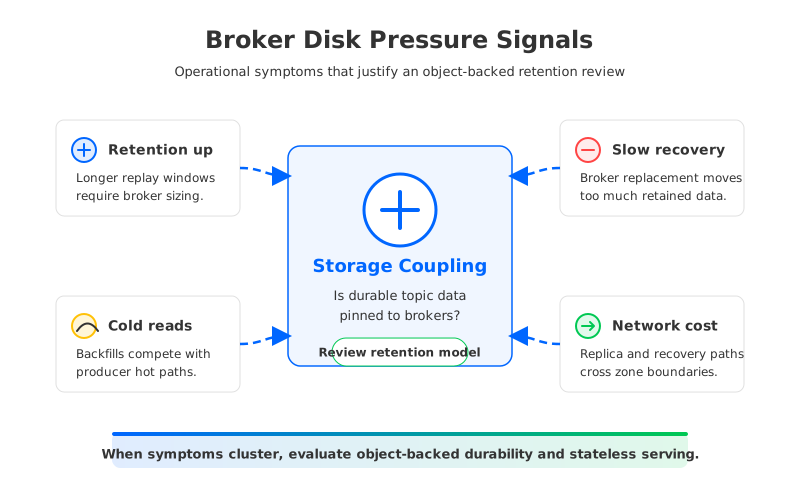
The strongest signal is not a single disk utilization threshold. It is a pattern of operational symptoms:
- Retention increases trigger broker sizing work. If every longer replay window requires larger nodes or more broker-local storage, retention is coupled to compute procurement.
- Broker replacement moves too much data. If replacing a failed or drained broker causes large partition movement, the recovery path is tied to local log ownership.
- Cold reads disturb hot traffic. If backfills or long-lag consumers compete with active producers on the same broker resources, retained data is not isolated from the hot path.
- Cross-zone traffic is hard to explain. If replication, producers, consumers, and rebalancing all contribute to the network bill, the storage model is leaking into the cloud bill.
- Capacity buffers keep growing. If the team needs large headroom to survive recovery, expansion, and retention spikes, the cluster is paying for risk rather than workload.
Those symptoms do not prove that object-backed retention is the answer. They prove that the current operating model deserves a storage architecture review.
2The storage constraint behind cloud Kafka
Kafka operators often talk about disk pressure as if it were only a utilization metric. In practice, broker disk pressure is a compound signal. Disk full risk is one part of it, but the deeper issue is that disk ownership determines where topic data lives, which brokers can serve it efficiently, how fast the cluster can recover, and how much network traffic recovery generates.
Tiered Storage, described in Apache Kafka's KIP-405 work and Kafka documentation, addresses one piece of this constraint by allowing older log segments to move to remote storage. This is valuable for retention-heavy topics because cold data no longer has to remain entirely on broker-local storage. It also preserves much of Kafka's existing model: brokers still own the hot path, local logs still matter, and operators still need to reason about cache behavior, remote reads, local tier sizing, and metadata overhead.
Object-backed retention goes further when the system treats object storage as the primary durable home for event data rather than a cold archive attached to local logs. Apache Kafka KIP-1150 discusses diskless topics in this direction, and Kafka-compatible systems can implement shared-storage designs that make brokers closer to a serving layer. The architectural promise is simple: if durable data is not pinned to individual broker disks, broker replacement, scaling, and retention growth can stop being dominated by local data movement.
The promise has to be tested carefully because object storage is not a local SSD with a different API. Writes are batched, acknowledged through a durable write path, cached for low-latency reads, and recovered through cloud storage semantics. Reads may behave differently depending on cache warmth, object layout, request concurrency, and consumer lag. A production platform team should avoid both extremes: assuming object storage makes Kafka storage trivial, or assuming local disk is always the right answer because it is familiar.
The practical framing is to separate three questions:
| Question | Why it matters | Evidence to collect |
|---|---|---|
| Where is durable topic data stored? | Determines whether broker replacement requires moving retained logs. | Storage path, WAL behavior, object layout, recovery design. |
| Which reads depend on broker-local cache? | Determines whether replay and lag create hot-path interference. | Cache hit rate, fetch latency, cold replay throughput, consumer lag. |
| What traffic crosses zones? | Determines whether storage architecture shows up as network cost. | Producer placement, consumer placement, replication paths, restore paths. |
The table is intentionally vendor-neutral. A local-disk cluster, a tiered-storage cluster, and a shared-storage cluster can all pass or fail these checks depending on implementation and workload shape.
3Architecture options: local disk, tiered storage, and shared storage
Most teams compare three families when broker disk pressure becomes material. The first is broker-local Kafka, where the team manages the pressure with better sizing, partition placement, quotas, and reassignment discipline. This is still the right answer for some workloads because the model is mature and widely understood. It becomes harder when retention growth, elastic scaling, or failure recovery dominates the operational calendar.
The second family is Kafka with Tiered Storage. It reduces local disk pressure by moving older segments to remote storage, while brokers remain central to the hot path and topic ownership. This can be a good fit when the team wants longer retention without changing too much of the current operating model. The risk is that tiering can be mistaken for statelessness. Remote storage reduces one storage burden; it does not automatically make brokers disposable.
The third family is Kafka-compatible shared storage. In this model, brokers serve Kafka requests, but durable stream data is written through a WAL and stored in shared object storage. The serving layer can then be scaled and replaced with less dependence on broker-local retained data. This model changes the operational checklist: the team now validates WAL durability, object storage behavior, cache efficiency, metadata recovery, and network topology instead of focusing mainly on local disks.
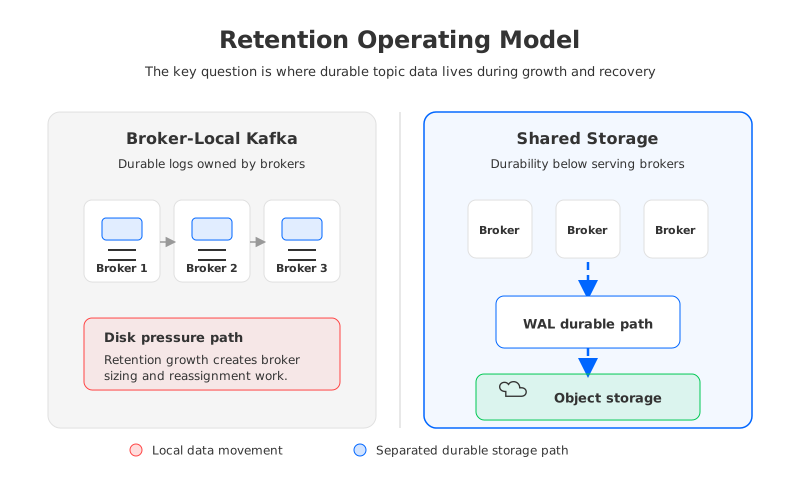
The most useful distinction is not "disk" versus "no disk." Many shared-storage systems still use local media for cache, logs, temporary files, or other implementation details. The real distinction is whether broker-local storage is the source of durable truth for topic data. If it is, disk pressure remains a cluster-shaping force. If it is not, the team can evaluate brokers as a compute and serving layer, with durability handled below that layer.
4Evaluation checklist for platform teams
An object-backed retention review should be run like a production launch review. The goal is to decide whether a particular workload can move to a storage model where retained data is durable outside broker-local disks, while the Kafka-facing application contract remains stable.
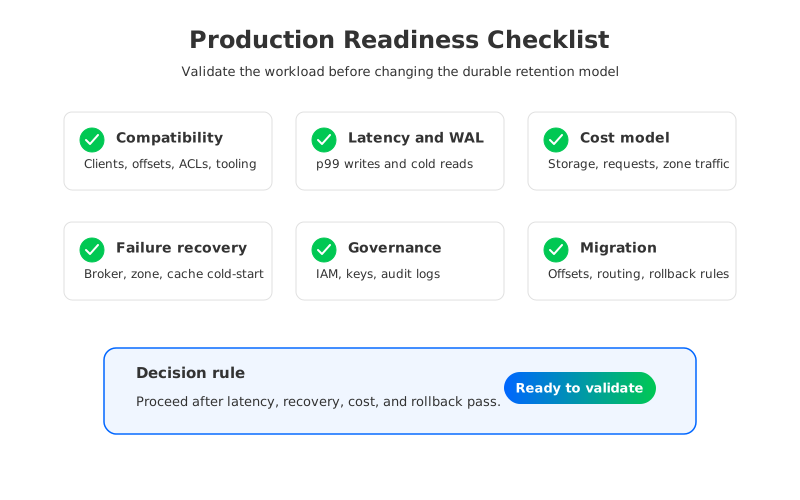
Start with compatibility. Inventory the Kafka features your applications use: producer idempotence, transactions, consumer groups, offset commits, ACLs, quotas, Kafka Connect, MirrorMaker-style migration, stream processing frameworks, and operational tooling. Kafka protocol compatibility is necessary, but real compatibility includes admin behavior, metrics, error timing, and the operational scripts your team already depends on.
Then test latency and durability together. A shared-storage architecture usually acknowledges writes through a WAL and later moves data to object storage. That can work well for logs, observability events, audit streams, asynchronous application events, and replay-heavy pipelines. It needs direct proof for workloads where p99 producer latency, transaction completion, or end-to-end freshness is the primary service-level objective.
Cost modeling should include storage, network, object requests, private connectivity, block volumes, and operational headroom. AWS and Google Cloud publish network pricing separately from object storage and compute pricing, which is the point: architecture determines which service meters move when traffic or retention grows. A model that ignores inter-zone traffic or recovery traffic will understate the value of reducing broker-local replication and data movement.
Failure testing should include broker loss, zone loss, object storage throttling, WAL degradation, cache cold-start, metadata controller failover, slow consumers, and long replay. The test should measure time to return to a known-good state, not only steady-state throughput. Broker disk pressure is often most painful during recovery, so a proof of concept that avoids failure drills is not answering the real question.
Governance matters because object-backed retention shifts responsibility toward cloud-native controls. Buckets, IAM roles, encryption keys, VPC endpoints, audit logs, and private networking become part of the streaming platform boundary. Regulated teams should decide where data lives, where the control plane operates, who can access operational metadata, and how deleted or expired data is governed.
Migration deserves the same rigor. Topic data, partition counts, offsets, consumer group progress, ACLs, producer routing, observability, and rollback rules all need validation. A migration plan that only proves producers can write to the target cluster is incomplete. The safer plan proves that consumers can continue from expected offsets, operators can detect divergence, and the team has a defined rule for pausing, promoting, or rolling back.
5How AutoMQ changes the operating model
Once the evaluation shows that broker-local durable storage is the constraint, AutoMQ becomes relevant as a Kafka-compatible streaming platform built around Shared Storage architecture. AutoMQ keeps Kafka protocol compatibility while moving durable stream storage into S3Stream, WAL storage, object storage, and cache layers. Brokers remain responsible for serving Kafka requests, partition leadership, scheduling, and cache behavior, but retained event data is no longer treated as durable broker-local ownership.
That architecture changes the disk-pressure conversation. Instead of asking how much local disk every broker needs for the next retention target, the team asks which WAL option, object storage backend, cache policy, and deployment boundary match each workload tier. Compute and storage can be evaluated separately. Broker replacement is no longer defined mainly by how fast retained logs can be copied from one broker to another.
AutoMQ's documentation also makes the network discussion concrete. The platform is designed to reduce cross-AZ traffic under supported deployment patterns, including server-side traffic caused by replica movement in traditional Kafka architectures. This should still be validated with the customer's topology because client placement, rack awareness, private networking, and cloud provider pricing all affect the result. The important shift is that network cost becomes a property to measure at the architecture boundary, not an unavoidable side effect of local replica ownership.
Migration is where Kafka compatibility and storage architecture meet. AutoMQ Kafka Linking is designed for moving data from Kafka-compatible sources while preserving partition counts, message offsets, and consumer progress, with a producer proxy path for lower-disruption cutover planning. A careful platform team will still rehearse the migration with representative topics. The difference is that the target architecture can be evaluated against the same pressure signals that motivated the project: less broker-local retained data, faster broker recovery, clearer cross-zone traffic, and a more explicit durability path.
If your team is evaluating object backed event retention kafka, start by instrumenting the disk pressure signals rather than debating product categories. Measure the recovery path, cold-read behavior, network paths, cache efficiency, and migration boundary for one representative workload from each tier. To examine how AutoMQ implements Kafka-compatible Shared Storage architecture, use the AutoMQ architecture overview as the next technical entry point.
6References
- Apache Kafka documentation: Tiered Storage
- Apache Kafka KIP-405: Kafka Tiered Storage
- Apache Kafka KIP-1150: Diskless Topics
- Apache Kafka documentation: Consumer Groups
- AutoMQ compatibility with Apache Kafka
- AutoMQ S3Stream Shared Streaming Storage overview
- AutoMQ WAL Storage
- AutoMQ Kafka Linking overview
- AutoMQ inter-zone traffic broker configuration
- Amazon S3 data durability documentation
- AWS EC2 data transfer pricing
- Google Cloud VPC network pricing
7FAQ
7.1Is object-backed Kafka retention the same as Tiered Storage?
No. Tiered Storage usually means older log segments move to remote storage while brokers still own the hot path and local log lifecycle. Object-backed retention can mean a stronger shared-storage design where object storage is the primary durable home for event data, with a WAL and cache layer protecting latency and durability.
7.2Does object-backed retention remove all broker disks?
Not necessarily. Brokers may still use local media for cache, temporary files, logs, metadata-related files, or implementation-specific needs. The important question is whether durable topic data is pinned to broker-local disks.
7.3Which workloads benefit most from object-backed retention?
Retention-heavy logs, audit events, observability streams, lakehouse ingestion, asynchronous application events, and replay-heavy pipelines are common candidates. Workloads with strict p99 producer latency or transaction timing requirements need direct testing before moving away from a broker-local hot path.
7.4What metrics should platform teams track during evaluation?
Track disk utilization, reassignment duration, broker replacement time, producer latency, fetch latency, consumer lag, cache hit rate, WAL latency, object storage request errors, recovery time, and cross-zone traffic. The strongest evaluation ties those metrics to one representative workload, not a synthetic topic shape.
7.5Where does AutoMQ fit in this architecture decision?
AutoMQ fits when the team wants Kafka compatibility with Shared Storage architecture, stateless brokers, object-storage-backed durability, WAL options, and deployment boundaries that can be validated inside the customer's cloud environment. It should be evaluated after the team defines workload tiers, failure drills, migration gates, and cost signals.


