
Table of Contents
Table of Contents
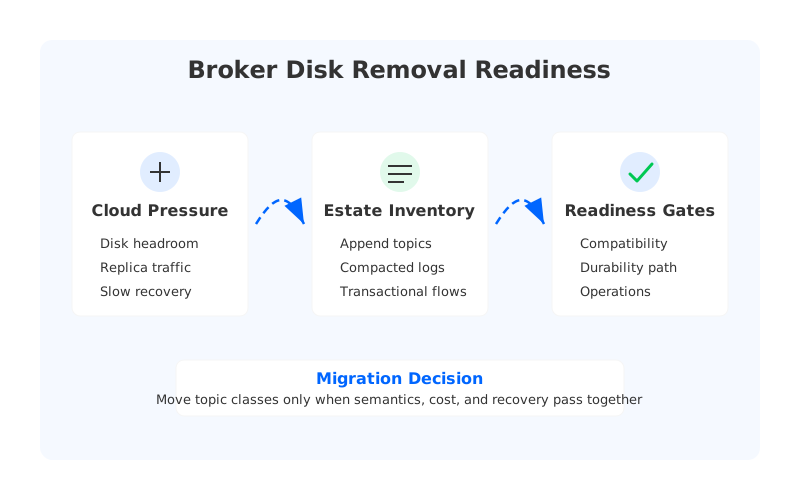
Teams searching for diskless kafka are usually past the curiosity stage. They have already felt the operational weight of broker-attached storage: disks sized for peak retention, partition reassignments that take too long, replica traffic that shows up in cloud bills, and recovery plans that depend on moving large local logs around the fleet. The useful question is not whether a broker can literally run without any disk. Apache Kafka's own KIP-1150 makes that distinction explicit: "diskless" means broker disks stop being the primary durable store for user data, while disks may still be used for metadata, cache, or temporary buffering.
That shift is big enough to deserve a readiness review before a platform team touches production. Traditional Kafka estates are not one cluster. They are a collection of topic classes, client behaviors, retention policies, security rules, monitoring assumptions, procurement contracts, and incident runbooks. Broker disk removal changes several of those assumptions at once. A good readiness process turns the diskless Kafka idea into a sequence of engineering gates: which workloads can move, which semantics must be preserved, which costs actually change, and which operational risks move into shared storage.
1Why Broker Disks Became the Wrong Center of Gravity
Classic Kafka was designed around a replicated local log. Brokers own partition replicas, leaders accept writes, followers replicate records, and consumers fetch by offset from the retained log. That model remains technically sound, especially for low-latency local storage. The problem is that cloud infrastructure changes the economics around every byte. Broker-local durability now means provisioned block storage, storage headroom, zone-aware replica placement, and network paths between clients and leaders.
Tiered storage reduces part of this burden by moving older segments to remote storage. It is valuable when long retention is the main problem, but it does not remove the need to handle active segments, replica durability, and hot-path broker disks. Diskless Kafka starts from a stronger claim: if object storage and shared cloud storage are already the durable foundation for many systems, Kafka-like streaming should be able to use that foundation for primary topic data instead of treating broker disks as the durable home.
That does not make object storage a magic log. Streaming writes still need ordering, acknowledgment rules, offset assignment, metadata, cache locality, and failure recovery. The readiness question is therefore not "can we put Kafka data in S3?" It is whether the target storage path preserves the behaviors your applications already rely on while reducing the operational work that broker-local disks create.
2Start With an Estate Inventory
A readiness review should start with workload classes, not a vendor shortlist. Most Kafka estates contain several very different topic families that happen to run on the same platform. An append-only observability topic, a compacted metadata topic, a Kafka Streams changelog, a transactional event pipeline, and a long-retention audit log do not create the same risk when storage ownership changes.
Group the estate into a small number of classes and score each class separately:
- Append-heavy ingestion: usually the easiest candidate because the workload depends on ordered appends and durable replay more than log mutation.
- Compacted and stateful topics: require deeper validation because compaction, state stores, and changelog semantics can expose gaps in diskless implementations.
- Transactional pipelines: need explicit testing for idempotent producers, transactions, fencing behavior, and recovery after broker or storage-path failure.
- High fan-out analytics: should be reviewed for cache behavior, remote fetch amplification, and object storage request patterns.
- Regulated retention: needs storage policy, encryption, lifecycle, auditability, and deletion semantics reviewed together.
This inventory prevents a common mistake: averaging the estate. A diskless Kafka design may be an excellent fit for high-throughput append workloads and still be risky for compacted changelogs if the implementation does not support the same semantics. The output of the inventory is not a yes-or-no decision. It is a migration map.
3The Five Readiness Gates
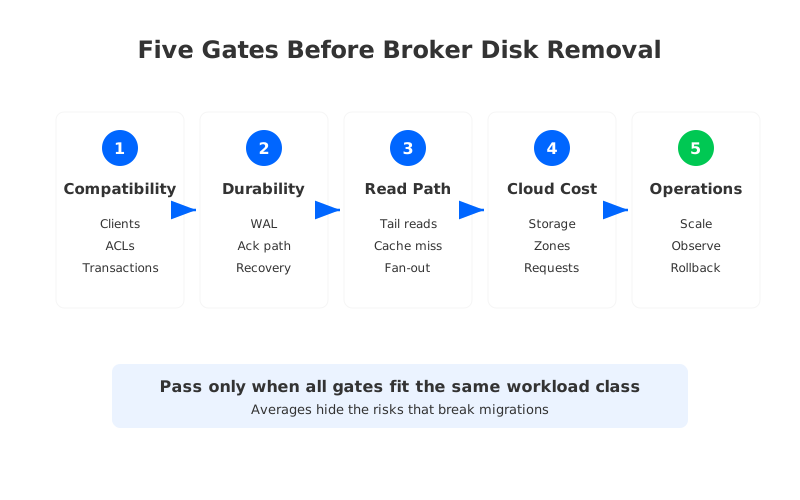
Once the workload classes are clear, the evaluation can move through five gates. Each gate asks a different question because diskless Kafka changes both architecture and operations.
| Gate | What to Validate | Failure Signal |
|---|---|---|
| Compatibility | Kafka clients, admin APIs, ACLs, transactions, compaction, consumer groups, schema tooling, connectors | Applications need rewrites or topic classes lose required semantics |
| Write durability | What must complete before produce acknowledgment, and how incomplete uploads recover | A broker loss can orphan acknowledged data or block offset recovery |
| Read behavior | Tail reads, catch-up reads, cache misses, high fan-out consumers, and lagging consumers | Consumers create unpredictable storage requests or latency spikes |
| Cloud cost | Broker storage, replica traffic, inter-zone paths, object storage requests, WAL resources | The bill moves instead of shrinking, or savings depend on unrealistic traffic placement |
| Operations | Scaling, upgrades, observability, rollback, incident response, disaster recovery, governance | The team cannot operate the added dependencies under incident pressure |
The first gate matters most. Kafka compatibility is not a logo. It is the sum of the behaviors applications have learned to assume: ordering by partition, offset visibility, retention, compaction, transactions, consumer group coordination, quotas, authentication, authorization, metrics, and ecosystem tools. KIP-1150 states that Diskless Topics are intended to preserve existing external semantics, but it also points to follow-up KIPs for implementation details. Buyers should treat upstream direction as important validation of the category, not as evidence that their current Apache Kafka release already includes a production-ready diskless implementation.
4Cost Modeling: Which Bytes Stop Moving?
Diskless Kafka cost analysis should be concrete. The expected savings usually come from reducing broker-attached storage pressure, avoiding unnecessary replica data movement, shrinking scaling and reassignment work, and changing which bytes cross availability zones. But those savings are workload-dependent. A platform can reduce replica traffic and still spend more on object storage requests, WAL resources, cache misses, or poorly placed consumers.
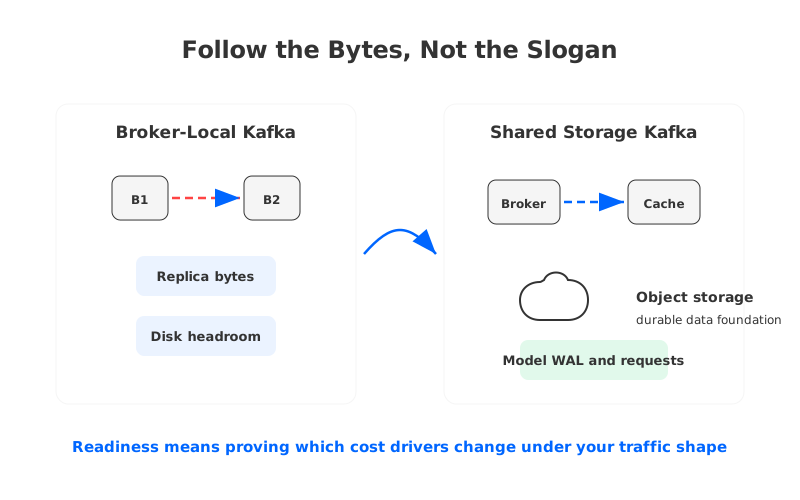
The most useful model follows bytes through the system. For each workload class, estimate producer ingress, replication or shared-storage writes, consumer egress, catch-up reads, retention volume, and inter-zone paths. Then compare the current design with the target design. In traditional Kafka, the active log is replicated across brokers, and those brokers often sit across zones for availability. In a shared-storage design, the durable store may become regional object storage, while brokers act more like request, cache, and coordination capacity.
This is where a readiness review should avoid generic "lower TCO" claims. Some workloads are dominated by retained storage. Others are dominated by read fan-out. Some clusters spend heavily on inter-zone traffic because producers or consumers are not aligned with leaders. Others have tight latency goals that require a lower-latency WAL path. The architecture may still be worth adopting, but the cost model should show which line items change and which added dependencies appear.
5Migration Risk Is Mostly About Contracts
The practical migration question is not whether a target cluster can pass a benchmark. It is whether existing application contracts can survive the move. Kafka clients are often old, varied, and embedded in business workflows that are harder to change than the brokers. Connectors may depend on specific admin operations. Monitoring systems may alert on broker disk metrics. Runbooks may assume that partition reassignment and disk pressure are the main failure modes.
Treat migration as a contract audit. For each workload class, identify the client versions, security mechanism, topic configuration, retention policy, compaction requirement, transaction usage, schema dependencies, and operational dashboards. Then run representative tests against the target platform. A serious proof of concept should include broker failure, storage-path degradation, consumer lag, cache cold reads, scale-out, scale-in, and rollback. The point is not to create an artificial torture test. The point is to force the new architecture to reveal where state now lives.
The rollback plan deserves special attention. Broker disk removal changes the durability boundary, so rollback is not the same as restarting old brokers. Teams need to know whether data is mirrored, whether offsets remain valid, how consumers are paused or resumed, and how write ownership returns to the previous platform if the target system fails an acceptance test.
6How AutoMQ Fits After the Framework
After the neutral readiness gates are defined, AutoMQ fits into a specific category: a Kafka-compatible, cloud-native streaming system that redesigns Kafka storage around shared storage. AutoMQ documentation describes S3Stream Shared Streaming Storage, with data written through a WAL path and uploaded to object storage, while cache accelerates reads. Its compatibility documentation positions AutoMQ as keeping the Apache Kafka compute layer and changing the storage layer underneath it.
That combination is relevant when a team wants broker disk removal without turning the project into a client migration. AutoMQ is not the right answer merely because the word "diskless" appears in a planning deck. It becomes relevant when the estate inventory shows that broker-local storage is the main constraint and the compatibility gate says the team still needs Kafka protocol behavior, ecosystem tools, and familiar operational semantics.
The strongest AutoMQ evaluation should focus on the same gates used for any diskless Kafka platform:
- Does the target workload require transactions, compaction, idempotent producers, or specific admin APIs?
- Which WAL mode and cloud topology match the latency and durability requirement?
- How does broker replacement work when retained data is already in shared storage?
- Which producer and consumer paths can stay zone-local, and which paths still cross zones?
- Can the team operate object storage, IAM, network policy, metrics, and recovery as part of the streaming platform?
AutoMQ's shared-storage architecture, stateless broker direction, BYOC deployment options, and documented inter-zone traffic reduction patterns make it a practical candidate for teams whose Kafka estates are constrained by disk operations and cloud network economics. The evaluation should still be evidence-driven. Run the workload classes, verify the semantics, and model the bill with your own traffic shape.
7A Readiness Worksheet for Platform Owners
The final readiness output should be a short worksheet that a platform owner can defend in architecture review. It does not need to be a long strategy document. It needs to show which workloads can move first, which workloads need more validation, and which risks remain open.
Use this structure:
| Decision Area | Ready Evidence |
|---|---|
| Workload scope | Topic classes grouped by semantics, throughput, retention, and read fan-out |
| Compatibility | Client and feature matrix tested against representative applications |
| Durability | Produce acknowledgment path, WAL behavior, object storage persistence, and recovery tested |
| Network and cost | Current and target byte paths mapped across zones and storage services |
| Operations | Runbooks updated for scaling, replacement, storage dependency, alerting, and rollback |
| Governance | Encryption, IAM, lifecycle, audit, deletion, and data boundary reviewed |
Broker disk removal is attractive because it attacks a real cloud Kafka problem: durable data is too tightly bound to broker instances. But the decision is strongest when it is not treated as a slogan. A diskless Kafka estate is ready when the team can explain which contracts remain Kafka-compatible, which bytes stop moving, which dependencies become critical, and how recovery works when the broker is no longer the durable home of the log.
If your next architecture review is trying to separate Kafka compute from durable storage, review AutoMQ's shared-storage architecture and deployment model here: AutoMQ BYOC on AWS. It gives your team a concrete implementation to test against the readiness gates above, with Kafka compatibility and cloud storage economics evaluated together rather than as separate projects.
8References
- Apache Kafka KIP-1150: Diskless Topics
- Apache Kafka Documentation: Tiered Storage
- Apache Kafka Documentation: Design
- Amazon EC2 On-Demand Pricing: Data Transfer
- Amazon S3 User Guide
- Amazon MSK Developer Guide: Tiered Storage
- AutoMQ Documentation: S3Stream Shared Streaming Storage
- AutoMQ Documentation: Compatibility with Apache Kafka
- AutoMQ Documentation: Eliminate Inter-Zone Traffic
9FAQ
9.1Does diskless Kafka mean brokers use no disks at all?
No. In serious architecture discussions, diskless Kafka means broker-attached disks are no longer the primary durable store for user topic data. Brokers may still use local resources for metadata, cache, buffering, or temporary files.
9.2Is tiered storage the same as diskless Kafka?
No. Tiered storage moves older segments to remote storage while the active log can still depend on broker-local storage and replication. Diskless Kafka changes the primary durability model for topic data, usually by introducing shared storage and a WAL or equivalent write path.
9.3What should move first in a diskless Kafka migration?
Append-heavy workloads with straightforward replay requirements are often the first candidates. Compacted topics, transactional pipelines, Kafka Streams changelogs, and high fan-out workloads need deeper compatibility and read-path testing before migration.
9.4When should a team evaluate AutoMQ?
Evaluate AutoMQ when your Kafka estate is constrained by broker disks, scaling friction, inter-zone traffic, or retention cost, but your applications still need Kafka-compatible APIs and ecosystem behavior. The right test is a workload-class proof of concept, not a generic benchmark.


