
Table of Contents
Table of Contents
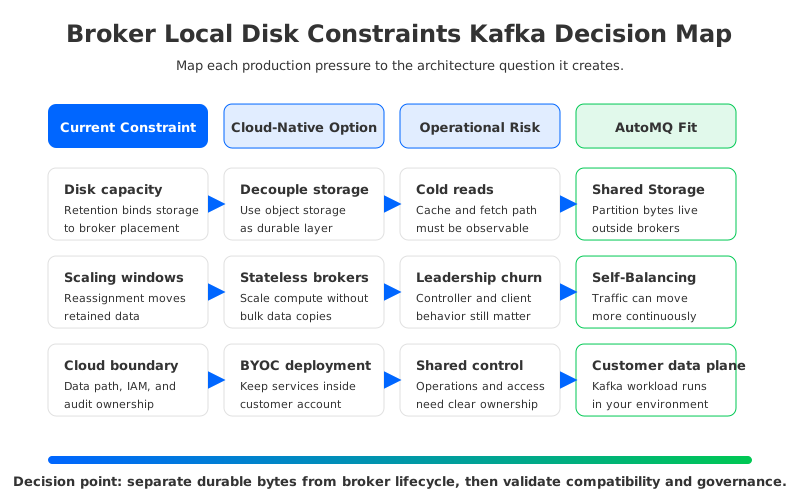
Searches for broker local disk constraints kafka usually do not come from curiosity. They come from a cluster that is doing its job but has become hard to change. Retention grows faster than planned, a few brokers carry more hot partitions than the rest, a node replacement looks like a data migration, and every capacity discussion ends with the same uncomfortable question: how much disk should we reserve before the next peak?
That is the practical problem behind broker-local disk constraints in Kafka. The issue is not that local disks are bad. Kafka's original design made a strong engineering choice: keep partition logs on brokers, replicate them across brokers, and let consumers read ordered records by offset. That model is coherent. The pressure appears when a cloud platform team wants Kafka semantics but no longer wants retained data to define every broker lifecycle.
The useful question is not "Should Kafka use disks?" The better question is "Which operational decisions become harder because durable partition data is tied to broker-local storage?" Once the question is framed that way, stateless brokers are easier to evaluate. They are not a shortcut around Kafka semantics. They are an architectural move that changes where durable bytes live, which changes how platform teams reason about scaling, recovery, cost, and governance.
1Why teams search for broker local disk constraints kafka
The search usually starts with a symptom that looks local. A broker's disk fills faster than its neighbors. A retention increase forces an instance-size change. A rebalance has to be scheduled around traffic because it moves data while the cluster is live. Tuning partitions, adjusting retention, adding brokers, or increasing disk size can be correct, but those actions treat the symptom rather than the operating model.
Broker-local storage makes the broker both a compute node and a durable data owner. That dual role keeps the hot path close to disk and gives Kafka a clear log abstraction. It also means a broker is not disposable compute. If it owns partition history, replacing it, shrinking it, or moving load away involves leadership changes, replica placement, catch-up behavior, and storage planning. The work is not only "add one more node." It is "add one more node and make the retained data layout healthy again."
This is why the same disk concern often expands into several platform questions:
- Capacity planning: How much local or attached storage should each broker reserve for retention, traffic bursts, and uneven partition growth?
- Elasticity: Can the cluster scale compute for a temporary traffic spike without also committing to a long-lived storage footprint?
- Recovery: When a broker fails, how much data has to be reconstructed, copied, or caught up before the cluster returns to a comfortable state?
- Cost visibility: Which bill line is driven by compute, which by storage, and which by data movement between failure domains?
- Governance: Who owns the data path, encryption boundary, IAM policy, audit trail, and operational access when storage becomes a first-class cloud resource?
Those questions are architecture questions. A team can improve a broker-local design with better partition hygiene, rack-aware placement, tiered storage, monitoring, and disciplined retention policies. The remaining constraint is that the broker still owns primary operating responsibility for durable partition data.
2The production constraint behind the problem
Traditional Kafka follows a Shared Nothing architecture: each broker manages its own local storage, and partition replicas are distributed across brokers. Producers write to partition leaders, followers replicate data, consumers read by offset, and consumer groups coordinate partition assignment. KRaft removes the need for ZooKeeper in Kafka metadata management, but it does not by itself change the fact that retained partition data is stored with brokers in a broker-local model.
That storage model couples decisions cloud teams often prefer to separate. Compute sizing is tied to broker count. Storage sizing is tied to broker placement. Availability is tied to replica layout. Operational change is tied to data movement. This is manageable when workload growth is predictable and the cluster changes slowly. It becomes painful with many retention windows, bursty traffic, frequent node replacement, or strict cost reviews.
Tiered Storage can reduce local disk burden by moving older log segments to remote storage while keeping active data on brokers. It can be right when the main problem is long retention. It does not turn brokers into stateless compute nodes, because the local log, leader/follower behavior, and broker placement still matter for active reads and writes. Tiering can reduce broker disk history, but it does not remove broker-local storage from the operating model.
The deeper constraint appears during change. If the platform team needs to replace a broker, rebalance hot partitions, expand during a peak, or shrink after demand falls, retained data influences the plan. The team has to think about movement volume, replica catch-up, client impact, disk headroom, and controller activity. Broker-local design makes storage locality part of every operations decision.
3Architecture options and trade-offs
There are three broad ways to respond to broker-local disk pressure. The first is to stay with the existing Kafka storage model and operate it more deliberately: better partition distribution, stricter retention policies, rack awareness, capacity alerts, and planned reassignment windows. It is the lowest-change path and keeps the team's mental model close to standard Kafka operations. It also preserves the coupling between brokers and durable data.
The second path is to use Tiered Storage or a remote-log feature for older data. This can make long retention more economical and reduce local disk growth, especially when most reads target recent records. The trade-off is a two-tier read path: local active data and remote historical data. Cold reads, cache behavior, object storage access, and recovery procedures need observability. This path is useful when retention is dominant, but less complete when elasticity and broker replacement are the main concerns.
The third path is Shared Storage architecture for Kafka-compatible streaming. Durable partition data lives in shared object storage, and brokers focus on Kafka protocol handling, leadership, caching, coordination, and write acceleration. A WAL (Write-Ahead Log) provides the durable write path before data is uploaded or compacted into object storage. The shift is that brokers no longer act as permanent owners of all partition bytes.
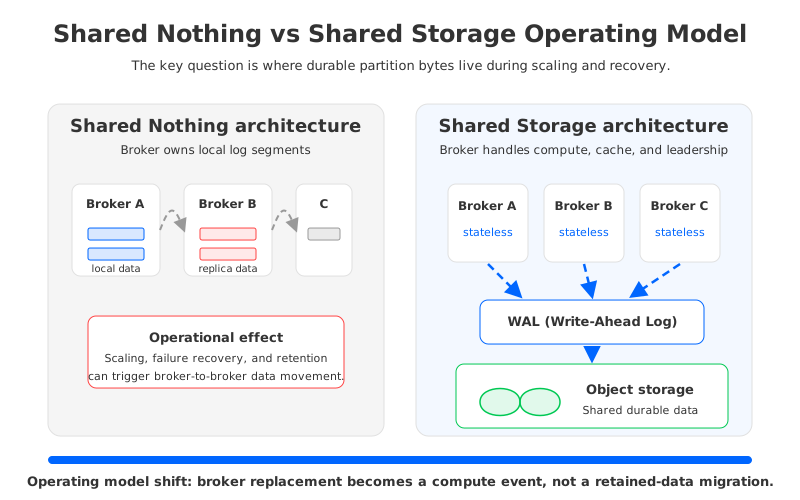
That third path is where stateless brokers become meaningful. "Stateless" does not mean a broker has no memory, no cache, no leadership role, or no operational state. It means broker replacement does not require the broker's local disk to be the source of truth for retained partition history. The durable data boundary moves away from the broker, so scaling and recovery can be planned around compute and metadata ownership rather than bulk data movement.
The trade-off is that shared storage introduces its own responsibilities. Object storage access patterns, WAL design, cache hit rates, cold-read behavior, metadata scale, encryption, and cloud permissions become part of the review. The real question is whether complexity moves to a layer the team can operate more predictably.
4Evaluation checklist for platform teams
A good evaluation starts before any vendor comparison. If the current cluster is stable, write down what is causing pain: disk headroom, scaling delay, reassignment risk, cross-AZ traffic, recovery time, retention cost, migration risk, or governance boundaries. Different symptoms lead to different choices. A team fighting only long retention may not need the same answer as a team trying to make broker capacity elastic.
Use the following framework to make the decision concrete:
| Evaluation area | What to verify | Why it matters |
|---|---|---|
| Kafka compatibility | Client versions, producer behavior, consumer groups, offsets, transactions, Kafka Connect, Schema Registry, and operational tooling. | A storage-model change should not force application teams to relearn Kafka. |
| Storage model | Whether durable data is broker-local, tiered, or fully shared. | This determines whether scaling is mostly compute work or data movement. |
| Read path | Hot reads, catch-up reads, cache behavior, and historical fetch patterns. | Object storage changes how cold data is served and observed. |
| Failure recovery | Broker replacement, leader movement, WAL recovery, and controller behavior. | Recovery plans must match the durable source of truth. |
| Cost model | Compute, storage, network, object operations, monitoring, and operational labor. | Savings claims are meaningless without a workload-specific model. |
| Governance | VPC or network boundary, IAM, encryption, audit, and data-plane ownership. | Cloud-native storage can improve control only when ownership is explicit. |
| Migration | Data sync, offset handling, producer cutover, rollback, and validation. | Compatibility at the protocol layer does not remove migration planning. |
This table also prevents a common mistake: treating stateless brokers as a feature checklist item. The value is not the label. The value appears when statelessness changes an expensive operational path. If a team never resizes, rarely changes retention, and already has a predictable cost profile, broker-local storage may remain acceptable. If every infrastructure change turns into a storage event, the architecture deserves a closer look.
5How AutoMQ changes the operating model
After the neutral evaluation, AutoMQ fits into the third category: a Kafka-compatible streaming platform built around Shared Storage architecture and stateless brokers. AutoMQ keeps Kafka protocol compatibility while replacing broker-local durable log storage with S3Stream, a shared streaming storage layer backed by WAL storage and S3-compatible object storage.
The design changes the broker's job. AutoMQ Brokers still handle Kafka requests, partition leadership, caching, routing, and coordination. They do not need to be the permanent home of retained partition bytes. Writes go through S3Stream and WAL storage before data is organized in object storage. Reads can use caching for hot data and prefetching for catch-up reads. The Controller and KRaft metadata coordinate ownership, object metadata, balancing, and scheduling.
This matters because the expensive part of many Kafka operations is not the metadata change itself. It is the data movement implied by that change. When durable data is already in shared storage, partition reassignment and broker replacement can be treated more like ownership and traffic changes. The platform still needs observability, client discipline, and migration planning, but the storage constraint moves out of the broker lifecycle.
AutoMQ BYOC adds another dimension for teams that care about cloud boundaries. In a BYOC (Bring Your Own Cloud) deployment, the control plane and data plane run in the customer's cloud environment, and Kafka workload data remains in customer-owned infrastructure. That does not remove the need for security design. It makes the design review more explicit: object storage buckets, WAL storage, network paths, IAM roles, encryption settings, logs, and metrics can be reviewed inside the customer's cloud account.
The point is not that every Kafka cluster should become stateless. The point is that teams evaluating broker-local disk constraints should separate compatibility questions from storage-model questions. If the application contract is Kafka, the first requirement is Kafka behavior: producers, consumers, offsets, transactions, Connect, and tooling must still work. If the operating problem is broker-local durable data, the second requirement is architectural: durable bytes should stop dictating every broker lifecycle decision.
6Readiness scorecard before you change the storage model
The safest way to evaluate stateless brokers is to score readiness across workflows that will fail in production. A proof of concept that only sends and consumes test records is not enough. It proves the protocol path works, but not that migration, recovery, governance, and observability are ready.
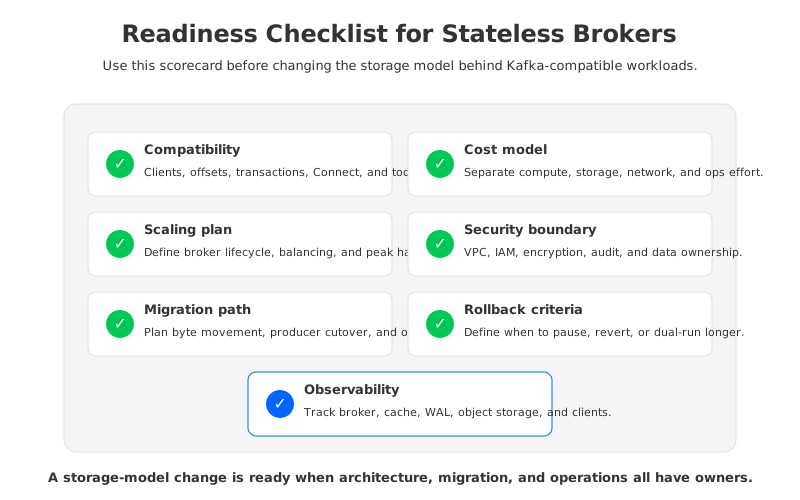
Start with compatibility. List your client libraries, Kafka versions, authentication mechanisms, transactional producers, consumer group patterns, Connect workers, stream processors, and monitoring tools. Then test the migration path with real topic shapes: high-partition topics, compacted topics, long-retention topics, busy consumer groups, and workloads that depend on stable offsets. The more stateful the application layer is, the more disciplined the cutover plan needs to be.
Next, model operating costs without turning the exercise into a slogan. A useful model separates broker compute, WAL storage, object storage, network movement, object operations, monitoring, and human operations. The result depends on workload shape: write rate, read fan-out, retention, cold-read frequency, Availability Zone placement, cloud provider, and deployment boundary. If a claim cannot be traced to those inputs, it should not drive the decision.
Finally, decide what "ready" means. Ready means the platform team can explain broker replacement, WAL recovery, object storage audit, cold-read monitoring, producer cutover, consumer offset validation, and rollback. That is when stateless brokers become more than an architectural phrase.
Broker-local disk constraints are frustrating because they turn a Kafka operations problem into a storage lifecycle problem. Stateless brokers change the shape of that problem, but they do not remove the need for engineering discipline. If your team wants Kafka compatibility while changing the storage model behind the brokers, evaluate AutoMQ's architecture and deployment options in your own environment: start with the AutoMQ BYOC console.
7FAQ
7.1Are stateless brokers still Kafka-compatible?
They can be, but statelessness alone does not prove compatibility. Evaluate producer and consumer behavior, offsets, transactions, client versions, Kafka Connect, security settings, and operational tooling against the platform's compatibility documentation.
7.2Is Tiered Storage the same as Shared Storage architecture?
No. Tiered Storage moves older log segments to remote storage while active broker-local storage remains important. Shared Storage architecture makes shared object storage the durable foundation and uses brokers mainly for compute, caching, leadership, and coordination.
7.3Does object storage make Kafka too slow?
It depends on the write path, WAL implementation, cache design, and workload. A shared-storage Kafka-compatible platform should explain how writes are durably acknowledged, how hot reads are served, and how catch-up reads are prefetched and monitored.
7.4When should a team keep broker-local Kafka storage?
Keep the existing model when the cluster is predictable, retention is moderate, operations are well understood, and the team does not need elastic broker lifecycle changes. Architecture changes are most useful when broker-local data ownership is blocking scaling, recovery, or cost goals.
7.5What should be tested before migration?
Test client compatibility, topic configuration, offset behavior, producer cutover, consumer restart, rollback, observability, security policy, and failure recovery. A migration plan should include both data synchronization and operational validation.


