
Table of Contents
Table of Contents
A Kafka broker is never only a network process. It owns local log segments, replica placement, page cache behavior, disk throughput, recovery work, and operational blast radius. That local state is part of why Kafka became reliable infrastructure in the first place: the broker can serve sequential writes and reads from disks it directly controls. The same property becomes harder to operate when the cluster moves into cloud environments where capacity, zones, storage classes, and network charges are all separate resources.
The phrase broker local state limits kafka usually appears when a platform team has already found the uncomfortable part. Scaling a broker is not the same as scaling a stateless service. Adding compute capacity can trigger partition movement. Replacing an unhealthy node can require replica rebuilding. Resizing storage can force a maintenance path that looks less like cloud elasticity and more like a carefully staged data migration.
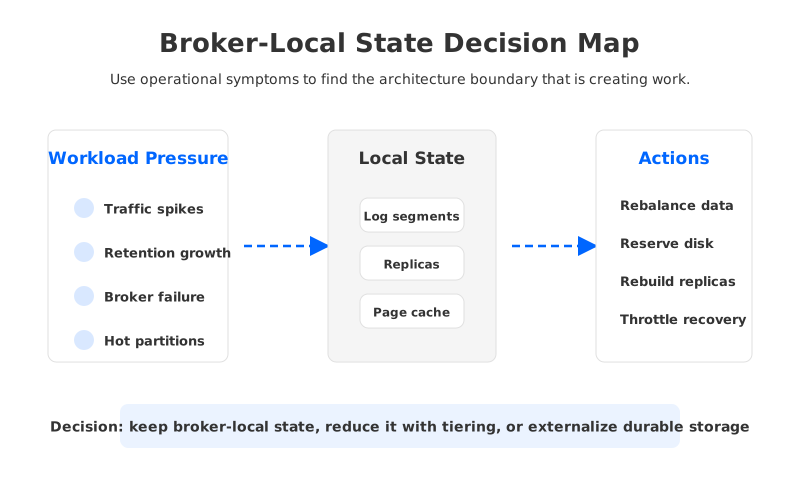
The practical question is not whether local disks are good or bad. Local state is excellent when workload shape, node count, and retention profile are stable. The question is whether broker-local state is still the right operational boundary for a cloud-native Kafka platform that must absorb traffic spikes, zone failures, retention growth, and team-level self-service without turning every change into a storage operation.
1Why Broker-Local State Becomes the Limit
Traditional Kafka follows a shared-nothing storage model. Each broker stores a subset of topic partitions on its local disks, and replicas are distributed across brokers for durability and availability. Producers write to partition leaders, followers fetch from leaders, and consumers read from the brokers that host the relevant partition data. This model is direct, understandable, and efficient when the broker's compute, network, and storage responsibilities grow together.
Cloud operations break that neat coupling. Compute pressure may rise without retention changing, retention may grow without more CPU being needed, and a few hot partitions can saturate disks on specific brokers while the rest of the fleet looks healthy. When storage is tied to broker identity, platform teams have to move data, reassign partitions, or overprovision the cluster ahead of time.
The most common symptoms are easy to recognize:
- Slow elastic scaling. Adding brokers increases capacity only after partitions and replicas are moved. The new node is empty at first, so the cluster must perform background data movement before the added capacity is fully useful.
- Recovery work competes with foreground traffic. A failed broker does not only remove compute. It removes local copies of partition data, which can cause replica catch-up, leader movement, and extra network load during an already degraded period.
- Capacity planning becomes pessimistic. Teams reserve disk and network headroom for rebalancing, maintenance, and failure recovery, not only for application traffic. None of these problems mean Kafka is flawed. They mean the original broker boundary carries more responsibility than cloud teams often want one machine to carry. Once the broker owns both request processing and durable data placement, every scaling decision has a storage consequence.
2The Production Constraint Behind the Search
The production constraint is simple: a Kafka cluster with broker-local state cannot treat brokers as disposable capacity units. A stateless service can replace an instance and rely on an external database or storage layer for durable state. A traditional Kafka broker is different. Its local disks contain the data that makes the broker useful, and the rest of the cluster must account for that data whenever the broker changes.
This matters most in four operating moments: traffic growth before the whole cluster is saturated, retention growth without matching CPU demand, broker replacement that turns instance churn into recovery work, and zone-aware placement that adds a network dimension. Kafka's logical abstractions do not remove that physical coupling. A topic is a logical stream, but its partitions still live on specific brokers. KRaft removes ZooKeeper from metadata management, which simplifies one part of the control plane, but it does not by itself make broker storage stateless.
That distinction is where many cloud migrations get messy. Teams expect cloud infrastructure to turn capacity into a dial. For Kafka, the dial has friction because data gravity lives inside the broker fleet. The larger the retained dataset, the more that friction dominates routine operations.
3Shared-Nothing Kafka vs Shared Storage Operations
The first useful evaluation step is to separate protocol compatibility from storage architecture. Kafka compatibility tells application teams whether existing producers, consumers, admin tools, and ecosystem integrations can keep working. Storage architecture tells platform teams how the system behaves when capacity, failure, retention, or placement changes. The two concerns are related, but they are not the same.
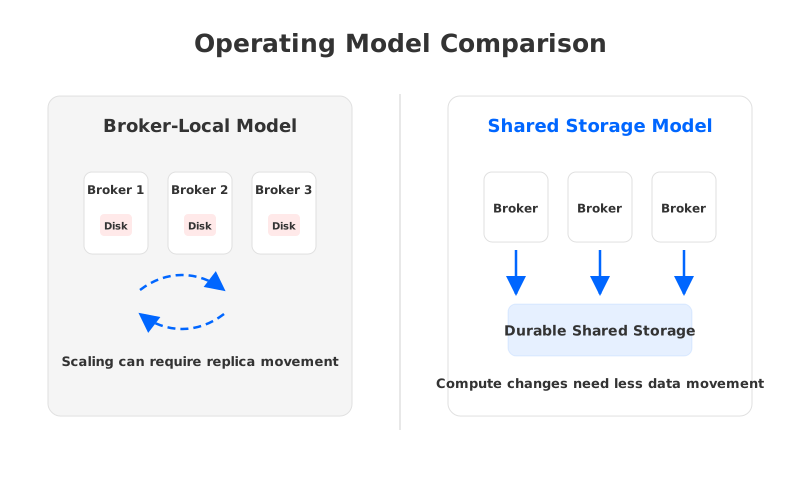
In a shared-nothing Kafka deployment, the broker is the unit of compute and durable storage. This keeps the data path direct, but it also makes partition reassignment, broker replacement, and disk balancing part of the normal operating model. Tiered storage can reduce older data kept on local broker disks, but hot data, leader placement, replica catch-up, and broker health still matter.
A shared storage architecture changes the boundary. Brokers can focus on Kafka protocol handling, request coordination, and serving hot paths, while durable data is persisted in a storage layer designed to outlive individual broker instances. The system still has state, but durable state moves to an external layer with different scaling, durability, and recovery properties.
The trade-off is worth stating plainly. Local disks can be fast and predictable. Shared storage depends on the durability, latency, and semantics of the storage system beneath it. A serious cloud-native Kafka design has to close that gap with a write-ahead log path, careful caching, placement-aware networking, and compatibility discipline.
| Evaluation dimension | Broker-local shared nothing | Shared storage Kafka-compatible model |
|---|---|---|
| Broker replacement | Requires attention to local replicas and catch-up behavior | Brokers can be treated closer to replaceable compute when durable data is externalized |
| Storage scaling | Often tied to broker count or disk resize path | Storage capacity can scale independently from broker compute |
| Rebalancing pressure | Partition movement is a normal capacity tool | Less data movement is required when compute changes do not imply data relocation |
| Failure recovery | Recovery competes for broker, disk, and network resources | Recovery can rely more on durable shared storage and faster broker reconstruction |
| Operational risk | Familiar Kafka mechanics, but more data gravity per broker | More cloud-native elasticity, but stronger dependency on storage layer design |
The table is not a universal verdict. If your cluster has stable traffic, short retention, and predictable maintenance windows, broker-local state may be manageable. If your team needs frequent scaling, long retention, fast recovery, and cloud cost control, the architecture boundary deserves a closer look.
4A Checklist for Platform Teams
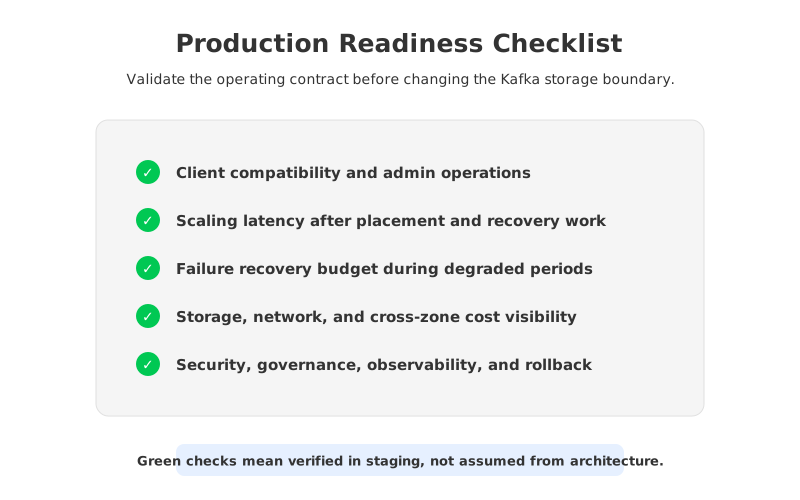
A good broker-local state review should start with observable operations, not architecture diagrams. The goal is to identify where broker identity and durable bytes are creating work that the platform team would rather remove. Application teams experience the platform through quotas, lead times, and incident impact rather than through storage topology.
Use this checklist as a practical review:
- Scaling latency. How long does added broker capacity take to become useful after partition placement, replica movement, and balancing are included?
- Failure recovery budget. During broker or zone failure, how much network, disk, and broker CPU is consumed by recovery work rather than application traffic?
- Storage headroom policy. How much extra disk is reserved for retention growth, reassignment, maintenance, and uneven partition distribution?
- Hot partition handling. Can the team respond to a small number of hot partitions without changing unrelated workloads?
- Cross-zone traffic shape. Which traffic comes from producer writes, follower replication, consumer reads, rebalancing, and recovery?
The answers usually reveal two separate problems. One is raw capacity: disks fill, network links saturate, and brokers run hot. The other is operational coupling: the cluster can have enough total resources but still require risky data movement because the resources are attached to the wrong brokers.
That is why a decision matrix helps. Instead of asking whether the cluster is "big enough," ask which operating action is blocked by broker-local state.
5Where AutoMQ Changes the Operating Model
If the underlying limit is durable state tied to broker identity, the architectural answer has to separate compute from storage without breaking Kafka expectations. AutoMQ fits into that category as a Kafka-compatible cloud-native streaming system that uses shared storage architecture and stateless brokers to reduce the amount of durable state pinned to individual broker machines.
The point is not that every Kafka deployment should abandon local disks. Some production teams want a different operating boundary: Kafka protocol compatibility for applications without turning every broker lifecycle event into a data placement event. AutoMQ's design moves durable stream data to object storage and uses a write-ahead log path to preserve the write path requirements that a streaming system needs.
This changes several decisions that matter to platform teams:
- Compute and storage can be reasoned about separately. Broker count can track request handling and throughput pressure, while retained data lives in shared storage rather than expanding only through broker-local disks.
- Recovery can focus on service reconstruction. When durable data is externalized, replacing broker compute does not require rebuilding the same volume of local state before the cluster becomes useful again.
- Cloud cost analysis becomes more explicit. Teams can evaluate object storage, write-ahead log choices, availability-zone placement, and network paths as separate parts of the architecture instead of bundling them into broker sizing.
- Governance boundaries stay closer to the customer's environment. For BYOC or private deployment models, the platform team can keep data-plane control within its own cloud account while still using a Kafka-compatible operating model.
This is also where precision matters. "Stateless broker" should not be read as "no state exists." Metadata, caches, inflight requests, and coordination still exist. The important shift is that durable stream storage is no longer primarily owned by the lifespan of a broker VM or pod.
6Migration Readiness: What to Validate Before Moving
A broker-local state review often leads to a migration discussion, but migration should start with compatibility and rollback, not product selection. Kafka sits behind producers, consumers, Kafka Connect pipelines, stream processing jobs, ACLs, schemas, monitoring dashboards, and incident runbooks. A platform that changes the storage model still has to respect those operational contracts.
For a production migration, validate the following before moving critical workloads:
- Client behavior. Test the actual producer and consumer versions in use, including idempotent producers, transactions if used, compression, batching, fetch behavior, and admin operations.
- Offset and consumer group handling. Confirm how consumer groups, committed offsets, lag reporting, and restart behavior appear during migration and rollback.
- Operational observability. Map broker health, request latency, throughput, storage usage, and error signals into the dashboards and alerts the SRE team already uses.
- Backout path. Define what happens if a workload must return to the previous cluster, including topic mapping, data freshness, and consumer position.
The key is to test the contract, not only the happy path. A Kafka-compatible system earns trust when applications behave normally during routine operations and when the platform has a credible answer during failure, rollback, and uneven load.
7Decision Framework
The most useful broker-local state decision is rarely binary. Many organizations will keep some workloads on traditional Kafka and evaluate cloud-native Kafka-compatible systems where elasticity and recovery matter more than preserving the exact existing operating model.
| Workload signal | Broker-local state is acceptable when... | Consider shared storage when... |
|---|---|---|
| Traffic growth | Growth is predictable and planned capacity changes are infrequent | Spikes require faster broker scaling than partition movement can comfortably support |
| Retention | Retention is short or storage growth tracks compute growth | Retention grows independently from broker CPU and network needs |
| Recovery objectives | Longer recovery windows are acceptable for noncritical topics | Broker or zone recovery must avoid large local-state rebuilds |
| Platform ownership | A small specialist team operates a small number of clusters | Many teams need self-service topics without operator-heavy capacity work |
| Cost control | Overprovisioned brokers are acceptable insurance | Storage, compute, and cross-zone traffic need separate optimization levers |
The decision becomes easier when the team names the constraint. If the pain is only disk price, tiered storage may be enough. If the pain is slow broker replacement, compute/storage separation deserves attention. If every topic change needs central operator review, the platform also needs better automation and clearer guardrails.
Start with one production-like workload and map operations that depend on broker-local state: scaling, replacement, retention, rebalancing, and recovery. If those operations constrain the platform, review AutoMQ's stateless broker architecture and test the contract against real clients before migration.
8References
- Apache Kafka documentation: Operations and cluster expansion
- Apache Kafka documentation: KRaft
- Apache Kafka documentation: Tiered Storage
- AutoMQ documentation: Stateless Broker
- AutoMQ documentation: Technical Advantage Overview
9FAQ
9.1What is broker-local state in Kafka?
Broker-local state is data and operational responsibility tied to a specific Kafka broker, especially local log segments, replica placement, disk usage, cache behavior, and recovery work. Metadata can describe where partitions should live, but the broker still stores and serves assigned bytes.
9.2Does KRaft remove broker-local storage limits?
No. KRaft removes ZooKeeper from Kafka's metadata quorum and simplifies metadata management, but it does not make partition data stateless. Broker-local log storage, replica placement, and data movement are still part of a traditional Kafka deployment.
9.3Is tiered storage the same as shared storage?
No. Tiered storage can move older log segments to remote storage and reduce pressure on local disks, but the broker can still own hot data, leader placement, and operational state. A shared storage architecture goes further by changing where durable stream data lives and how broker lifecycle events interact with that data.
9.4When should a team evaluate a Kafka-compatible shared storage architecture?
Evaluate it when broker replacement, elastic scaling, long retention, cross-zone traffic, or recovery work are becoming regular operational constraints. The strongest signal is not cluster size by itself. It is the amount of engineering time spent moving data so broker capacity changes can take effect.
9.5How does AutoMQ fit into this evaluation?
AutoMQ is relevant when a team wants Kafka API compatibility with a cloud-native operating model based on shared storage and stateless brokers. It should be evaluated with the same discipline as any infrastructure change: client compatibility, write path behavior, observability, security boundaries, failure recovery, and rollback.
9.6What is a practical next step?
Start with a workload inventory, a broker replacement drill, and a retention-growth model. Those checks reveal whether the constraint is storage price, recovery, or the broader broker-local operating model.


