
Table of Contents
Table of Contents
Broker recovery is where a Kafka architecture shows its real operating model. Under normal traffic, most clusters look orderly: producers append records, consumers advance offsets, controllers track metadata, and dashboards show partition leaders distributed across brokers. The illusion breaks when a broker disappears and the team asks a much more concrete question: how long until this node is useful again without turning the recovery into a data movement project?
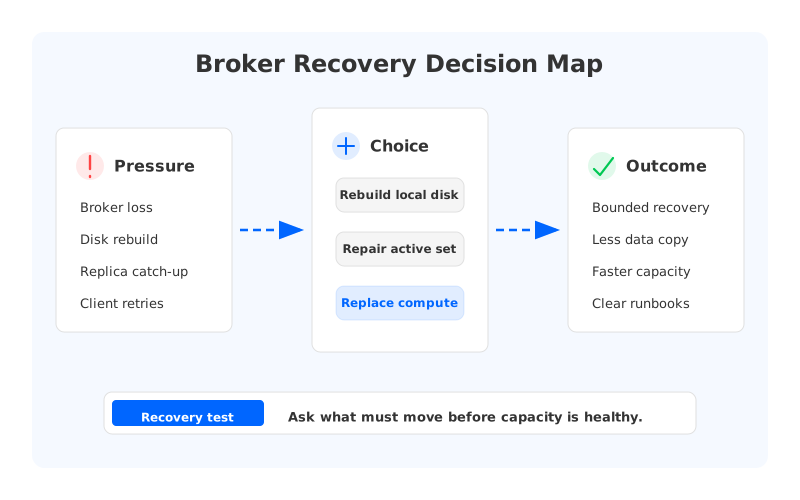
That is why engineers search for stateless broker recovery kafka. They are not looking for a slogan. They are usually dealing with slow broker replacement, long partition reassignments, cloud disk limits, multi-AZ network cost, or operational playbooks that depend on rebuilding broker-local state before capacity is healthy. The important design question is not whether Kafka can survive broker failure. Kafka can. The question is how much durable data must be copied, rebuilt, or rebalanced before the platform returns to a steady state.
1Why broker recovery becomes painful
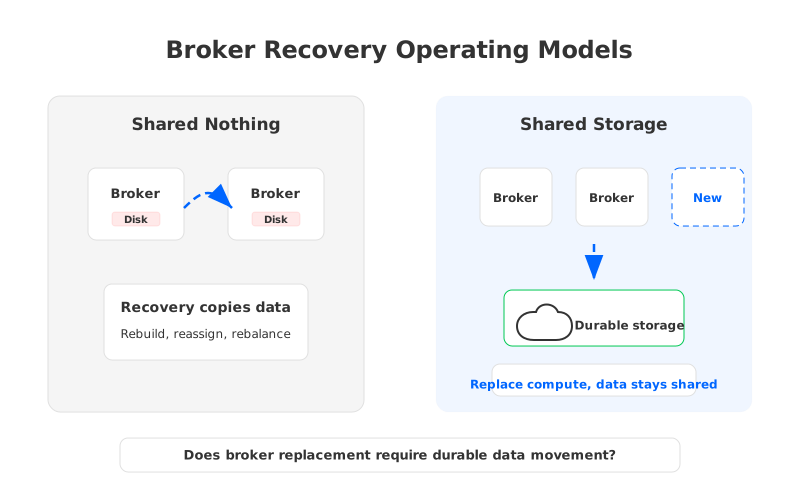
Traditional Kafka uses a shared-nothing storage model. Each broker owns local replicas for some partitions, and durability comes from replication across brokers. This model is mature and understandable, which is why it has served production teams for years. It also means that a broker is not a disposable compute endpoint. It is a compute process, a storage owner, a cache, a leader host, and a recovery unit wrapped into one operational object.
The pain starts when that operational object fails or needs replacement. If the failed broker held replicas, the cluster has to restore redundancy somewhere. If capacity is tight, replacement can compete with live traffic. If the cluster runs across availability zones, replication and reassignment may move data across zones. If many partitions are involved, controller and metadata operations become part of the recovery timeline. The platform is still available, but the team is paying recovery tax in network bandwidth, disk throughput, operational attention, and risk.
A useful recovery review separates failure tolerance from recovery efficiency. Failure tolerance asks whether the application keeps working. Recovery efficiency asks what the system must do after the immediate failure has been absorbed. Those are different standards, and mature platform teams need both.
2The local disk constraint behind recovery
Broker-local storage makes recovery slower because durable state is physically attached to the broker lifecycle. When a broker is replaced, the durable bytes it used to hold must either be rebuilt on another broker, fetched from replicas, or served from another storage tier. None of those operations are wrong, but they are not free. They consume IO that the same cluster may need for producers and consumers.
This coupling affects more than incident response. It influences capacity planning, maintenance windows, autoscaling, and cloud procurement. A team that wants fast recovery may over-provision brokers so the cluster has room for replica catch-up. A team that wants lower cost may run closer to saturation and accept longer recovery. A team that wants strict governance may add more replication and encryption controls, which can increase the amount of infrastructure that participates in recovery.
The recovery path usually has four moving parts:
- Replica health: The platform must restore the intended replication factor and in-sync replica set after losing a broker or disk.
- Leader placement: Partition leaders need to be balanced so the remaining brokers do not inherit a traffic hotspot.
- Data movement: Local replicas, remote segments, caches, and metadata may need to be rebuilt or revalidated.
- Client impact: Producers and consumers need stable routing, offset continuity, and predictable latency while the cluster repairs itself.
The last point is easy to underestimate. Application teams care less about which broker owns a replica than whether writes continue, consumers avoid repeated timeouts, and replays do not starve normal reads. Recovery architecture should therefore be judged from the client path inward, not from storage mechanics outward.
3Architecture options: local disk, tiered storage, and shared storage
There are three broad ways to think about broker recovery in Kafka-compatible systems. The first is local-disk Kafka. In this model, brokers own persistent log replicas on attached storage, and recovery restores the broker-local replica set through replication, reassignment, or replacement disks. It is familiar and well documented. Its weakness is that compute lifecycle and durable data lifecycle stay tightly coupled.
Tiered Storage changes part of that equation by moving older log segments to remote storage while keeping the active log path local. This can reduce the amount of historical data that must live on broker disks, and it can make longer retention more practical. During recovery, however, the platform still has to reason about active local replicas, remote segment metadata, cache warming, and cold-read behavior. Tiered Storage reduces some local disk pressure; it does not make every broker stateless.
Shared Storage architecture changes the recovery boundary more directly. Durable stream data is stored in shared object storage, while brokers act as replaceable compute nodes that handle Kafka protocol traffic, caching, coordination, and serving. The write path still needs a WAL because object storage is not a low-latency commit log by itself. But the durable ownership model changes: replacing broker compute does not imply rebuilding the full local log footprint of that broker.
| Recovery question | Local-disk Kafka | Tiered Storage | Shared Storage architecture |
|---|---|---|---|
| What is tied to the broker? | Compute, active log replicas, cache, and local durability | Compute, active replicas, cache, and remote segment metadata | Compute, cache, and protocol serving |
| What happens after broker loss? | Replicas are rebuilt or reassigned across brokers | Active replicas still need repair; older segments may remain remote | Broker compute can be replaced while durable data remains shared |
| Main recovery cost | Disk IO, network copy, reassignment time | Local repair plus remote metadata and cache behavior | WAL recovery, cache warm-up, metadata correctness, access control |
| Best fit | Stable clusters with predictable capacity | Longer retention where active-set recovery is acceptable | Elastic cloud workloads where recovery should not move durable data |
This table is not a universal ranking. Local disk can be a good fit for compact, stable clusters with predictable workload shape. Tiered Storage is useful when retention growth is the dominant problem. Shared Storage becomes more interesting when broker replacement, scaling, or failure recovery should be a compute operation rather than a storage rebuild.
4Evaluation checklist for platform teams
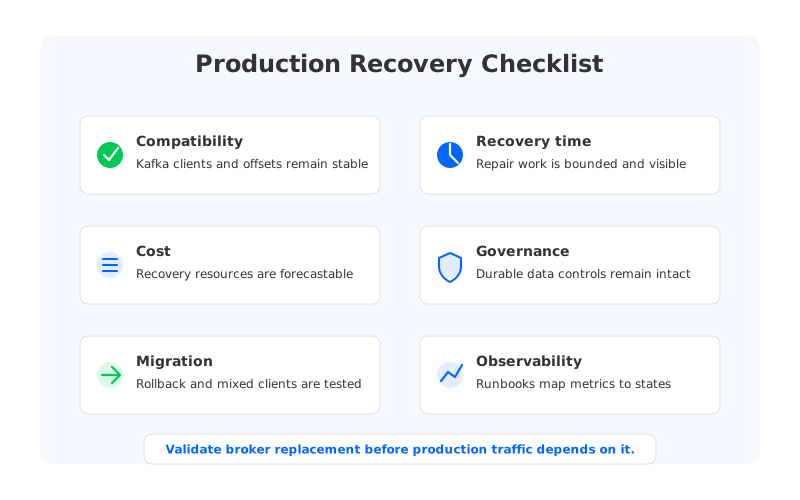
A recovery checklist should be written before the incident, not during the incident. The goal is to make the recovery path observable and repeatable enough that an on-call engineer can distinguish normal repair from a platform fault. If the team has to infer recovery state from disk growth and vague lag symptoms, the architecture is carrying hidden operational complexity.
| Area | Question to answer | Healthy production signal |
|---|---|---|
| Compatibility | Do existing producers, consumers, transactions, and consumer groups behave through broker replacement? | Client behavior follows standard Kafka semantics without custom retry logic |
| Recovery time | What has to be copied or rebuilt before the cluster is fully redundant again? | Recovery work is bounded and visible in metrics |
| Cost | Which resources grow during recovery: disk IO, network transfer, object-store requests, or compute? | Finance and SRE teams can forecast incident-side capacity needs |
| Governance | Who controls storage access, encryption, deletion, and audit trails during broker replacement? | Security controls apply to durable data independently from broker hosts |
| Migration | Can the team test rollback, old client versions, and mixed workloads before production cutover? | A proof of concept includes failure injection, replay, and broker restart tests |
| Observability | Can operators see leader movement, cache behavior, WAL health, remote reads, and client latency? | Runbooks explain what each recovery state means |
The checklist also forces a valuable conversation with application teams. Some workloads tolerate a short period of elevated consumer lag. Others treat delayed event delivery as a user-facing outage. Some topics are replay-heavy, while others mostly serve tailing consumers. A platform that supports all of them under one recovery policy may be easy to standardize and hard to operate.
5How AutoMQ changes the operating model
Once the evaluation framework is clear, the architectural requirement becomes more precise: keep Kafka-compatible client behavior, but remove broker-local disks from the durable recovery boundary. AutoMQ is a Kafka-compatible cloud-native streaming platform built around Shared Storage architecture. It preserves Kafka APIs and ecosystem expectations while using S3-compatible object storage as the durable storage foundation and keeping brokers stateless.
That distinction matters for broker recovery. In AutoMQ, S3Stream provides shared streaming storage, and the WAL handles the low-latency write path before data is persisted into object storage. Brokers are designed to be replaceable compute nodes rather than long-term owners of broker-local partition data. When the platform needs to replace or scale brokers, the durable data boundary is not the same as the broker process boundary.
This does not make recovery magical. Platform teams still need to validate metadata behavior, WAL configuration, cache warm-up, object-store permissions, networking, authentication, and observability under their own workload. The improvement is that the recovery conversation moves from "how do we rebuild this broker's disk state?" to "how do we safely restore compute capacity against shared durable state?" That is a different operational model, and it is closer to how cloud teams already manage stateless services.
AutoMQ is most relevant when broker recovery is tied to broader cloud constraints:
- Elastic capacity: Compute can be scaled for current traffic without expanding durable storage through broker-local disks.
- Lower recovery movement: Broker replacement does not require copying the full durable log footprint of the replaced broker.
- Cloud cost control: Object storage becomes the durability layer, while architecture choices can reduce traditional broker replication and cross-zone transfer pressure in supported deployments.
- Customer-controlled boundaries: BYOC and software deployment models let teams keep data, infrastructure, and security controls inside their cloud environment while using Kafka-compatible clients.
The product should enter the evaluation after the recovery requirements are explicit. If the main problem is a small, stable Kafka cluster with predictable maintenance, a conventional design may be adequate. If the main problem is that every broker lifecycle event turns into storage repair, Shared Storage deserves serious testing.
6Migration and readiness guidance
A safe migration starts with topic classification. Separate high-throughput hot paths, replay-heavy feeds, CDC streams, compliance-retention logs, and AI data pipelines. The classification matters because broker recovery pressure is not evenly distributed. A topic with high write throughput stresses WAL and serving capacity. A topic with frequent historical reads stresses cache and object-store fetch behavior. A topic with strict governance stresses access control and auditability.
After classification, define recovery service levels. A recovery service level should include client impact, acceptable lag, redundancy target, rollback path, cost owner, and the observable metrics that prove the system is returning to health. This sounds more formal than "replace the broker and wait," but the discipline pays off. It gives SRE, platform engineering, application teams, and security reviewers the same language for evaluating architecture.
Then run a proof of concept that fails the system on purpose. Restart brokers during writes. Replace broker nodes while consumers tail and replay. Start consumers from older offsets. Interrupt storage permissions in a controlled environment. Rotate credentials. Measure the client-visible effect and the time until the platform is fully redundant again. A useful PoC produces a runbook, not only a throughput chart.
Procurement should be included before the architecture is declared successful. Recovery consumes temporary resources that may not appear in steady-state cost models. Local-disk architectures may pay through spare brokers and network movement. Tiered architectures may pay through remote fetches and operational complexity. Shared Storage architectures may pay through object-store requests, WAL capacity, and cache design. The right answer is the one whose failure behavior, cost model, and team ownership are explicit.
If your team is evaluating stateless broker recovery kafka because broker-local rebuilds have become a bottleneck, test recovery as a first-class workload. The AutoMQ overview is a practical next step for validating a Kafka-compatible Shared Storage design against your own broker replacement, scaling, and failure-recovery requirements.
7References
- Apache Kafka documentation: Operations
- Apache Kafka documentation: Tiered Storage
- Apache Kafka documentation: KRaft
- Apache Kafka KIP-405: Kafka Tiered Storage
- Apache Kafka KIP-1150: Diskless Topics
- AutoMQ documentation: What Is AutoMQ
- AutoMQ documentation: Difference with Tiered Storage
- AutoMQ documentation: S3Stream shared streaming storage
8FAQ
8.1Does stateless broker recovery mean Kafka has no state?
No. Kafka-compatible systems still have metadata, offsets, logs, caches, and coordination state. Stateless broker recovery means durable stream data is not tied to the lifecycle of one broker-local disk, so broker compute can be replaced without rebuilding that broker's full durable log footprint.
8.2Is Tiered Storage the same as Shared Storage?
No. Tiered Storage usually keeps the active log path on broker-local storage and moves older segments to remote storage. Shared Storage moves the durable storage boundary deeper into the platform, so brokers act more like compute nodes over shared durable data.
8.3What should be measured in a broker recovery proof of concept?
Measure write latency, consumer lag, leader movement, time to restored redundancy, WAL health, cache warm-up, remote read behavior, object-store access errors, and client retry patterns. The useful result is a runbook that explains each recovery state.
8.4When should a team evaluate AutoMQ for broker recovery?
Evaluate AutoMQ when broker replacement, scaling, or failure recovery is slowed by local disk rebuilds, partition movement, or cloud cost pressure. It is most relevant when the team wants Kafka compatibility but a cloud-native Shared Storage operating model.
8.5Do applications need to change Kafka clients for AutoMQ?
AutoMQ is designed for Kafka compatibility, so applications can keep using Kafka APIs and common client patterns. As with any production migration, teams should validate client versions, authentication, transactions, consumer behavior, and operational tooling before cutover.


