
Table of Contents
Table of Contents
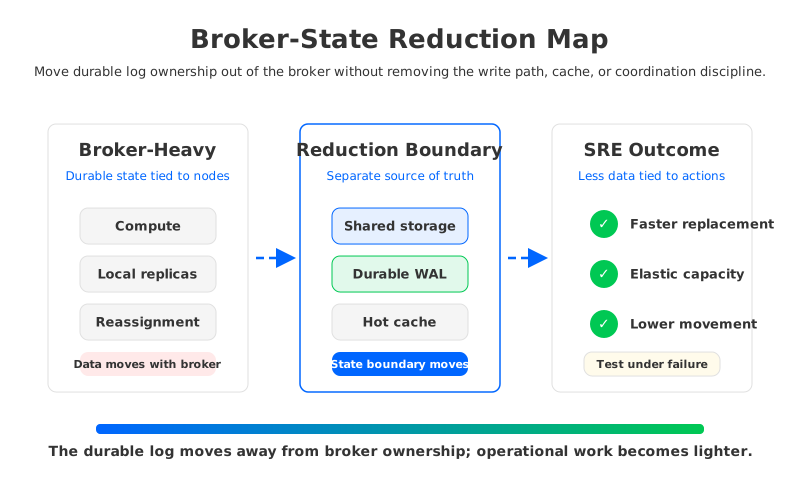
Cloud Kafka incidents rarely start with the phrase "broker state." They start with a full disk, a slow reassignment, a broker replacement that moves more data than expected, or a cloud bill where storage and network lines grow faster than traffic. The root cause is often the same: too much durable system state is tied to individual brokers. That is why many platform teams now search for diskless kafka, not because they want brokers to have no local files at all, but because they want brokers to stop being the place where durable log ownership makes every operational action heavy.
The useful question is not whether a Kafka architecture uses disks. Every production system needs a write path, a cache, metadata, and failure recovery. The useful question is which state must remain broker-local, which state can move to shared storage, and what operational properties change when that boundary moves. SREs should evaluate diskless Kafka through that lens rather than treating it as a product label.
1Why Broker State Became the Operational Bottleneck
Apache Kafka's original shared-nothing model was a reasonable design for its time. Each broker owns partition replicas on local storage, and Kafka's replication protocol keeps followers in sync with leaders. That model gives Kafka strong operational clarity: if a broker owns a replica, the data is on that broker, and recovery can reason about in-sync replicas. It also makes brokers more than stateless request routers. They are compute nodes, storage nodes, replica owners, recovery units, and capacity units at the same time.
That coupling becomes expensive in cloud environments because the broker is now sitting on top of cloud primitives that already provide durability, elasticity, and billing boundaries. A three-replica Kafka topic on cloud block storage can combine Kafka-level replication with storage-service replication underneath. The exact physical copy count depends on the storage service, but the architectural pattern is clear: durability responsibilities can stack instead of replacing each other. SRE teams then pay for capacity, network movement, and operational time across layers.
Broker-local state also slows down common operations that should be boring:
- Replacing a failed broker can require replica recovery and traffic reshaping, not only compute replacement.
- Scaling out can trigger partition reassignment before added capacity is truly useful.
- Scaling down can be blocked by the time needed to drain local replicas.
- Hot partitions create a storage and network problem, not only a CPU scheduling problem.
- Retention changes affect disk sizing and rebalance planning, not only object lifecycle policy.
Tiered storage reduces part of this pressure by moving older log segments to remote storage. It is an important Kafka feature, and it helps with long retention and catch-up reads. But tiered storage does not fully remove broker-state ownership from the hot write path. The broker still owns active segments locally, and many operational actions still need to respect where those active replicas live. Diskless Kafka discussions usually begin where tiered storage stops: can durable log state be redesigned so broker replacement, scaling, and recovery depend less on moving broker-owned data?
2A Better Definition of Diskless Kafka
"Diskless" is an overloaded word. In production architecture, it should not mean "no persistence near the broker." A system that acknowledges writes still needs a durable write-ahead path before data is safely available for replay. It may use cloud block storage, file storage, object storage, or another replicated persistence service. It may also keep cache near compute for tail reads and hot fetches. Treating diskless as "no disks anywhere" leads to the wrong review.
A more useful definition is this: diskless Kafka reduces durable broker-owned log state and moves the primary persistence boundary to shared cloud storage. Under that definition, the broker can still have transient cache, WAL buffers, network connections, metadata leases, and local process state. What changes is the blast radius of broker loss and the amount of data that must be copied because a broker was added, removed, or replaced.
That definition also separates three architecture patterns that are often mixed together:
| Pattern | What Moves Off Broker | What Usually Remains Broker-Coupled | SRE Impact |
|---|---|---|---|
| Traditional Kafka | Nothing by default; replicas live on broker storage. | Active log replicas, ISR ownership, local recovery work. | Predictable semantics, but heavy scaling and recovery. |
| Kafka tiered storage | Older segments can move to remote storage. | Hot active segments and write-path replicas. | Better retention economics, partial operational relief. |
| Shared-storage Kafka-compatible systems | Primary durable log state moves to shared storage. | Cache, WAL coordination, request handling, metadata participation. | Faster compute replacement and less data movement, if compatibility holds. |
The last row is where teams should spend most of their review time. Moving state away from brokers is powerful, but it is not magic. The architecture still has to preserve ordering, durability, offset behavior, consumer group semantics, security controls, and predictable failure handling. Otherwise, the team has only moved complexity from disks into another subsystem.
3What State Should Stay Near Brokers?
The goal is not to make brokers empty. Empty brokers would be slow brokers. The goal is to keep only the state that benefits from locality while moving durable ownership out of the scaling unit. That distinction matters because Kafka workloads are not only append workloads. Consumers read tails, replay old data, compacted topics have different access patterns, and platform teams often run mixed workloads in the same cluster.
There are four state categories worth separating during an architecture review:
- Durable log state is the committed stream data that must survive broker loss and support replay. This is the state diskless architectures try to remove from broker ownership.
- Write-frontier state is the short-lived durability boundary used before data is organized into long-lived objects or segments. It must be fast, durable, and recoverable.
- Cache state accelerates tailing reads, catch-up reads, and repeated fetches. It improves latency but should not become the source of truth.
- Coordination state controls leadership, metadata, consumer groups, ACLs, and operational decisions. It may be small compared with log data, but it is correctness-critical.
SREs should ask vendors and internal platform teams to identify these categories explicitly. If every category is described as "object storage," the explanation is too vague. If every category is described as "local disk," the system probably remains broker-heavy. A credible design explains why each category is placed where it is and how the system behaves when that component fails.
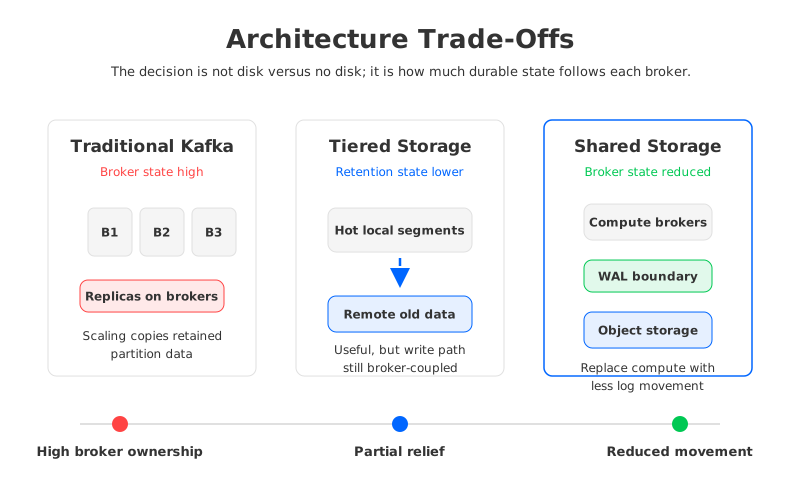
The most important boundary is the write frontier. Object storage is excellent for durable, elastic, cost-effective capacity, but direct small writes to object storage are not the same as appending to a broker-local log. Production systems usually need a WAL or equivalent write path that absorbs small appends efficiently, confirms durability, and then compacts or uploads data into shared storage. This is where diskless Kafka implementations differ sharply. Two products may both say "Kafka on object storage" while using very different write paths, recovery models, and latency trade-offs.
4The Cost Model Is Mostly About Movement
Kafka cost discussions often start with storage price, but SREs know that storage is only the visible part of the problem. Broker-state reduction changes cost because it changes data movement. When brokers own durable replicas, the platform moves data for replication, recovery, reassignment, balancing, and retention management. In cloud networks, movement has billing and operational consequences.
AWS publishes separate pricing pages for EC2 data transfer and S3, and the exact rates vary by region, direction, and service path. The important review pattern is not one universal number. It is to map each byte of your Kafka workload to the infrastructure boundary it crosses:
| Movement Type | Traditional Broker-Centric Pressure | Broker-State Reduction Question |
|---|---|---|
| Producer writes | Written to leaders and replicated to followers. | Does the write path avoid unnecessary cross-zone replica traffic? |
| Broker recovery | Lost replicas must be rebuilt or fetched. | Can compute be replaced without copying full broker-local logs? |
| Rebalancing | Partition movement copies retained hot data. | Is scaling mostly metadata and cache warming? |
| Consumer replay | Reads may hit local, remote, or tiered storage. | Does shared storage plus cache preserve acceptable catch-up behavior? |
| Retention | Disk sizing must follow retained local data. | Is long retention priced and operated as object storage capacity? |
This is also why a diskless Kafka cost review should include failure drills. Normal steady-state ingestion can look attractive while broker replacement or zone impairment reveals hidden movement. The test is not only "how much does storage cost per month?" It is "what data moves when the cluster changes shape?"
5Production Readiness Questions SREs Should Ask
Once the state boundary is clear, the evaluation becomes more concrete. A platform team can run a readiness review that looks like an incident rehearsal rather than a feature checklist. The point is to prove that the target architecture changes operations without weakening Kafka expectations.
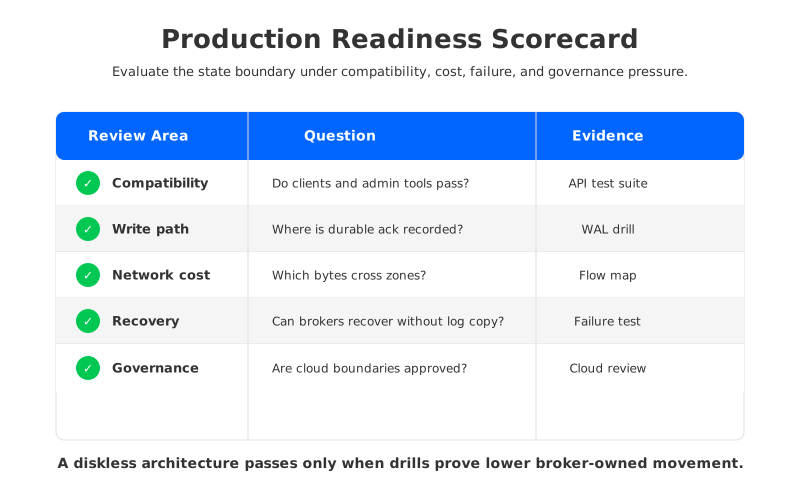
Start with compatibility because it is the easiest place to underestimate risk. Kafka compatibility is not only whether a producer can send and a consumer can fetch. Real clusters depend on idempotent producers, transactions where enabled, ACLs, quotas, compaction, offset retention, consumer group behavior, partition leadership, and ecosystem tools. Some workloads use only a narrow subset; others rely on edge semantics accumulated over years. The review should list the exact client libraries, broker APIs, security mechanisms, and operational tools that matter.
Then move to failure behavior. Kill a broker during sustained produce traffic and observe the acknowledgement path. Remove capacity and see whether consumers experience only expected rebalances or prolonged fetch instability. Increase partitions and watch whether placement work is mostly metadata-driven or whether retained data movement dominates. Replay from older offsets and inspect cache behavior rather than relying on a steady-state tail latency number.
Governance deserves the same rigor. Many teams considering diskless Kafka are also trying to keep data in their own cloud accounts, VPCs, IAM boundaries, KMS keys, and observability systems. A cloud-native architecture that reduces broker state but forces an unacceptable control boundary may not solve the real enterprise problem. Procurement, security, and platform teams should review deployment ownership as part of the technical decision, not after it.
6Where AutoMQ Fits
After this framework, AutoMQ is best understood as a Kafka-compatible, shared-storage streaming system that tries to reduce broker-local durable state while preserving familiar Kafka APIs. AutoMQ replaces Kafka's broker-local log storage with S3Stream, a shared streaming storage layer that uses object storage as the primary repository and a WAL layer for the write path. In AutoMQ's architecture, brokers become much closer to stateless compute nodes, while WAL, cache, and object storage handle the persistence and read-path requirements that a production stream system still needs.
That design maps directly to the SRE questions above. If the operational pain is slow broker replacement, heavy partition reassignment, storage overprovisioning, or cross-zone traffic from broker-centric replication, then reducing durable broker ownership is a rational architecture direction. AutoMQ also documents Kafka compatibility, shared storage, WAL options, and practices for reducing cross-AZ traffic costs, which gives platform teams concrete topics to test instead of relying on a generic "diskless" label.
The honest evaluation still has to be workload-specific. A latency-sensitive trading workload, a logging pipeline, and a multi-tenant analytics backbone will not choose the same WAL option, cache policy, or migration window. The value of a Kafka-compatible shared-storage system is that those decisions move from "how do we keep broker disks alive?" to "which durability, latency, cost, and governance boundary fits this workload?"
7Migration Pattern: Reduce State Before You Replace the Platform
The safest migration plans treat broker-state reduction as a staged operating model change. Before moving production traffic, identify the topics where local broker ownership creates the most pain: high retention, bursty write traffic, frequent scaling, expensive cross-zone replication, or slow recovery. Those topics make better pilot candidates than the most fragile workload in the estate.
A practical pilot should include five artifacts. First, capture baseline metrics from the current cluster: produce latency, fetch latency, rebalance duration, recovery time, storage utilization, and data transfer cost categories. Second, define compatibility gates for the exact clients and features used by the pilot topics. Third, run failure drills on the target architecture while traffic is flowing. Fourth, compare movement during scaling and recovery, not only steady-state throughput. Fifth, write the rollback path before the first production cutover.
This approach keeps the decision technical. A diskless Kafka architecture is worth adopting when it removes broker-owned durable state from the operations that currently consume SRE time and cloud budget. It is not worth adopting merely because the diagram has fewer disks.
If broker-local state is driving recovery time, cloud network cost, or scaling friction in your Kafka estate, use the scorecard above to choose a pilot workload and test the state boundary directly. AutoMQ provides a Kafka-compatible shared-storage path for that evaluation: explore AutoMQ for cloud-native Kafka streaming.
8References
- Apache Kafka documentation: Message delivery semantics
- Apache Kafka documentation: Tiered storage
- Apache Kafka KIP: KIP-1150: Diskless Topics
- AWS: EC2 On-Demand Pricing, Data Transfer
- AWS: Amazon S3 pricing
- AutoMQ documentation: S3Stream shared streaming storage
- AutoMQ documentation: Compatibility with Apache Kafka
- AutoMQ documentation: Save cross-AZ traffic costs with AutoMQ
9FAQ
9.1Is diskless Kafka the same as Kafka tiered storage?
No. Tiered storage moves older log segments to remote storage, while the hot write path and active broker-owned replicas can still remain local. Diskless Kafka, as an architecture goal, tries to reduce durable broker-owned log state more fundamentally so broker replacement and scaling require less data movement.
9.2Does diskless Kafka mean brokers have no local state?
No. Production systems still need cache, process state, metadata participation, and a durable write-frontier mechanism such as a WAL. The important distinction is whether committed log data is durably owned by individual brokers or by a shared storage layer.
9.3What should SREs test before adopting a diskless Kafka architecture?
Test compatibility, write durability, broker failure, scaling, consumer replay, governance boundaries, and observability. The strongest signal comes from failure and scaling drills under real traffic, because those drills reveal whether data movement actually decreased.
9.4Where does AutoMQ belong in this evaluation?
AutoMQ belongs in the Kafka-compatible shared-storage category. It uses S3Stream, WAL storage, object storage, and cache design to reduce broker-local durable state while keeping Kafka protocol compatibility as a core requirement.
9.5What is the next step for platform teams?
Pick one representative topic class, write the failure and rollback checklist, and compare broker replacement, scaling, replay, and network movement under load.


